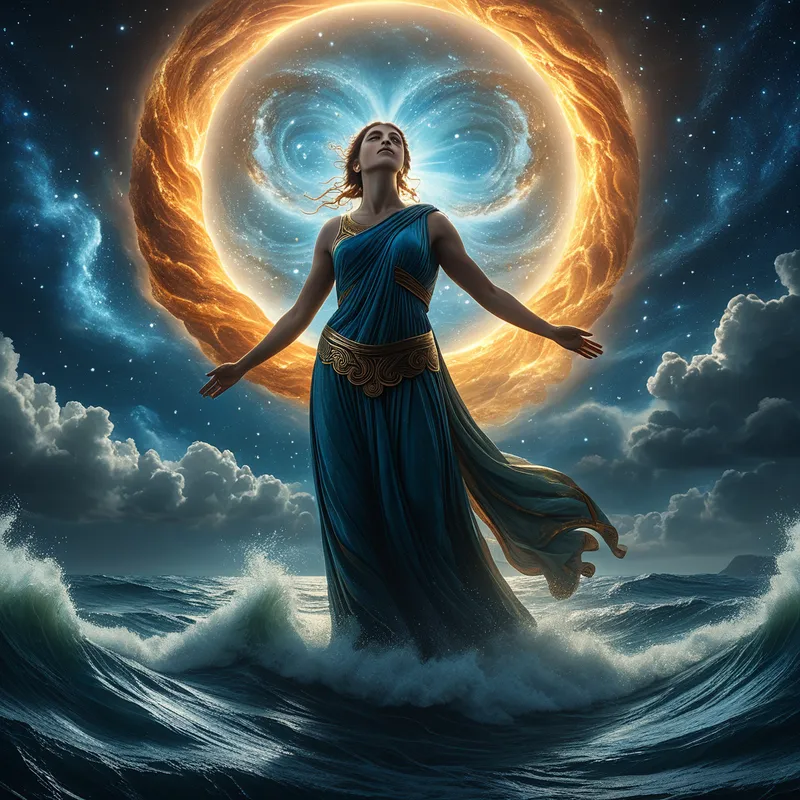
The Four Classical Elements Myth Meaning & Symbolism
A primordial story of cosmic order emerging from chaos, personified through the sacred elements of Earth, Water, Air, and Fire.
The Tale of The Four Classical Elements
Before time had a name, there was only Chaos—a yawning, breathless, formless deep. It was not empty, but pregnant, a seething potential where all opposites slept entwined. From this womb of un-being, the first great powers emerged, not as gods we might recognize, but as vast, sentient principles of existence itself.
First came Gaia, the broad-breasted Earth. She rose from the nothingness, solid and sure, her body the foundation of all that would be—the mountains her bones, the fertile plains her flesh. She was stability, the mother of all. From herself, without consort, she then brought forth Ouranos, the starry Sky. He arched over her, a dome of infinite depth, glittering and cold, the father of space. His embrace was total, and from their union, the first children were born: the Titans, whose essence was the untamed forces of the world.
But Gaia was not done. From the same primal source, she gave birth to Pontus, the sterile, salt-tinged Sea. His waters were not yet life-giving, but deep, dark, and mysterious, the realm of hidden depths and unseen currents. And then, a different kind of birth. From the very fingertips of Ouranos, as he strained against the limits of Chaos, a spark fell into the abyss. This was not a child, but a stolen ember—the first Fire. It was wild, hungry, and brilliant, the element of change, will, and destruction that begets creation.
For ages, these powers coexisted in a tense, creative embrace. Gaia bore the weight of the world. Ouranos pressed down upon her, jealous and fearful of the potential of their Titan children, whom he imprisoned in her dark caverns. Pontus murmured at her edges, a constant, fluid whisper. And the stolen Fire flickered in the hearts of the trapped Titans, a promise of rebellion.
The resolution came not from the elements themselves, but from the will they fostered. Gaia, groaning under the oppression, fashioned a great sickle of adamant, the hardest stone of her body. She gave it to her youngest Titan son, Kronos, in whom the fiery spark burned brightest. When Ouranos next descended to cover Gaia, Kronos struck. He severed the Sky from the Earth.
In that cataclysmic separation, the world was defined. The blood of Ouranos fell upon Gaia, fertilizing her to birth new beings—the Erinyes, the Giants, the Meliae. His severed member, cast into the sea, mingled with the foam of Pontus to birth Aphrodite. And the space between Sky and Earth became the realm of Air, no longer just emptiness, but the breath of life, the medium of sound and thought. The Four were now distinct: the solid Earth below, the fluid Sea upon her, the gaseous Air between, and the transformative Fire, now freed, dancing in lightning and forge. Order was born from chaos, not through gentle agreement, but through a necessary, violent act of differentiation.
Cultural Origins & Context
This elemental narrative is not a single, codified myth from one source, but a foundational cosmology woven from the threads of early Greek thought, primarily preserved in Hesiod’s Theogony (c. 700 BCE). Hesiod, a poet, acted as a conduit for older, oral traditions, systematizing the genealogies of the gods into a coherent story of cosmic origins. The elements—Earth (Gaia), Sea (Pontus), Sky (Ouranos)—are presented not as inert substances but as the first divine personalities, the Protogenoi (First-Born).
This myth served a crucial societal function. It answered the fundamental human questions: How did the world come to be? Why do things have their nature? By personifying the elements, it made the forces of nature comprehensible and subject to narrative. It established a sacred hierarchy and order (cosmos) out of primal disorder (chaos), mirroring the Greek polis’s need for law and structure. The myth was told and retold not just as entertainment, but as a sacred history that validated the world’s structure and humanity’s place within it—children of the Earth, living under the Sky, bounded by the Sea, and masters of Fire.
Symbolic Architecture
The Four Elements represent the fundamental states of matter and, by profound extension, the foundational states of being and consciousness. They are the archetypal building blocks of reality, both external and internal.
Gaia (Earth) is the principle of Body, Stability, and Nourishment. She symbolizes the physical vessel, the ground of all experience, the unconscious as the fertile soil from which life springs. She is receptivity, patience, and the enduring container.
Pontus (Water) is the principle of Emotion, the Unconscious, and Flow. It represents the realm of feeling, intuition, memory, and the hidden depths of the psyche. It is adaptive, cleansing, and can be both life-giving and terrifying in its depths.
The Air born of the separation is the principle of Mind, Intellect, and Communication. It is the realm of thought, breath (pneuma, also meaning spirit), perspective, and the invisible connections between things. It allows for distinction, analysis, and the voice.
The stolen Fire is the principle of Spirit, Will, and Transformation. It is energy, desire, inspiration, and the catalytic force that drives change. It is both creative and destructive, the spark of consciousness itself that refuses to be contained.
The myth teaches that the cosmos—and the coherent self—is not a given, but an achievement. It is forged in the necessary violence of separating fused opposites to create a living, breathing space in between.
The Dreamer’s Resonance
When the Four Elements appear in modern dreams, they often signal a process of psychic re-ordering or a call to integrate disparate parts of the self. Dreaming of earthquakes or cracking ground may point to a foundational shift in one’s identity or values (Gaia shaking). Overwhelming floods or tranquil seas speak directly to the dreamer’s emotional landscape, indicating either a need to navigate deep feelings or a state of emotional fluidity (Pontus’s domain).
Howling winds, stifling stillness, or clear vistas from a high place reflect the current state of the mind—chaotic, stagnant, or gaining clarity (the Air principle). Wildfires, hearths, or being burned connect to the fire of passion, anger, creative drive, or a transformative ordeal that is altering the dreamer’s essential spirit.
To dream of all four in tension or harmony—a storm over a mountain lake, a volcano by the sea—suggests the somatic experience of a major life transition. The psyche is actively working to re-balance its core components: the stability of the body, the flow of emotion, the clarity of thought, and the drive of the spirit. It is the internal replay of the primordial drama, moving from personal chaos toward a new, more conscious order.
Alchemical Translation
The myth of the Four Elements is a master blueprint for the alchemical process of individuation—the journey toward becoming a whole, self-realized individual. It maps the stages of psychic transmutation.
First, we begin in Chaos: the undifferentiated state of psychological confusion, where thoughts, feelings, instincts, and spirit are a tangled mass. This is the massa confusa of the alchemists.
The emergence of the elements is the stage of Analysis (Separatio). We must, like Kronos with his sickle, make conscious distinctions. We separate our solid ground (our values, our physical being) from our boundless aspirations (our sky-high ideals). We acknowledge our deep emotional waters as distinct from our fiery will. This separation can feel violent—cutting away old identities, confronting repressed feelings—but it is necessary.
The space created by this separation is the Psychic Realm (The Coagula). It is the “air” where reflection happens, where we can observe the interplay of our inner earth, water, and fire. This is the realm of ego consciousness, the necessary mediator.
The goal is not to remain separated, but to consciously re-unite the elements at a higher level. The integrated self is not a return to chaos, but a sacred marriage where earth provides grounding for fire’s vision, water cools fire’s rage and nourishes earth’s soil, and air carries the whispers of intuition between them all.
The final, ongoing stage is Integration (The Unus Mundus). The mature individual does not have less fire, water, earth, or air, but has become a skilled steward of all four. They are grounded yet inspired, fluid yet defined, thoughtful yet passionate. They have, in effect, become a living cosmos—a microcosm of the myth itself, where order is a dynamic, creative balance born from acknowledging and honoring every fundamental part of existence.
Associated Symbols
Explore related symbols from the CaleaDream lexicon: