The Founding of Ile-Ife Myth Meaning & Symbolism
The myth of Oduduwa descending from the heavens to create the first land, establishing order, civilization, and the sacred city of Ile-Ife.
The Tale of The Founding of Ile-Ife
In the time before time, there was only the endless, silent expanse of [Olokun](/myths/olokun “Myth from Yoruba culture.”/). No land, no hill, no tree broke the surface of the deep. Above, the vault of Olorun held the heavens, a realm of pure potential and light. Between them, a gulf of formless possibility, a world waiting for its name.
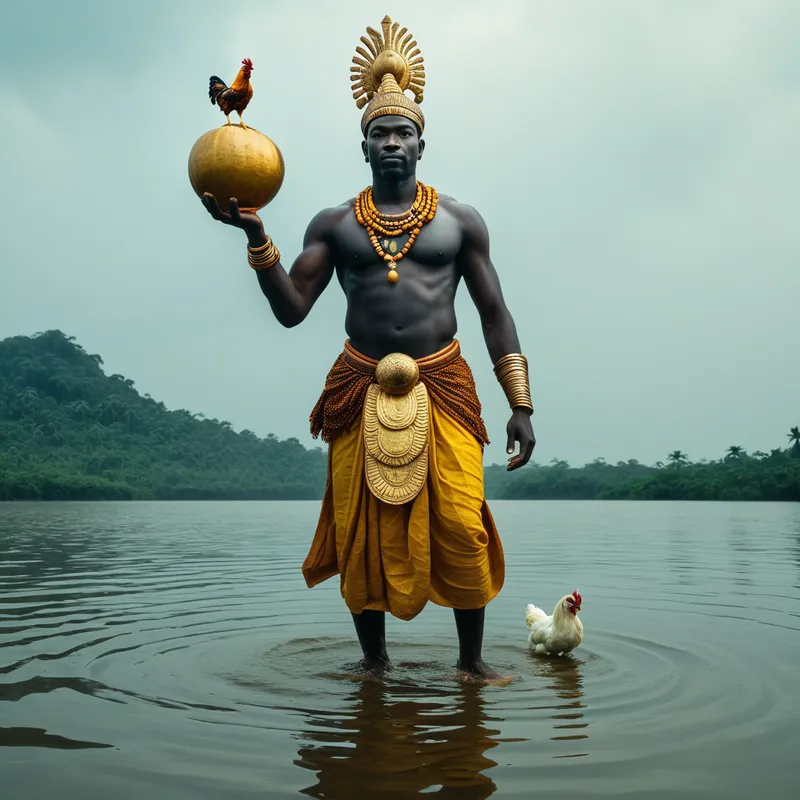
From that luminous realm, Oduduwa was chosen. The task was immense: to descend into the watery void and create a place of firmament, a home for life. The means were given: a chain of gold, long enough to span the cosmos, a calabash filled with sacred earth, and a five-toed chicken. The instructions were clear, yet the descent was a journey into the unknown, a fall from unity into the task of separation.
Down the golden chain Oduduwa climbed, leaving the certainty of the sky for the murmuring darkness of the waters. The chain swayed in a wind that was not a wind, over an ocean that reflected nothing but its own depth. Upon reaching the end, Oduduwa stood upon the very waters, feeling the formless wetness beneath. This was the moment. From the calabash, the first handful of earth was cast upon the waters. It did not sink, but held, a tiny island of solidity in the liquid world.
Then, the chicken was released. It did not merely stand; it began to scratch and scatter the sacred earth. With each deliberate scrape of its five-toed feet, the mound grew. It spread outward and upward, pushed from a center point, transforming the tiny island into a vast expanse of land. Hills rose where its claws dug deep; valleys formed where the soil was spread thin. The world was being sculpted from intention and action.
But creation is never uncontested. Orisanla, the Great Orisha, who had been tasked with this very duty, lay in a deep slumber, overcome by the weight of palm wine. Some say it was the wine of forgetfulness; others, the intoxication of potential too vast to grasp. Awakening to find the work done, a tension was born—not of malice, but of displaced destiny. Yet, from this tension, a resolution was forged. The land was named Ile-Ife, the place where the world spread wide. Here, at the very center, Oduduwa planted a palm nut. It sprouted instantly, becoming the first ope, its roots anchoring the new earth, its fronds reaching back toward the sky from whence the creator came. The first city was born, and from its sacred soil, humanity would later emerge.

Cultural Origins & Context
This myth is the cornerstone of Yoruba cosmology and identity. It is not merely a story of beginnings but the charter for civilization, kingship, and the sacred relationship between the people and the land. Passed down through generations of Arokin and Babalawo, its recitation was (and remains) a sacred act, performed during important festivals like the Olojo festival.
Its societal function is multifaceted. It establishes Ile-Ife as the spiritual and geographical navel of the Yoruba world, the origin point from which all other kingdoms derive their legitimacy. It provides a divine sanction for the institution of the Ooni and the hierarchical order of society. Furthermore, it encodes fundamental Yoruba philosophical principles: the transformation of chaos (Olokun) into order (Aye), the necessity of divine authority and human agency (symbolized by the chain and the chicken’s work), and the sacredness of the earth itself.
Symbolic Architecture
The myth is a profound map of psychic and cosmic processes. The primordial waters represent the unconscious, the unformed potential of the psyche—a state of boundless possibility that is also a state of non-[differentiation](/symbols/differentiation “Symbol: The process of distinguishing or separating parts of the self, emotions, or identity from a whole, often marking a developmental or psychological milestone.”/) and potential [terror](/symbols/terror “Symbol: An overwhelming, primal fear that paralyzes and signals extreme threat, often linked to survival instincts or deep psychological trauma.”/). The golden chain is the [axis](/symbols/axis “Symbol: A central line or principle around which things revolve, representing stability, orientation, and the fundamental structure of reality or consciousness.”/) mundi, the connecting principle that allows [consciousness](/symbols/consciousness “Symbol: Consciousness represents the state of awareness and perception, encompassing thoughts, feelings, and experiences.”/) (the sky/[heaven](/symbols/heaven “Symbol: A symbolic journey toward ultimate fulfillment, spiritual transcendence, or connection with the divine, often representing life’s highest aspirations.”/)) to engage with and [structure](/symbols/structure “Symbol: Structure in dreams often symbolizes stability, organization, and the framework of one’s life, reflecting how one perceives their environment and personal life.”/) the unconscious (the waters/[earth](/symbols/earth “Symbol: The symbol of Earth often represents grounding, stability, and the physical realm, embodying a connection to nature and the innate support it provides.”/)).
The act of creation is not a gentle emergence, but a deliberate intervention—a descent into chaos to establish a point of consciousness.
Oduduwa embodies the [creator](/symbols/creator “Symbol: A figure representing ultimate origin, divine power, or profound authorship. Often embodies the source of existence, innovation, or personal destiny.”/) principle, the [aspect](/symbols/aspect “Symbol: A distinct feature, quality, or perspective of something, often representing a partial view of a larger whole.”/) of the Self that initiates differentiation. The five-toed [chicken](/symbols/chicken “Symbol: Chickens often symbolize fear, anxiety, or vulnerability, as well as domesticity and nurture depending on the context of the dream.”/) is a potent [symbol](/symbols/symbol “Symbol: A symbol can represent an idea, concept, or belief, serving as a powerful tool for communication and understanding.”/) of instinctual, earthy labor. It represents the necessary, almost mundane, repetitive work required to manifest an [idea](/symbols/idea “Symbol: An ‘Idea’ represents a spark of creativity, innovation, or realization, often emerging as a solution to a problem or a new outlook on life.”/) into [reality](/symbols/reality “Symbol: Reality signifies the state of existence and perception, often reflecting one’s understanding of truth and life experiences.”/)—the “scratching out” of a [life](/symbols/life “Symbol: The symbol of ‘Life’ represents a journey of growth, interconnectedness, and existential meaning, encompassing both the joys and challenges that define human experience.”/), a psyche, or a civilization from the raw [material](/symbols/material “Symbol: Material signifies the tangible aspects of life, often representing physical resources, desires, and the physical world’s influence on our existence.”/) given. The sleeping Orisanla suggests that the potential for creation exists within all, but can remain dormant, “intoxicated” by passivity or the overwhelming [nature](/symbols/nature “Symbol: Nature symbolizes growth, connectivity, and the primal forces of existence.”/) of the [task](/symbols/task “Symbol: A task represents responsibilities, duties, or challenges one faces.”/).

The Dreamer’s Resonance
When this myth pattern stirs in the modern dreamer, it often signals a profound process of inner foundation-building. The dreamer may find themselves standing on unstable ground, or upon dark waters, holding a vessel or a tool of unknown purpose. There is a somatic sense of suspension—between an old state that has dissolved and a new one not yet formed.
This is the psyche’s depiction of a critical transition: the end of a formless period (depression, confusion, loss of identity) and the nascent, terrifying beginning of creating a new inner structure. The “chain” in the dream might be a literal ladder, a rope, or a strand of DNA—a symbol of connection to a higher guidance or an ancestral pattern that makes the descent possible. The “chicken” could manifest as a small animal, a child, or one’s own hands engaged in simple, repetitive work. The dream is affirming that the new “land”—a renewed sense of self, purpose, or stability—is built not by grand, single acts, but by consistent, grounded effort applied to the “sacred earth” of one’s own potential.

Alchemical Translation
For the individual, the myth models the alchemical opus of individuation: the descent into one’s own unconscious (the waters) to retrieve the prima materia (the sacred earth) and coagulate it into the lapis philosophorum, the solid, enduring Self (Ile-Ife).
The first step is the descensus, the willing climb down the golden chain. This is the courage to engage with one’s shadow, one’s formless grief, rage, or unarticulated potential. It is a relinquishment of the “heaven” of spiritual bypassing or intellectual abstraction for the messy, wet reality of the psyche’s depths.
The sacred earth in the calabash is the core, often buried, truth of one’s own nature. The chicken is the disciplined, daily practice—therapy, art, meditation, honest relationship—that slowly, scratch by scratch, spreads that truth into the landscape of one’s life.
The conflict with Orisanla represents the resistance from within—the part of us that is “drunk” on old stories, laziness, or fear, which protests the new order being built. The resolution is integration; the sleeping giant must be acknowledged and assigned a new role in the newly ordered kingdom of the Self. The final act, planting the palm tree, signifies establishing a central, living axis—a core value, a vocation, a spiritual practice—that roots the new consciousness and allows for future growth, connecting the realized self back to its transcendent source.
Associated Symbols
Explore related symbols from the CaleaDream lexicon:
- Earth — The sacred soil from the calabash represents the prima materia, the fundamental substance of creation and the tangible reality formed from divine intention.
- Water — The primordial ocean of Olokun symbolizes the formless unconscious, the chaotic potential that precedes all structured existence and consciousness.
- Chain — The golden chain represents the axis mundi, the connection between heaven and earth, spirit and matter, and the means by which divine order descends into chaos.
- Bird — The five-toed chicken embodies instinctual, earthly labor and the repetitive, grounding action required to manifest potential into tangible, lived reality.
- Tree — The first palm tree signifies the world axis, life, resilience, and the enduring structure that grows from the center of the newly created world.
- Creation — The entire narrative is an archetypal map of the creative act, moving from void to form, from idea to manifestation.
- Order — The founding of Ile-Ife represents the establishment of cosmos from chaos, the imposition of structure, law, and civilization onto the formless.
- Sacrifice — Oduduwa’s descent represents the sacrifice of heavenly unity for the arduous task of creation, a model of the sacrifice required to build a conscious self.
- Mountain — The first mound of earth, scratched into hills, symbolizes the world mountain, the omphalos or navel of the world, the central point from which all expands.
- Sky — The realm of Olorun represents transcendent consciousness, pure potential, and the source of divine authority and creative impulse.