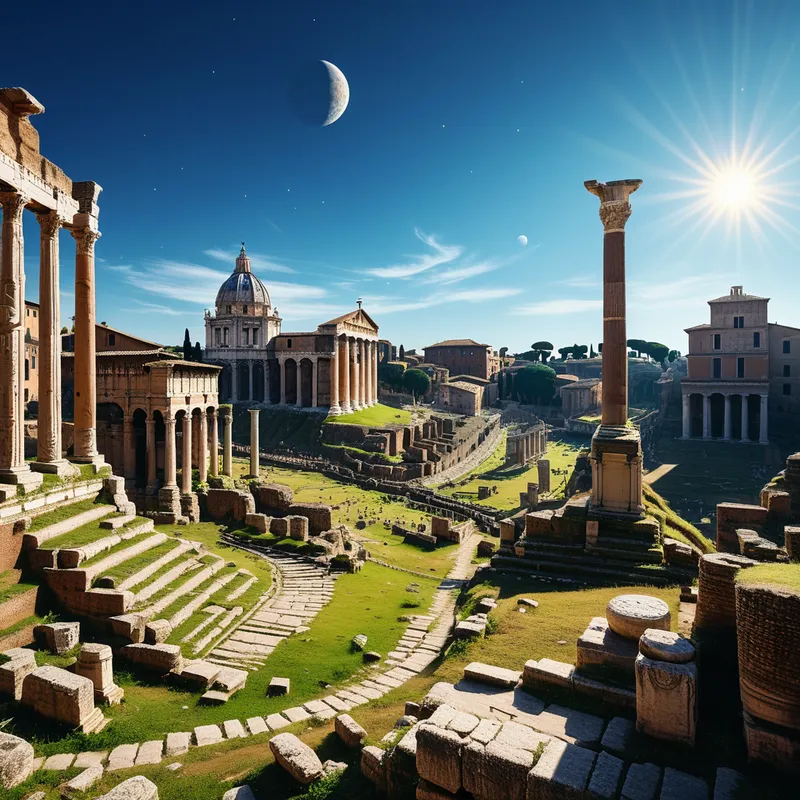
The Forum Romanum Myth Meaning & Symbolism
The sacred narrative of the Forum's creation, where divine will, human ambition, and the chthonic powers of the marsh are reconciled to birth the heart of Rome.
The Tale of The Forum Romanum
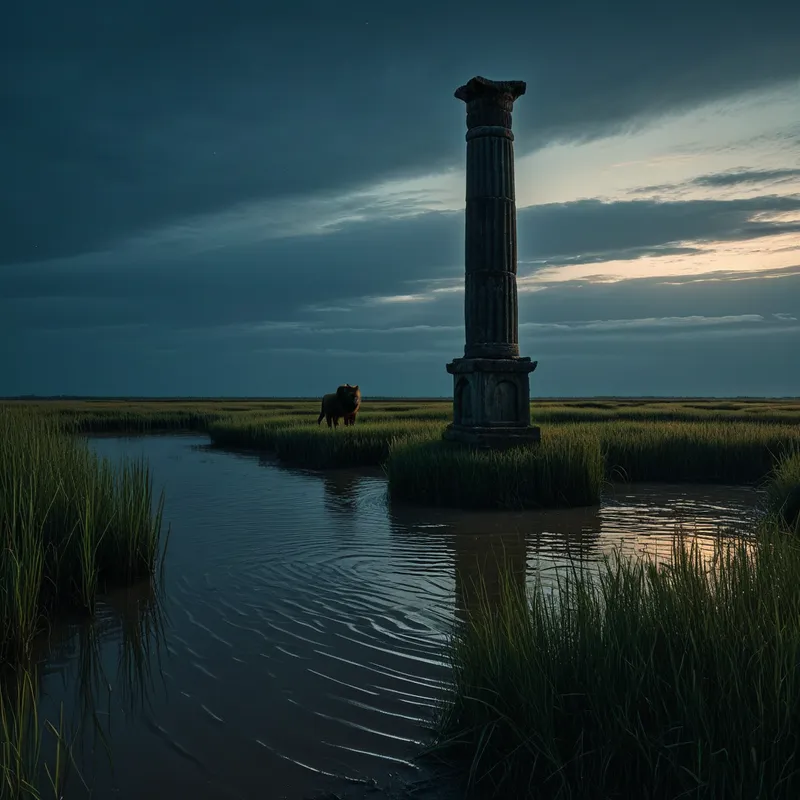
Hear now, and listen well, for I sing not of a city of stone, but of its beating heart. Before the marble, before the law, there was only the silence of the swamp. The Velabrum lay between the Palatine and Capitoline hills, a sunken, breathing thing. Its waters were dark, its mud clung with the weight of forgotten things, and its mists whispered of the di inferi. This was the realm of the unseen, the unformed, the chaotic potential from which all things must first be dredged.
Into this liminal space stepped the twins, Romulus and Remus, marked by Mars and suckled by the she-wolf. Their new city, scraped from the hilltops, needed a center—not just for trade, but for meaning. Romulus, his brow furrowed with the divine burden of kingship, looked upon the marsh and saw not a problem, but a covenant. “Here,” he declared, his voice cutting the humid air, “we shall build the mundus—the meeting point of heaven, earth, and the underworld. Here, we shall speak with the gods and with each other.”
But the earth itself resisted. The ground would not hold. The first altars sank, swallowed by the greedy mud. The people murmured, fearing the displeasure of the swamp spirits. The conflict was not against a foreign army, but against the very nature of the place. The rising action was a sacred struggle, a ritual of reclamation. They did not conquer the swamp with brute force; they negotiated with it. They dug deep trenches, the Cloaca Maxima, as offerings to the earth, channels for the primal waters to find a new, ordered path. They brought soil from the healthy, settled communities of the Latins and Sabines, mingling it with the Roman mud, a marriage of peoples mirrored in the marriage of earths.
Then came the omen that sealed the pact. A chasm opened in the forum’s center—the Lacus Curtius. Soothsayers proclaimed it a gateway to the underworld, and it would not close until Rome offered its most precious possession. A young, noble knight, Marcus Curtius, understood. In full armor, upon his steed, he declared that nothing was more precious to Rome than the courage of its citizens. With a cry to the gods, he rode headlong into the abyss. The earth trembled, and then, slowly, solemnly, the chasm closed over him. The marsh had been fed, not with fear, but with sacred valor. The resolution was not an end, but a beginning. Upon this reconciled ground, the Temple of Vesta was built, its eternal flame a promise of continuity. The Rostra arose, from which voices would shape destiny. The Curia stood, where debate would forge order. The heart now beat, a sacred space wrested from the void, forever holding within it the memory of the swamp and the sacrifice that made it solid.
Cultural Origins & Context
The myth of the Forum’s foundation is not a single authored story, but a palimpsest of history, ritual, and ideology. It emerged from the Roman drive to sanctify their geography and legitimize their power. Historians like Livy recorded these tales centuries after the fact, weaving together folk memories, priestly annals, and political propaganda. The myth was passed down not merely in books, but in the very fabric of life: every senator walking to the Curia trod over the Lacus Curtius; every sacrifice at the Capitoline Temple looked down upon the ordered space below.
Its societal function was multifaceted. For the common citizen, it explained the sacredness of their civic center—it was templum, a space consecrated by augury and sacrifice. For the ruling class, it was a master narrative of justification: our authority is rooted in a divine pact sealed by heroic sacrifice. The myth served as the foundational drama for the Roman value of pietas, the respectful fulfillment of obligations to gods, state, and family. The Forum was where those obligations were negotiated and displayed, making the myth a living script for Roman identity.
Symbolic Architecture
Psychologically, the Forum Romanum is not merely a public square; it is the archetypal image of the conscious ego establishing a temenos, a sacred precinct, within the psyche. The swamp represents the undifferentiated, chaotic unconscious—the primal, emotional, and instinctual ground of being. The act of draining and filling is the heroic, yet necessary, ego-function of bringing order, structure, and light to the inner world.
The true foundation is always a reconciliation with the depths; consciousness built upon repressed chaos is a temple on shifting sand.
The key figures are facets of a single psychic process. Romulus represents the organizing, kingly principle of the will, intent on building a lasting identity. The Lacus Curtius is the sudden, terrifying eruption of the unconscious—a depression, a complex, a trauma—that threatens to swallow everything. Marcus Curtius symbolizes the ultimate psychological sacrifice: the willingness of the conscious ego to offer up its own pride, its defensive structures, and dive into the abyss of the unknown to achieve integration. His ride is an act of radical acceptance, acknowledging that the dark, chthonic parts of the self are not enemies to be vanquished, but powers to be acknowledged and incorporated.
The Dreamer’s Resonance
When this myth stirs in modern dreams, the dreamer is often at a pivotal point of inner foundation-building or facing a collapse of existing structures. To dream of a swamp or bog where a building should be speaks to a feeling that one’s sense of self or public life is unstable, emotionally “waterlogged,” or lacking solid ground. It is the somatic sensation of sinking, of being unable to find footing in one’s own life.
Dreaming of a sudden pit or crack opening in a familiar place—one’s living room, workplace, or a town square—mirrors the Lacus Curtius. This is the psyche signaling a rupture. A repressed content, a neglected duty (pietas), or a foundational wound is demanding attention. The dream ego’s reaction is crucial: flight indicates ongoing repression, while curious approach or, powerfully, a voluntary descent into the pit marks the beginning of the Curtian sacrifice. The dream may present the forum as an empty, echoing space, suggesting a need for inner dialogue and community, or as impossibly crowded and noisy, indicating a psyche overwhelmed by competing internal voices (personas) with no central Rostra from which to govern them.
Alchemical Translation
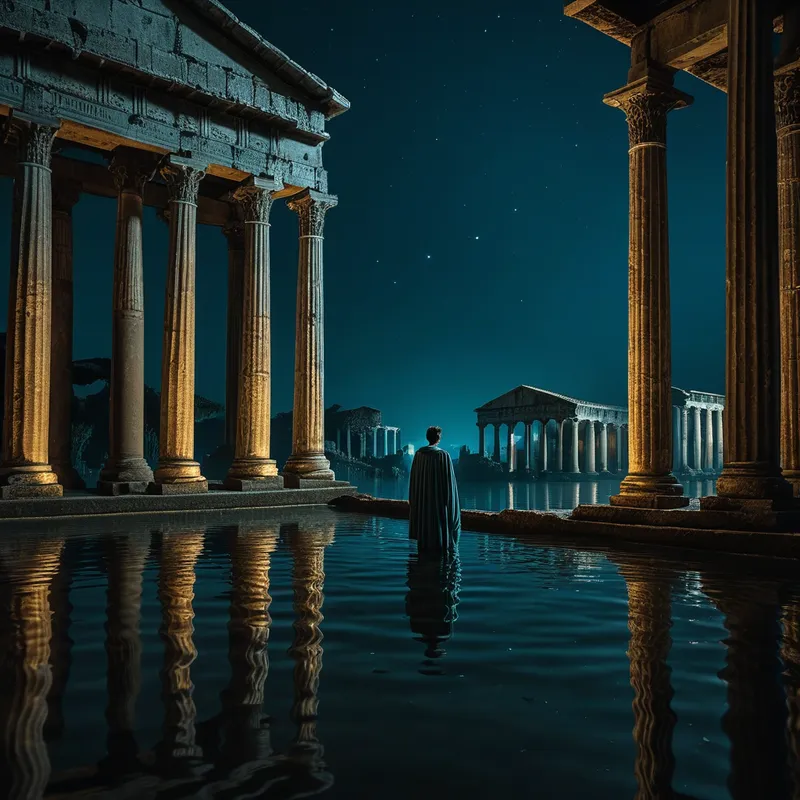
The alchemical process modeled here is the nigredo followed by the albedo. The swamp is the prima materia, the black, fecund, and despised starting point of the work. The individual’s first task is to acknowledge this inner swamp—the murky emotions, the chaotic drives, the unresolved past. This is the confrontation with the shadow.
The heroic draining and engineering work is the discipline of consciousness—therapy, reflection, art, ritual—that begins to structure the chaos. But the true transmutation occurs at the moment of the sacrifice, the coniunctio of the conscious and the unconscious. The knight (the valued, armored ego) must surrender to the chasm (the terrifying shadow).
Individuation is not achieved by building walls against the abyss, but by consecrating the abyss as the sacred center of one’s being.
The resulting Forum is the lapis philosophorum, the achieved personality. It is a psychic space where opposites are held in tension: law and spirit (Comitium and Temple), commerce and sacrament (markets and altars), private and public (House of the Vestals and Basilicas). The modern individual undergoing this process moves from a life of fragmented, swampy impulses and reactions to one of inner governance. They build their own internal forum—a grounded, sacred space within where different inner voices can be heard, where sacrifices to truth are made, and where the eternal flame of one’s essential spirit, like Vesta’s fire, is conscientiously tended. They become, in essence, both the ruler and the faithful citizen of their own soul.
Associated Symbols
Explore related symbols from the CaleaDream lexicon: