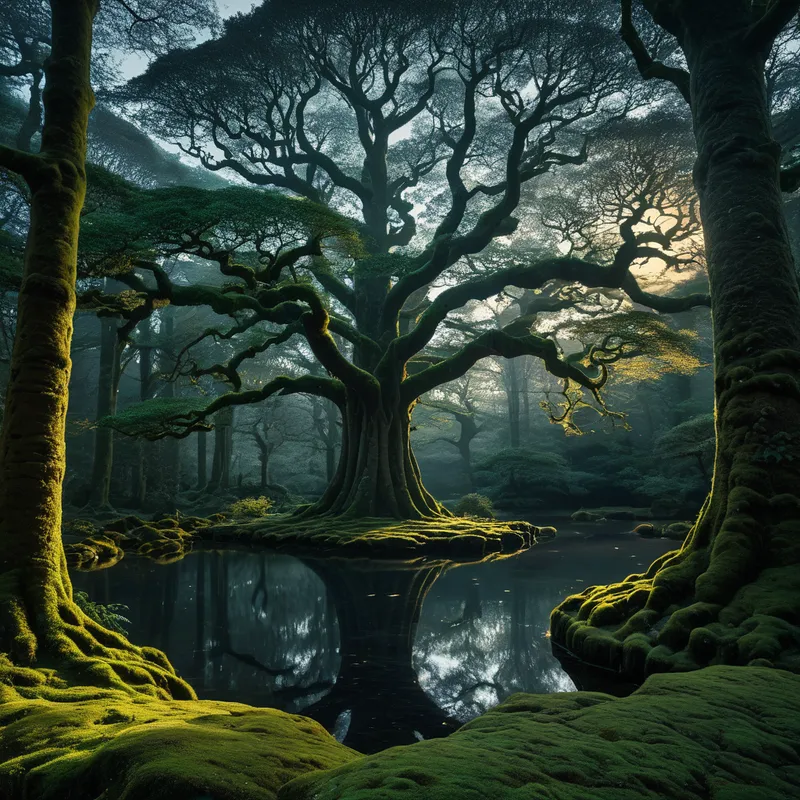
The Forest of Brocéliande Myth Meaning & Symbolism
A mythic forest of magic and fate, where heroes seek truth, lovers are ensnared, and the land itself dreams the world into being.
The Tale of The Forest of Brocéliande
Listen, and let the mists of Brittany gather around you. There is a forest where the world is still being dreamed. It is called Brocéliande. Its oaks are older than kingdoms, and its springs remember the first rain. Here, the boundary between the world of men and the Sídhe is as thin as a spider’s silk, glistening with dew and peril.
Into this whispering green cathedral came the seekers, those whose hearts were restless with a question only magic could answer. The most famous was Merlin, he who knew the speech of stones and the paths of stars. But in Brocéliande, even the wisest can be undone. It was here he beheld Viviane, the Lady of the Lake. She was not a woman of flesh alone, but a spirit of the place itself—her eyes held the depth of the forest pools, her voice the rustle of leaves in a forgotten tongue. Merlin, in his profound loneliness, loved her. He poured his arcane knowledge into her, teaching her charms to bind the wind and spells to shape water.
And she, with the cunning of the wild and a heart guarded by ancient secrets, learned all he knew. In a hidden glade, she wove the air itself into an invisible tower, a prison of enchantment. With a kiss and a whispered spell born of his own teaching, she sealed him within it. The greatest enchanter was captured not by force, but by the very magic he embodied, trapped forever in a timeless sleep, woven into the dream of the forest he loved.
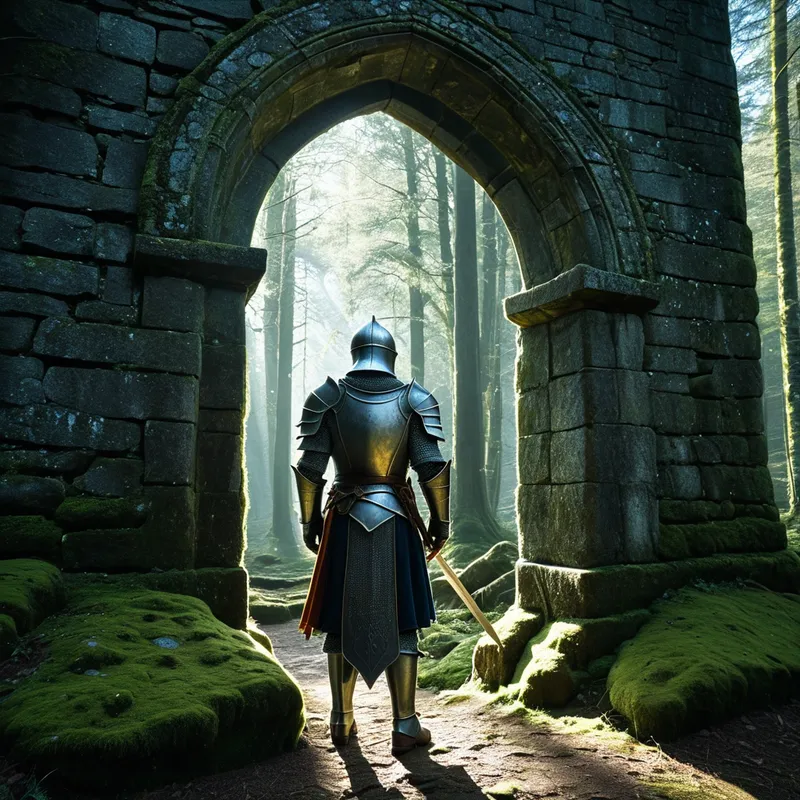
But Brocéliande’s tales are many. Here too, the knight Percival found the Grail Castle, a vision that flickered between the trees, offered only to the pure of heart. And at the Fountain of Barenton, a challenge echoed: pour water upon the nearby stone, and the sky will darken, winds will howl, and the very guardians of the storm will answer. This was no simple trick; it was a test of courage, a summoning of the raw, untamed forces that the forest curates. The forest does not give its secrets; it reveals them to those who dare the encounter, often at a price that reshapes the soul.
Cultural Origins & Context
The Forest of Brocéliande is rooted in the Celtic tradition of nemeton, places where the divine was immanent in the natural world. It first emerges in written lore in the 12th century, within the Arthurian cycle of Chrétien de Troyes. However, its soul is far older, belonging to the oral traditions of the Breton people. This was not a story told in courts for mere entertainment, but a living geography of myth recounted by bards and elders. It functioned as a psychic map, explaining the uncanny power of the landscape—the sudden storms, the strangely still pools, the feeling of being watched by an older intelligence.
The forest served a crucial societal function: it was the ultimate “outside.” Beyond the village fence and the tamed field, Brocéliande represented the realm of the unknown, of fate, of the deities and spirits who controlled fertility, weather, and destiny. Stories of entering it were cautionary and initiatory. They taught respect for the wild, illustrated the dangers of untamed knowledge (as with Merlin), and framed the hero’s journey not as a conquest of nature, but as a perilous negotiation with a conscious, sentient world.
Symbolic Architecture
Psychologically, Brocéliande is the unconscious itself—dense, autonomous, and teeming with latent life and archaic patterns. It is not a passive backdrop but an active participant in the psyche’s drama.
The enchanted forest is not a place you walk through; it is a consciousness you step into, and it dreams you as much as you perceive it.
Merlin represents the archetype of the guiding intellect, the Logos principle that seeks to order and understand. His entrapment by Viviane, the embodiment of the forest’s soul (the Eros principle), is a profound symbolic event. It illustrates the fate of consciousness that becomes entranced by the depths it seeks to master. The teacher is consumed by his pupil; the knower is enveloped by the mystery. This is not a tragedy, but a completion—a return of differentiated awareness to the undifferentiated source.
The Fountain of Barenton symbolizes the triggering point, the nexus where a deliberate action (pouring the water) catalyzes a unconscious upheaval (the storm). It is the act of confronting a complex, willingly invoking the emotional and psychic tempest that must precede clarity.
The Dreamer’s Resonance
When the Forest of Brocéliande appears in modern dreams, it rarely manifests as a literal medieval woodland. Instead, one dreams of endless, labyrinthine office corridors that become root-filled tunnels, of a familiar city park that suddenly deepens into a trackless wild, or of being in a house that reveals an ancient, overgrown forest in its basement. This is the psyche signaling that the dreamer has crossed a threshold into a process of deep, autonomous transformation.
The somatic experience is often one of being watched or guided by an unseen presence, a feeling of awe mixed with anxiety. You may dream of finding a mysterious pool or spring—a symbol of the deep, reflective Self. The conflict in such dreams is not with a monster, but with disorientation, enchantment, or the haunting beauty of the place itself. The psychological process is one of initiation into the unknown parts of oneself. The dream-ego is being led away from the cleared paths of persona and conscious identity into the thicket of the personal and collective unconscious. The goal is not to cut down the forest, but to learn its language and survive its tests.

Alchemical Translation
The myth of Brocéliande models the alchemical stage of nigredo and albedo. The hero’s entry into the forest is the nigredo—the descent into the dark, chaotic material of the soul. Here, one confronts the shadow, the entangled emotions, and the forgotten memories. Merlin’s captivity is the ultimate nigredo: the dissolution of the conscious ego into the unconscious.
The prison of enchantment is also the womb of rebirth; to be dissolved in the mystery is the prerequisite for being remade by it.
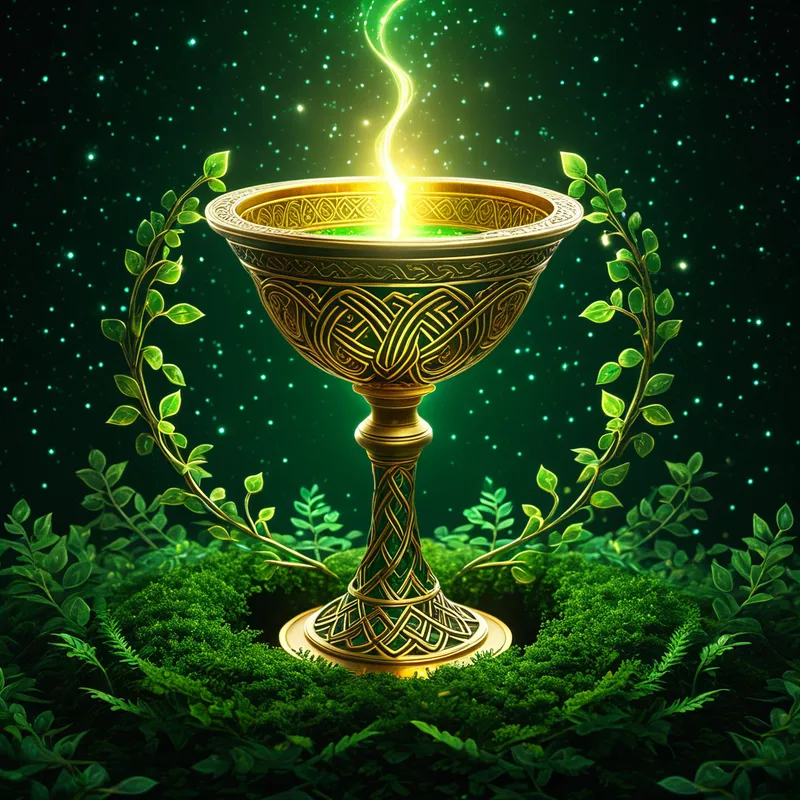
The subsequent journey—like Percival’s glimpse of the Grail—represents the albedo. After the confrontation and dissolution comes a purification, a glimpse of meaning (the Grail) that was only possible because the forest was entered and its storms endured. The individual does not leave Brocéliande as they entered. They are transmuted. The modern parallel is the individual who, through a midlife crisis, deep therapy, or creative breakdown, allows their old identity to be “enchanted” and dissolved by the unconscious. From that seeming captivity emerges a new, more integrated Self, one that acknowledges its roots in the wild, magical, and irrational depths. The forest is not escaped; its magic is integrated. The individual becomes, in a sense, a living part of Brocéliande, carrying its ancient, dreaming wisdom within the structure of a modern life.
Associated Symbols
Explore related symbols from the CaleaDream lexicon: