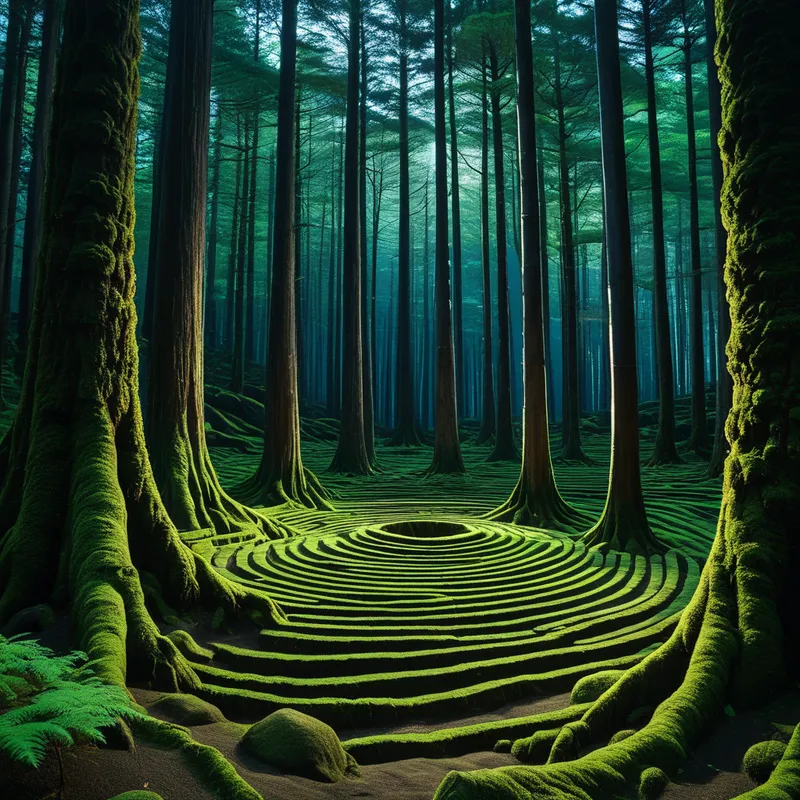
The Forest of Aokigahara Myth Meaning & Symbolism
A mythic forest of silence and spirits, where the soul confronts its deepest shadows to find transformation or be consumed by them.
The Tale of The Forest of Aokigahara
Listen, and let the silence of the tale settle upon you.
Long ago, when the world was younger and the gods walked closer to the earth, the great mountain, Fuji-san, roared in a fury of fire and stone. For days and nights, the sky wept ash, and the land trembled. When the mountain’s anger finally subsided, a new land was born at its feet—a vast, silent sea of hardened, black lava. And upon this barren wound, life, stubborn and profound, began to whisper. Moss crept first, a soft green sigh. Then seeds, carried by wind and bird, took root in the stone itself. They grew not as ordinary trees, but as beings of immense patience, their roots weaving through and gripping the rock like sinewy fingers, creating a dense, impenetrable canopy that swallowed sound and light.
This was the birth of Aokigahara Jukai. But it was not merely a forest of wood and leaf. In the profound quiet, the boundary between worlds grew thin. The spirits of those who had perished in the eruption, and of all who would later come to the forest in states of unbearable sorrow, did not depart. They remained, becoming yūrei, woven into the very fabric of the trees, the moss, and the cold volcanic stone. Their collective sigh became the wind that did not blow; their tears became the dew on the spiderwebs.
The forest became a place of testing, a final threshold. It was said that if a soul, burdened by a grief too heavy to bear, entered its depths, the forest would listen. It would offer not condemnation, but a choice—a fork in the invisible path. One path, lined with the softest moss and the faint, comforting glow of foxfire, led deeper into oblivion, a gentle embrace of eternal silence where the self would dissolve into the collective sigh. The other path was harder to find, known only by a sudden, sharp coldness in the air and the distant, almost-memory of a bird’s call. This path demanded the bearer to turn and face the specters of their own sorrow, to name each ghost, and to walk back toward the world carrying that acknowledged weight.
Few tales speak of heroes who emerged. Instead, they speak of a woodcutter who entered to find a lost child and instead found his own long-dead father, sitting peacefully on a log. After a night of shared silence, the woodcutter left alone, his grief for his father finally laid to rest. They speak of a monk who sought extreme solitude for enlightenment and was haunted not by demons, but by the echoing laughter of his own forgotten joy, which he had to reclaim to find his way out. The forest does not battle its visitors with claws and fangs. It battles them with the absolute mirror of their own soul, reflected in the stillness. Its victory is a whisper; its defeat, a profound and terrible clarity.
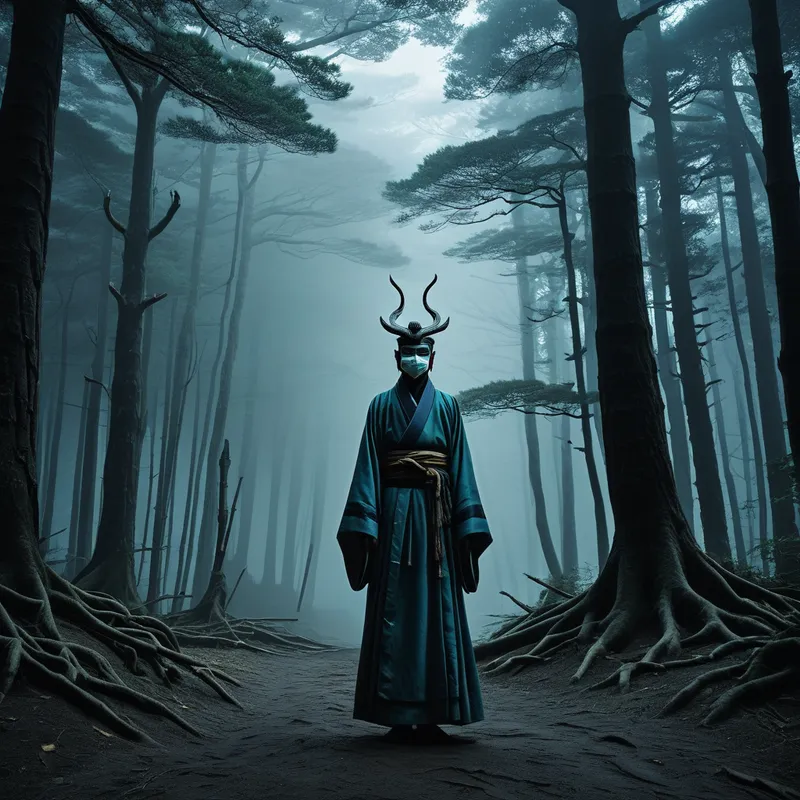
Cultural Origins & Context
The narrative of Aokigahara is not a single, codified myth from a classical text like the Kojiki or Nihon Shoki. It is a modern folklore, a living mythology born from the convergence of potent cultural streams. Its bedrock is the deep Shinto veneration of nature, where forests (chinju no mori) are understood as dwelling places of kami, capable of profound spiritual power (kami no kage).
This sacred geography was layered with Buddhist concepts of the afterlife and the hungry ghost realm (Gaki), and later, with Edo-period kaidan traditions that populated specific, lonely places with restless spirits. The forest’s real, tangible characteristics—its unnerving silence due to the wind-blocking canopy, its magnetic fields that disrupt compasses, its labyrinthine quality—provided the perfect physical vessel for these beliefs. The myth was passed down not by court bards, but by woodcutters, pilgrims, and travelers’ tales, functioning as a societal caution and a metaphysical map. It served to delineate a sacred, taboo space where the normal rules of the human world ceased, and the psyche’s raw landscape began.
Symbolic Architecture
Psychologically, Aokigahara is not a forest of death, but a forest as the unconscious, specifically the personal and collective shadow. The volcanic rock upon which it grows symbolizes the traumatic, solidified foundation of pain—individual or ancestral—from which our most tangled growth emerges.
The labyrinth is never outside; it is the architecture of a memory you have not yet dared to face.
The trees, with roots fused to stone, represent the psyche’s structures built directly upon and around trauma, creating a dense, self-enclosed system. The legendary silence is the void of meaning, the depression or dissociation that follows profound loss. The yūrei are not external monsters, but the psychic complexes—unresolved grief, shame, betrayal—that we have failed to properly mourn and release. They are emotional energy bound to a past event, haunting the present. The infamous “compasses spinning” speaks to the disorientation one feels when entering this inner landscape, where the ego’s usual navigational tools (rationality, identity) fail utterly.
The Dreamer’s Resonance
When this mythic pattern erupts in modern dreams, the dreamer is at a critical juncture of introversion and confrontation with the shadow. Dreaming of being lost in a dense, silent forest where paths disappear signifies a somatic experience of being overwhelmed by unconscious material. The body may feel heavy, trapped, or cold.
The appearance of silent, observing figures (the spirits) points to repressed emotions or memories seeking acknowledgment. A dream of finding an object in the forest—a tattered piece of clothing, a cold lantern—suggests the psyche is ready to retrieve a lost part of the self. The most potent dream symbol is the fork in the path. This is not a logical choice, but a somatic one: one path feels like a seductive release (a warm bath, a soft bed), representing the temptation to dissociate or succumb to the shadow’s pull. The other feels like a chilling, arduous responsibility (a steep climb, a narrow gate), which is the call to conscious integration. The dreamer wakes not with a narrative, but with a profound mood—a residue of the silence—that lingers for days, signaling deep psychic work in progress.
Alchemical Translation
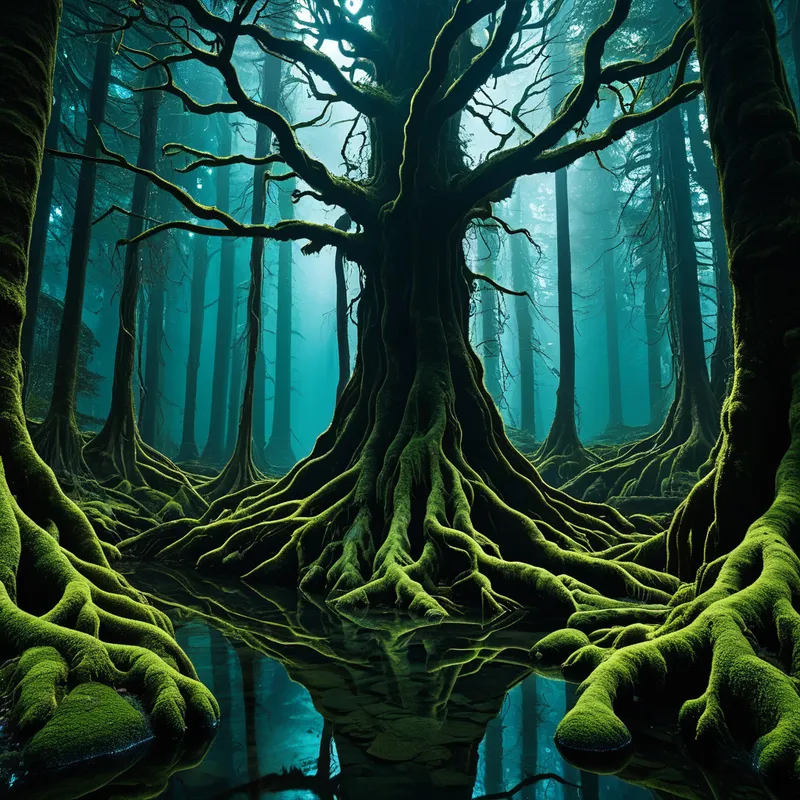
The alchemical process modeled here is the nigredo, the descent into the blackness, essential for any true psychic transmutation. The forest is the alchemical vessel (vas), the sealed space where the confrontation must occur. The journey into its heart is the voluntary dissolution of the ego’s certainties.
To walk into Aokigahara is to consent to the dissolution of the persona. To walk out is to have forged a soul from the shards.
The volcanic rock is the prima materia, the base, leaden state of the suffering self. The spirits are the aspects of the psyche that must be “sat with” in the silent zazen of the soul—not fought, but witnessed until their emotional charge is understood and integrated. The resolution is not a slaying of a beast, but an act of sacred naming and bearing witness. The “return” is the albedo, where the integrated self, now carrying the acknowledged shadow, emerges with a new, quieter clarity. The transformed individual does not conquer the forest; they carry a piece of its respectful, terrible silence within them, a touchstone of their own depth. They have learned to navigate not by the compass of the ego, but by the colder, more reliable stars of inner truth.
Associated Symbols
Explore related symbols from the CaleaDream lexicon: