
The Fool Myth Meaning & Symbolism
A youth, a dog, a cliff, and a leap. The Fool's myth is the eternal story of beginning the journey with nothing but faith.
The Tale of The Fool
Listen. Before the first card is drawn, before the spread is laid, there is a breath. And in that breath, a story begins.
It begins not in a kingdom, but on a road. A high, winding path that clings to the shoulders of mountains older than gods. The air is thin and sharp, tasting of ice and distant stone. Here, at the very lip of the world, walks a figure.
They are young, or perhaps ageless. Their clothes are bright, a patchwork of journeys not yet taken, and on their shoulder rests a bindle, carrying little more than a spark of potential. In their hand, a single white rose, held not with care, but with the casual grace of one who carries their heart openly. At their heel, a small, lively dog—part companion, part conscience, barking not in warning, but in pure, exuberant joy at the motion forward.
The traveler does not look at their feet. Their gaze is lifted, fixed on the brilliant, impossible sun, or perhaps on a distant peak still shrouded in cloud. They walk with a dancer’s lightness, a step that seems to barely touch the earth. And so, absorbed in the vision ahead, they do not see the path end.
The ground simply falls away.
A yawning chasm opens before them, a gulf of mist and echoing wind. The dog leaps, nips playfully at their heel. In any sane tale, this is the moment of terror. The gasp. The stumble back from the edge.
But the Fool does not stumble.
The booted foot, suspended in mid-step, does not hesitate. It continues its arc. It steps out into the empty, glorious air. There is no bridge. There is no net. There is only the step, the commitment, the act of motion itself. The bindle hangs in the void. The rose still blooms. The sun still shines. And the fall, if it is a fall, becomes a kind of flying. The story does not end with the step; it begins because of it. The cliff is not an end, but the first true threshold.

Cultural Origins & Context
The Fool is the genesis card of the Major Arcana, but its roots are tangled in the carnival soil of medieval Europe. Emerging in the 15th century in Italy as the Il Matto (The Madman), this figure was not initially a heroic seeker. In the context of Tarocchi games, The Fool was a wild card, a trump that could sometimes win, sometimes lose, operating outside the established hierarchy of kings and emperors.
This societal function is key. The Fool was the licensed outsider—the jester at court who could speak truth to power, the vagabond on the road who lived outside feudal law, the “holy fool” whose madness was seen as a conduit to divine wisdom. The myth was passed down not in scrolls, but in woodcuts and painted cards, told by gamblers, travelers, and fortune-tellers. Its societal role was to embody the unpredictable, the unbounded potential that exists at the frayed edges of order. It was a narrative container for the anxiety and allure of the unknown, a reminder that the structured journey of life (the sequential Major Arcana from Magician to World) must be preceded by a willing surrender to chaos.
Symbolic Architecture
Psychologically, The Fool represents the primal self before ego-formation. It is the pure potential of the psyche, the unburdened spirit poised at the beginning of individuation.
- The Cliff & The Step: The central, terrifying symbol. The cliff represents the known world, the ego’s safe ground. The step is the act of faith into the unconscious. It is not suicidal, but vital. It is the decision to grow, which always feels like a risk before it feels like liberation.
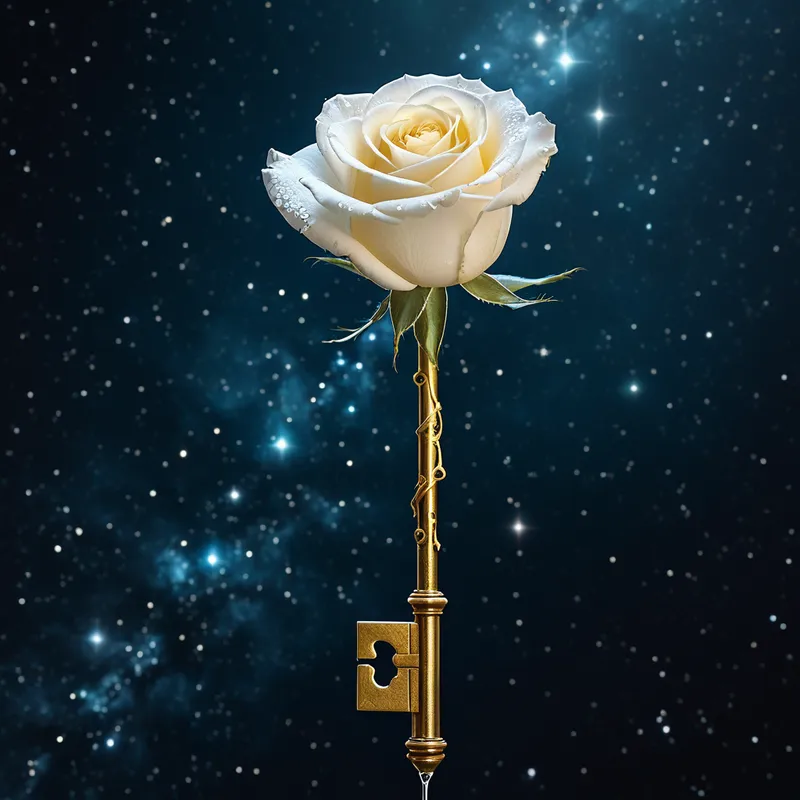
- The White Rose: Purity, innocence, and the beauty of the present moment. It signifies the Fool’s connection to life not through experience, but through direct, unfiltered perception. The rose is held, not clutched—a symbol of carrying one’s essence lightly.
- The Dog: An often-misunderstood companion. This is not a warning, but the instinctive, animal vitality of the psyche. It is the life force that barks with joy at the journey, the somatic intelligence that urges us forward even when the intellect balks.
- The Bindle: It contains all one needs, which is almost nothing. It symbolizes the minimal, essential wisdom we carry from past lives or experiences—not a heavy burden of knowledge, but a seed.
The Fool does not possess wisdom; they are the space in which wisdom can occur. Their emptiness is their potency.
The number of The Fool is 0. It is the womb, the egg, the blank page. It contains all numbers but is defined by none. This is the ultimate symbolic statement: The Fool is not a character in the story of the Major Arcana; they are the consciousness from which the entire story is dreamed into being.
The Dreamer’s Resonance
When The Fool strides into modern dreams, they rarely appear as a card. They manifest as the sensation of the myth. You dream of standing at the edge of a new job, a new relationship, a new city, feeling that dizzying mix of exhilaration and terror. You dream of missing a flight but feeling inexplicably free. You dream of walking off a path into a dark forest, compelled by curiosity, not fear.
Somatically, this is the process of de-integration. The conscious, structured self (the ego) is preparing to temporarily dissolve to allow for new growth. The body may register this as anxiety—the pit in the stomach before the cliff—but also as a strange, electric aliveness. Psychologically, you are encountering the call to adventure, as mythologist Joseph Campbell framed it. The dream is the psyche’s way of rehearsing the leap, of testing your capacity for trust in a process larger than your plans. If you resist the step in the dream, you may be resisting a necessary life change. If you take it, even amidst fear, you are aligning with a deep, archetypal current of becoming.

Alchemical Translation
The alchemical journey begins with Nigredo, a dissolution into primal matter. The Fool is this first matter. Their leap is the voluntary descent into the massa confusa of the unconscious. For the modern individual, this translates not to literal recklessness, but to the courage to begin.
The process models psychic transmutation thusly:
- Innocence as Catalyst: The Fool’s naive trust is not ignorance, but a necessary suspension of cynical knowing. It is the willingness to say “I don’t know,” which is the only true starting point for learning. In individuation, we must become fools to our old identities to discover new ones.
- The Void as Crucible: The empty air off the cliff is the alchemical vessel. It is the liminal space of not-knowing, of unemployment, of silence after a loss, of the blank canvas. This void is not empty; it is pregnant. It is where the old self dissolves so the new can coalesce.
- The Step as Operation: The act of leaping is the alchemical operation itself—Solve et Coagula (dissolve and coagulate). You dissolve your attachment to the safe ground (the known identity) and, in the freefall, you begin to coagulate around a new, more authentic center of gravity.
The goal is not to stop being The Fool, but to integrate its spirit. The sage who has completed the journey of the Major Arcana must, in a sense, become a Fool again—wise enough to know they know nothing, and free enough to begin anew.
Thus, The Fool’s myth is the eternal blueprint for the first breath of any transformation. It teaches that wisdom is not the accumulation of answers, but the cultivation of a relationship with the question. It affirms that every ending is secretly a precipice, and every true beginning requires the faith to step into thin air, trusting that the path will appear only after the step has been taken.
Associated Symbols
Explore related symbols from the CaleaDream lexicon: