The Flying Dutchman Myth Meaning & Symbolism
A ghost ship doomed to sail the seas forever, its captain a figure of hubris and obsession, seeking a redemption forever out of reach.
The Tale of The Flying Dutchman
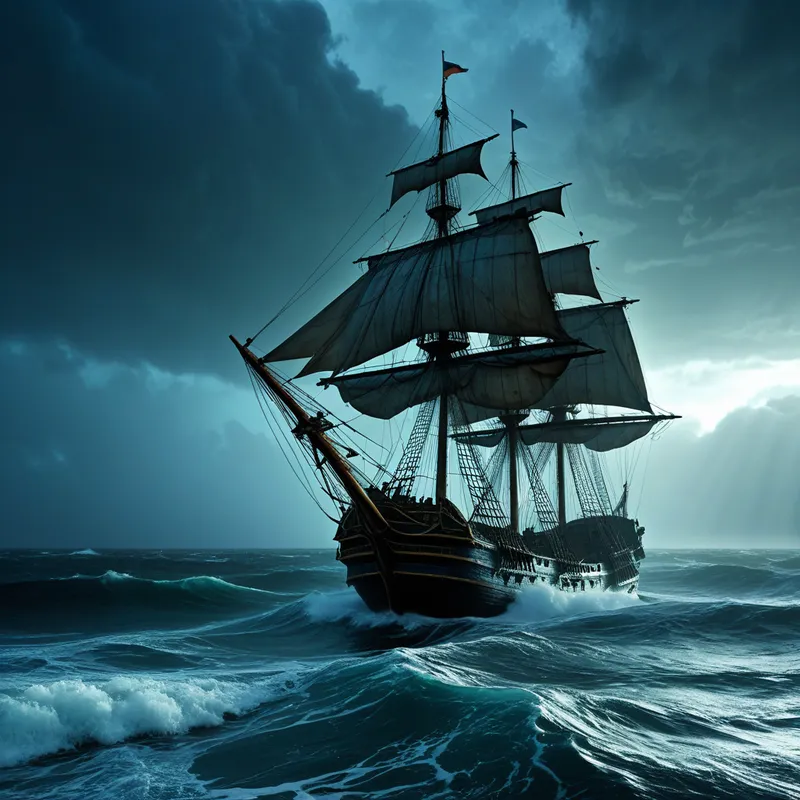
Hear now the tale that rides the salt wind, a whisper in the rigging of every ship that dares the southern capes. It begins not with a birth, but with a curse, born from the marriage of a man’s will and the ocean’s wrath.
There was a captain, Hendrick van der Decken, whose soul was as hard as the oak of his ship’s keel. His vessel, a mighty fluyt, was his only kingdom, and [the sea](/myths/the-sea “Myth from Greek culture.”/) his only law. He was bound for home, his hold heavy with the spices of the East, when the great Cape of Storms—the Kaap de Goede Hoop—rose before him like a snarling jaw of rock and foam. A gale howled down from the Table Mountain, a wall of wind and [water](/myths/water “Myth from Chinese culture.”/) that sought to dash his pride to splinters.
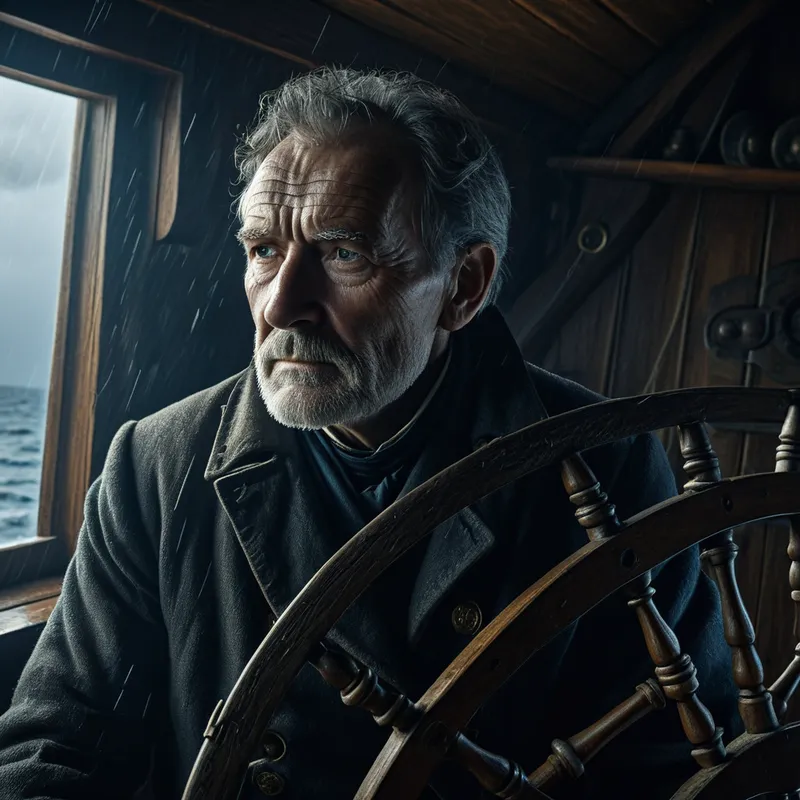
For seven days and seven nights, the storm wrestled with the ship. Sailors wept and prayed, but van der Decken stood fast at the helm, his beard crusted with salt, his eyes burning with a fire not of this earth. He would round the Cape. He had sworn it. When the heavens themselves seemed to plead for reason, a spectral figure appeared upon the wave-tossed deck. Some say it was an angel; others, a spirit of the deep. The apparition commanded him to cease his mad quest and seek shelter.
Van der Decken, his heart a furnace of defiance, raised a shaking fist. “I will round this Cape,” he roared into the shrieking wind, “if I must sail until the Day of Judgment!” He is even said to have fired a pistol at the holy messenger. The words, woven of pure hubris, became the fabric of his fate.
A terrible silence fell, colder than the storm. Then, the voice of eternity spoke: “So be it. You shall sail on forever.”
In that moment, the ship was unmade from [the world](/myths/the-world “Myth from Tarot culture.”/) of men. The raging sea calmed, but not into peace—into a perpetual, eerie twilight. The Vliegende Hollander was born, a phantom vessel with sails of blood-red mist and a hull that groaned with the weight of centuries. It is seen in the rogue waves of the Southern Ocean, a fleeting shadow in the fog banks off the Bloubergstrand, forever trying to round the headland, forever failing. On still nights, sailors hear the ghostly chorus of its damned crew, singing songs of a home they will never see. To sight it is an omen of doom, a mirror held up to the stubborn, sailing soul in every mariner.
Cultural Origins & Context
The legend of the [Flying Dutchman](/myths/flying-dutchman “Myth from Dutch culture.”/) is not a myth of ancient gods, but a folklore born from the very real perils and [psyche](/myths/psyche “Myth from Greek culture.”/) of the Dutch [Golden Age](/myths/golden-age “Myth from Universal culture.”/) of sail. In the 17th and 18th centuries, the Dutch Republic was a global maritime power, its wealth and identity flowing through the holds of the mighty vessels of the Vereenigde Oostindische Compagnie (VOC). The voyage to the East Indies was a monumental gamble—a two-year journey through treacherous seas where storms, scurvy, and shipwreck were commonplace.
The story functioned as a profound sea-story, passed down in sailor’s taverns and watchful nights on deck. It served multiple purposes: a stark moral tale against the sin of hubris and blasphemy, a supernatural explanation for the terrifying and unpredictable violence of the sea (especially around the Cape of Good Hope), and a psychological container for the immense isolation and pressure felt by ship captains, who held absolute authority and absolute responsibility. The phantom ship became a shared nightmare, a cultural shadow figure representing the thin line between triumphant return and eternal, catastrophic loss. Its persistence in lore was ensured by countless “sightings,” which were likely mirages, [Fata Morgana](/myths/fata-morgana “Myth from Various culture.”/), or the desperate visions of exhausted, sun-scorched men.
Symbolic Architecture
At its core, the Flying Dutchman is not merely a ghost [story](/symbols/story “Symbol: The symbol of ‘Story’ represents the narrative woven through our lives, embodying experiences, lessons, and emotions that shape our identities.”/); it is a profound [symbol](/symbols/symbol “Symbol: A symbol can represent an idea, concept, or belief, serving as a powerful tool for communication and understanding.”/) of the psyche trapped in a self-made [prison](/symbols/prison “Symbol: Prison in dreams typically represents feelings of restriction, confinement, or a lack of freedom in one’s life or mind.”/).
The ship itself represents the [vehicle](/symbols/vehicle “Symbol: Vehicles in dreams often symbolize the direction in life and the control one has over their journey, reflecting personal agency and decision-making.”/) of [the ego](/myths/the-ego “Myth from Jungian culture.”/)—the constructed self, our ambitions, and our worldly projects. [Captain](/symbols/captain “Symbol: A captain symbolizes leadership, authority, and the ability to navigate through life’s challenges.”/) van der Decken embodies the tyrannical [aspect](/symbols/aspect “Symbol: A distinct feature, quality, or perspective of something, often representing a partial view of a larger whole.”/) of the will, the driven, obsessive [consciousness](/symbols/consciousness “Symbol: Consciousness represents the state of awareness and perception, encompassing thoughts, feelings, and experiences.”/) that refuses to yield, adapt, or acknowledge limits, whether from [nature](/symbols/nature “Symbol: Nature symbolizes growth, connectivity, and the primal forces of existence.”/), circumstance, or the divine. The [Cape](/symbols/cape “Symbol: A cape symbolizes transformation, protection, and the ability to hide one’s true identity or purpose.”/) of Storms symbolizes the insurmountable [obstacle](/symbols/obstacle “Symbol: Obstacles in dreams often represent challenges or hindrances in waking life that intercept personal progress and growth. They can symbolize fears, doubts, or external pressures.”/), the ultimate test that, when met with inflexibility, becomes a [curse](/symbols/curse “Symbol: A supernatural invocation of harm or misfortune, often representing deep-seated fears, guilt, or perceived external malevolence.”/).
The curse is not to suffer, but to be forever almost arriving, forever in striving but never in being. It is the agony of potential forever unrealized.
The phantom [crew](/symbols/crew “Symbol: A crew often symbolizes collaboration, teamwork, and collective purpose, suggesting a need for shared goals and support from others in one’s journey.”/) represents the other parts of the psyche—instincts, emotions, [community](/symbols/community “Symbol: Community in dreams symbolizes connection, support, and the need for belonging.”/)—damned and enslaved to the captain’s fixed [idea](/symbols/idea “Symbol: An ‘Idea’ represents a spark of creativity, innovation, or realization, often emerging as a solution to a problem or a new outlook on life.”/). The eternal voyage is the [nightmare](/symbols/nightmare “Symbol: Nightmares symbolize deep fears, unresolved anxiety, and emotional turmoil, often reflecting internal conflicts or stressors in waking life.”/) of stagnation disguised as [motion](/symbols/motion “Symbol: Represents change, progress, or the flow of life energy. Often signifies transition, personal growth, or the passage of time.”/), a [life](/symbols/life “Symbol: The symbol of ‘Life’ represents a journey of growth, interconnectedness, and existential meaning, encompassing both the joys and challenges that define human experience.”/) lived on autopilot, repeating the same doomed patterns. The inability to make [port](/symbols/port “Symbol: Represents transitions, journeys, and the gateway to new beginnings.”/) symbolizes the ultimate failure of [integration](/symbols/integration “Symbol: The process of unifying disparate parts of the self or experience into a cohesive whole, often representing psychological wholeness or resolution of internal conflict.”/); the [hero](/symbols/hero “Symbol: A hero embodies strength, courage, and the ability to overcome significant challenges.”/) cannot complete his [journey](/symbols/journey “Symbol: A journey in dreams typically signifies adventure, growth, or a significant life transition.”/), cannot bring his treasures (the spices, or psychic contents) home to be assimilated into the wider world of [the self](/myths/the-self “Myth from Jungian culture.”/).
The Dreamer’s Resonance
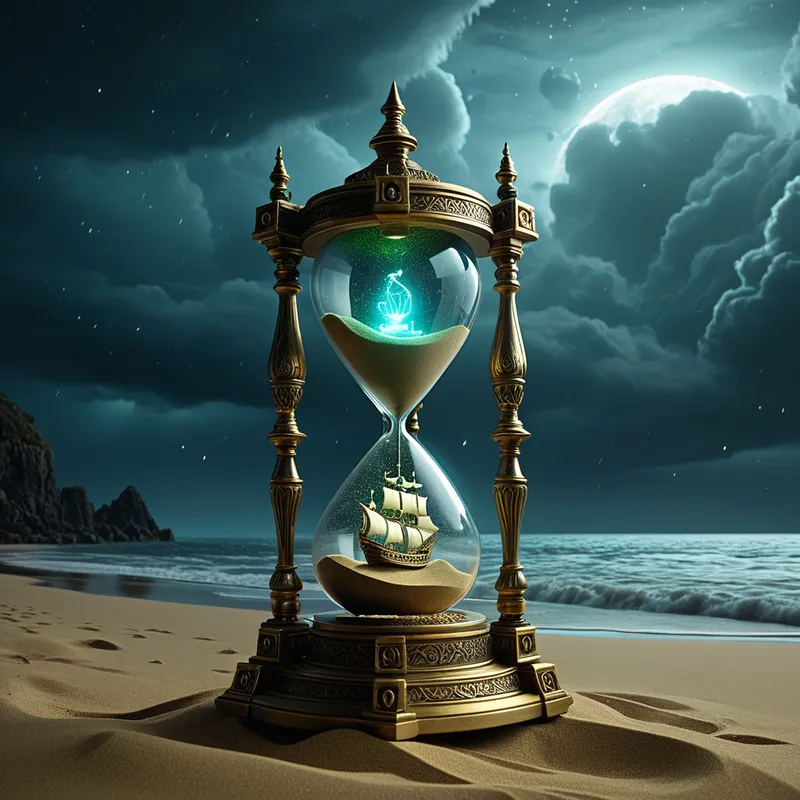
When this myth stirs in the modern dreamer, it rarely appears as a full-rigged ship. Instead, one may dream of being trapped in an endless, circular commute; working feverishly on a task that never completes; or trying to send a message that never arrives. The somatic feeling is one of profound frustration, weight, and existential fatigue—the soul’s version of muscle ache.
Psychologically, this signals a state of psychic inflation. The dreamer’s conscious attitude has become so rigid, so identified with a single goal, role, or belief (“I must achieve X,” “I am always the responsible one,” “This is the only way”), that it has cut itself off from the guiding forces of the unconscious (the angel/spirit). The dream is a portrait of the Self, alienated and adrift. The haunting quality points to a neglected part of life—often rest, relationship, or surrender—that now demands recognition as the price for ending the curse.
Alchemical Translation
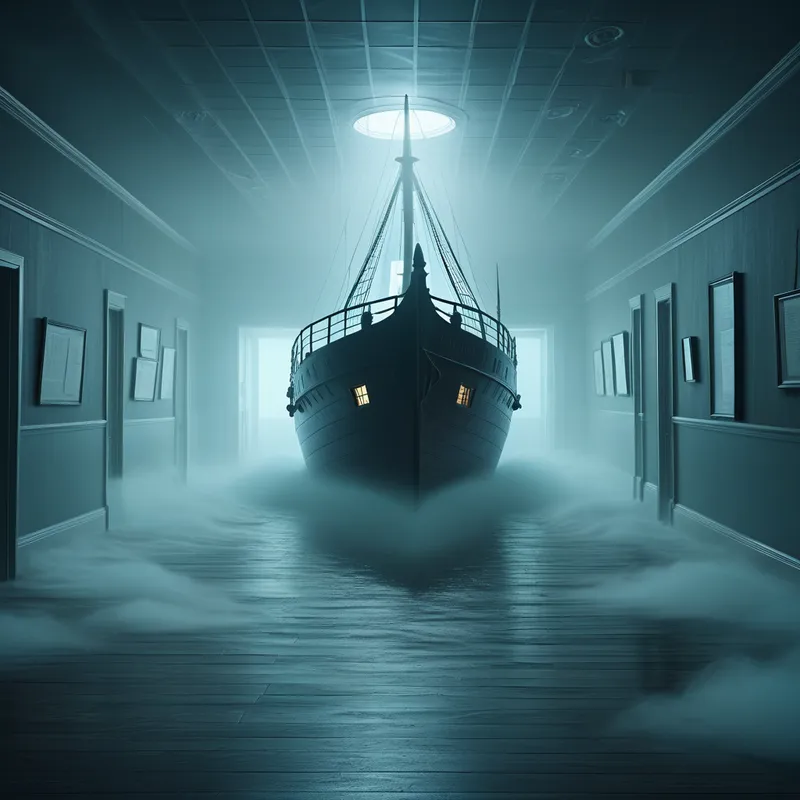
The alchemical process modeled here is the mortificatio—the necessary death of the inflated, rigid ego-attitude. Van der Decken’s curse is the ultimate [nigredo](/myths/nigredo “Myth from Alchemical culture.”/), the blackening, a state of despair and putrefaction that is, paradoxically, the starting point for transformation.
The redemption hinted at in some variants of the tale—that the curse can be broken every seven years if the captain can find a woman who will love him faithfully—provides the key. This represents the arrival of the anima, the connecting function to the depths. It is not more willpower that saves him, but the capacity for relatedness, vulnerability, and love—everything his defiant, isolated stance originally rejected.
The transmutation occurs when the obsessive drive (sailing on) is sacrificed to the receptive state (being found). The harbor is not reached by conquering the storm, but by allowing the storm to pass through and change the sailor.
For the modern individual, the “alchemical translation” means recognizing one’s own van der Decken moment: Where am I stubbornly trying to round an impossible Cape? What heavenly messenger (intuition, body signal, friend’s advice) am I shooting at? The work is to lower the pistol. To heave to in the storm. To listen. The journey of individuation requires not an eternal, straight-line obsession, but the cyclical wisdom to sometimes turn back, to wait, and ultimately, to allow the original, cursed goal to dissolve so that a truer destination—a home port one never knew existed—can be revealed. The ghost ship finds peace not by finishing its old voyage, but by realizing it is no longer the ship that began it.
Associated Symbols
Explore related symbols from the CaleaDream lexicon: