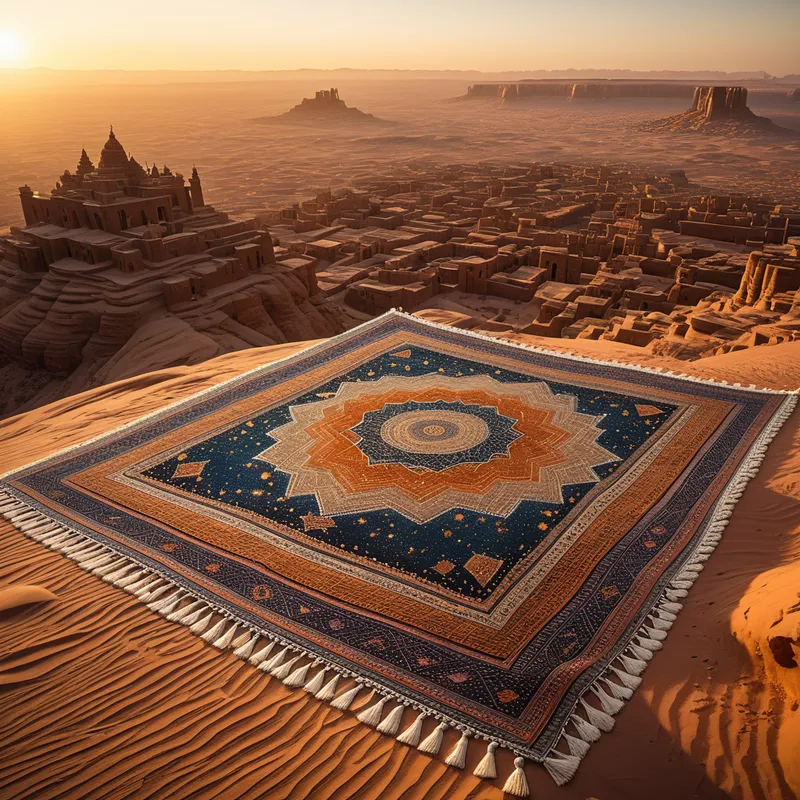
The Flying Carpet from Middle Myth Meaning & Symbolism
A myth of a woven artifact that defies gravity, carrying its bearer from the center of a labyrinthine world to the boundless horizon of the self.
The Tale of The Flying Carpet from Middle
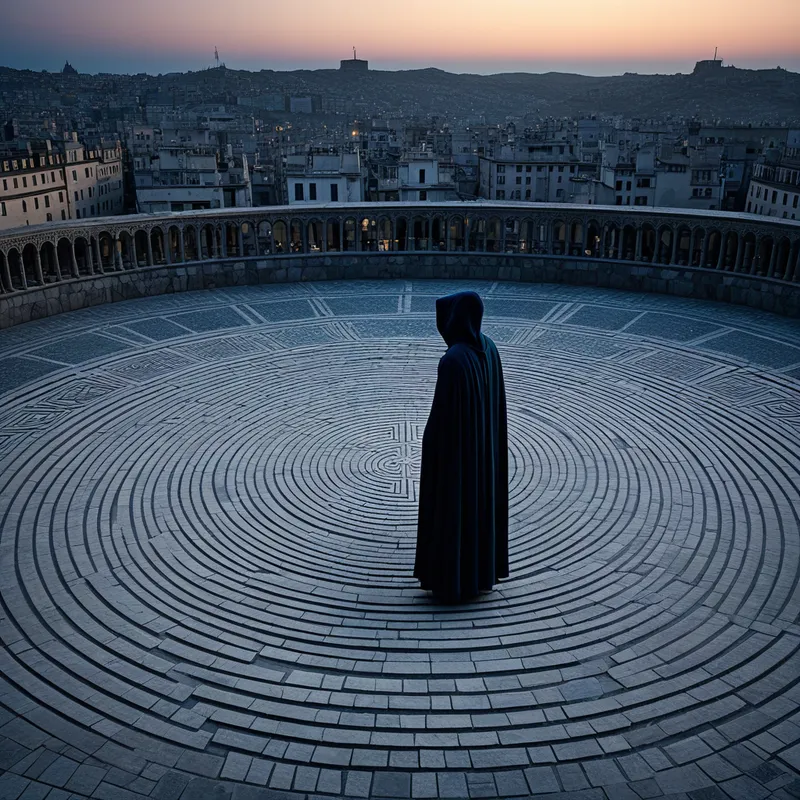
Listen, and let the wind in the high places carry this tale. There is a city, not of East or West, but of the Middle. Its streets are not laid in grids, but in rings, concentric and perfect, spiraling inward like the grooves on a great stone record. At its absolute heart lies a plaza, circular and empty save for a single, worn stone dais. The city is a masterpiece of order, a clockwork of habit, and its people move through its rings with the serene, unquestioning rhythm of planets in a fixed orbit. To live in the Outer Rings is to know commerce and community. To dwell in the Inner Rings is to know philosophy and governance. But to stand in the Central Plaza is to know only silence, and the weight of being the still point of the turning world.
In this city lived a weaver named Kaelen. His hands were skilled, his patterns flawless, replicating the precise geometries of the city itself in wool and silk. Yet, his soul was restless. While his threads followed the sanctioned circles and angles, his mind wandered to the spaces between the lines, to the notion of a line that did not curve back on itself but pointed, defiantly, outward. He began to weave a private rebellion. Into a carpet of standard size and approved pattern, he secretly plied threads of a different sort: strands of his own longings, whispers of questions asked only at night, and the subtle, almost-forgotten memory of wind that was not channeled down stone corridors, but wild and free.
The work made him heavy with a strange melancholy. The finished carpet was, to any official inspector, unremarkable. But to Kaelen, it hummed with a silent potential. Driven by a compulsion he could not name, he carried it one evening to the Central Plaza, the null point of his world. He unrolled it upon the ancient dais and sat, not to meditate, but simply to be in the presence of his own quiet heresy. As the first star pierced the violet twilight, a tremor passed through the stone beneath him—or was it through him? The carpet shuddered. The geometric patterns woven into its fabric began to glow with a soft, internal light, not of fire, but of captured moonlight and aspiration.
Then, with a sigh like the release of a breath held for a lifetime, the edges of the carpet curled upward. The weave tightened, becoming taut as a drumhead. Kaelen, heart hammering against his ribs, did not flee. He lay down upon the fabric of his own making. And the carpet, his silent confidant and manifested dream, lifted. It rose from the dais, floating upward through the still air, above the perfect rings of the city. He saw his world then not as a destiny, but as a pattern—beautiful, intricate, and finite. The carpet carried him past the highest spire of the innermost ring, over the walls of the outermost, and into the vast, unscripted embrace of the open desert sky, leaving the labyrinth of the Middle behind, a diminishing mosaic beneath the endless stars.
Cultural Origins & Context
The myth of the Flying Carpet from Middle is a quintessential ur-myth of the human psyche, appearing in fragments and echoes across countless traditions. It is not the property of a single culture, but a universal story of the center and the escape. Scholars find its motifs in Sufi parables of spiritual ascent, in Eurasian shamanic tales of sky journeys on hide or cloth, and even in the Platonic allegory of leaving the cave. It was never the sole story of a priesthood or a palace; it was the whispered story of the artisan, the introspective child, the one who feels the geometry of their life as both sanctuary and cage.
Its primary function was societal and psychological counterbalance. In cultures that prized order, stability, and defined roles—be they theocratic, feudal, or intensely communal—this myth served as a necessary psychic pressure valve. It was told not to inspire literal desertion, but to validate the inner experience of longing for perspective. It gave a shape and a hope to the feeling of being trapped at the center of one’s own existence, assuring the listener that the very tools of one’s confinement (one’s craft, one’s thoughts, one’s quiet yearnings) could, if woven with authentic intent, become the vehicle for liberation. It affirmed that the center must be fully inhabited and understood before it can be transcended.
Symbolic Architecture
The myth’s power lies in its stark, potent symbols. The City of Middle represents the completed, integrated psyche or social order. It is the individuated self in its first, static form—organized, functional, but potentially airless. Its concentric rings are the layers of persona, adaptation, and conscious identity we build around our core.
The center is not a place of power, but of potential. It is the silent axis where all motion cancels itself out, awaiting a new vector.
The Central Plaza is the Self in its dormant state. It is not the bustling ego, but the often-empty, quiet core where one confronts the totality of one’s own construction. Kaelen is the ego that becomes servant to the Self, the part of us that feels the insufficiency of mere order and intuits a calling beyond the pattern.
The Carpet itself is the masterpiece of this symbolic architecture. It is the sublimated creation. Woven on the loom of convention (the approved patterns), it is secretly threaded with the gold of the personal and transpersonal unconscious—the “longings and questions.” It symbolizes the moment when one’s life’s work, one’s art, or one’s deepest introspection ceases to be an object within the world and becomes the very means to see the world as an object, from a new height. Its flight is not physical travel, but the acquisition of a transcendent viewpoint.
The Dreamer’s Resonance
When this myth stirs in the modern dreamscape, it rarely appears as a literal carpet. Instead, one may dream of a familiar room detaching from a house and floating away, of a book whose pages become wings, or of a subway car leaving its tracks and ascending through a tunnel into open sky. The somatic sensation is crucial: a lifting in the solar plexus, a mixture of exhilaration and vertigo.
Such a dream marks a critical phase in psychic process. The dreamer is experiencing a “rise” in consciousness, a sudden, involuntary gain in perspective on a life situation that had felt confining and inescapable. The “Middle” is their current psychological predicament—a job, a relationship, a self-concept—that feels like the total world. The act of “flying from” it in the dream does not foreshadow literal abandonment, but signals that the psyche has successfully woven a new understanding. The conflict between duty and desire, structure and freedom, has been synthesized into a vehicle (the dream symbol) that allows the dreamer to hold the entire pattern in view without being trapped within its logic. It is the moment the problem becomes the solution.
Alchemical Translation
The journey of Kaelen is a perfect map for the individuation process. The first stage, living in the rings, is the building of the conscious personality—necessary, skillful, but ultimately conformist. The weaving of the secret carpet is the active imagination and inner work done in private, where the ego consciously engages with unconscious contents (the threads of longing).
The alchemy occurs not in the escape, but in the weaving. The base metal of confinement is spun, by the patience of the soul, into the golden thread of agency.
The journey to the Central Plaza is the crucial, often terrifying, stage of confrontation with the Self. It is the voluntary immersion in one’s own core loneliness, stillness, and potential. This is the nigredo, the dark night, where all previous motion ceases. The lifting of the carpet is the albedo—the dawn, the emergence of a new, liberating consciousness from the fertile darkness. The ego (Kaelen) does not dissolve; it submits to and rides the creation born of its partnership with the Self.
Finally, the flight over the city represents rubedo, the attainment of a transcendent viewpoint. The individual sees the totality of their own psyche—the beautiful, intricate labyrinth they have built—with compassion and detachment. They are no longer identical with it. They have achieved what the alchemists sought: not to destroy the base material, but to transform it into a vessel for spirit. The Flying Carpet myth tells us that liberation is not found in rejecting the pattern of our lives, but in weaving its very threads into a new dimension of being, carrying the wisdom of the center out into the boundless sky of the possible.
Associated Symbols
Explore related symbols from the CaleaDream lexicon: