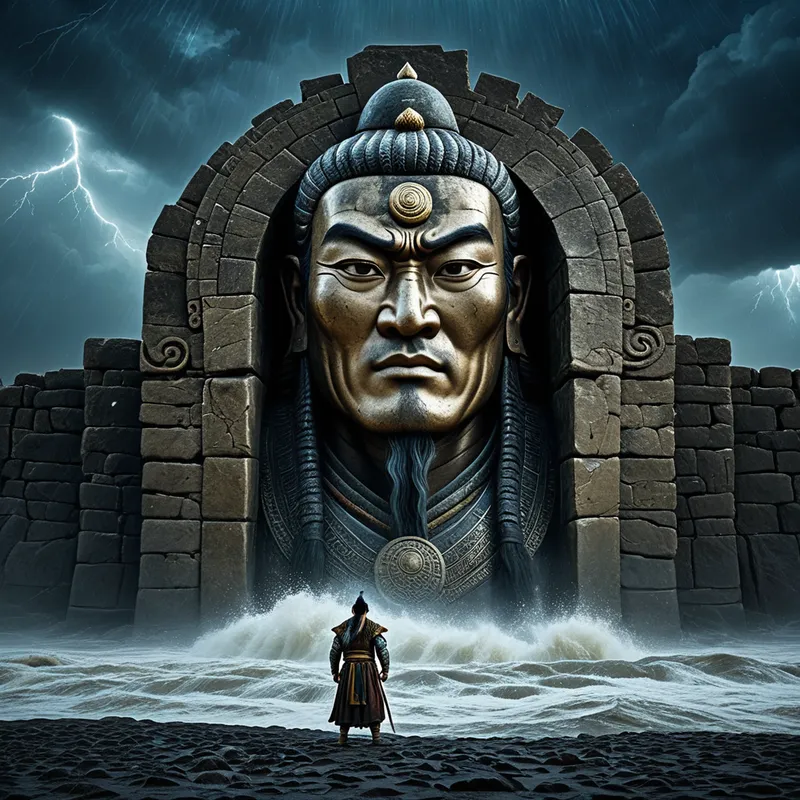
The Flood Myth of Mongolia Myth Meaning & Symbolism
A myth where a divine hero, Borte Chino, sacrifices himself to a great flood, transforming into a sacred mountain to save his people and restore cosmic order.
The Tale of The Flood Myth of Mongolia
Listen, and hear the tale from when the world was soft and the sky wept without end.
In the time before time was counted, when the Tengri was young in its rule, a great discord stirred in the belly of the world. The earth, generous and vast, had grown heavy with the forgetfulness of men. They quarreled with the spirits of the rivers, they hunted without giving thanks to the forest, and their hearts turned hard like winter stone. The harmony between the A上部世界, the middle world of the living, and the A下部世界 frayed, thin as an old horsehair.
Then, the rains began. Not the gentle rains that coax the grass from the steppe, but a weeping of the heavens so profound it seemed the sky itself was grieving. For forty days and forty nights, the drumbeat of the downpour did not cease. Springs burst from the earth, rivers swelled into roaring beasts, and the great lakes overflowed their stone cups. The world became a churning, grey soup. The endless sea of grass, home to the herds and the people, vanished beneath a cold, relentless flood. The people fled to the highest hills, but the water, patient and hungry, climbed after them. Despair, colder than the water, seeped into their bones. All seemed lost.
But from among them rose a figure of resolve. His name was Borte Chino. He was not a king by throne, but a leader by the strength of his spirit and the clarity of his vision. He saw that this was no ordinary storm, but a cleansing, a terrible rebalancing of the cosmic scales. To plead was useless; the Tengri demanded action, a sacrifice equal to the catastrophe.
As the last rocky peak threatened to be swallowed, Borte Chino stood at its pinnacle. He did not raise his arms in futile defiance. Instead, he turned his gaze inward, to the sacred center of his being, and then outward, to the heart of the deluge. He called out, not with a shout, but with a silence that pierced the roar of the water. He offered a trade: his own form, his own life, for the survival of his people and the land that bore them.
The waters seemed to pause, listening. Then, a great trembling moved through the world. Borte Chino’s body began to change. His feet fused with the mountain stone. His spine stretched and hardened, his flesh transforming into rugged cliffs and fertile soil. His outstretched arms became sheltering ridges. Where his heart beat its last, a pure spring burst forth. Before the eyes of the weeping, grateful people, the hero became a mountain—a permanent, unshakable sanctuary in the midst of the retreating chaos. The floodwaters, their purpose fulfilled, began to drain away, flowing around the slopes of this new-born sacred peak. Life, tentative and green, returned to the world, watered by sacrifice and anchored by memory.
Cultural Origins & Context
This myth, while less codified than the flood narratives of sedentary civilizations, flows through the oral traditions of the Mongolian peoples, intertwined with the foundational legend of Borte Chino and Gua Maral, the primordial ancestors. In the vast, open landscape of the steppe, where one’s survival is intimately tied to the mercy of the skies and the health of the land, the threat of catastrophic weather is not a metaphor but a historical reality. The myth likely served as an etiological narrative, explaining the origins of specific, prominent mountains considered sacred.
It was a story told by shamans (Böö) and elders around the hearth fire of the ger, especially during times of environmental stress or communal crisis. Its function was multifaceted: it reinforced the Tengriist worldview of cosmic balance, warned against ecological and social hubris, and provided a template for heroic conduct. The hero does not conquer the flood with force, but through a profound act of willing self-transformation, modeling the ultimate responsibility of a leader—to become the foundation for the community’s future.
Symbolic Architecture
At its core, the myth is a profound [drama](/symbols/drama “Symbol: Drama signifies narratives, emotional expression, and the exploration of human experiences.”/) of cosmogony re-enacted. The flood represents the return of undifferentiated, primal [Chaos](/symbols/chaos “Symbol: In Arts & Music, chaos represents raw creative potential, uncontrolled expression, and the breakdown of order to forge new artistic forms.”/), the unformed waters that existed before creation. It is the unconscious, in its most overwhelming and devouring [aspect](/symbols/aspect “Symbol: A distinct feature, quality, or perspective of something, often representing a partial view of a larger whole.”/), rising up to dissolve the fragile structures of the conscious ego and society.
The flood is not merely punishment, but the psyche’s brutal, necessary return to its own source to be remade.
Borte Chino embodies the archetypal principle of the Ego that must learn it cannot survive as it is. His sacrifice is the ultimate act of conscious surrender. He does not fight the [water](/symbols/water “Symbol: Water symbolizes the subconscious mind, emotions, and the flow of life, representing both cleansing and creation.”/); he lets it transform him. By becoming the [mountain](/symbols/mountain “Symbol: Mountains often symbolize challenges, aspirations, and the journey toward self-discovery and enlightenment.”/), he performs a miraculous [alchemy](/symbols/alchemy “Symbol: A transformative process of purification and creation, often symbolizing personal or spiritual evolution through difficult stages.”/): he gives the formless flood a [boundary](/symbols/boundary “Symbol: A conceptual or physical limit defining separation, protection, or identity between entities, spaces, or states of being.”/), a container. The mountain is the emergent Self, the indestructible core of [personality](/symbols/personality “Symbol: Personality in dreams often symbolizes the traits and characteristics of the dreamer, reflecting how they perceive themselves and how they believe they are perceived by others.”/) that is forged only through such a catastrophic encounter. It is [stability](/symbols/stability “Symbol: A state of firmness, balance, and resistance to change, often represented by solid objects, foundations, or steady tools.”/) born from fluidity, permanence born from sacrifice.

The Dreamer’s Resonance
When this myth stirs in the modern dreamer, it often manifests as dreams of overwhelming floods, tsunamis, or being trapped in rising water. Somaticly, one may feel a crushing pressure on the chest, a sense of suffocation, or profound helplessness. Psychologically, this signals a point of critical saturation. The ego is being inundated by contents of the unconscious—repressed emotions, neglected duties, or a life structure that has become too rigid and is now being dissolved.
The dream is not necessarily a prophecy of literal disaster, but a snapshot of an inner process where old identities are being washed away. The pivotal question the dream poses is: What in me must become the mountain? What core value, what piece of conscious understanding, must I be willing to “sacrifice” in its current form so that it can be transmuted into a lasting, foundational part of my being? The terror of the dream is the terror of this necessary death.

Alchemical Translation
For the individual on the path of individuation, the Mongolian flood myth maps the opus of psychic transmutation with stark clarity. The first stage, nigredo, is the flood itself: the dark night of the soul, the depression, the crisis that dissolves all certainty. Everything one thought was solid is revealed to be contingent.
The heroic act of Borte Chino represents the conscious engagement with this darkness—the mortificatio. It is the willing death of the ego’s current configuration. The modern equivalent is the brutal honesty of therapy, the surrender in meditation, the acceptance of a devastating truth. One stops trying to bail out the flood and instead asks, “What must I become to contain this?”
The transformation into the mountain is the albedo and rubedo combined—the whitening and reddening. It is the emergence of a new, more capacious structure of being from the ashes of the old.
The resulting “mountain” in the psyche is a complex of greater stability, resilience, and perspective. It is the capacity to hold contradiction, to endure suffering without being destroyed by it, to provide a “sacred space” within oneself where life can take root again. The flood recedes because its purpose—to force this transformation—is complete. The individual is not the same person who faced the waters; they have become the ground upon which a new life is built.
Associated Symbols
Explore related symbols from the CaleaDream lexicon:
- Flood — The overwhelming return of primal chaos and the unconscious, demanding a dissolution of the old order and a sacrificial transformation for renewal.
- Mountain — The enduring Self forged through sacrifice, representing stability, sanctuary, and a permanent connection between the earthly and the divine.
- Sacrifice — The conscious surrender of the ego’s current form, the essential act that transmutes personal loss into communal or psychic foundation.
- Hero — The archetypal force that confronts collective catastrophe not with brute force, but through willing self-transformation for a greater whole.
- Water — The primordial substance of life and the unconscious, here in its destructive, cleansing, and ultimately transformative aspect.
- Earth — The stable middle world that is lost to chaos and then re-anchored through the hero’s fusion with it, symbolizing the reclaimed ground of being.
- Chaos — The undifferentiated state that precedes and sometimes threatens to re-absorb creation, necessitating a heroic act of re-ordering.
- Order — The cosmic and psychic harmony that is shattered by human failing and restored through a foundational act of selfless transformation.
- Stone — The irreducible, eternal essence the hero becomes, representing the indestructible core of identity that survives all psychic floods.
- Spirit — The animating force of the hero’s sacrifice and the sacred presence that comes to inhabit the mountain-sanctuary thereafter.
- Rebirth — The new life for the community and the new, more integrated state of consciousness that emerges from the waters of dissolution.
- Journey — The collective flight from the rising waters, representing the traumatic but necessary transition from one state of being to another.