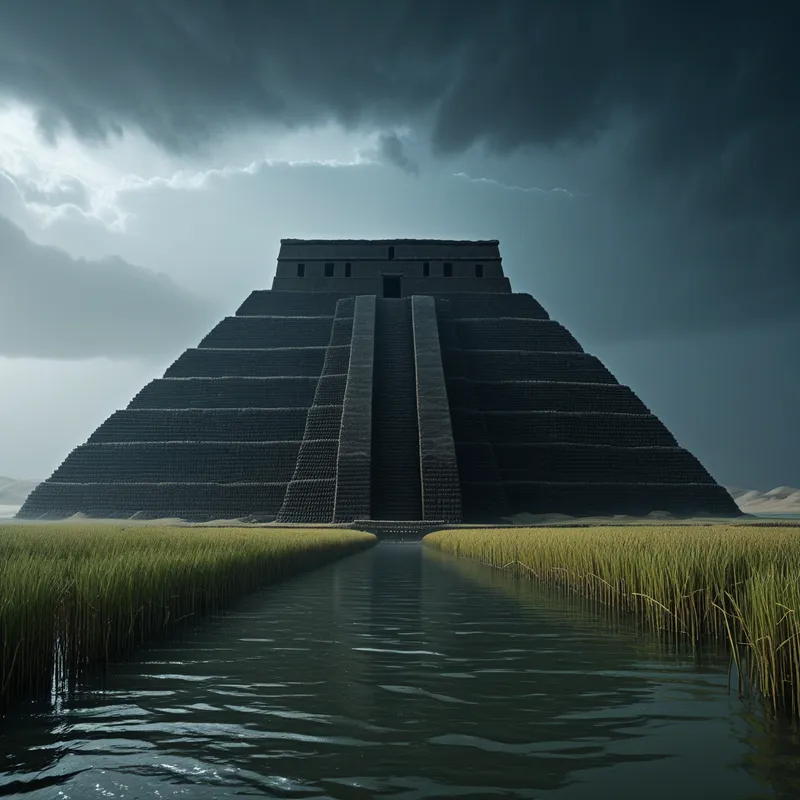
The Flood in the Epic of Gilgamesh Myth Meaning & Symbolism
A king learns of a great flood sent by gods to wipe out humanity, and the one man who survived by building an ark, gaining eternal life but not peace.
The Tale of The Flood in the Epic of Gilgamesh
Hear now the whisper from the baked-brick heart of Uruk, carried on the dust-laden wind. It tells of Gilgamesh, the mighty king, whose friend Enkidu was taken by the cold hand of the earth. Grief-stricken and terrified of his own end, Gilgamesh wanders to the ends of the known world. He seeks Utnapishtim, the Faraway, the one man who cheated the great silence.
After a journey through sun-scorched wastes and the twin-peaked mountain where the sun sets, Gilgamesh finds him. Utnapishtim sits by the shore, an old man with eyes that have seen the world die. “Why do you seek what you cannot have?” he asks. But Gilgamesh pleads. And so, Utnapishtim tells his tale, a story older than kings.
Long ago, in the city of Shuruppak, the air grew thick with divine discontent. The clamor of humanity had risen like smoke to the heavens, grating on the ears of the great gods. In their council, Enlil, lord of the storm, declared, “The noise of mankind is intolerable! I will bring a flood, a whirlwind to destroy the seed of humanity!”
But Ea, the clever one who loves humankind, could not bear this. He did not break his oath to the council. Instead, he spoke to the reed wall of Utnapishtim’s house. “Reed wall, reed wall! Listen and understand! Tear down your house, abandon your wealth. Build a boat, a perfect cube, with decks above and below. Seal it with pitch. Bring into it the seed of all living creatures.”
Utnapishtim, trembling, obeyed. For seven days, his family and the craftsmen labored. The people of Shuruppak laughed, asking why he built a boat on dry land. He could not tell them. He loaded the ark with his kin, craftsmen, gold, silver, and every beast and fowl he could gather.
Then the weather changed. The Adad bellowed in the clouds. The dawn came with a black cloud, and a tempest ripped the land. For six days and seven nights, the deluge raged. The gods themselves cowered, shrinking back like dogs, weeping at the destruction they had unleashed. The world was returned to a flat, featureless sea.
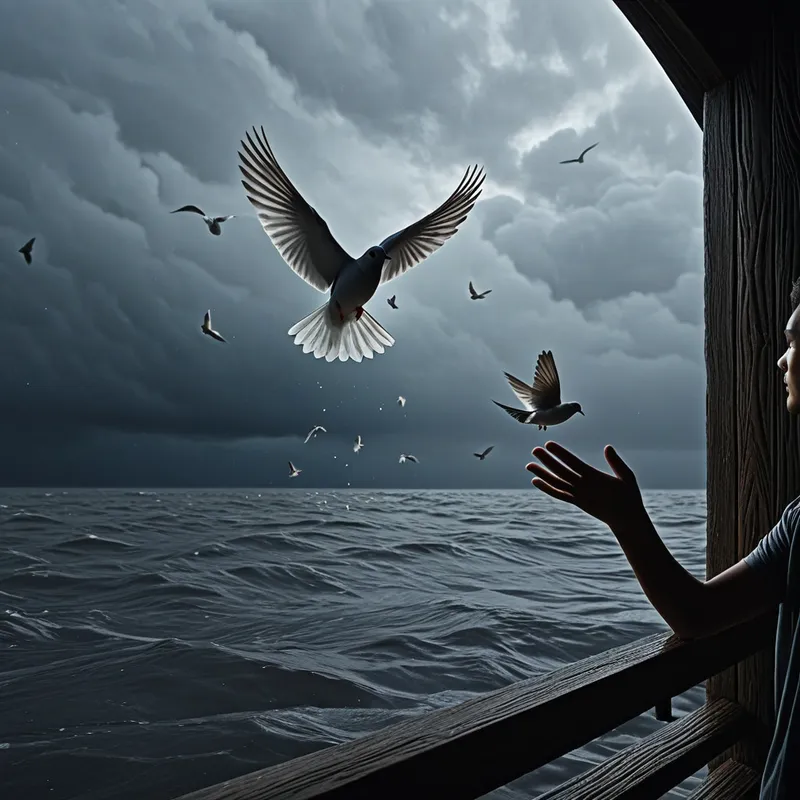
On the seventh day, the storm died. Utnapishtim opened a window. Silence. He wept. The boat grounded on the slopes of Mount Nisir. He sent out a dove. It returned, finding no perch. He sent a swallow. It returned. He sent a raven. It did not return. Then Utnapishtim knew the waters had receded. He made an offering upon the mountain. The smell of the sacrifice, sweet and rich, drifted up to the starving gods, who gathered like flies around the offering.
Enlil was furious to see survivors. But Ea spoke wisely: “Punish the sinner for his sin, the wrongdoer for his wrongdoing. But do not unleash a flood again! Would a lion have devoured all the people? Would a famine have cut them off?” The gods agreed. And as a reward for preserving life, they granted Utnapishtim and his wife immortality, setting them to live at the mouth of the rivers, forever apart.
Cultural Origins & Context
This story is not a singular, fixed text, but a living river of tradition flowing through the clay of Mesopotamia for over a millennium. Its earliest known fragments are Sumerian, dating to the late third millennium BCE. The version we know best is inscribed in Akkadian on twelve cuneiform tablets from the library of Ashurbanipal at Nineveh (7th century BCE), where it forms Tablet XI of the Epic of Gilgamesh.
It was a story told in scribal schools, recited in royal courts, and likely echoed in more popular forms. The flood narrative itself existed independently before being woven into Gilgamesh’s quest, suggesting it was a foundational cultural memory—a mythic explanation for a cataclysmic, perhaps even historical, riverine disaster that shaped the collective psyche of the Tigris-Euphrates civilization. Its societal function was multifaceted: it explained the capricious relationship between gods and humans, justified the need for ritual and obedience, and served as a profound narrative about the limits of human ambition and the inescapable reality of divine decree.
Symbolic Architecture
The Flood is the ultimate symbol of psychic dissolution. It represents the unconscious, chaotic waters of Tiamat returning to erase the ordered world of ego-consciousness, which had become too noisy, too arrogant. The gods’ decision is not mere cruelty, but a necessary, if terrifying, reset of a system grown corrupt with psychic inflation.
The ark is not an escape, but a vessel of containment. It is the fortified ego, or the conscious self, that must seal itself off from the overwhelming deluge of the unconscious to preserve the essential “seed” of the psyche.
Utnapishtim is the archetype of the obedient listener, the one who heeds the whisper from the “reed wall”—a symbol of the thin, permeable boundary between divine inspiration (Ea) and human perception. His survival is not a triumph of heroism, but of receptive wisdom. The animals represent the instinctual, archetypal contents of the psyche that must be saved from total annihilation. The landing on the mountain signifies the emergence of a new, stable consciousness from the flood, a place of offering and reconciliation between the conscious and the divine (or unconscious) forces.
The failed quest of Gilgamesh, who seeks but cannot gain Utnapishtim’s immortality, underscores the myth’s core truth: the gift given for preserving life (wholeness) cannot be taken by one seeking to avoid death (the ego’s end).
The Dreamer’s Resonance
When this myth stirs in modern dreams, it often manifests not as a literal flood, but as overwhelming emotional tides—anxiety, grief, rage, or depression that threatens to erase one’s sense of self. Dreaming of being in an ark or a safe room while waters rise outside signals a necessary retreat. The psyche is enacting a Utnapishtim process: the conscious self is building a temporary container to weather a psychic storm, often triggered by life events that feel divinely punitive (job loss, betrayal, illness).
Dreams of sending out birds—doves, ravens—mirror the somatic process of tentative reconnection. The body and psyche are testing if the outer world (or a part of the inner world) is yet habitable after trauma. A dream where the floodwaters are receding, revealing mud and debris, points to the beginning of a painful but necessary integration phase. The “mud” is the fertile yet chaotic material of the unconscious now exposed to the light of consciousness, ready for the hard work of rebuilding.

Alchemical Translation
The alchemical journey mirrored here is the nigredo, the profound blackening and dissolution that precedes any true transformation. Gilgamesh’s ego, inflated by kingship and shattered by loss, must be dissolved in the waters of despair (his journey) to hear the story. Utnapishtim’s narrative is the albedo—the washing clean. It provides the purifying insight: immortality is not the avoidance of death, but the achievement of a symbolic wholeness that survives cyclical destruction.
The individual’s “ark” is the disciplined vessel of introspection, therapy, or spiritual practice that allows one to hold the tension while the old self is dissolved. The offering made after the flood is the sacrifice of the old, noisy identity to the greater Self.
For the modern individual, the myth models the process of surrendering the ego’s demand for eternal specialness (Gilgamesh’s quest) in favor of becoming a vessel for life (Utnapishtim’s role). The “immortality” granted is not literal, but psychological: it is the hard-won wisdom that comes from having faced total annihilation of meaning and survived, having integrated the floodwaters of the unconscious into a broader, more resilient consciousness. One becomes, like Utnapishtim, “the Faraway”—set apart by one’s experience, no longer identified with the collective noise, dwelling at the source where the waters of life and death eternally meet.
Associated Symbols
Explore related symbols from the CaleaDream lexicon: