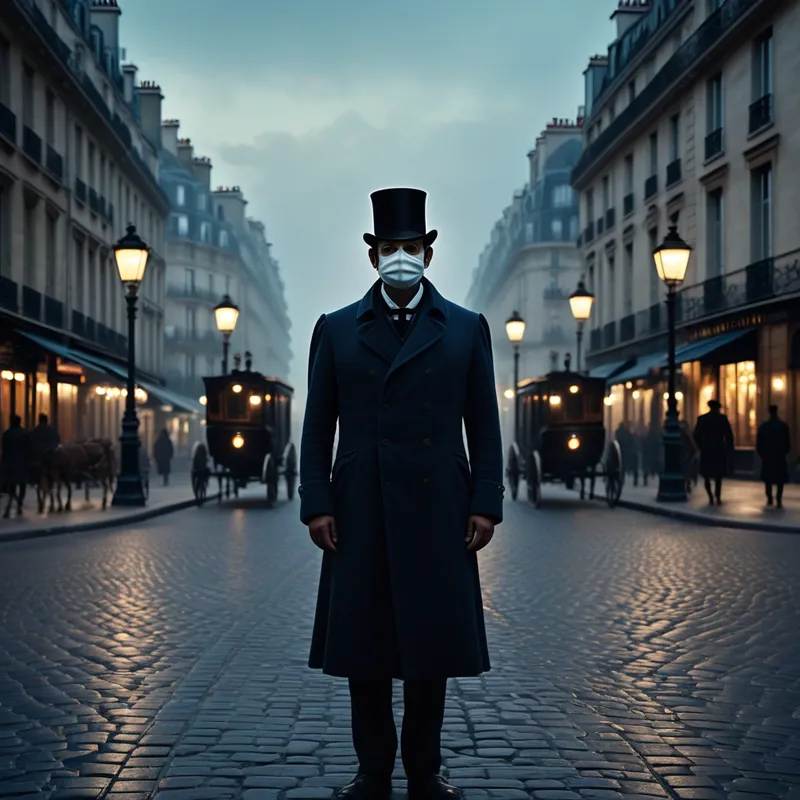
The Flâneur Myth Meaning & Symbolism
The myth of the solitary urban wanderer who finds profound meaning not in destination, but in the alchemy of pure, purposeless observation.
The Tale of The Flâneur
Listen. There is a god who walks not in forests or on mountaintops, but in the canyoned heart of the stone [labyrinth](/myths/labyrinth “Myth from Various culture.”/). He is born not of earth and sky, but of gaslight and paving stone, of rumor and reflection. They call him the Flâneur.
His kingdom is the arcade, a temple of glass and iron where [the sky](/myths/the-sky “Myth from Persian culture.”/) is a prisoner of progress. His chariot is his own two feet, shod in leather that whispers secrets against the cobbles. He carries no weapon but a cane, and his shield is a gaze that absorbs without possessing.
He does not battle dragons or court muses. His great labor is to drift. To be a perfect, polished mirror held up to the rushing torrent of the crowd. He moves against its current, or parallel to it, a silent eddy in the human stream. He hears the symphony of the city: the clatter of hooves, the cry of the newsboy, the rustle of silk, the sigh of steam from a café urn. He smells the perfume of a passing countess layered over the odor of wet horse and roasting chestnuts.
His conflict is invisible, a war fought in the arteries of attention. The demon he resists is Utility. To have a destination is to be enslaved. To need to purchase, to meet, to achieve—this is the vulgar mortality from which he is exempt. His rising action is a pause before a shop window, where commodities become a theater of the absurd. His climax is the fleeting, profound communion with a stranger’s face, a story glimpsed and released in an instant.
His resolution is never arrival, only the perpetual promise of the next corner, the next play of light on a puddle, the next fragment of overheard conversation. He dissolves into the twilight fog at [the river](/myths/the-river “Myth from Buddhist culture.”/)’s edge, not gone, but become part of the atmosphere itself—a watching spirit of the boulevard. He triumphs by surrendering to the endless, beautiful, meaningless flow. He wins by losing himself so completely that the city begins to dream through his eyes.

Cultural Origins & Context
This myth crystallized in the mid-19th century, primarily in Paris, the first true capital of modernity. It was not passed down by bards but by poets, journalists, and painters—Charles Baudelaire, the myth’s principal prophet, and later, the German philosopher Walter Benjamin. The Flâneur was a product of specific, concrete conditions: the architectural innovation of the arcade, which created a new, interiorized street; the rise of the daily press, which fed on urban vignettes; and the emergence of a consumer society that turned the city into a spectacle.
The myth’s societal function was dual. For the bourgeois gentleman, it offered a dignified, intellectualized model for leisure and people-watching, a way to partake of the crowd while maintaining an aura of aristocratic detachment. For the artist and intellectual, it was a methodology. The Flâneur was a researcher of the ephemeral, a collector of impressions, turning the chaos of the modern metropolis into raw material for art and philosophy. He was a counter-figure to the specialized, hurried worker, embodying a form of radical idleness that was itself a critical act.
Symbolic Architecture
At its core, the myth of the Flâneur is a parable of [consciousness](/symbols/consciousness “Symbol: Consciousness represents the state of awareness and perception, encompassing thoughts, feelings, and experiences.”/) in the age of the [mass](/symbols/mass “Symbol: Mass often symbolizes a gathering or collective experience, representing shared beliefs, burdens, or the weight of emotions within a community.”/).
The true object of the Flâneur’s gaze is not the city, but his own mind reflecting the city.
He represents the observing Ego that strives to maintain its integrity amidst sensory and social overload. His leisurely [pace](/symbols/pace “Symbol: The rhythm or speed of movement, thought, or life, reflecting internal tempo, urgency, or harmony with one’s environment.”/) is a rebellion against [the tyranny](/symbols/the-tyranny “Symbol: A symbol of oppressive control, unjust authority, and systemic domination that suppresses individual freedom and collective well-being.”/) of [clock](/symbols/clock “Symbol: Clocks symbolize the passage of time, reminding us of life’s temporality, deadlines, and the urgency to act.”/) time, a reclaiming of subjective, psychological time. The crowd is the modern [ocean](/symbols/ocean “Symbol: The ocean symbolizes the vastness of the unconscious mind, representing deeper emotions, intuition, and the mysteries of life.”/)—a sublime, threatening, and fascinating force. The Flâneur is both a part of this sea and a solitary [island](/symbols/island “Symbol: An island represents isolation, self-reflection, and the need for separation from the external world.”/) within it, performing the delicate [alchemy](/symbols/alchemy “Symbol: A transformative process of purification and creation, often symbolizing personal or spiritual evolution through difficult stages.”/) of being in society but not of it.
His cane is a profound [symbol](/symbols/symbol “Symbol: A symbol can represent an idea, concept, or belief, serving as a powerful tool for communication and understanding.”/): a tool of support, a [weapon](/symbols/weapon “Symbol: A weapon in dreams often symbolizes power, aggression, and the need for protection or defense.”/) of non-violence, a [pointer](/symbols/pointer “Symbol: A symbol of direction, guidance, or authority, often representing external influence, instruction, or the act of singling something out.”/) of [attention](/symbols/attention “Symbol: Attention in dreams signifies focus, awareness, and the priorities in one’s life, often indicating where the dreamer’s energy is invested.”/), and a dandy’s [ornament](/symbols/ornament “Symbol: An ornament often symbolizes celebration, beauty, and the adornment of life during special occasions.”/). It marks his [detachment](/symbols/detachment “Symbol: A psychological or emotional separation from oneself, others, or reality, often indicating a need for self-protection, perspective, or spiritual growth.”/) (he leans on it, apart) and his [connection](/symbols/connection “Symbol: Connection symbolizes relationships, communication, and bonds among individuals.”/) (it taps the shared ground). The act of [window](/symbols/window “Symbol: Windows in dreams symbolize opportunities for insight, clarity, and a desire to connect with the outside world or one’s inner self.”/)-shopping, or lèche-vitrine, symbolizes a [relationship](/symbols/relationship “Symbol: A representation of connections we have with others in our lives, often reflecting our emotional state.”/) to desire that is contemplative, not consumptive. He savors the promise, the [image](/symbols/image “Symbol: An image represents perception, memories, and the visual narratives we create in our minds.”/), the potential, but refuses the finality of possession.

The Dreamer’s Resonance
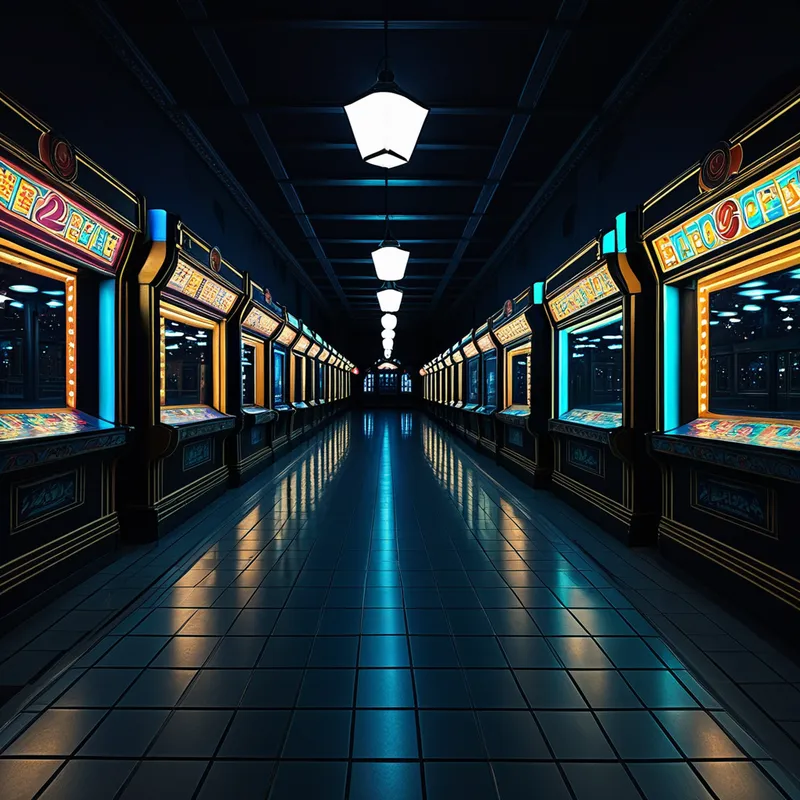
When this myth stirs in the modern dreamer, it often manifests as dreams of wandering through vast, unfamiliar yet compelling urban landscapes—airports, malls, infinite hotel corridors, or sprawling, empty downtowns at night. The somatic feeling is one of simultaneous anxiety and profound curiosity. There is a pressure to find something or get somewhere, coupled with a liberating realization that there is, in fact, no destination.
Psychologically, this dream pattern signals a process of dis-identification. The dream-ego is practicing how to step back from the pressing, goal-oriented complexes of daily life (the inner Utility-demon). It is learning to observe the internal “crowd” of thoughts, impulses, and anxieties without being swept away by them. The dream may evoke a sense of loneliness, but also of immense, unburdened freedom. It is the [psyche](/myths/psyche “Myth from Greek culture.”/)’s workshop for developing a witness consciousness, creating a psychic arcade—a protected, illuminated space within which the contents of the unconscious can be viewed safely, as displays.
Alchemical Translation
The individuation journey modeled by the Flâneur is not one of heroic conquest, but of alchemical dissolution and reconstitution through observation. The [prima materia](/myths/prima-materia “Myth from Alchemical culture.”/) is the leaden, chaotic experience of modern life—the noise, the rush, the fragmented self.
The first operation is [Solutio](/myths/solutio “Myth from Alchemical culture.”/): the Flâneur dissolves his fixed identity into the solvent of the crowd. He becomes anonymous, a nobody. This is a voluntary ego-death, a surrender of personal agenda.
The second is Circumambulatio: the sacred wandering. He walks [the labyrinth](/myths/the-labyrinth “Myth from Greek culture.”/) of the city, which mirrors the labyrinth of the psyche. Each street is a neural pathway, each face a projected aspect of [the Self](/myths/the-self “Myth from Jungian culture.”/). He does not analyze, he beholds.
The goal is not to find the center, but to realize that the act of conscious wandering is the center.
The final, elusive stage is Coagulatio: the re-solidification. From the myriad impressions, a new consciousness precipitates. It is not a “self” with rigid boundaries, but a crystalline, reflective capacity—a Self that knows itself primarily as a vessel for experiencing [the world](/myths/the-world “Myth from Tarot culture.”/). The transformed individual is no longer a consumer of experience, but its connoisseur. He has internalized the cane as an inner axis of calm, and the entire world, in all its terrifying beauty, has become his arcade. He achieves mastery not by doing, but by seeing. In the end, the myth reveals that the most profound journey in the hyper-connected world is the one that goes nowhere, and thus, everywhere.
Associated Symbols
Explore related symbols from the CaleaDream lexicon: