The Five Elements' Transformation Myth Meaning & Symbolism
An ancient myth of cosmic balance, where five primordial forces clash and cycle, weaving the fabric of the world from chaos into a living, breathing order.
The Tale of The Five Elements’ Transformation
In the time before time, when the heavens had not yet fully parted from the earth, there existed only a vast, sighing expanse known as Hun Dun. It was a formless, swirling mass, a cosmic egg of potential where all things were one and nothing was distinct. No seasons turned, no rivers ran, no mountains rose. There was only the great, silent hum of everything and nothing at once.
But within that humming unity, five primordial whispers began to stir. They were not yet forces, but yearnings. A yearning to grow, to rise, to push upward—this was the whisper of Mu. A yearning to blaze, to illuminate, to transform—this was the spark of Huo. A yearning to nurture, to stabilize, to give and receive—this was the murmur of Tu. A yearning to structure, to define, to cut and refine—this was the chime of Jin. And a yearning to flow, to descend, to dissolve and carry—this was the sigh of Shui.
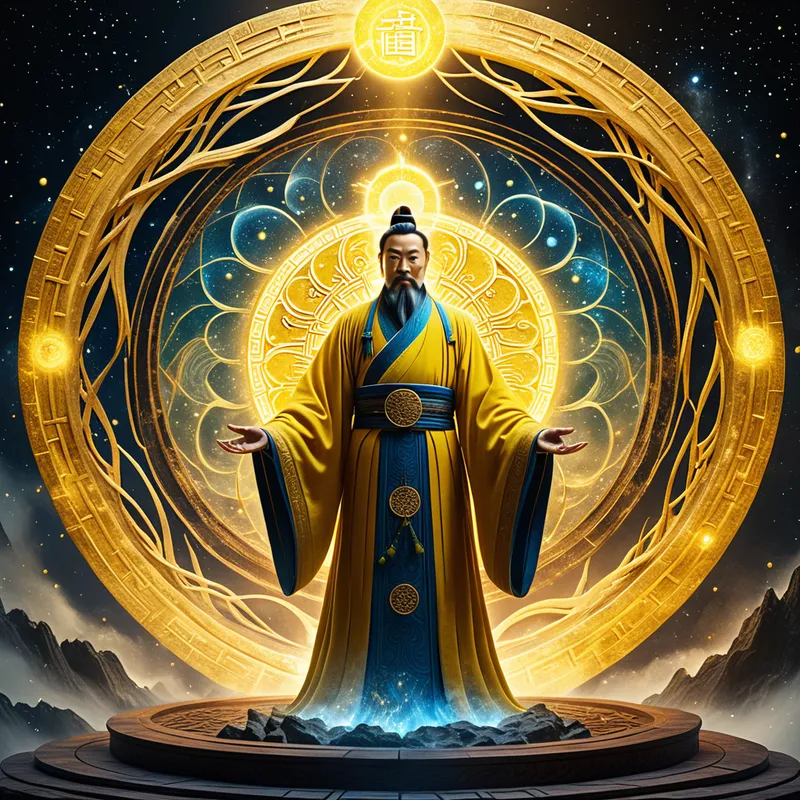
These whispers grew from longing into tension, and from tension into a great, silent struggle within the belly of Hun Dun. The egg of chaos began to tremble. It was the Huang Di, the luminous sovereign who had emerged from the first ordering of the stars, who perceived this inner turmoil. He did not see chaos as an enemy, but as a mother in the throes of a difficult birth.
With a breath that carried the pattern of the constellations, Huang Di spoke not a word of command, but a poem of relationship. He gave voice to the whispers. To the pushing yearning of Wood, he said, “You may rise, but only to feed the spark.” To the blazing spark of Fire, he whispered, “You may transform, but your ash must return to the soil.” To the murmuring soil of Earth, he intoned, “You may nurture, but from your depths, metal must be born.” To the chiming metal of Jin, he declared, “You may condense, but you must weep the water that flows.” And to the sighing water of Shui, he promised, “You may descend, but you must nourish the root of the rising wood.”
Thus, he did not impose order from without, but midwifed a pattern from within. The great struggle ceased to be a war and became a dance—a sacred, inevitable cycle. The formless sack of Hun Dun dissolved not into void, but into a magnificent, breathing tapestry. Forests clawed at the sky and fed the hearth-fires. Mountains rose from the plains and cradled veins of ore. Rivers carved the metal-rich stone and flowed to the sea, whose mists rose to rain upon the forests once more. The world was not made; it was sung into being through the Five Elements’ eternal transformation.
Cultural Origins & Context
This myth, less a single story than a foundational cosmological principle, is woven into the very fabric of Chinese thought. Its most systematic expression is found in the Yijing (I Ching) and later elaborated by philosophers during the Warring States period, particularly within the naturalist school of Yin-Yang and the Five Agents (Wu Xing). It was not merely a “myth” told by bards, but a living framework used by imperial astronomers to chart calendars, by doctors of TCM to diagnose illness, by strategists to plan battles, and by farmers to time their harvests.
Its societal function was profound: to provide a model of a dynamic, interconnected, and self-regulating universe. It taught that conflict (the “conquest” cycle) and nurture (the “generation” cycle) were two sides of the same cosmic process. Stability was not a static condition, but the dynamic balance of perpetual transformation. This myth-code was passed down through canonical texts, imperial rituals, and everyday proverbs, making it arguably the most pervasive narrative template in Chinese cultural history, explaining everything from dynastic change to the flow of seasons in one’s own garden.
Symbolic Architecture
At its heart, the myth is a symbolic map of process itself. It moves the psyche from the terrifying, fertile ambiguity of Hun Dun—the undifferentiated unconscious—toward the complex, ordered, and living reality of conscious existence. The Five Elements are not substances, but verbs. They are five fundamental modes of being and relating.
Wood is the archetype of the Pioneer, the thrust of new life, vision, and assertion. It is the sprout breaking the soil, the planning phase of any endeavor. Fire is the archetype of the Transformer, the radiant peak of expression, joy, and consumption. It is the celebration, the moment of brilliant realization. Earth is the archetype of the Nurturer, the grounding center that integrates, stabilizes, and provides context. It is the home, the stomach, the moment of reflection. Metal is the archetype of the Refiner, the force of analysis, judgment, and letting go. It is the harvest, the critique, the necessary ending. Water is the archetype of the Philosopher, the deep flow of wisdom, storage, and dissolution. It is the winter, the dream, the return to source before a new beginning.
Huang Di represents the emerging consciousness (the ego or self) that does not fight the chaos of the unconscious, but learns its language. He is the principle of mindful observation that discerns the inherent pattern within the tumult and, by naming the relationships, allows a cosmos to emerge from the psyche.
The Dreamer’s Resonance
When this myth stirs in modern dreams, it often manifests not as a literal story, but as a somatic or environmental pattern. One may dream of a house with five rooms, each in a state of disrepair or flourishing. One may dream of a tree that catches fire, whose ashes become rich soil, from which a metallic flower blooms, weeping water that feeds the tree’s roots. These are dreams of systemic rebalancing.
To dream of one element run rampant—a terrifying flood (Water out of balance), a consuming wildfire (Fire unchecked), a landscape choked with rigid, metallic structures (Metal dominating)—signals a psyche where one mode of being has overthrown the cycle. The dream is the unconscious initiating the corrective phase. The feeling is often one of profound unease, stagnation, or uncontrollable change. Conversely, to dream of the elements flowing seamlessly, perhaps as colored lights or harmonious landscapes, indicates a period of integrated psychic function, where creativity, emotion, intellect, intuition, and physical being are in a generative dialogue.
Alchemical Translation
For the modern individual, the myth models the alchemical opus of individuation—the process of becoming a whole, self-regulating psyche. Our personal Hun Dun is the raw, undifferentiated mass of our potentials, traumas, and instincts. The journey begins not by violently imposing a rigid order (a false self), but by doing the work of Huang Di: listening to the inner whispers.
The alchemy lies in recognizing that our Wood-like ambition must ultimately feed our Fire-like passion for life, not burn out in isolation. That our passionate successes (Fire) must be allowed to become integrated experience (Earth). That from this grounded center, we can make discerning judgments and let go of what no longer serves (Metal). And that in letting go, we descend into the watery depths of the unconscious (Water) to receive the hidden wisdom that will, in time, nourish the seeds of our next beginning (Wood).
The “transformation” is psychic integration. It is understanding that depression (an excess of Water) may be countered by activating Wood-like movement or Fire-like engagement. That obsessive over-analysis (Metal) can be softened by Earth-like self-care or Water-like acceptance. The cycle is both a diagnostic tool and a prescription. The triumph is not a final, static state of perfection, but the lifelong mastery of participating consciously in one’s own eternal, elemental dance. We become, like the cosmos birthed from the myth, not a fixed thing, but a graceful, resilient, and ever-transforming process.
Associated Symbols
Explore related symbols from the CaleaDream lexicon: