The First Three Creations Myth Meaning & Symbolism
A myth of cosmic trial and error, where gods attempt to create beings of praise, only to find the perfect substance after three cycles of creation and cataclysm.
The Tale of The First Three Creations
In the time before time, there was only the black, endless water. In its deep, silent heart, slept the great monster Cipactli, all mouths and hunger. And above the water, in the supreme darkness, dwelt the dual creator gods: Ometeotl. From their stillness, a thought was born—a need for song, for praise, for a mirror to behold their own majesty. Thus began the labor of the suns.
Four sons sprang from the duality: the four Tezcatlipocas, each a aspect of fate and force. They descended to the dark waters. With a terrible struggle, they seized the writhing Cipactli and stretched her body across the void. From her flesh, they made the earth. But she demanded payment, and so the first law was written: all life must feed the earth that sustains it.
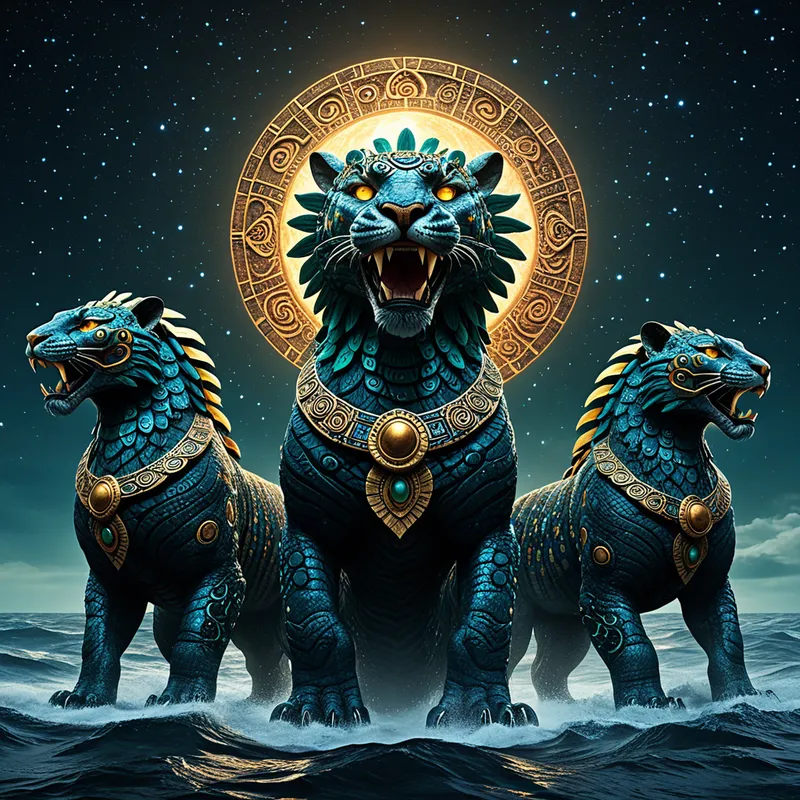
The first sun, Nahui Ocelotl, was born. Its lord was Tezcatlipoca, the Smoking Mirror. The gods fashioned the first people from ash. They were giants, silent and strong, who ate the wild acorns from the primal forests. For a time, the sun burned in the sky. But Tezcatlipoca, capricious and proud, grew weak. He was struck from the sky by his rival, Quetzalcoatl. The sun died. In the ensuing eternal night, the jaguars of the underworld emerged. They prowled the dark world, their eyes like green fire, and devoured the giant people until not one remained. The first creation was unmade.
From the silence of that first ruin, the second sun, Nahui Ehecatl, dawned. Its lord was Quetzalcoatl, the Feathered Serpent. With the world remade, the gods tried again. This time, they shaped people from wood. They populated the earth, but these beings were hollow, without hearts, without memory. They did not sing. They did not weep. They moved like puppets, and forgot the names of the gods. The gods were displeased. Quetzalcoatl summoned a great wind, a hurricane that scraped the flesh from the wooden people, that tore them apart and scattered their splinters. Those who survived were chased into the forests, transformed into monkeys who chattered meaninglessly in the trees. The second creation was swept away.
Then came the third sun, Nahui Quiahuitl. Its lord was Tlaloc, He Who Makes Things Sprout. Hope was tried once more. The gods created a people of flesh and blood, and gave them the gift of maize. These people knew sustenance. But they also knew desire, and greed. They hoarded the maize, and their hearts grew cold to the gods. Tlaloc, in his watery realm, watched their ingratitude. His wife, the beautiful goddess Xochiquetzal, was stolen from him, and his sorrow turned to a furious, scouring grief. He withheld the rain. The earth cracked and burned. When the people cried out, he did not send water, but fire. A rain of molten rock and obsidian knives fell from the sky for years, consuming the world in a torrent of ash and glass. The people perished, or were transformed into turkeys, dogs, and butterflies. The third creation was burned and buried.
The world was silent again, a wasteland of ash and deep water. The gods gathered in the darkness at the sacred city of Teotihuacan. They looked upon the three ruins and knew a terrible truth: to create a sun that would not fall, a people who would not forget, required not just power, but the ultimate sacrifice. The most sacred substance would be needed. And so they prepared for a fourth attempt, knowing the price would be written not in ash, wood, or flesh, but in divine blood and penitential bone.
Cultural Origins & Context
This profound cosmological narrative is primarily preserved in post-Conquest texts like the Historia de los Mexicanos por sus pinturas and the Leyenda de los Soles, which recorded indigenous pictorial histories and oral traditions. It is a core Aztec (Mexica) myth, though it shares deep thematic roots with broader Mesoamerican worldviews. The myth was not merely a story of the past but a living blueprint for the present. It explained the precarious nature of existence—why the sun needed the nourishment of blood (sacrifice) to continue its journey, why earthquakes occurred (the movement of the earth monster), and why humanity’s relationship with the gods was one of profound, reciprocal debt.
Priests and elder storytellers would recount these cycles during significant festivals, embedding the lesson of cosmic fragility and the necessity of ritual order into the collective psyche. The myth functioned as a societal anchor, justifying the central religious practice of sacrifice as the sacred duty that prevented a return to the chaotic darkness of a fallen sun. It was a narrative of collective anxiety and responsibility, teaching that existence itself was a hard-won, and constantly renegotiated, agreement between the human and divine realms.
Symbolic Architecture
The myth is a masterclass in symbolic thought, mapping the psyche’s [journey](/symbols/journey “Symbol: A journey in dreams typically signifies adventure, growth, or a significant life transition.”/) through foundational states of being. Each failed creation represents a developmental stage of [consciousness](/symbols/consciousness “Symbol: Consciousness represents the state of awareness and perception, encompassing thoughts, feelings, and experiences.”/), moving from primal instinct to hollow form to emotional complexity, each lacking the essential integrating principle.
The first people, made of ash, symbolize the primordial, undifferentiated self—powerful (giants) but ultimately unconscious, devoured by the shadowy, instinctual forces (the jaguars) it cannot comprehend.
The Four Tezcatlipocas represent the fracturing of unitary consciousness into competing aspects: intellect, [intuition](/symbols/intuition “Symbol: The immediate, non-rational understanding of truth or insight, often described as a ‘gut feeling’ or inner knowing that bypasses conscious reasoning.”/), [emotion](/symbols/emotion “Symbol: Emotion symbolizes our inner feelings and responses to experiences, often guiding our actions and choices.”/), and [sensation](/symbols/sensation “Symbol: Sensation in dreams often represents the emotional and physical feelings experienced in waking life, highlighting one’s intuition or awareness.”/). Their rivalry drives the cycle of creation and destruction, mirroring the inner conflicts that dismantle immature states of the psyche. The wooden people of the second sun embody the [persona](/symbols/persona “Symbol: The social mask or outward identity one presents to the world, often concealing the true self.”/)—a hollow, socially acceptable form that lacks authentic [heart](/symbols/heart “Symbol: The heart symbolizes love, emotion, and the core of one’s existence, representing deep connections with others and self.”/) and [soul](/symbols/soul “Symbol: The soul represents the essence of a person, encompassing their spirit, identity, and connection to the universe.”/), easily shattered by the winds of [truth](/symbols/truth “Symbol: Truth represents authenticity, honesty, and the quest for knowledge beyond mere appearances.”/) (Quetzalcoatl’s [hurricane](/symbols/hurricane “Symbol: A hurricane symbolizes overwhelming chaos, transformation, and the inevitable forces of nature impacting one’s life.”/)).
The rain of fire in the third sun is the psyche’s own purgative rage and scorching grief, unleashed when emotional life (Tlaloc’s realm) is betrayed or neglected.
The overarching [symbol](/symbols/symbol “Symbol: A symbol can represent an idea, concept, or belief, serving as a powerful tool for communication and understanding.”/) is the Xiuhmolpilli, the binding of the years. The myth asserts that time and existence are not [linear](/symbols/linear “Symbol: Represents order, predictability, and a direct, step-by-step progression. It symbolizes a clear path from cause to effect.”/) but cyclical, moving through necessary phases of [dissolution](/symbols/dissolution “Symbol: The process of breaking down, dispersing, or losing form, often representing transformation, release, or the end of a state of being.”/) to allow for more conscious reintegration. The destruction is not an end, but a return to the primordial waters—the unconscious—where the [material](/symbols/material “Symbol: Material signifies the tangible aspects of life, often representing physical resources, desires, and the physical world’s influence on our existence.”/) for a new attempt is gathered.
The Dreamer’s Resonance
When this myth stirs in the modern dreamer, it often manifests as dreams of recurrent failure or apocalyptic change. To dream of a world dissolving into darkness, of being chased by primal beasts, or of a loved one turning to wood or stone, is to touch the “First Creations” within.
The somatic experience is one of profound groundlessness—the feeling of the “floor” of one’s identity being swept away by hurricane winds or melted by inner fire. Psychologically, this signals a deep, necessary deconstruction. The dream ego is identified with a “creation” that has outlived its usefulness: perhaps a rigid self-image (the giant), a hollow professional role (the wooden person), or a relationship built on need rather than heart (the people of Tlaloc). The cataclysm in the dream is the unconscious insisting on the collapse of this outdated structure. The grief, terror, and disorientation are the birth pangs of the psyche preparing to return to its own “black waters” to find the truer substance for the next attempt at a coherent self.
Alchemical Translation
The alchemical journey mirrored in the Three Creations is the opus of individuation—the slow, often painful transformation of base psychic material into a conscious, integrated Self. The myth provides a grand map for this internal process.
The first creation, ruled by Tezcatlipoca (the shadowy trickster), is the nigredo: the initial confrontation with the unconscious, where the ego is humbled and “devoured” by what it has ignored. The second creation, ruled by Quetzalcoatl (the spirit), is the albedo: an attempt at spiritual purification that can result in a sterile, “wooden” spirituality devoid of human warmth and passion. The third creation, ruled by Tlaloc (the feeling function), is the citrinitas: the integration of emotion and desire, which, if not guided by reverence and sacrifice, leads to a destructive inflation or scorching conflict.
The myth teaches that true creation—the fourth sun, the people of maize—requires the rubedo, the final alchemical stage of integration achieved through sacred sacrifice. Psychologically, this is the conscious offering up of the ego’s demands—its pride, its hollowness, its greed—to a higher ordering principle.
For the modern individual, the “sacrifice at Teotihuacan” is the voluntary surrender of an old identity. It is the hard-won decision to stop rebuilding the same flawed “world” from ash, wood, or conflicted flesh. Instead, one must descend into the dark waters of the soul (the unconscious), retrieve the precious, buried bones of one’s essential nature (the prima materia), and grind them on the stone of introspection. Then, and only then, can they be mixed with the life-giving water of feeling and the sacred corn of sustenance to fashion a self that is both grounded and capable of true praise—a self that can sustain its own inner sun.
Associated Symbols
Explore related symbols from the CaleaDream lexicon:
- Sun — The central goal of each creation, representing consciousness, life, and the ruling principle of an era of the soul, which must be nourished to avoid catastrophic collapse.
- Water — The primordial, chaotic source of all potential, the dark unconscious from which each world is formed and into which it dissolves for renewal.
- Sacrifice — The essential, non-negotiable law of existence in the myth; the divine and human offering required to maintain cosmic and psychic order, leading to the final, successful creation.
- Blood — The sacred substance of life and vitality, offered by the gods to create the lasting sun and humanity, representing the ultimate cost of conscious existence.
- Earth — The body of the monster Cipactli, symbolizing the foundational, often treacherous, and hungry ground of material reality and the physical self.
- Fire — The destructive, purifying agent of the third world’s end, representing scorching emotion, rage, and the necessary annihilation of flawed structures.
- Wind — The great hurricane that unmade the second world, symbolizing the spirit of truth that scours away hollow, inauthentic forms of being.
- Stone — The obsidian knives of the fiery rain and the grinding stone for maize, representing both destructive force and the tool for creating sustenance from sacrifice.
- Seed — The maize from which the true, lasting people are made, symbolizing the latent potential for conscious life that requires the fertilizer of sacrifice to sprout.
- Circle — The endless cycle of the five suns (including the current one), representing the nonlinear, recursive nature of time, destruction, and rebirth in the cosmos and the psyche.
- Death — Not an end, but a transitional phase in the cosmic cycle, a return to the source that makes each new, more conscious attempt at creation possible.
- Rebirth — The inevitable promise following each cataclysm; the core hope of the myth that from the ashes of failed selves, a more authentic being can emerge.