
The First Storyteller Myth Meaning & Symbolism
A primal myth of how the first human, through sacrifice and listening, stole the divine pattern of story from the gods to give meaning to a silent world.
The Tale of The First Storyteller
In the time before time, when the world was all raw material and divine noise, there was only the Chaos and the Pattern. The gods moved through the Pattern, singing the mountains into sharpness and the rivers into flow. Their language was not words, but pure meaning—a thunderous poetry of cause and effect. Humanity, newly formed from clay and starlight, wandered this finished world in a profound silence. They saw the eagle’s dive, the wolf’s hunt, the river’s relentless journey to the sea, but they saw them as isolated facts, beautiful but mute. They had no thread to connect the moments. Life was a series of dazzling, terrifying snapshots with no story to live inside.
Among them was one who was different. This one, whose name is lost because names came later, did not just see the world; they listened to the space between things. They heard not just the wolf’s howl, but the longing in it. Not just the river’s rush, but the memory of the mountain it carried. This listening became an ache, a hollow place where understanding should be.
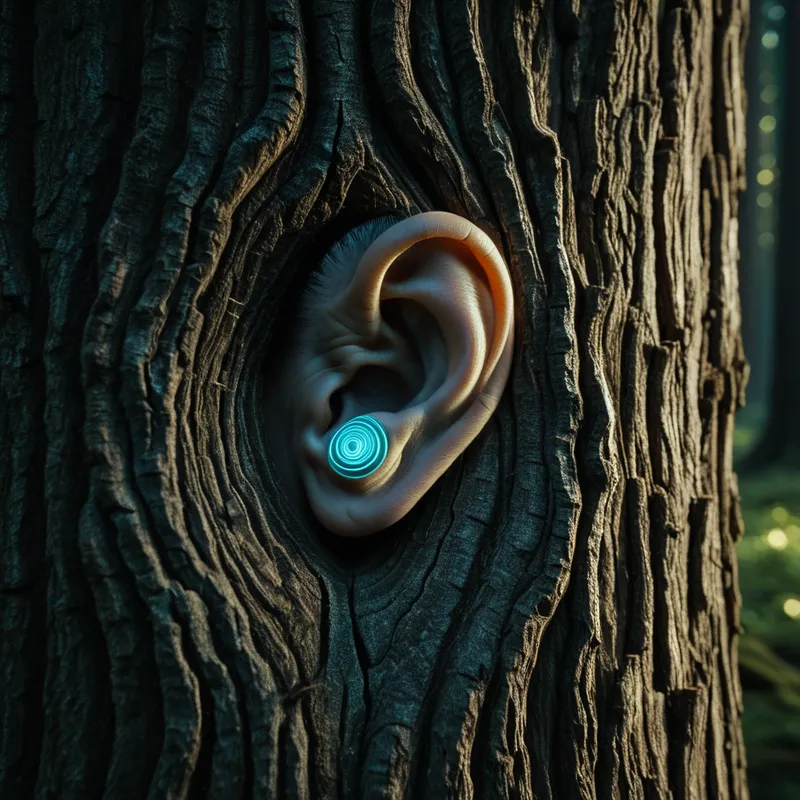
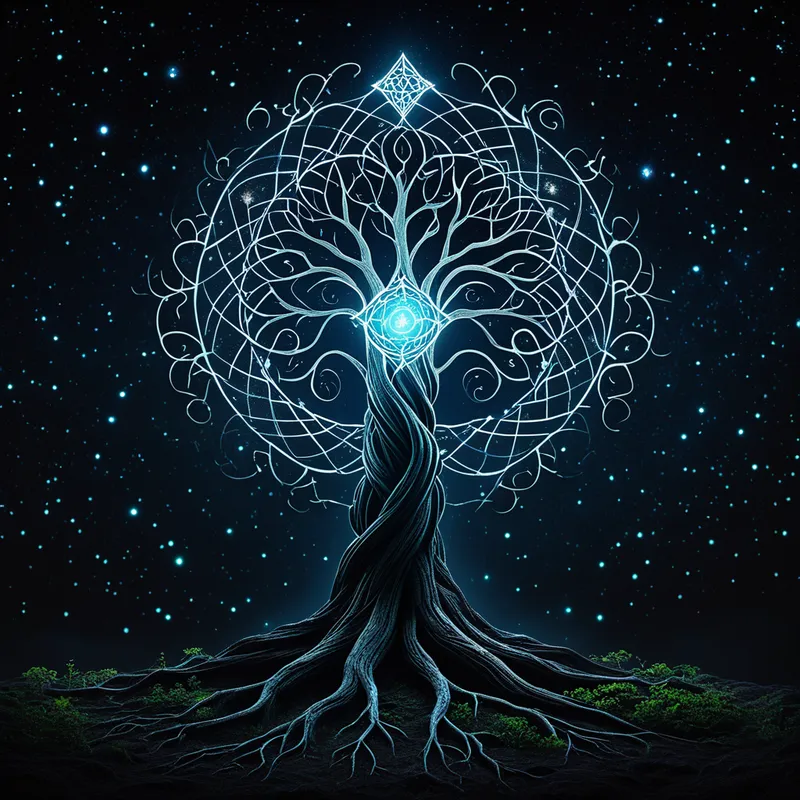
Driven by this ache, the listener journeyed to the axis of the world, to the foot of the great World Tree. Its roots drank from the dark waters of memory, and its highest branches scraped the vault of heaven where the gods kept the Pattern. The listener pressed their ear to the rough bark. And there, vibrating up from the roots and down from the stars, they heard it: the hum of the Pattern itself. It was the story of everything—the story of the seed becoming the forest, of the spark becoming the flame, of birth, struggle, decay, and return.
But to hear was not to understand. The divine language was too vast, too simultaneous. It was like trying to drink the ocean. The listener stayed at the tree, seasons turning their skin to leather, their hair to moss. They fasted. They listened until their own heartbeat seemed to sync with the Tree’s slow pulse. The gods, noticing this singular attention, were first amused, then intrigued, then wary. The Pattern was theirs alone.
One night, during a celestial conjunction, the chief of the gods descended. “You have hungered at our table long enough, little one,” the god’s voice boomed, a sound of shifting continents. “You have heard the music. What will you do with it? You cannot hold it. It will burn your mind to ash.”
The listener, weak but clear-eyed, spoke for the first time in years. “I do not wish to hold it. I wish to… translate it.”
The god laughed, and the laugh shook fruit from the branches. “Translate? Into what? Your grunts and gestures? The Pattern is. It does not need your small words.”
“It does not need them,” the listener agreed, their voice a dry whisper. “But my people do. We are drowning in your beautiful, silent world. Give us not the fire, but the shape of the smoke. Give us not the ocean, but the story of the wave.”
A great debate then stirred among the gods. Some saw arrogance. Others saw a fascinating new potential—a mirror for their creation. The chief god proposed a cruel bargain. “The Pattern is woven into the fabric of my being. To take even a thread of it for yourself, you must give up a thread of your own. You must exchange a piece of your literal, factual reality for a piece of this symbolic truth. You will gain the power to tell the story of the hunt, but you may forget the true face of the deer. You will gain the metaphor of the river as journey, but may lose your way home. Do you understand? This is not a gift. It is a theft, and you are the thing being stolen from.”
The listener did not hesitate. They offered their throat—the instrument of simple sound. In a flash of painful, glorious light, the exchange was made. The listener fell back, gasping. When they opened their eyes, the world was both less and infinitely more. The solid, singular tree before them was also the Tree of Life, was also a ladder of ascent, was also their own spine reaching for the sky. They had lost the one thing for the many things. They had traded a fact for a universe of meaning.
They returned to the people, who gathered around the strange, glowing-eyed figure. Opening their mouth, the First Storyteller did not report. They did not describe. They began, “Long ago, when the world was young and the sky was close enough to touch…” And as they spoke, the people did not just hear about the hunt; they felt the tension, the chase, the triumph. They did not just hear about the river; they understood loss, persistence, and destiny. The silent, frightening world suddenly had a plot. They had a place in it. They had a past to remember and a future to imagine. The First Storyteller had given them the most vital tool of all: a world that made sense.
Cultural Origins & Context
The myth of the First Storyteller is a pan-global archetype, a foundational layer in the human psyche that has surfaced in countless cultures under different names and guises. It is not the property of one tribe but appears as a core function in the mythology of many, from the trickster figures like Eshu or Iktomi who bring language and stories, to the more solemn figures like the Vedic Vāc or the muse-invoking bards of Celtic and Greek tradition.
This myth was never a single, fixed text. It was the implicit story told by the act of storytelling itself. It was performed by shamans at seasonal rites, by griots around the fire to cement lineage and law, by elders teaching the young the “why” behind the “what.” Its societal function was paramount: it was the psychic technology that transformed biological groups into cultural communities. It encoded ethics (through cautionary tales), explained the cosmos (through origin myths), and provided a narrative container for trauma and joy, allowing individuals to process experience collectively. The storyteller was thus not merely an entertainer but a psychic surgeon and a civilizational architect, weaving the shared dream that held society together.
Symbolic Architecture
At its heart, this myth is about the birth of human consciousness—specifically, narrative consciousness. The silent world represents the pre-conscious state, a realm of pure, uninterpreted sensation. The divine Pattern is the objective, archetypal realm of meaning that exists beyond human perception, what Jung might term the collective unconscious.
The First Storyteller is the archetype of the ego that dares to bridge the chasm between the overwhelming totality of the unconscious and the fragile need for order in the conscious mind.
The act of listening at the World Tree symbolizes the inward turn, the deep introspection necessary to perceive the deeper patterns beneath surface reality. The cruel bargain is the central, painful truth of symbolic life: to gain meaning, we must sacrifice literalness. To understand the metaphor, we must let go of the absolute, concrete fact. This is the price of consciousness itself. We exchange a portion of pure, animal certainty for the fraught, beautiful power of interpretation. The stolen “thread” is the symbolic perspective—the ability to see “as if,” which is the very root of language, art, and psychology.
The Dreamer’s Resonance
When this myth activates in the modern psyche, it often manifests in dreams of profound listening or urgent communication. You may dream of straining to hear a vital message in howling wind or static. You may dream of having a crucial story to tell but finding your mouth sewn shut or your voice stolen. You may dream of a tree whose leaves are pages of text, or a river speaking in a language you almost understand.
These dreams signal a critical phase in psychological development: the somatic process of translating raw, undigested experience—a trauma, a passion, a period of confusion—into a coherent personal narrative. The ache of the First Storyteller is the dreamer’s own ache to make sense of their life. The “divine noise” is the chaotic swirl of emotions, memories, and impulses from the unconscious. The dream ego is being called to perform the sacred, terrifying act of listening to its own inner pattern and formulating a story from it. This is not about fabricating a fiction, but about discovering the mythos—the meaningful plot—inherent in one’s own existence.

Alchemical Translation
The journey of the First Storyteller is a perfect map for the alchemical process of individuation. It begins with the nigredo, the blackening: the painful awareness of life’s silent, chaotic, or meaningless face (the listener’s ache). The journey to the World Tree is the meditatio, the deep, introspective work of engaging the unconscious (the collective Pattern).
The cruel bargain represents the pivotal mortificatio and separatio—the death of the old, literalistic identity and the separation of the precious symbolic faculty from the inert mass of mere fact. This is the ego’s sacrifice: it must relinquish its claim to total, objective control and allow itself to be reshaped by the deeper truths of the psyche.
The theft from the gods is, in psychological terms, the heroic act of stealing fire from the autonomous complexes of the unconscious to illuminate the conscious mind.
Finally, the return to the people with a story is the albedo and rubedo—the whitening and reddening. It is the distillation of personal insight (the whitening) and its integration into one’s life in the world, giving it color, warmth, and vitality (the reddening). The modern individual undergoing this transmutation moves from being a passive sufferer of events to being the active author—the Storyteller—of their own life. They learn to speak not just of what happened, but of what it means. In doing so, they perform the same miracle as the first: they turn the leaden weight of fate into the gold of destiny, and in the telling, they become whole.
Associated Symbols
Explore related symbols from the CaleaDream lexicon: