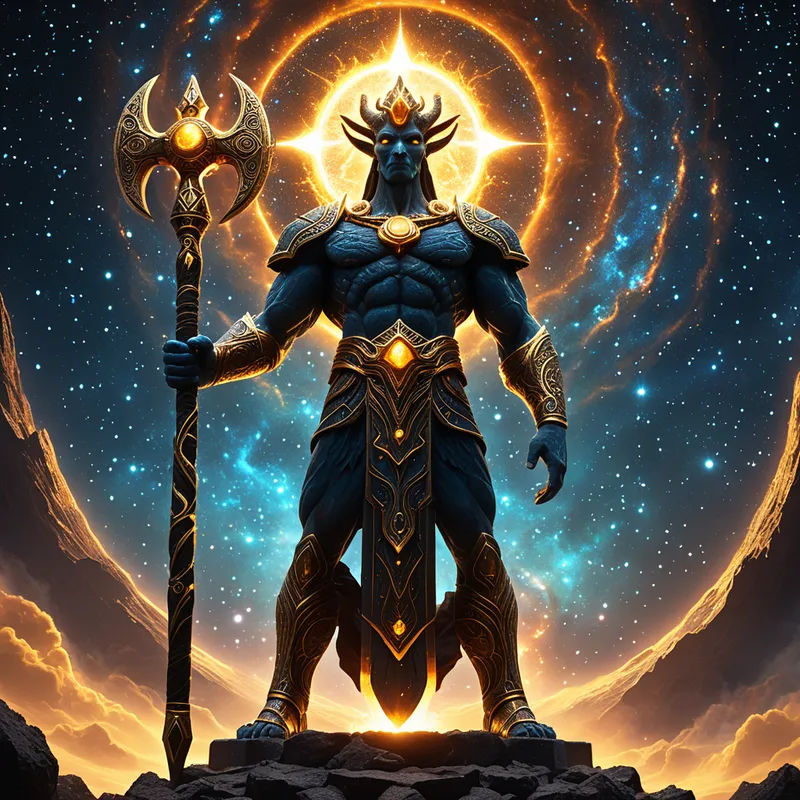
The First Smith Myth Meaning & Symbolism
The primal myth of the deity who, through sacrifice and mastery of fire, forges the ordered world from the raw, chaotic substance of the void.
The Tale of The First Smith
In the time before time, there was only the Chaos-Soup, a seething, formless murk of potential. No light, no dark, no up, no down. Only a silent, pregnant churning. From within this womb of everything-and-nothing, a consciousness stirred. Not born, but awakened. This was the First Smith.
He opened eyes that were not eyes and saw the void. He felt a longing, not for companionship, but for distinction. For a thing to be separate from another thing. For a line to be drawn. He reached into the Chaos-Soup with hands that were not hands and gathered a handful of the stuff. It was cold and hot, heavy and light, all at once. It resisted. It wanted only to return to the featureless whole.
But the Smith had within him a secret: the First Fire. It was not a flame as we know it, but the very principle of change, of passion, of will. He breathed this fire into the gathered chaos. The substance screamed in transformation, glowing first a dull red, then a brilliant, painful white. It became malleable, alive with possibility.
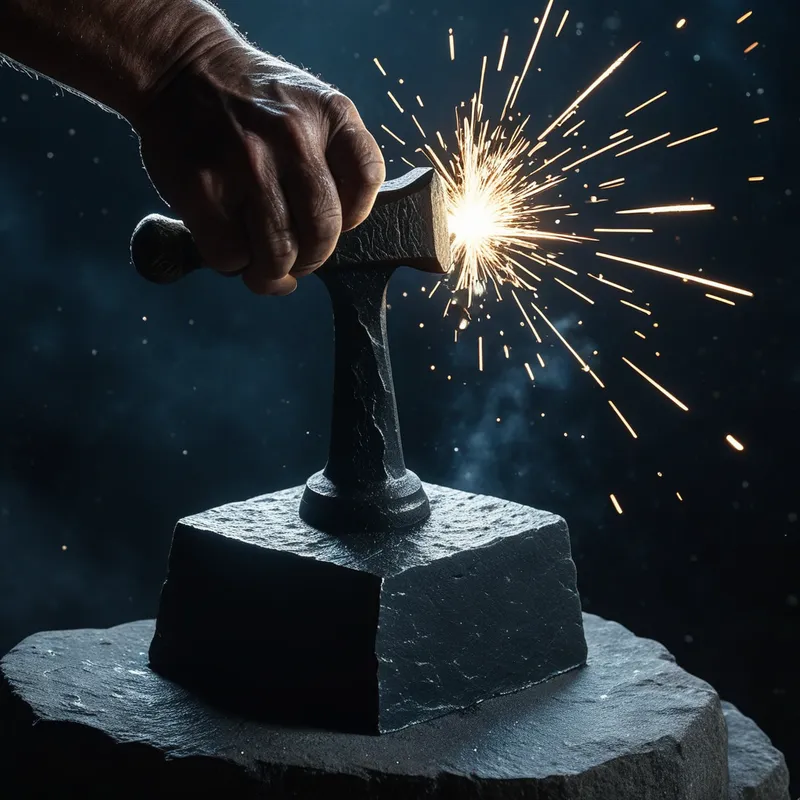
He needed a surface upon which to work. From the void itself, he called forth the First Anvil, a block of absolute stillness amidst the churn. Upon it, he placed the glowing mass. Then, from his own essence, he forged his tool: the Hammer of Division. Its head was made of necessity, its haft of intent.
The first blow rang out—a sound that was also the first light. A shower of sparks flew into the void and became stars. Clang! The second blow defined hardness from softness, earth from sky. Clang! The third separated the waters above from the waters below. With each strike, the Smith imposed order, but also paid a price. With each definition, a piece of the primal unity was lost forever. With each spark thrown free, a bit of his own inner fire was spent. He was not just creating the world; he was sacrificing his own undivided wholeness to do so.
He worked until the raw ingot of chaos was exhausted, transformed into the myriad things: mountains and rivers, metals and winds. Finally, weary, his fire dimmed, he looked upon his work—a cosmos of separate, beautiful things, humming with their own unique notes. He laid down his hammer, its surface now scarred and cool. The act was complete. The world was forged, and the Forger was forever changed by the work.
Cultural Origins & Context
The myth of the First Smith is not the property of a single culture, but a profound archetypal pattern that echoes across continents and epochs. We find its resonance in the Dogon’s Nommo, in the Ilmarinen of the Kalevala, in Vishvakarman, and in the Hephaestus who, though Olympian, carries the limping wound of the creator. This myth was likely told not in grand temples first, but beside the very real forge fires of early human settlements. It was a story of the shamans who worked metal, who understood the terrifying, magical process of turning rock into tool through fire and force.
Its societal function was multifaceted. It sanctified the craft of smithing, elevating it from mere labor to a sacred, cosmological act. It explained the origin of a world of diverse forms from a primordial unity. Most importantly, it modeled the fundamental human truth that creation is inseparable from sacrifice, and that order is born from a violent, willful act upon chaos. The storyteller was often the smith-priest, whose soot-stained hands were proof of their intimacy with this primal mystery.
Symbolic Architecture
The myth’s power lies in its stark, potent symbols. The Chaos-Soup represents the unconscious, the un-lived life, the mass of potentialities and unlived traumas within the psyche. It is everything we are before we choose to become someone.
The Anvil is the immutable Self, the core of consciousness that must remain steady and resilient beneath the blows of experience.
The First Fire is the libido, the psychic energy, the fierce heat of attention and desire that makes transformation possible. Without this fire, the chaos remains inert. The Hammer of Division is the focused force of consciousness itself—the act of making a decision, drawing a boundary, saying “this, not that.” It is the painful, necessary tool of differentiation.
The Smith’s gradual exhaustion symbolizes the cost of individuation. To become a distinct self, one must give up the blissful, undifferentiated state of psychic infancy. Each choice, each defined trait, is a spark thrown from our own primal fire to illuminate the world, leaving us paradoxically more defined yet less than the whole we once were.
The Dreamer’s Resonance
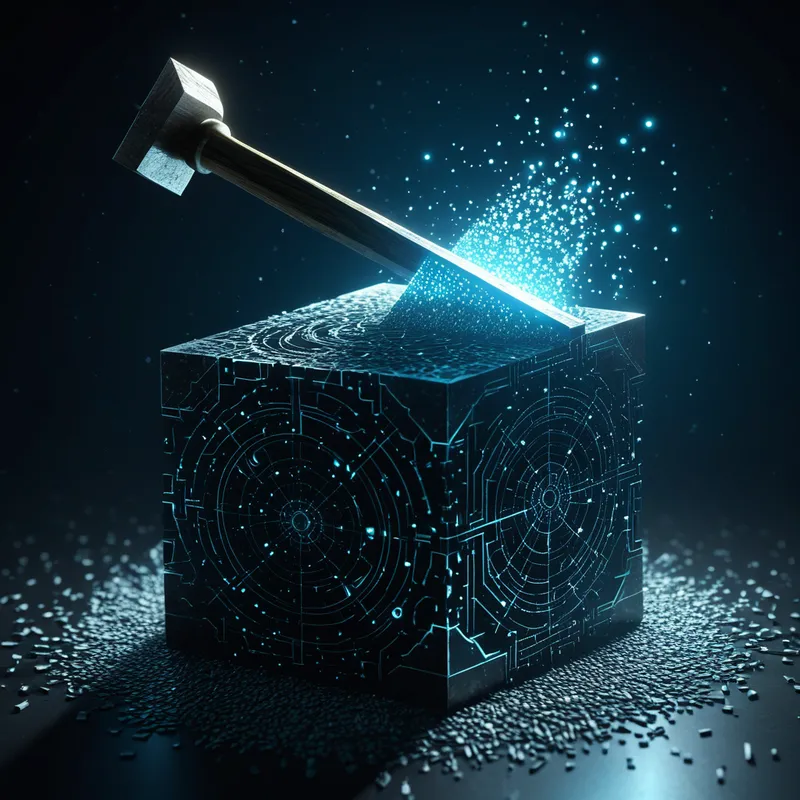
When this myth stirs in the modern unconscious, it often manifests in dreams of forging, building, or urgent, physical creation. You may dream of desperately hammering a strange metal in a basement workshop, or of tending a crucial, dying fire. You might dream of your own body as the anvil, feeling immense pressure. These are not dreams of literal craftsmanship, but somatic metaphors for a psychological process underway.
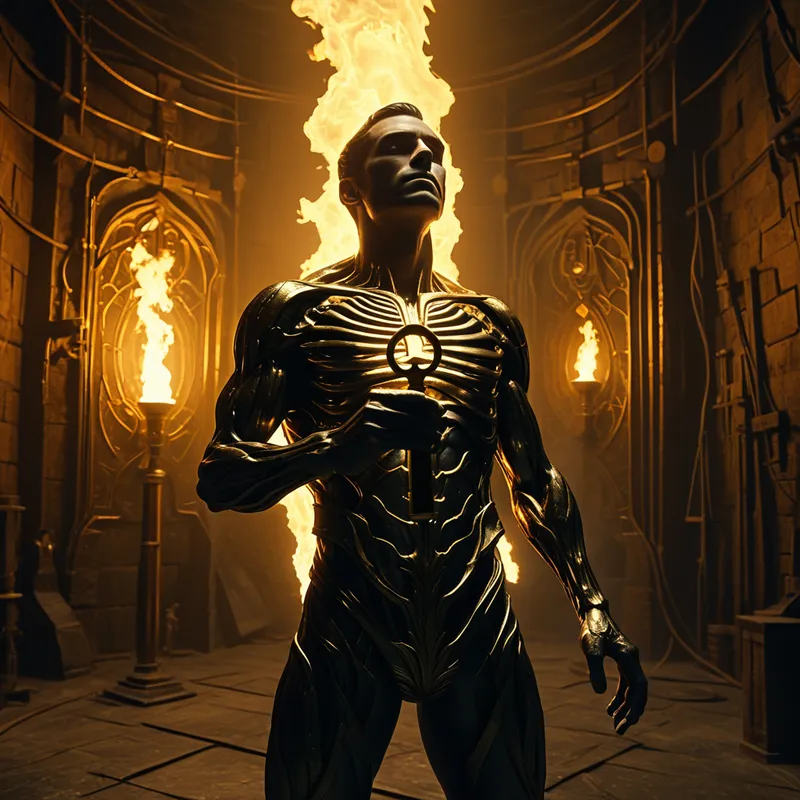
The body often responds with a sense of pressure in the chest or solar plexus—the forge of the emotions. There can be a feeling of being “under the hammer,” of life circumstances applying transformative force. This is the psyche’s signal that a core aspect of the self—a long-held identity, a buried complex, a raw talent—is in the crucible. It is being heated by the fires of circumstance or introspection, and is now malleable, ready to be struck into a new, more conscious form. The anxiety in such dreams is the chaos resisting; the triumph is the clear ring of the hammer-strike.
Alchemical Translation
The journey of the First Smith is the quintessential map for the alchemical process of Individuation. We all begin as a Chaos-Soup of inherited patterns, cultural expectations, and unconscious drives. The first step is to “gather a handful”—to bring a specific, troublesome, or promising content (a relationship pattern, a creative block, a childhood wound) into the light of consciousness. This is the nigredo, the blackening, where it feels raw and resistant.
The fire we breathe upon it is our sustained, courageous attention—the heat of analysis, of feeling the emotion fully, of refusing to look away.
This is the albedo, the whitening. Then comes the hammer work: the conscious acts of re-shaping. This might be setting a firm boundary (clang!), choosing a new path despite fear (clang!), or articulating a truth long held inside (clang!). Each blow is a sacrifice of an old, easier way of being. The sparks that fly become new insights, new capacities that light up the inner world.
The goal is not to return to chaos, nor to hammer the self into a rigid, static shape. It is to become the conscious Smith of your own being—to willingly engage with the transformative fire, to find your steady anvil in a centered Self, and to wield the hammer of your will with purpose. You are both the sacrificed chaos and the sacrificing creator, forging a soul distinct, resonant, and whole from the raw material of a life.
Associated Symbols
Explore related symbols from the CaleaDream lexicon: