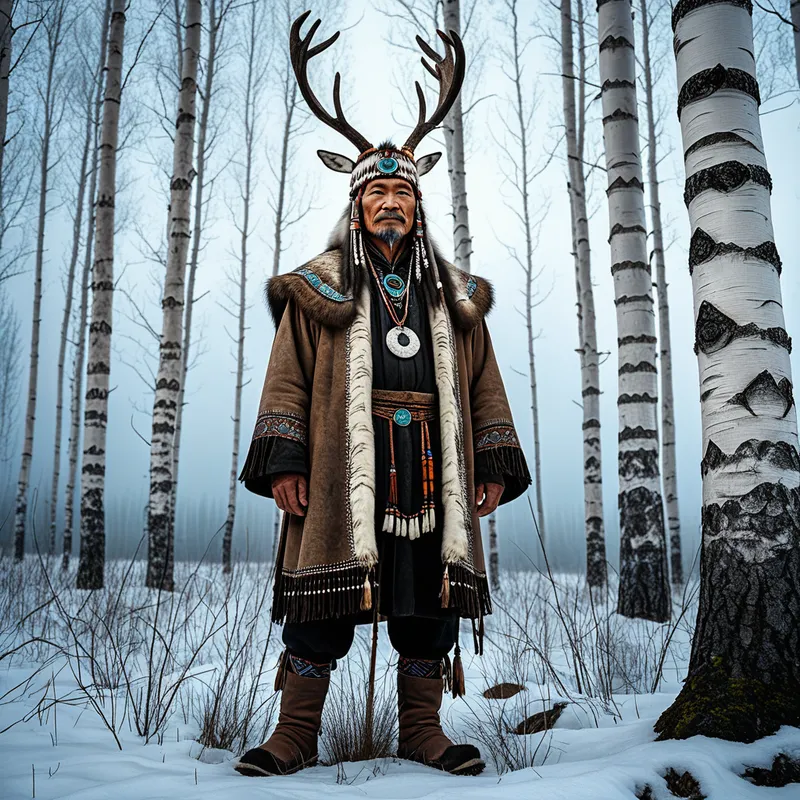
The First Shaman Siberian Myth Meaning & Symbolism
A myth of divine election, where a chosen one is torn apart and remade by spirits, becoming the bridge between the human world and the unseen realms.
The Tale of The First Shaman Siberian
Listen. In the time before time, when the world was raw and the spirits spoke directly to the wind, the people suffered. Sickness clung to the tents like a bitter frost. Souls wandered lost after death, with no one to guide them to the upper world. The great Tengri looked down from the endless blue and saw this disharmony. The world was out of balance.
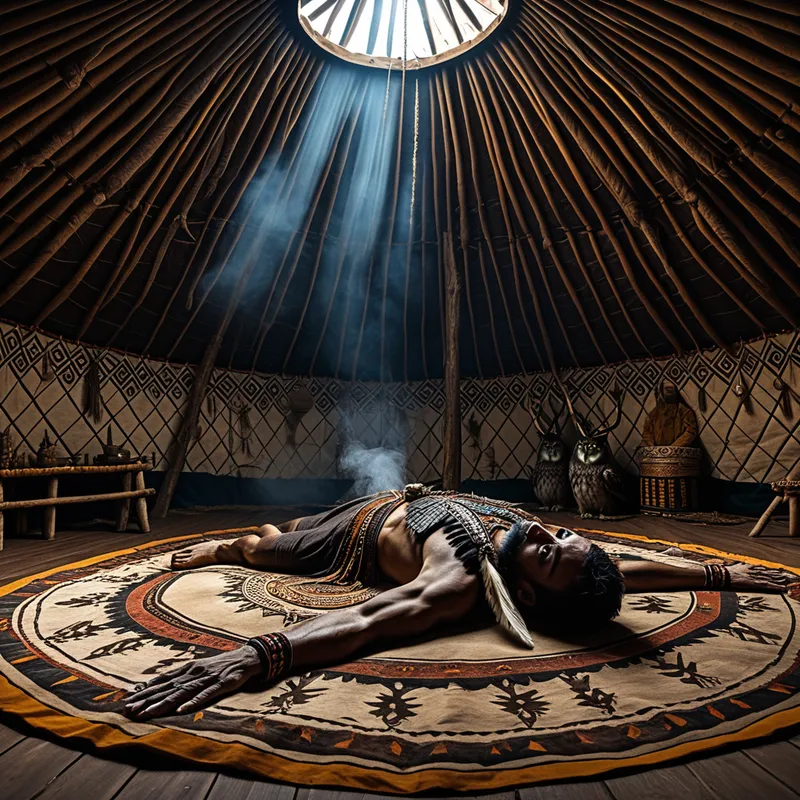
In a humble camp by a river that sang with salmon, there lived a young man. He was not the strongest hunter, nor the most cunning tracker. But in his dreams, he walked with the beasts and flew with the birds. He heard the whispers of the cosmic tree before he even knew its name. One day, a great sickness fell upon him. His body burned; his spirit trembled. His people laid him in the tent, certain he would join the ancestors.
But he did not die. As his body lay still, his soul was snatched away. The Great Eagle Spirit descended from the sun, its talons of lightning piercing his dream-self, carrying him high, high into the realm of blinding light. There, his human eyes were burned away and replaced with the all-seeing eyes of the spirit. “See,” commanded the Eagle, and he saw the threads of life connecting all things.
Then, a terrible plunge. The spirits of the lower world, led by the horned Lord of the Depths, seized him. They dragged him down into a cavern of roots and black water. Here, in the womb of the earth, the true making began. They laid him upon a stone slab of destiny.
With claws of flint and teeth of obsidian, they took him apart. Not in anger, but with the terrible precision of butchers preparing a sacred offering. They opened his body. They removed his bones, one by one. They scraped the flesh from them, and they threw the flesh to the spirits of disease, a ransom for the people’s health. They washed his bones in the icy water of the primordial river. Then, they forged them anew—not with human marrow, but with iron from the heart of the meteorite, with quartz from the mountain’s core. His skeleton became a framework of power, a literal ironwood.
His skull was drilled so the wind of the spirits could enter and exit. His eyes were set with stones that could see in the dark of the soul. His heart was replaced with a drum, its hide stretched from the skin of his own sacrifice, its beat now the pulse of the world itself. For three days and three nights, they worked. The Eagle brought feathers for his thoughts. The Bear gave claws for his strength. The Serpent gave its coiled wisdom for his spine.
Finally, they reassembled him. They sang his name back into his iron bones. He awoke in his tent, gasping, whole in body but utterly changed within. He sat up, and the people drew back in awe and fear. For in his eyes, they saw the fire of the upper world and the deep stillness of the lower world. He reached for a nearby deerskin and a piece of wood, and without being taught, he fashioned his first drum. When he struck it, the very air vibrated. The sick in the camp sighed as their fever broke. The First Shaman had returned. The bridge was built.
Cultural Origins & Context
This foundational narrative is not a single story from one tribe, but a core, recurring mythic pattern found across the vast tapestry of Siberian indigenous cultures—from the Evenki and Nenets in the west to the Chukchi and Buryat in the east. It is the archetypal “shamanic illness” and initiation myth, passed down through generations by the shamans themselves, often during apprenticeship or in the rhythmic cadence of ritual storytelling. Its function was multifaceted: it legitimized the shaman’s terrifying, often antisocial power by rooting it in divine election and terrible sacrifice. It served as a cosmological map, explaining the shaman’s ability to traverse the three worlds. Most importantly, it modeled a profound truth: that the one who heals is first utterly broken. The shaman was not a mere priest, but the living scar-tissue between the community and the volatile spirit world, his authority born from a personal catastrophe transformed into communal service.
Symbolic Architecture
The myth is a perfect symbolic blueprint for the creation of a mediator. The shaman is not born; he is unmade and remade. This process encodes deep psychological truths.
The path to wholeness requires a willing descent into fragmentation. The old self must be dismembered so that a more authentic, resilient structure can be forged in its place.
The World Tree is the axis of reality, and the shaman’s journey up and down its trunk represents the necessity of integrating the heights of spirit (Eagle) and the depths of the unconscious, instinct, and death (Lord of the Depths). The iron bones are crucial—they symbolize an indestructible core of identity, a will forged in the fires of extreme suffering. The flesh given to the spirits of disease represents the sacrifice of personal, egoic concerns for a transpersonal purpose. The shaman’s new body is not human, but an ecosystem of power relationships: he contains the animal spirits, becoming a living parliament of the wild.
The Dreamer’s Resonance
When this mythic pattern stirs in the modern dreamer, it often manifests not as a literal story, but as a profound somatic and psychological process. You may dream of your body being taken apart by shadowy figures or machines, not in terror, but with a strange, surgical necessity. You may dream of finding metal reinforcements in your skeleton, or of your heart being replaced with a clock or engine. You may have recurring dreams of falling into caverns or being carried by giant birds.
These dreams signal a deep, archetypal initiation underway in the psyche. The ego-structure is being challenged, deconstructed. The “sickness” is often a life crisis—a burnout, a depression, a loss—that, like the shaman’s illness, is the call to a larger life. The psyche is attempting to rebuild you from a more authentic blueprint, stripping away what is no longer essential (the “flesh” of old identities, compromises, and wounds) to reveal and strengthen your core integrity (the “iron bones”). It is a terrifying but ultimately healing process, where the very source of your wounding becomes the seat of your future authority.
Alchemical Translation
For the individual on the path of individuation, the First Shaman’s journey is the ultimate model of psychic alchemy. The prima materia—the raw, suffering ego—is dissolved (solve) through the crisis (the illness, the dismemberment). The essential components are separated, purified in the waters of the unconscious, and then recombined (coagula) into a new, more complex synthesis.
The shaman’s gift is not bestowed upon a whole person; it is what emerges from the sacred assembly of broken parts.
The modern “shamanic work” is interior. The drum becomes the disciplined rhythm of self-reflection, therapy, or creative practice that calls the scattered soul-parts back home. The animal spirits are the instinctual powers and archetypal energies we must befriend and integrate, rather than repress. To become the wounded healer of one’s own life is to acknowledge that our deepest flaws and fractures are the very places where light—and understanding for others—can enter. We are not called to literal spirit-flight, but to build the inner bridge between our conscious mind, our personal unconscious, and the collective archetypal realm. The goal is the same: to restore balance, first within oneself, and then, by reflection, in one’s corner of the world.
Associated Symbols
Explore related symbols from the CaleaDream lexicon:
- Shaman — The living bridge and wounded healer, whose authority is born from a personal catastrophe of dismemberment and rebirth, transformed into service for the community.
- Shamanic Journey — The core action of the myth, representing the necessary descent into the unconscious (lower world) and ascent to spiritual insight (upper world) to retrieve knowledge and healing.
- Bone — Symbolizes the indestructible, essential core of identity that remains after the ego is stripped away, forged into iron in the myth to represent unshakable resilience.
- Dismemberment — The central transformative ordeal, representing the deconstruction of the old, limited self so a more complex and capable psyche can be reassembled.
- Eagle — Represents the spirit of the upper world, celestial vision, and the initiatory force that grants the shaman the ability to see the larger patterns of life and destiny.
- Bear — Embodies the power of the lower world, primal strength, introspection, and the healing knowledge that comes from confronting the depths of the unconscious and mortality.
- Drum — The shaman’s primary tool and his reborn heart, symbolizing the rhythmic call that aligns individual consciousness with the pulse of the world and summons the spirit allies.
- Iron — The metal of the shaman’s remade bones, representing strength, endurance, and a will tempered and forged in the extreme fires of spiritual ordeal.
- Tree — The cosmic axis or world tree, the vertical pathway the shaman travels, symbolizing the connection between all realms of existence that the integrated psyche must navigate.
- Sacrifice — The voluntary offering of the old self (his flesh) to the spirits of illness, representing the necessity of surrendering egoic attachments to gain a transpersonal purpose.
- Bridge — The ultimate role and identity of the shaman, the living connection between the human community and the unseen spirit worlds, between illness and health, death and life.
- Dream — The initial gateway and constant medium for the shaman’s power, representing the state of consciousness where the boundaries between worlds are thin and transformation begins.