
The First Eclipse Myth Meaning & Symbolism
The myth of the sun goddess Malina fleeing her moon brother Anningan, whose pursuit creates the first eclipse, a story of separation and eternal chase.
The Tale of The First Eclipse
Listen. In the time before time, when the world was new and the sky was close enough to touch, there were two great lights. Not as they are now, distant and cold, but as beings of flesh and spirit, living in the same lodge. Malina, the Sun, was a woman of such brilliance that her very presence warmed the ice and brought the first green things to life. Her brother was Anningan, the Moon, a great hunter who roamed the dark.
They lived in harmony, their light shared in a gentle rhythm. But a shadow grew between them. Some say it was a quarrel over a shared lamp. Others whisper of a deeper transgression, a violation of the sacred bond between kin. The stories vary, but the wound was the same. In a moment of fury or shame, Malina took the grease from the lamp and smeared it across her brother’s face, marking him with soot. Or perhaps it was Anningan who, in a fit of desire, sought what was not his to claim.
The result was a rupture that cracked the world. Malina, in her radiant anger and grief, could bear his presence no longer. She seized a burning torch, and she fled. She ran from the lodge, out onto the endless tundra, and with a mighty leap, she flung herself into the sky. There she became the Sun, forever moving, a blazing path across the dome of heaven.
But Anningan, marked by darkness, was consumed. Not by anger, but by a desperate, hungry need. The mark upon his face became his nature—a pale, reflected light, chasing the warmth he had lost. He followed her into the sky, becoming the Moon. His hunt is eternal. He pursues his sister across the celestial plain, growing lean and hungry with his obsession, until he must descend to the earth to hunt for seal and caribou to regain his strength.
And sometimes—oh, sometimes—his hunger and his need grow so vast, and his path aligns so perfectly, that he catches her. He runs directly before her brilliant face. For a few, breathless moments, his dark body obscures her light. The world grows cold and still. The animals fall silent. This is the first eclipse, and every eclipse since: the moment the separated brother touches his fleeing sister, a temporary, terrifying reunion in the sky. But he can never hold her. She is too bright, too essential. She always escapes, and the chase begins anew, defining the very order of day and night, of light and dark.
Cultural Origins & Context
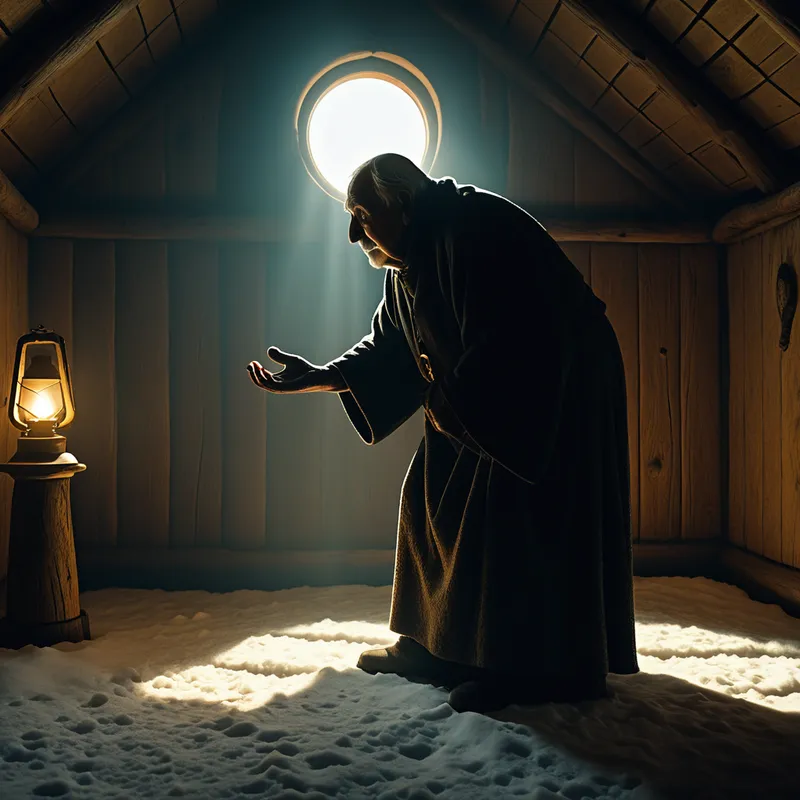
This myth originates from the Inuit peoples across the Arctic regions of Greenland, Canada, and Alaska. It is a foundational etiological myth, told not in grand halls but in the intimate warmth of the iglu or the communal gathering space. The storyteller was often a elder, a grandmother or grandfather, whose voice carried the weight of generations. The tale was not mere entertainment; it was a vital piece of cosmological instruction. It explained the most dramatic and unsettling celestial event known to them: the solar eclipse, when the predictable order of the world was suddenly, violently overturned.
In a world where survival depended on reading the subtle signs of weather and animal behavior, the eclipse was a profound disruption. The myth provided a framework for understanding it, embedding the event within a familial drama. It transformed a potentially terrifying astronomical phenomenon into a story with recognizable emotions—rage, shame, pursuit, and longing. This narrative served to re-integrate the chaotic event back into the known order of the world. It was a reminder that even the great lights in the sky were subject to the same passions and mistakes as humans, and that the cosmic order, though born of conflict, was ultimately stable and cyclical.
Symbolic Architecture
At its [heart](/symbols/heart “Symbol: The heart symbolizes love, emotion, and the core of one’s existence, representing deep connections with others and self.”/), this is not a [story](/symbols/story “Symbol: The symbol of ‘Story’ represents the narrative woven through our lives, embodying experiences, lessons, and emotions that shape our identities.”/) of heroes and villains, but of fractured wholeness. Malina and Anningan represent a primordial unity—[consciousness](/symbols/consciousness “Symbol: Consciousness represents the state of awareness and perception, encompassing thoughts, feelings, and experiences.”/) and instinct, feminine and masculine, sustaining light and seeking darkness—that has been catastrophically split. The grease or soot is the [shadow](/symbols/shadow “Symbol: The ‘shadow’ embodies the unconscious, repressed aspects of the self and often represents fears or hidden emotions.”/) made visible, the [mark](/symbols/mark “Symbol: A ‘mark’ often symbolizes identity, achievement, or a defining characteristic in dreams.”/) of a psychic injury that forces [separation](/symbols/separation “Symbol: A spiritual or mythic division between realms, states of being, or consciousness, often marking a transition or loss of connection.”/).
The first eclipse is the moment the shadow passes directly before the light of consciousness, not to destroy it, but to be seen by it in its totality.
The eternal [chase](/symbols/chase “Symbol: Dreaming of a chase often symbolizes avoidance of anxiety or confrontation, manifesting as fleeing from something threatening or overwhelming in one’s waking life.”/) is the psyche’s attempt at reconciliation. Anningan is not evil; he is hungry, incomplete, driven by a need for the warmth and wholeness his [sister](/symbols/sister “Symbol: The symbol of a sister in a dream often represents connection, support, and the complexities of familial relationships.”/) embodies. His cyclical descent to hunt mirrors the necessary return to the instinctual, earthly [realm](/symbols/realm “Symbol: The symbol of ‘Realm’ often signifies the boundaries of one’s consciousness, experiences, or emotional states, suggesting aspects of reality that are either explored or ignored.”/) to gather [strength](/symbols/strength “Symbol: ‘Strength’ symbolizes resilience, courage, and the ability to overcome challenges.”/) for the continued inner work. The [eclipse](/symbols/eclipse “Symbol: An eclipse symbolizes change, transitions, and sometimes unexpected challenges, marking a significant transformation process.”/) itself is the symbolic core: a temporary, awe-inspiring [conjunction](/symbols/conjunction “Symbol: In arts and music, a conjunction represents the harmonious or dissonant merging of separate elements to create a new, unified whole.”/) of the separated parts. It is a forced meeting, brief and often frightening, where the light must acknowledge the shadow that is perpetually in [pursuit](/symbols/pursuit “Symbol: A chase or being chased in dreams often reflects unresolved anxieties, unfulfilled desires, or internal conflicts demanding attention.”/).
The Dreamer’s Resonance
When this myth patterns a modern dream, it often manifests during a life phase of profound separation or alienation. The dreamer may be fleeing a persistent, shadowy figure, or they may be the pursuer, driven by an insatiable hunger for something just out of reach. The landscape is often vast, cold, and luminous—an internal tundra.
Somatically, this can feel like a chill in the chest, a racing heart with nowhere to run, or a profound fatigue from an endless chase. Psychologically, it signals a critical point in individuation: the ego (the sun) has become aware of a repressed complex or aspect of the self (the moon) that it has been fleeing, perhaps out of shame, guilt, or fear of being overtaken. The dream is the psyche staging the pursuit. The eclipse moment in the dream—the capture—is not a catastrophe, but an opportunity. It is the unconscious forcing a confrontation, saying, “You must stop and let this dark part of yourself be seen, if only for a moment, or the chase will consume all your energy forever.”

The Alchemical Translation
The alchemical process modeled here is separatio followed by the longed-for coniunctio oppositorum—the separation of opposites and their subsequent sacred marriage. The initial, violent separation (Malina’s flight) is a necessary, if painful, first step. Consciousness must differentiate itself from the undifferentiated mass of the unconscious to exist at all. But it cannot remain in isolated brilliance.
The goal is not for the sun to defeat the moon, nor for the moon to consume the sun. The goal is for the chase itself to become a dance, a recognized interdependence that defines a stable cosmos.
The modern individual’s journey involves first acknowledging the “grease-smearing” moment—the original wound or act that created our inner split. This is often a core shame or a foundational betrayal of self. Then, one must consciously engage in the “chase.” Instead of blindly fleeing our shadow (our Anningan), we turn and study its patterns. We note what makes us “hungry,” what we pursue compulsively. We allow its periodic “eclipses”—those moments of depression, rage, or obsession where the shadow temporarily blots out our conscious light—not as failures, but as sacred, if difficult, meetings.
The transmutation occurs when we stop trying to outrun the darkness and instead understand its orbit as part of our own totality. The reconciled self is not a fusion, but a stable system where light and dark, consciousness and the unconscious, acknowledge their eternal relationship. The eclipse becomes not a time of fear, but a time of awe-filled introspection, a reminder of the beautiful, tragic, and necessary dance that creates a whole life.
Associated Symbols
Explore related symbols from the CaleaDream lexicon:
- Sun — The radiant, conscious self that provides warmth, life, and order, but whose very brilliance necessitates a separation from its darker counterpart.
- Moon — The reflective, instinctual, and hungry aspect of the self that pursues wholeness, operating in cycles of need, pursuit, and replenishment.
- Shadow — The marked or darkened part of the self, born from a primal conflict, which perpetually chases consciousness in an attempt to be integrated.
- Eclipse — The profound, temporary conjunction of light and shadow, representing a forced but sacred meeting between the conscious ego and the repressed unconscious.
- Chase — The eternal dynamic of the psyche, where separated parts seek reconciliation, modeling the ongoing process of individuation.
- Separation — The foundational, traumatic act that creates distinct consciousness and sets the cosmic and psychological order into motion.
- Sky — The vast, cold theater of the psyche where this eternal drama between archetypal forces is played out.
- Hunger — The driving force of the unconscious aspect, a deep, insatiable need for the light and warmth of conscious recognition and connection.
- Darkness — Not an evil, but a necessary counterpart to light, whose occasional obscuring of brilliance allows for a different kind of seeing and feeling.
- Sister — The feminine principle of luminous, sustaining consciousness in a necessary but fraught relationship with its masculine counterpart.
- Brother — The masculine principle of active pursuit and instinctual need, whose desire disrupts unity but also propels the cosmic order.
- Light — The principle of awareness, clarity, and life, which must be periodically obscured for the shadow to be recognized as part of the whole.