The First Death African Myth Meaning & Symbolism
A foundational myth where a primordial being chooses mortality, transforming the nature of existence and gifting humanity its spiritual depth.
The Tale of The First Death African
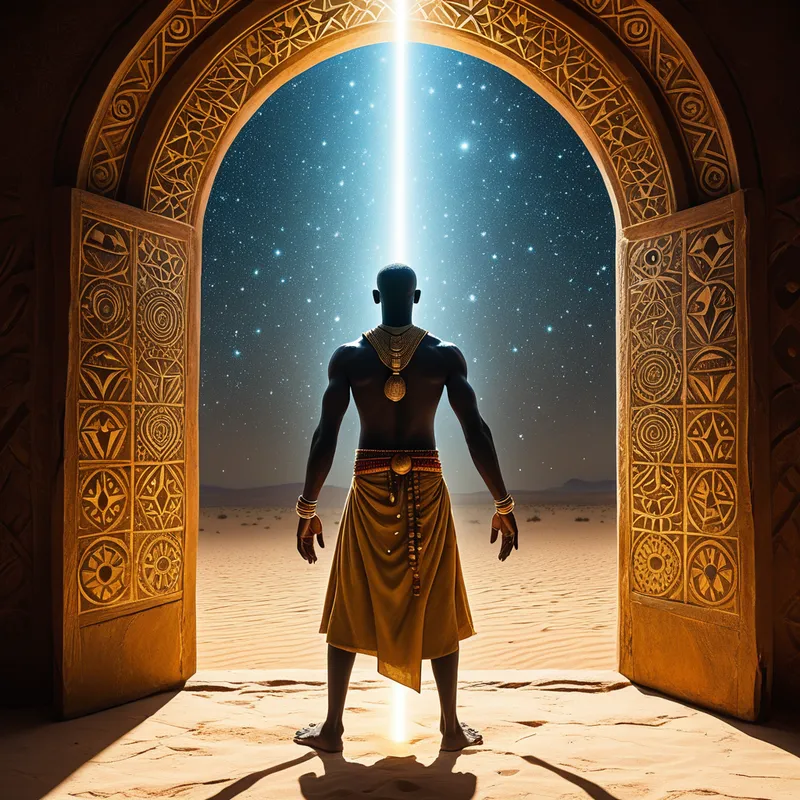
In the time before time, when the world was still soft from the dreaming of Nyame, there walked among the first beings one who was neither fully of the spirit realm nor yet of the clay. This was the First Death African. They were fashioned from the breath of the sky and the patience of the mountain, their skin holding the sheen of the first river under the sun, their eyes twin pools reflecting the whole, unbroken circle of existence.
The world then was a place of endless becoming, but without end. Creatures of light played in eternal fields; the great beasts of the earth knew no fear of the dark. All was in motion, yet nothing was lost. It was a song without a final note, a story without a last page. And in this perfect, unchanging cycle, the First Death African felt a strange and growing sorrow—a hollow echo in the place where a heart would one day beat.
They walked to the edge of the great Earth, where the roots of the Baobab drank from the waters of the deep, and they spoke to Nyame, whose voice was the wind. “I see the antelope run, but I do not feel its tiredness. I hear the river flow, but I do not know where it is going. Everything is, but nothing matters. There is no love, for there is nothing to lose.”
Nyame was silent for an age of the world. Then the wind spoke, heavy with the scent of coming rain. “To feel the weight of a moment, you must know it will pass. To cherish a connection, you must see its end. What you ask for is a shadow that will touch all things. It is the great price for the great depth.”
The First Death African did not hesitate. They looked upon the laughing, unburdened creatures, the unfading flowers, and they saw not perfection, but a beautiful, empty shell. “Then let the shadow be mine first,” they declared. “Let me carry the end, so that the beginning may have meaning.”
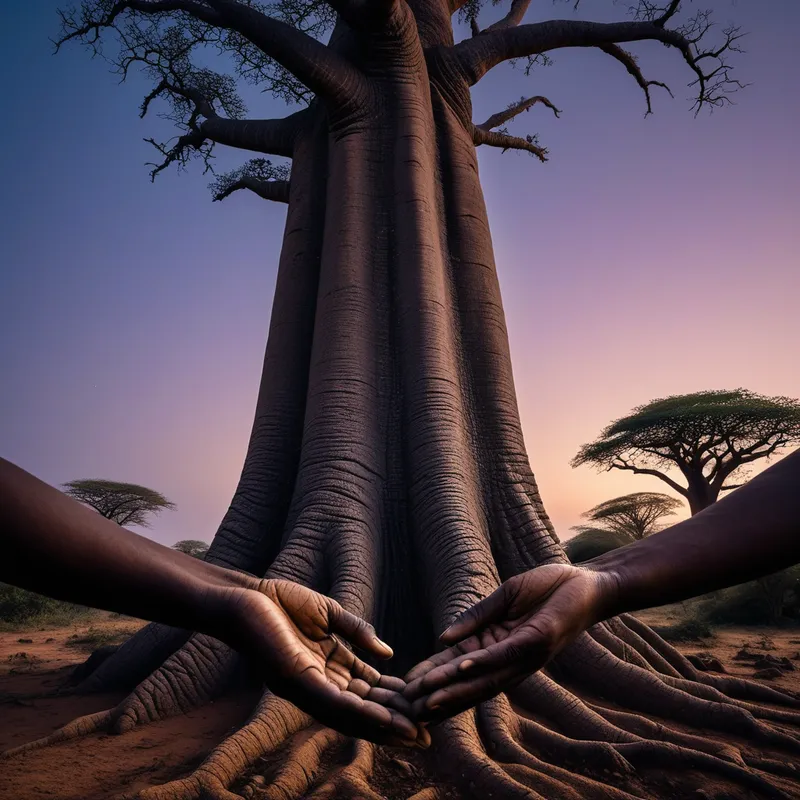
And so, at the foot of the primordial Baobab, as the first true sunset painted the sky in colors of farewell, the First Death African lay down upon the cool soil. They did not fight the gathering darkness. They felt their light, their unending essence, begin to seep into the earth. It was not a violent tearing, but a slow, deliberate pouring—like a vessel tipping its contents onto thirsty ground. As their form grew still, a sigh escaped them, not of pain, but of release. That sigh became the first cool wind of evening, the first whisper of memory.
Where their body rested, the first true mushrooms pushed through the soil. The first seeds, which had lain dormant in eternal spring, now felt the urgency to sprout. And in the hearts of all who witnessed, a new space opened—a space that could fill with love, with grief, with the fierce, burning joy of a temporary flame. The first chapter had closed, so the story could truly begin.
Cultural Origins & Context
This foundational narrative exists in myriad forms across the African continent, particularly within the cosmologies of West and Central African peoples, such as the Akan, Yoruba, and Dogon. It is not a story of a singular, historical event, but a metaphysical explanation for the very architecture of reality. It answers the perennial question: Why must we die?
The myth was traditionally held by griots, elders, and ritual specialists. It was not told lightly or as mere entertainment, but during rites of passage, funerals, and ceremonies honoring the ancestors. Its telling was a Ritual in itself, a way of reconnecting the community with the original covenant between the spiritual and mortal realms. Its societal function was profound: to frame mortality not as a curse or a random tragedy, but as a sacred, purposeful inheritance. It taught that our finite lives are the direct consequence of a primordial Sacrifice, which in turn grants our experiences their weight and our connections their preciousness.
Symbolic Architecture
The First [Death](/symbols/death “Symbol: Symbolizes transformation, endings, and new beginnings; often associated with fear of the unknown.”/) [African](/symbols/african “Symbol: The symbol ‘African’ encompasses a rich tapestry of cultures, traditions, and histories originating from the African continent.”/) is the ultimate [archetype](/symbols/archetype “Symbol: A universal, primordial pattern or prototype in the collective unconscious that shapes human experience, behavior, and creative expression.”/) of the conscious Sacrifice. They represent the part of the psyche that willingly accepts limitation, decay, and an endpoint to forge meaning, [depth](/symbols/depth “Symbol: Represents profound layers of consciousness, hidden truths, or the unknown aspects of existence, often symbolizing introspection and existential exploration.”/), and love. They are not a [victim](/symbols/victim “Symbol: A person harmed by external forces, representing vulnerability, injustice, or sacrifice in dreams. Often symbolizes powerlessness or moral conflict.”/) of [death](/symbols/death “Symbol: Symbolizes transformation, endings, and new beginnings; often associated with fear of the unknown.”/), but its author.
The choice to become finite is the first and greatest act of soul-making. It is the moment potential gains a heartbeat.
The eternal, unchanging world before the sacrifice symbolizes a state of psychic stagnation—a [consciousness](/symbols/consciousness “Symbol: Consciousness represents the state of awareness and perception, encompassing thoughts, feelings, and experiences.”/) that is complete but unrealized, like an unwritten [poem](/symbols/poem “Symbol: A poem in a dream often symbolizes creativity, emotional expression, and inner thoughts coming to the surface.”/). The Baobab is the [Axis](/symbols/axis “Symbol: A central line or principle around which things revolve, representing stability, orientation, and the fundamental structure of reality or consciousness.”/) Mundi, the point where the [decision](/symbols/decision “Symbol: A decision in a dream reflects the choices one faces in waking life and can symbolize the pursuit of clarity and resolution.”/) touches both [heaven](/symbols/heaven “Symbol: A symbolic journey toward ultimate fulfillment, spiritual transcendence, or connection with the divine, often representing life’s highest aspirations.”/) and [earth](/symbols/earth “Symbol: The symbol of Earth often represents grounding, stability, and the physical realm, embodying a connection to nature and the innate support it provides.”/), changing the [nature](/symbols/nature “Symbol: Nature symbolizes growth, connectivity, and the primal forces of existence.”/) of both. The [dissolution](/symbols/dissolution “Symbol: The process of breaking down, dispersing, or losing form, often representing transformation, release, or the end of a state of being.”/) of the First Death’s form into the wind and [soil](/symbols/soil “Symbol: Soil symbolizes fertility, nourishment, and the foundation of life, serving as a metaphor for growth and stability.”/) is not an annihilation, but a [Transmutation](/symbols/transmutation “Symbol: A profound, alchemical process of fundamental change where one substance or state transforms into another, often representing spiritual evolution or personal metamorphosis.”/); their individual [consciousness](/symbols/consciousness “Symbol: Consciousness represents the state of awareness and perception, encompassing thoughts, feelings, and experiences.”/) becomes the [collective unconscious](/symbols/collective-unconscious “Symbol: The Collective Unconscious refers to the part of the unconscious mind shared among beings of the same species, embodying universal experiences and archetypes.”/), the [fertile ground](/symbols/fertile-ground “Symbol: Fertile ground symbolizes potential, growth, and the promise of new beginnings, reflecting a state where life can thrive.”/) from which all individual souls now grow.
The Dreamer’s Resonance
When this myth stirs in the modern Dream, it often manifests as dreams of profound, voluntary endings. You may dream of willingly walking away from a radiant, safe city into a dark Forest. You may dream of holding a beautiful, glowing object and deliberately letting it sink into a pool of dark Water.
Somatically, this can feel like a deep, melancholic ache in the chest—not a panic, but a solemn gravity. Psychologically, you are encountering the “First Death” within your own psyche. This is the process of sacrificing an old, perhaps comfortable, identity or way of being that has become “eternal” and thus lifeless. It is the ego’s confrontation with the necessity of its own limitations and eventual dissolution for the sake of a richer, more authentic existence. You are rehearsing the courage to let a part of yourself die so that your life can truly matter.

Alchemical Translation
The individuation journey mirrors this myth precisely. We begin in a state of unconscious unity with the world, a kind of psychic immortality where we are defined by roles, expectations, and patterns (the unchanging eternal field). The call to individuation is the awakening of that same “strange sorrow”—the feeling that this perfect, adapted life lacks essence.
The alchemical nigredo, the first darkening, is not a fall from grace, but a descent into meaning. It is the conscious embrace of the mortal coil.
The heroic task is to consciously choose our “death”—not physical death, but the death of the outgrown self. We must willingly “lie down at the Baobab”—confront our core complexes and inherited scripts—and allow that old identity to dissolve. This is an act of supreme will and surrender. The “light” of our former, simpler consciousness seeps into the soil of the unconscious, fertilizing it. From this decay blooms the differentiated, authentic self. What was once a fear of ending becomes the very catalyst for becoming. We realize that by accepting our finitude, our conflicts, and our shadows, we gain a soul with weight, history, and genuine connection. We inherit the legacy of the First Death: a life that is precious precisely because it is passing.
Associated Symbols
Explore related symbols from the CaleaDream lexicon:
- Sacrifice — The central, voluntary act of the First Death African, representing the conscious offering of one state of being to birth a more meaningful reality for all that follows.
- Death — Not as an end, but as the transformative threshold and necessary condition for depth, love, and psychic substance.
- Tree — Symbolizes the Baobab as the world axis, the sacred location where the covenant between eternity and mortality was sealed.
- Earth — Represents the receptive, fertile ground that receives the sacrifice, transforming spiritual essence into the substance of mortal life.
- Soul — The unique, individual consciousness born as a direct result of the First Death’s sacrifice, gaining its depth from its inherent finitude.
- Journey — The path from unconscious eternity to conscious mortality, which becomes the fundamental journey of every human life and psyche.
- Shadow — The necessary companion to light, introduced into the world by the First Death, giving form, contrast, and meaning to all experience.
- Destiny — The chosen fate of the First Death African, reframing destiny not as a predetermined path, but as a profound and willing acceptance of a cosmic role.
- Rebirth — The continual process unleashed by the first death, where endings are forever linked to new beginnings on both a cosmic and personal level.
- Heart — The psychic organ that becomes possible only through mortality, capable of holding the profound contradictions of love and loss, joy and grief.