The Final Renovation Frashokereti Myth Meaning & Symbolism
The Zoroastrian eschatological myth where the world is purified by molten metal, the dead are resurrected, and Ahura Mazda's perfect order is eternally established.
The Tale of The Final Renovation Frashokereti
Listen, and hear the tale of the world’s great mending.
For nine thousand years, the twin spirits have waged their war. [Ahura Mazda](/myths/ahura-mazda “Myth from Persian culture.”/), whose essence is boundless light and truthful order, and Angra Mainyu, who is lie and void. Their battleground is all of creation—the sky, the earth, the waters, and the heart of humankind. The world groans under this strife, a beautiful vessel cracked by the frost of evil, poisoned by the serpent’s breath, and wearied by the long night of mortality.
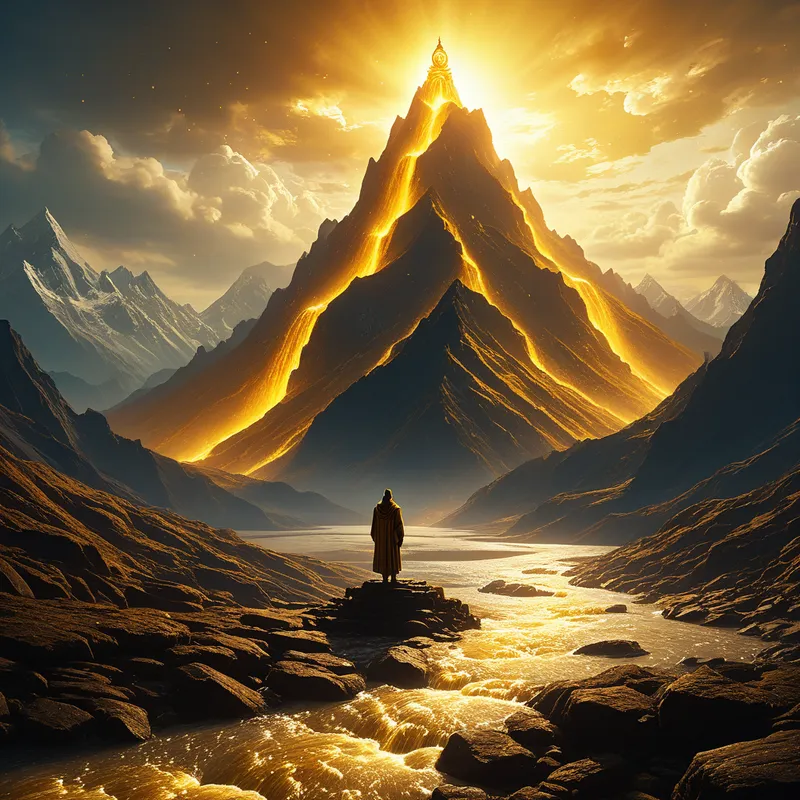
But this is not an endless tale. The prophets foretold it: a time of turning, a great making wonderful. The signs will come. The sun will grow pale and hang motionless for ten days and nights. The stars will fall like embers from the sky. Mountains will melt like wax, and the very earth will become a sea of fire. This is not destruction, but the forge. For the metal in the hills and deep in the bones of the world will run molten, a cleansing flood. Every living soul must walk through this river. For the righteous, it will feel like warm milk. For the wicked, it will be a searing agony, scouring the lie from their essence.
Then, from the waters of the eastern sea, the final savior will arise: the Saoshyant, born of a virgin and the prophet’s seed preserved in the deep. His countenance will outshine the sun. At his call, the dead will stir. Gravestones will shatter, and from every corner of the earth, the bones will gather, reassembled. The spirits will return from their celestial sojourn, and body and soul will be reunited, immortal and incorruptible.
Then comes the last gathering. All of humanity, every soul that ever was, will assemble on the plain. The Saoshyant will hold aloft the Hadhayans, and from its fat, he will prepare the drink of immortality. The final judgment is not a decree from a distant throne, but a revelation within one’s own soul. Each person’s own conscience, their Fravashi, will step forward. It will lead the righteous across the Chinvat Bridge into the House of Song, a world remade. The wicked, seeing their own deeds reflected, will fall into the abyss of their own making, a final purification.
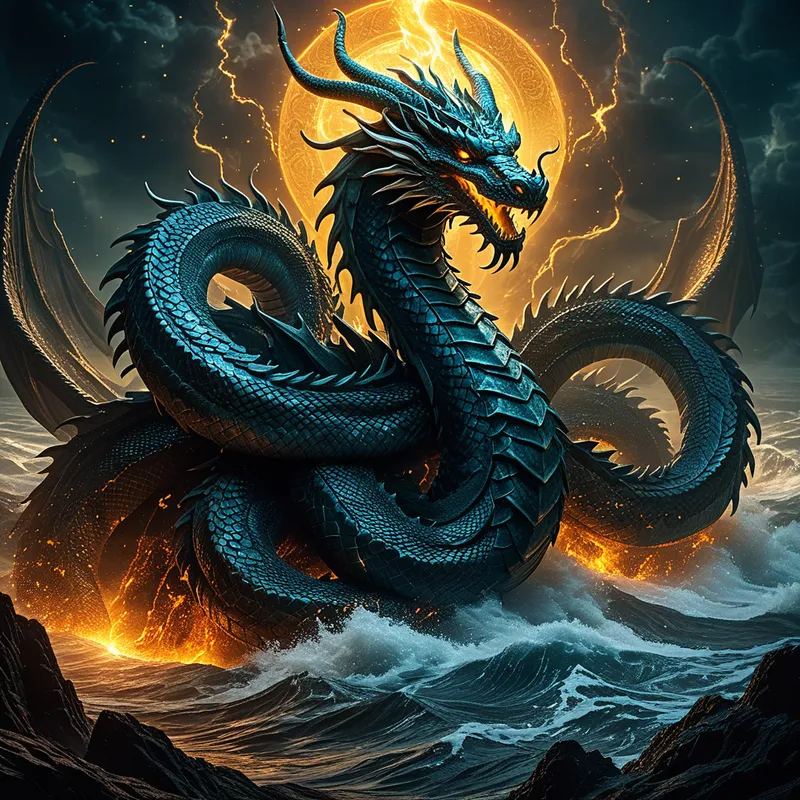
And Angra Mainyu? The great dragon, Azhi Dahaka, will be slain. The Lie itself will be rendered powerless, burned away in the universal river of metal. Then, Ahura Mazda and the Amesha Spentas, the Holy Immortals, will perform the ultimate sacrifice. They will offer the last vestige of evil in a final, cosmic Haoma. The universe will shudder, and then… stillness. Perfect, radiant, eternal. The world becomes as it was always meant to be: undying, without shadow, without hunger, without hatred. Frashokereti. The renovation that makes wonderful. The work is finished.
Cultural Origins & Context
This profound narrative is the heart of Zoroastrian eschatology, one of the world’s oldest prophetic religions, originating in ancient Persia (modern-day Iran) with the teachings of the prophet Zarathustra (Greek: Zoroaster). It is a myth of destiny, not fate—a cosmology where human choice actively participates in the cosmic outcome. The myth was preserved orally by priestly magi and later in the sacred texts of the Avesta, particularly the Bundahishn and Arda Viraf Namag.
Its societal function was multifaceted. It provided a comprehensive ethical framework: every thought, word, and deed was a vote for either Asha (truth, order, righteousness) or Druj (the lie, chaos). It offered hope and meaning in the face of suffering, framing life as a temporary assignment in a cosmic war that good was guaranteed to win. It also established a sacred responsibility for agriculture and husbandry, seen as acts of combating the decay introduced by Angra Mainyu, literally healing the world in preparation for the Final Renovation.
Symbolic Architecture
Frashokereti is not merely an end-time [prophecy](/symbols/prophecy “Symbol: A foretelling of future events, often through divine or supernatural means, representing destiny, fate, and hidden knowledge.”/); it is a grand symbolic map of psychic and cosmic [integration](/symbols/integration “Symbol: The process of unifying disparate parts of the self or experience into a cohesive whole, often representing psychological wholeness or resolution of internal conflict.”/). The central conflict between Ahura Mazda and Angra Mainyu represents the fundamental [human](/symbols/human “Symbol: The symbol of a human represents individuality, complexity of emotions, and social relationships.”/) [tension](/symbols/tension “Symbol: A state of mental or emotional strain, often manifesting physically as tightness, pressure, or unease, signaling unresolved conflict or anticipation.”/) between the drive toward [consciousness](/symbols/consciousness “Symbol: Consciousness represents the state of awareness and perception, encompassing thoughts, feelings, and experiences.”/), order, and meaning, and the pull of the unconscious, [entropy](/symbols/entropy “Symbol: In arts and music, entropy represents the inevitable decay of order into chaos, often symbolizing creative destruction, impermanence, and the natural progression toward disorder.”/), and destructive impulses.
The river of molten metal is the ultimate truth serum of the soul. It does not punish from without but reveals the inherent quality of what passes through it.
The Saoshyant symbolizes the emergent, unified consciousness that can orchestrate this inner renovation. He is not a foreign deity descending, but the latent potential within the spiritual [lineage](/symbols/lineage “Symbol: Represents ancestral heritage, family connections, and the transmission of traits, values, and responsibilities across generations.”/) of humanity, awakened. The resurrection of the [body](/symbols/body “Symbol: The body in dreams often symbolizes the dreamer’s self-identity, personal health, and the relationship they have with their physical existence.”/) is a powerful [symbol](/symbols/symbol “Symbol: A symbol can represent an idea, concept, or belief, serving as a powerful tool for communication and understanding.”/) of the [redemption](/symbols/redemption “Symbol: A theme in arts and music representing transformation from failure or sin to salvation, often through creative expression or cathartic performance.”/) of the physical and instinctual self—the “bones” of our being—from the [realm](/symbols/realm “Symbol: The symbol of ‘Realm’ often signifies the boundaries of one’s consciousness, experiences, or emotional states, suggesting aspects of reality that are either explored or ignored.”/) of [shame](/symbols/shame “Symbol: A painful emotion arising from perceived failure or violation of social norms, often involving exposure of vulnerability or wrongdoing.”/) and decay, integrating them into a perfected, whole Self.
The myth presents a [vision](/symbols/vision “Symbol: Vision reflects perception, insight, and clarity — often signifying the ability to foresee or understand deeper truths.”/) of evil (druj) not as an eternal equal opposite, but as a parasitic, corrosive force that is ultimately unreal in the face of fundamental [reality](/symbols/reality “Symbol: Reality signifies the state of existence and perception, often reflecting one’s understanding of truth and life experiences.”/) (asha). Its defeat is not a violent conquest, but a final exposure and [dissolution](/symbols/dissolution “Symbol: The process of breaking down, dispersing, or losing form, often representing transformation, release, or the end of a state of being.”/) in the light of total [awareness](/symbols/awareness “Symbol: Conscious perception of self, surroundings, or internal states. Often signifies awakening, insight, or heightened sensitivity.”/).
The Dreamer’s Resonance
When this myth stirs in the modern unconscious, it often manifests in dreams of profound personal reckoning and transformation. One may dream of a world-ending flood, but of fire or light, not water—a purgative, cleansing cataclysm. Dreams of meeting all versions of one’s past self, or of a great family or tribal gathering under a strange sun, echo the final assembly on the plain.
Somatically, this process can feel like a “burning away”—a period of intense anxiety, feverish introspection, or physical purging that feels destructive but leaves a curious clarity in its wake. Psychologically, it is the process of “shadow confrontation” at its most absolute. Every repressed fault, every denied malice or cowardice, demands recognition. The dreamer is not judged by an external god, but by their own Fravashi—their higher Self or inner guide. The terror in the dream is the fear of facing the totality of one’s own being.

Alchemical Translation
For the individual on the path of individuation, Frashokereti models the ultimate goal: the lapis philosophorum, the creation of the permanent, integrated personality. The long cosmic struggle mirrors the lifelong effort to bring unconscious contents to light, to consciously choose order over psychic chaos.
The alchemical solve et coagula—dissolve and coagulate—is performed on a cosmic scale: the world dissolved in fire to be coagulated into its perfect, eternal form.
The “molten metal” stage is the painful but necessary phase of analysis and ego-dismantling, where rigid personas and neurotic complexes are liquefied by the heat of self-awareness. The “resurrection of the dead” is the recovery of lost parts of the personality—childhood potentials, abandoned passions, split-off traumas—and their reintegration into a vibrant, whole self.
The final state, where Ahura Mazda’s order reigns supreme, translates psychologically as a state of inner sovereignty. The conscious ego is no longer a frail ruler battling rebellious instincts, but a wise administrator in a harmonious psyche, where all elements serve the totality of the Self. Conflict ceases because integration is complete. The inner “Angra Mainyu” is not slain in battle but assimilated; its chaotic energy is transmuted into creative vitality. The individual achieves a state of inner Frashokereti—a renovation of the personal cosmos that feels both like a homecoming and a glorious new creation.
Associated Symbols
Explore related symbols from the CaleaDream lexicon:
- Fire — The primary agent of Frashokereti, representing the purifying, transformative, and revelatory power that separates truth from falsehood and prepares the world for renewal.
- River — The flowing, molten metal that judges and cleanses all of humanity, symbolizing the unstoppable, immersive process of ultimate truth and reckoning.
- Bridge — The Chinvat Bridge, representing the critical transition or judgment point where one’s inner state determines their passage into a renewed existence or a fall into dissolution.
- Resurrection — The core event of Frashokereti, signifying the ultimate redemption and reunification of all aspects of being—physical, spiritual, and historical—into a perfected, immortal whole.
- Order — The cosmic principle of Asha, the divine truth and harmony that is the destined end-state of creation after the defeat of chaos and falsehood.
- Dragon — Azhi Dahaka, the embodiment of chaotic evil, tyranny, and decay that must be conclusively defeated for the renovation to be complete.
- Light — The essential nature of Ahura Mazda and the perfected world, representing consciousness, truth, purity, and the ultimate victory over the darkness of ignorance and evil.
- Mountain — The place from which the Saoshyant works his renovation, a symbol of spiritual ascent, stability, and the meeting point between the divine and the earthly.
- Sacrifice — The final cosmic Haoma ritual that eliminates the last trace of evil, representing the ultimate offering or surrender needed to achieve total purification and unity.
- Sun — A symbol of the Saoshyant and the new, eternal day that dawns after the renovation, representing unchanging truth, life, and divine sovereignty.
- Bone — The physical remnants gathered for resurrection, representing the foundational, enduring structure of the self or the world, which is redeemed and made immortal.
- Final — The definitive, irreversible conclusion of the cosmic cycle, representing the end of all struggle, suffering, and ambiguity, and the establishment of permanent perfection.