The Fifth Sun Myth Meaning & Symbolism
A myth of cosmic sacrifice where gods must immolate themselves to birth a new sun, establishing the fragile, sacred world we inhabit.
The Tale of The Fifth Sun
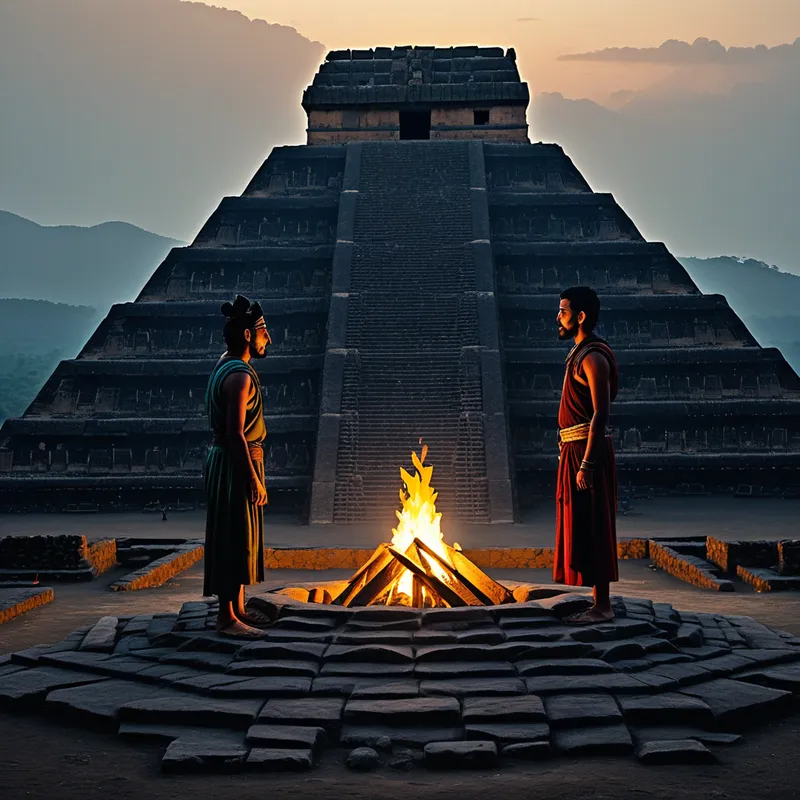
Listen. [The world](/myths/the-world “Myth from Tarot culture.”/) you know is not the first. It is the fifth. Four worlds have been born, lived, and died before this one, each destroyed by its own cataclysm. Now, there is only darkness. The gods, the Ometeotl, gather in the sacred, silent plain of Teotihuacan. The bones of the previous suns are dust beneath their feet. The cosmos holds its breath.
A question hangs in [the void](/myths/the-void “Myth from Buddhist culture.”/): Who will leap? Who will cast themselves into the divine, all-consuming fire to become the new sun, to pull the new age from [the womb](/myths/the-womb “Myth from Various culture.”/) of night? Without this sacrifice, all remains formless, weightless, dark.
Two gods step forward. The first is Tecciztecatl, lord of riches and pride. He is adorned in quetzal feathers and gold, certain of his glory. The second is Nanahuatzin, the pustular one, the poor and humble god, whose body is a map of suffering. He is clad in paper garments, his offering simple reeds.
A great pyre is built, a mountain of sacred wood that burns for four days and four nights. The flames roar, a gateway to transformation. The moment arrives. Tecciztecatl approaches, his finery glittering. But when he feels the furnace breath of the fire, his courage fails him. He recoils. Four times he tries, and four times he steps back, frozen by the terror of his own annihilation.
Then Nanahuatzin, without hesitation, closes his eyes. He does not stride; he resolves. He gathers all his humility, all his perceived inadequacy, and runs. He flings himself into the very heart of the blaze. His body is not consumed; it is transmuted. The fire accepts his offering.
Shamed by this act of ultimate courage, Tecciztecatl, in a burst of desperate pride, finally leaps into the flames after him.
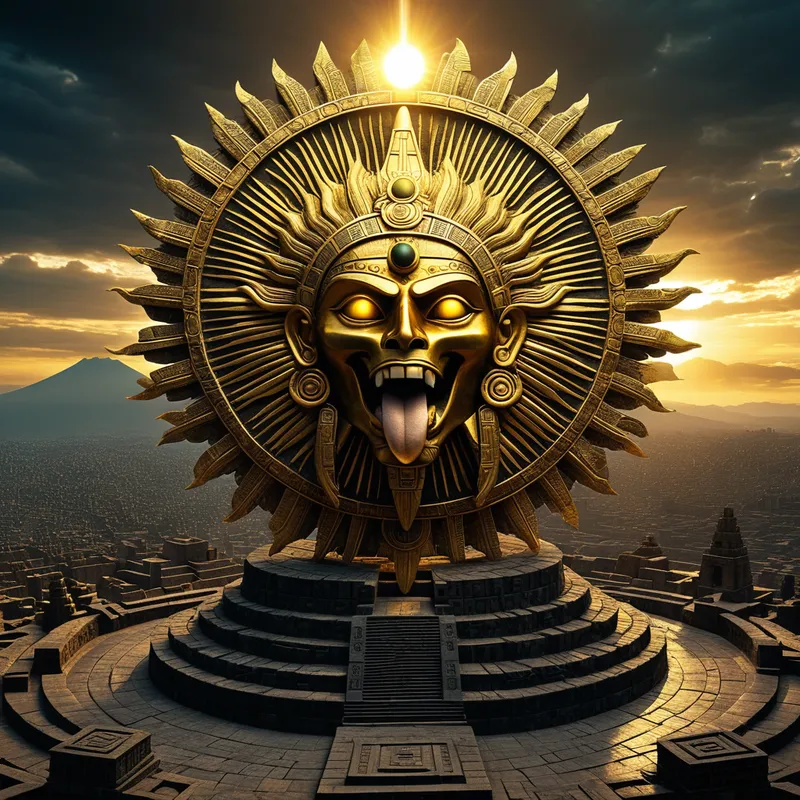
The gods wait. The darkness deepens. Then, on the eastern horizon, a glow. Not one, but two suns begin to rise. The first, brilliant and fierce, is Nanahuatzin, now transformed into [Tonatiuh](/myths/tonatiuh “Myth from Aztec culture.”/). The second, just as bright, is Tecciztecatl. The world cannot bear two suns; it would be scorched to ash. One of the gods, swift and decisive, takes a rabbit and hurls it at the face of the second sun. Its light dims, its fire cools. Tecciztecatl becomes [the moon](/myths/the-moon “Myth from Tarot culture.”/), forever marked by [the shadow](/myths/the-shadow “Myth from Jungian culture.”/) of the rabbit, forever following his humble counterpart.
But Tonatiuh does not move. He hangs, radiant, at the zenith. The gods cry out in dismay. The sun has been born, but it is inert. A new understanding dawns upon them. The sacrifice must be continuous. The sun demands not a one-time offering, but a perpetual covenant of life-force to fuel its journey across [the sky](/myths/the-sky “Myth from Persian culture.”/).
And so, the gods themselves offer their blood. They pierce their own tongues, their ears, their flesh, letting their divine essence flow. Nourished by this sacred debt, Tonatiuh begins his first journey from east to west, establishing the rhythm of days, the promise of dawn. The Fifth Sun, Nahui Ollin, the Sun of Movement, is born. Its price is eternal. Its life is our own.
Cultural Origins & Context
This foundational narrative was the bedrock of the Mexica (Aztec) worldview, recorded in codices like the Codex Borgia and passed down through generations of tlamatinime (wise ones) and priests. It was not merely a story of the past, but a living cosmological map and a social contract. The myth was ritually enacted and reaffirmed at the great Templo Mayor in the heart of Tenochtitlan, [the axis mundi](/myths/the-axis-mundi “Myth from Chinese culture.”/) of their world.
Its societal function was profound and twofold. First, it explained the precarious nature of existence: the current world was destined to end in earthquakes, and its survival depended on maintaining cosmic balance. Second, it legitimized the practice of human sacrifice, or nextlahualli (“the paying of debts”). If the gods had offered their own blood to set the sun in motion, then humans, made from the ground bones of previous ages and the blood of the gods, owed the same life-force to sustain the cosmos. The myth was a constant reminder that life, from the harvest to the empire itself, was purchased through sacred debt and cyclical sacrifice.
Symbolic Architecture
At its core, the myth is an alchemical [blueprint](/symbols/blueprint “Symbol: A blueprint represents the foundational plan or design for something, often symbolizing potential, structure, and the mapping of one’s inner self or future.”/) for transformation through ego-[death](/symbols/death “Symbol: Symbolizes transformation, endings, and new beginnings; often associated with fear of the unknown.”/). The two volunteer gods represent two aspects of [the self](/myths/the-self “Myth from Jungian culture.”/) confronting the ultimate transition.
Tecciztecatl is the adorned ego, the [persona](/symbols/persona “Symbol: The social mask or outward identity one presents to the world, often concealing the true self.”/) built on [wealth](/symbols/wealth “Symbol: Wealth in dreams often represents abundance, security, or inner resources, but can also symbolize burdens, anxieties, or moral/spiritual values.”/), [status](/symbols/status “Symbol: Represents one’s social position, rank, or standing within a group, often tied to achievement, power, or recognition.”/), and pride. He believes he is worthy by external measure, but when faced with the true cost of renewal—the total [dissolution](/symbols/dissolution “Symbol: The process of breaking down, dispersing, or losing form, often representing transformation, release, or the end of a state of being.”/) of the self—he hesitates. His light, when it finally emerges, is too much, too identical to the true [source](/symbols/source “Symbol: The origin point of something, often representing beginnings, nourishment, or the fundamental cause behind phenomena.”/); it must be diminished into the reflective, passive light of the [moon](/symbols/moon “Symbol: The Moon symbolizes intuition, emotional depth, and the cyclical nature of life, often reflecting the inner self and subconscious desires.”/), the [realm](/symbols/realm “Symbol: The symbol of ‘Realm’ often signifies the boundaries of one’s consciousness, experiences, or emotional states, suggesting aspects of reality that are either explored or ignored.”/) of dreams and illusions.
Nanahuatzin is the rejected [shadow](/symbols/shadow “Symbol: The ‘shadow’ embodies the unconscious, repressed aspects of the self and often represents fears or hidden emotions.”/), the part of the self deemed unworthy, diseased, and poor. Yet, he holds the key precisely because he has nothing to lose but his own suffering. His offering is not of gold, but of his very state of being. His leap is not an act of pride, but of absolute surrender.
The most radiant consciousness is not born from perfection, but from the willing immolation of the wounded self.
The fire is the [crucible](/symbols/crucible “Symbol: A vessel for intense transformation through heat and pressure, symbolizing spiritual purification, testing, and alchemical change.”/) of individuation. The resulting two suns represent the [danger](/symbols/danger “Symbol: The symbol of ‘Danger’ often indicates a sense of threat or instability, calling for caution and awareness.”/) of [inflation](/symbols/inflation “Symbol: A dream symbol representing feelings of diminishing value, loss of control, or expansion beyond sustainable limits in one’s life or psyche.”/)—the [birth](/symbols/birth “Symbol: Birth symbolizes new beginnings, transformation, and the potential for growth and development.”/) of a new conscious principle so powerful it can become tyrannical if not balanced. The [rabbit](/symbols/rabbit “Symbol: Rabbits often symbolize fertility, intuition, and resourcefulness in dreams, potentially reflecting a need for growth or change.”/) thrown to create the moon introduces the necessary principle of softening, [reflection](/symbols/reflection “Symbol: Reflection signifies self-examination, awareness, and the search for truth within oneself.”/), and cycles. Finally, the sun’s refusal to move reveals the most profound [truth](/symbols/truth “Symbol: Truth represents authenticity, honesty, and the quest for knowledge beyond mere appearances.”/): no transformation is complete with a single act. It requires continual offering, a perpetual cycle of giving over one’s limited [energy](/symbols/energy “Symbol: Energy symbolizes vitality, motivation, and the drive that fuels actions and ambitions.”/) (tonalli) to fuel the greater [journey](/symbols/journey “Symbol: A journey in dreams typically signifies adventure, growth, or a significant life transition.”/).
The Dreamer’s Resonance
When this myth stirs in the modern [psyche](/myths/psyche “Myth from Greek culture.”/), it often manifests in dreams of pivotal choice or necessary endings. You may dream of standing before a great fire, a chasm, or a doorway, knowing you must pass through but gripped by paralyzing fear. The figure of the proud, hesitant dream-self (Tecciztecatl) and the humble, resolved self (Nanahuatzin) may appear as separate characters or as conflicting feelings within.
Somatically, this can feel like a pressure in the chest—the “heart sacrifice”—or a burning sensation, a psychic fever preparing the ground for a new state of being. The dream is signaling a point of psychic inevitability. An old identity, a worn-out way of being, has reached its end (Sun Four), and the dreamer is being called to offer it up, to stop trying to repair the old structure and instead consent to its dissolution in the service of something not yet fully known. The terror in the dream is real; it is [the ego](/myths/the-ego “Myth from Jungian culture.”/)‘s rightful fear of its own demise. The resolution comes not from overcoming the fear, but from the part of the self that, in its humility and exhaustion, finally says, “I will jump.”
Alchemical Translation
For the individual, the myth of the Fifth Sun models the process of psychic rebirth. We all inhabit worlds that eventually crumble: careers, relationships, identities, belief systems. The “Tecciztecatl” within us wants to make the transition glorious, controlled, and worthy of admiration. We prepare, we adorn our intentions, but we falter at the brink because we are trying to preserve the self while changing it.
The alchemical work is to locate the “Nanahuatzin” within—the part of us that is sick of the old condition, the humble, unadorned truth of our situation. This is not about worthiness; it is about necessity. The leap into the fire is the act of fully committing to a therapy, leaving a toxic situation, embracing a creative void, or surrendering an addiction. It is the conscious decision to stop hesitating and allow the old form to be consumed.
The new sun does not negotiate with the night; it is born from an agreement with the fire.
The subsequent phase—the inert sun requiring further sacrifice—translates to the often-overlooked stage after the initial breakthrough. A new consciousness is born, but it is fragile. It requires daily, ongoing “blood” offerings: discipline, attention, vulnerability, and the continual letting-go of the smaller ego’s demands to feed the larger journey of the soul. We must nourish our own transformation, or it will stall. The moon, meanwhile, remains as a necessary reminder: the reflective, introspective, and cyclical part of the psyche must balance the fierce, forward-moving light of the new conscious attitude. We are both the sacrificed and the sacrificer, the sun and its sustenance, living in the fragile, sacred movement of our own Fifth World.
Associated Symbols
Explore related symbols from the CaleaDream lexicon: