The Festival of Dionysus - anc Myth Meaning & Symbolism
A myth of divine madness and communal ecstasy, where the god of wine dissolves boundaries, revealing the primal unity beneath social order.
The Tale of The Festival of Dionysus - anc
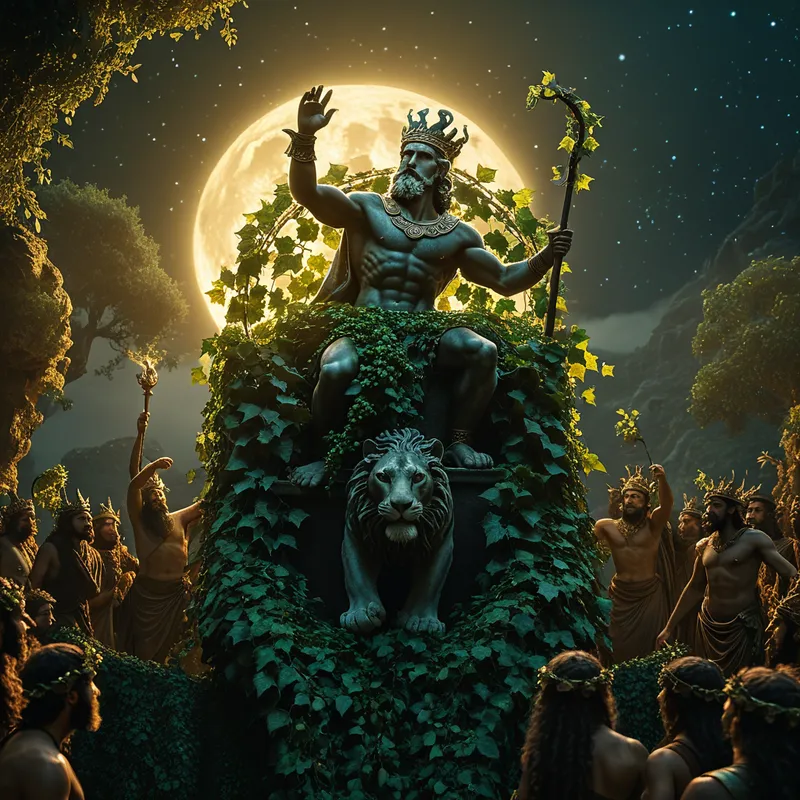
Hear now the tale that is not told in the marble halls, but whispered by the wind in the pine forests, carried on the scent of crushed grapes and damp earth. It begins not with a king’s decree, but with a presence felt in the shiver down the spine, the sudden, inexplicable urge to laugh or weep. He has arrived. Dionysus, the twice-born, the stranger-god.
He walks into the ordered city, this youth with the curl of a smile and eyes like deep, dark wine. His hair is crowned with ivy, his hand holds the thyrsus. He is followed not by soldiers, but by a wild retinue: the Maenads, their feet bare and eyes blazing with a light not of this world, and the Satyrs, piping tunes that make the blood quicken. They bring no weapons, only skins of wine and the promise of a different truth.
The king, from his high throne, sees only chaos. He sees the women of the city—mothers, daughters, wives—hearing a call older than duty, dropping their looms and water jars. Their eyes glaze with a divine mist. They flee the gates, not in fear, but in a rapturous exodus, drawn to the god’s voice in the mountains. The men, confused and furious, give chase. Order must be preserved.
In the high, lonely places, under the moon’s cold eye, the Festival begins. It has no stage, no schedule. It is the rhythm of the drum, the dizzying spiral of the dance. The Maenads, possessed by the god’s spirit, the enthusiasmos, become something more and less than human. They handle serpents as if they were ribbons. With their bare hands, they tear goats—and sometimes, in the darkest whispers, men who spy on their mysteries—limb from limb, sparagmos. This is not mere violence; it is a holy, terrifying unbinding.
They consume the raw flesh, omophagia, a sacrament of unity with the god and the beast within. The wine flows, not to bring forgetfulness, but a piercing, painful remembrance: that we are flesh and blood and wildness, that the civilized self is a fragile mask. The mountain itself seems to pulse. Pine trees bend to the music. Streams run with wine. The boundary between self and other, human and animal, mortal and divine, dissolves in the smoky, perfumed air.
The king, in his rage and disbelief, finally confronts the god. He seeks to chain this madness, to imprison the stranger. But the stones of his prison grow vines. The chains become garlands. Dionysus looks upon him not with anger, but with a terrible pity, and offers the king a final chance to see. The king refuses, clinging to his solitary, rigid “I.” And in his refusal, he is torn apart by the very forces of nature he denied, mirrored in the madness of his own mother, now a Maenad. The Festival’s ecstasy holds its shadow: a divine justice for those who will not bend.
As dawn pales the sky, the frenzy ebbs. The Maenads awaken in the dew-strewn grass, weary, cradling fox cubs or crowned with flowers, the memory of the night a blur of sublime terror and joy. They return to the city, not as rebels, but as quiet vessels of a mystery. The god departs, but the vine remains, growing over the wall. The Festival is over, but nothing is the same. The city has been reminded, at a terrible and glorious cost, that it is built not just on law, but on the deep, dark, fertile soil of the soul.
Cultural Origins & Context
This mythic pattern is rooted in the historical City Dionysia and the more ancient, rural orgia. It was not merely a story but a lived, annual reality in the Greek world. The myth was passed down through the very rituals it described—in the dithyrambic choruses, and later, crystallized in the tragedies of Aeschylus, Euripides (most famously in The Bacchae), and others performed at Dionysus’s own festivals.
Its societal function was profoundly ambivalent and essential. It served as a sanctioned, ritualized pressure valve—a temenos of chaos within the polis’s cosmos. It allowed, once a year, for the expression of everything civilization repressed: irrationality, feminine power, animal instinct, and collective ecstasy. By giving these forces a ritual container and a divine narrative, Greek society acknowledged their power and sought to integrate them safely, preventing a more catastrophic, real-world eruption. The myth was a warning to rulers and a revelation to the people: deny the Dionysian at your peril, for it is the raw stuff of life itself.
Symbolic Architecture
At its core, the Festival of Dionysus symbolizes the necessary, cyclical dissolution of the ego’s fortress—the principium individuationis shattered by the primal unity, the aporia.
The god does not bring wine to drown sorrow, but to dissolve the dam between the well of the self and the ocean of the unconscious.
The Maenads represent the instinctual, intuitive, and creative libido—often repressed as the “wild feminine”—breaking free from patriarchal, hyper-rational control (the King). The Satyrs embody untamed masculine sensuality and fertility, distinct from the ordered masculinity of the warrior or statesman. The ritual sparagmos is not mere brutality; it is the symbolic dismantling of the rigid, identified self. The omophagia is the terrifying, yet holy, act of re-integrating that raw, undifferentiated life-force.
Dionysus himself is the archetypal embodiment of this process. He is the eniautos-daimon, the god who is torn apart and reborn, mirroring the fate of his followers’ psyche. He represents the paradoxical unity of opposites: joy and terror, creation and destruction, the most refined culture (theater, wine) and the most primal nature.
The Dreamer’s Resonance
When this myth stirs in modern dreams, it signals a profound somatic and psychological uprising against excessive order. The dreamer may find themselves in chaotic, overwhelming festivals, losing their clothing or identity in a crowd, being chased through wild landscapes, or witnessing a terrifying yet fascinating wild ritual.
Somatically, this can correlate with feelings of uncontrollable energy—restlessness, sudden bursts of emotion (laughter, rage, tears), or a sense of vital force pushing against the “container” of the body and life structure. Psychologically, it is the process of the unconscious demanding recognition. The “Maenad” within—be it repressed creativity, passion, grief, or rage—is breaking her bonds. The “King” in the dream (often a boss, father figure, or one’s own critical voice) is the over-developed, rigid ego-complex that is being threatened with dissolution. The dream is an internal enthousiasmos, a call from the Self to surrender a too-strict control and allow a necessary, if frightening, psychic reorganization.

Alchemical Translation
The alchemical journey modeled here is the nigredo leading to a chaotic, vital albedo. It is the stage of solutio—dissolution in the primal waters (or wine) of the unconscious.
Individuation is not a process of building a better, stronger ego, but of allowing the ego to be periodically dissolved in the service of a greater, more fluid wholeness.
The modern individual’s “Festival” occurs when life itself forces a breakdown: the loss of a career, the end of a relationship, a depression, a creative block that shatters old forms. This is the Dionysian invasion. The triumph is not in “winning” against this chaos, but in the sacred surrender to it—allowing the old identity (the King) to be torn apart. The ritual participation, the “dance,” is the active engagement with this process through therapy, art, deep feeling, or somatic practice—allowing the raw, uncensored material to emerge.
The goal is not to live in perpetual frenzy, but to integrate the Festival’s wisdom into daily life. It is to become like the vine: rooted in dark, fertile soil (the unconscious), yet capable of producing both the nourishing grape and the intoxicating wine. One returns from the mountain, like the Maenad at dawn, carrying not madness, but a newfound depth—a consciousness that has tasted its own origins and is forever humbled, enlivened, and made truly whole by the memory of the divine chaos.
Associated Symbols
Explore related symbols from the CaleaDream lexicon: