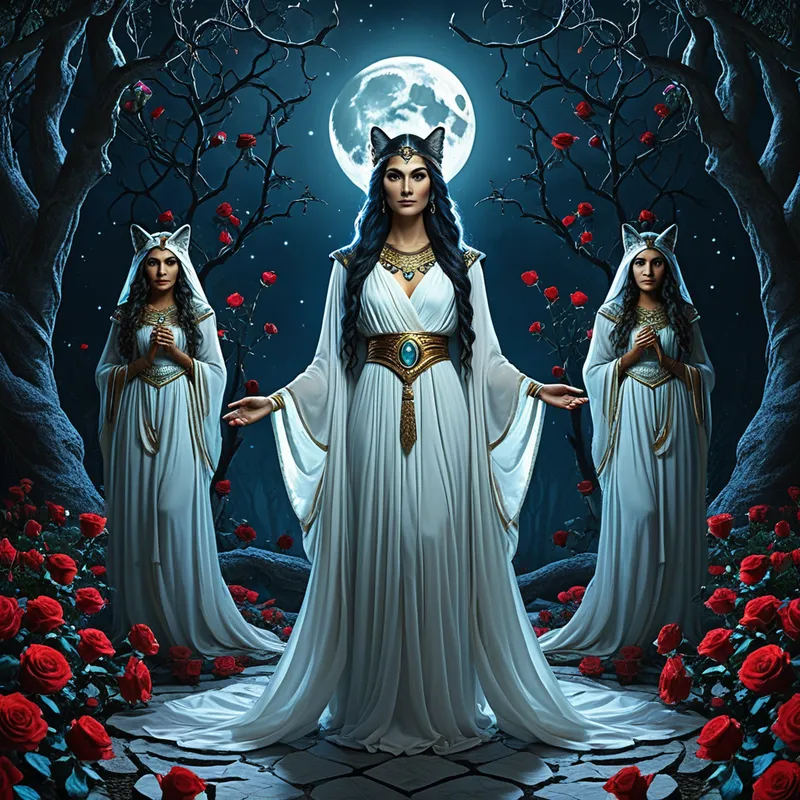
The Femme Fatale Myth Meaning & Symbolism
A timeless archetype of the dangerous seductress, weaving enchantment and destruction, embodying the untamed power of nature and the unconscious.
The Tale of The Femme Fatale
Listen. The air is thick with [jasmine](/myths/jasmine “Myth from Persian culture.”/) and the promise of ruin. She does not walk into a room; she coalesces from the shadows, a shape formed from the unspoken longings of men. Her name is whispered in a hundred tongues: [Ishtar](/myths/ishtar “Myth from Babylonian culture.”/), who descended to [the underworld](/myths/the-underworld “Myth from Greek culture.”/) and halted all love on earth. Circe, on her sun-drenched Aegean isle, where the pigs that were once sailors root in the dirt. [Kitsune](/myths/kitsune “Myth from Japanese culture.”/), her nine tails a fan of silver fire in the moonlight, her laughter like wind chimes over a grave.
She finds you when you are lost. The hero, weary from his quest, his sword heavy, his purpose grown dim. He sees a light in the forest—not a campfire, but a lantern in a window of a house that was not there yesterday. The door opens. She is there, offering wine that tastes of forgotten summers, a bed softer than any peace he has known. Her touch is cool silk; her words paint a future where the struggle is over, where he can lay down his burden and simply be. She asks for nothing but his attention, his surrender. She sings the song of the end of striving.
And for a night, or a season, it is paradise. [The world](/myths/the-world “Myth from Tarot culture.”/) outside fades. His armor rusts in the corner. His map curls and blackens by [the hearth](/myths/the-hearth “Myth from Norse culture.”/). He is fed on honeyed lies and nocturnal pleasures, until he is plump with inertia. Then, the change. The wine sours on his tongue. The silken touch becomes a grip. The beautiful eyes reflect not his desire, but his own hollowing core. The paradise is a gilded cage, the bed a slab for a ritual not yet understood. She reveals her teeth—not in a smile, but in the grimace of a natural law. She is the harvest of his inattention, the consequence of a choice to trade his soul for comfort. He is consumed, transformed, or left broken on [the threshold](/myths/the-threshold “Myth from Folklore culture.”/) at dawn, a shell of who he was, with only the bitter perfume of jasmine to prove it was ever real.

Cultural Origins & Context
The Femme Fatale is not a myth from a single culture, but a haunting refrain across the tapestry of human storytelling. She appears wherever civilization grapples with the untamed, unpredictable forces of nature, sexuality, and the unconscious. In ancient Mesopotamia, Ishtar embodied the terrifying duality of creative and destructive love, her cult rituals acknowledging her power to give life and bring devastating war. In the Greek world, figures like Circe and [the Sirens](/myths/the-sirens “Myth from Greek culture.”/) were narrative warnings for a patriarchal, hero-centric culture about the perils of abandoning reason (the voyage) for sensual oblivion.
In the East, the Huli Jing or Kitsune of Chinese and Japanese folklore served a similar function, often acting as karmic agents. They punished the greedy, the lustful, the arrogant—those who had lost their moral or social way. These tales were told by firelight, by elders to youths, by sailors to greenhorns. Their societal function was multifaceted: to codify fear of female autonomy, to warn against the dissolution of [the ego](/myths/the-ego “Myth from Jungian culture.”/), and paradoxically, to acknowledge a potent, ancient power that existed entirely outside the bounds of controlled, rational male society.
Symbolic Architecture
Psychologically, the Femme Fatale is a supreme embodiment of the [anima](/symbols/anima “Symbol: The feminine archetype within the male unconscious, representing soul, creativity, and connection to the inner world.”/) in its most devouring and autonomous form. She is not the integrative, [soul](/symbols/soul “Symbol: The soul represents the essence of a person, encompassing their spirit, identity, and connection to the universe.”/)-guiding [anima](/symbols/anima “Symbol: The feminine archetype within the male unconscious, representing soul, creativity, and connection to the inner world.”/), but the anima as sorceress—the [aspect](/symbols/aspect “Symbol: A distinct feature, quality, or perspective of something, often representing a partial view of a larger whole.”/) of the unconscious that seduces the conscious mind away from its differentiated [purpose](/symbols/purpose “Symbol: Purpose signifies direction, meaning, and intention in life, often reflecting personal ambitions and core values.”/).
She is the siren song of the unlived life, the temptation to let the complex, difficult work of individuation dissolve back into the blissful, undifferentiated waters of the unconscious.
She symbolizes the raw, amoral power of instinct—of Eros not as romantic love, but as a primal, binding force of [nature](/symbols/nature “Symbol: Nature symbolizes growth, connectivity, and the primal forces of existence.”/) that can enchant and enmesh. The [hero](/symbols/hero “Symbol: A hero embodies strength, courage, and the ability to overcome significant challenges.”/) she ensnares is the ego that has become inflated, rigid, or weary. His “fall” is a symbolic descent into a necessary, if terrifying, encounter with his own [shadow](/symbols/shadow “Symbol: The ‘shadow’ embodies the unconscious, repressed aspects of the self and often represents fears or hidden emotions.”/) and his dependence on unconscious contents. The cage or transformation she effects is not merely [punishment](/symbols/punishment “Symbol: A dream symbol representing consequences for actions, often tied to guilt, societal rules, or internal moral conflicts.”/), but a grotesque [reflection](/symbols/reflection “Symbol: Reflection signifies self-examination, awareness, and the search for truth within oneself.”/) of his own inner state: the man who chooses unconsciousness becomes a [beast](/symbols/beast “Symbol: The beast often represents primal instincts, fears, and the shadow self in dreams. It symbolizes the untamed aspects of one’s personality that may need acknowledgment or integration.”/) (Circe’s swine), or a hollow [shell](/symbols/shell “Symbol: Shells are often seen as symbols of protection, transition, and the journey of personal growth.”/).
Her gifts—the [wine](/symbols/wine “Symbol: Wine often symbolizes celebration, indulgence, and the deepening of personal connections, but it can also represent excess and escape.”/), the bed, the [paradise](/symbols/paradise “Symbol: A perfect, blissful place or state of being, often representing ultimate fulfillment, harmony, and transcendence beyond ordinary reality.”/)—are the seductive promises of the complex: the alluring [pattern](/symbols/pattern “Symbol: A ‘Pattern’ in dreams often signifies the underlying structure of experiences and thoughts, representing both order and the repetitiveness of life’s situations.”/) of [behavior](/symbols/behavior “Symbol: Behavior encompasses the actions and reactions of individuals, often as a response to various stimuli or contexts.”/) that offers a shortcut to wholeness, but at the cost of true selfhood. She represents the [danger](/symbols/danger “Symbol: The symbol of ‘Danger’ often indicates a sense of threat or instability, calling for caution and awareness.”/) of confusing possession by an [archetype](/symbols/archetype “Symbol: A universal, primordial pattern or prototype in the collective unconscious that shapes human experience, behavior, and creative expression.”/) (being “in love” with the [idea](/symbols/idea “Symbol: An ‘Idea’ represents a spark of creativity, innovation, or realization, often emerging as a solution to a problem or a new outlook on life.”/) of love, or [peace](/symbols/peace “Symbol: Peace represents a state of tranquility and harmony, both internally and externally, often reflecting a desire for resolution and serenity in one’s life.”/), or pleasure) with an authentic [relationship](/symbols/relationship “Symbol: A representation of connections we have with others in our lives, often reflecting our emotional state.”/) to the inner and outer world.
The Dreamer’s Resonance
When this pattern stirs in the modern dreamscape, it rarely appears as a mythological goddess. She is the mesmerizing but toxic new partner who appears just as one commits to sobriety or self-work. In dreams, she may be a figure of breathtaking beauty who leads the dreamer into a labyrinthine mansion that grows increasingly dilapidated, or a charismatic boss who offers a promotion that requires the sacrifice of all ethical boundaries.
Somatically, dreaming of the Femme Fatale can be accompanied by feelings of thrilling intoxication followed by claustrophobic dread or profound lethargy upon waking. Psychologically, this signals that the dreamer’s [psyche](/myths/psyche “Myth from Greek culture.”/) is enacting a deep conflict. A part of [the Self](/myths/the-self “Myth from Jungian culture.”/) is being seduced away from its conscious direction—perhaps by an addictive pattern, a regressive fantasy, or an overwhelming [projection](/myths/projection “Myth from Alchemical culture.”/). The dream is a stark enactment of the cost of that seduction. The process is one of enchantment and awakening: the ego is being shown, in visceral dream logic, the consequence of abandoning its conscious standpoint for the sake of an alluring, unconscious pull. It is a call to recognize where one is giving away one’s agency, one’s “sword,” in exchange for the illusion of comfort or consummation.

Alchemical Translation
The alchemical journey modeled by this myth is not one of conquering the Femme Fatale, but of being utterly transformed by the encounter. The initial stage is [nigredo](/myths/nigredo “Myth from Alchemical culture.”/), the blackening: the hero’s conscious world dissolves in her embrace. His old identity is consumed. This is a necessary death. The paradise she offers is the false albedo, a pseudo-whiteness of blissful ignorance, which must be seen through.
The triumph is not in escaping her, but in surviving the revelation of her true nature—and in doing so, discovering one’s own.
The moment he sees the cage for what it is, or feels the silken bond become a chain, the [rubedo](/myths/rubedo “Myth from Alchemical culture.”/), the reddening or suffering of consciousness, begins. This is the agonizing birth of a new awareness. He must reclaim his rusted sword—not to slay her, for she is an archetypal force and cannot be killed—but to cut himself free from his own enchantment. To understand that she was both tempter and mirror.
The alchemical gold forged in this process is a conscious relationship to one’s own anima and to the power of Eros. The individual learns to differentiate between the soul-guide and the soul-sorceress within. He learns that desire, instinct, and the pull of the unconscious are not enemies to be slain, but forces to be related to with respect and awareness, lest they possess him. The Femme Fatale, in the end, is the ruthless initiator into a deeper masculinity—not one of brute force, but of psychological responsibility. She destroys the boy who seeks motherly solace in the lover, and makes room for the man who can stand in conscious, related tension with the great and terrible mystery of the Other, both within and without.
Associated Symbols
Explore related symbols from the CaleaDream lexicon: