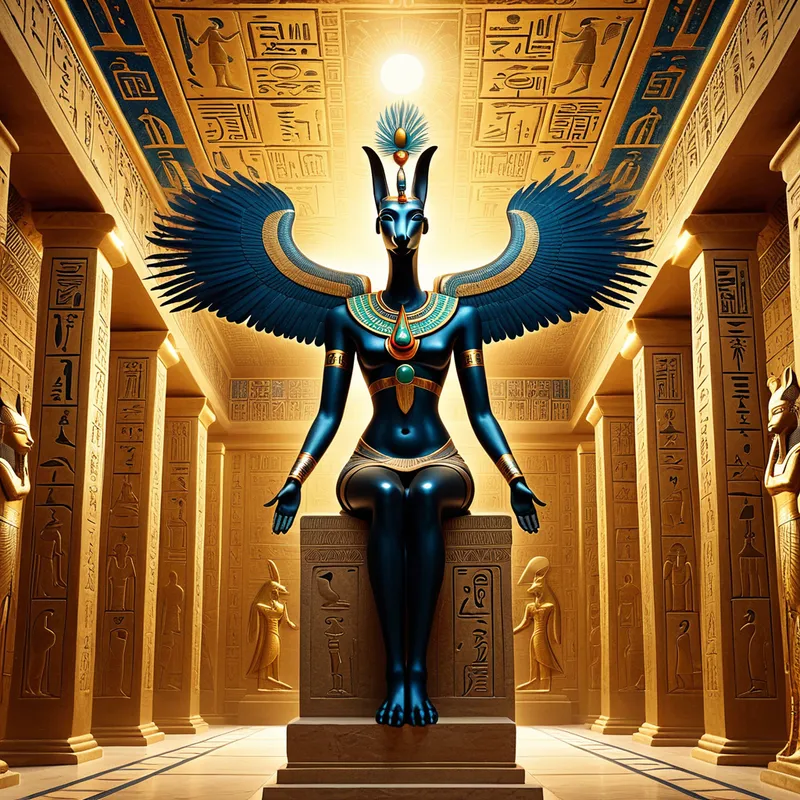
The Feather of Ma'at Myth Meaning & Symbolism
In the Hall of Two Truths, the deceased's heart is weighed against the Feather of Ma'at, a trial of cosmic truth that determines the soul's eternal fate.
The Tale of The Feather of Ma’at
The air in the Duat is not like the air of the living world. It is thick, silent, and smells of incense older than the pyramids. You do not walk here; you are drawn, a silent speck of consciousness pulled along a corridor of impossible length. The walls are not stone but the compressed memories of a million lifetimes, and the light comes from nowhere and everywhere at once.
At the end of this passage lies the Hall of Two Truths. Its ceiling is the night sky, but the stars are the unblinking eyes of the gods. In the center, upon a dais of black basalt, rests a scale of gold so pure it hums with a sound just below hearing. This is the instrument of your eternity.
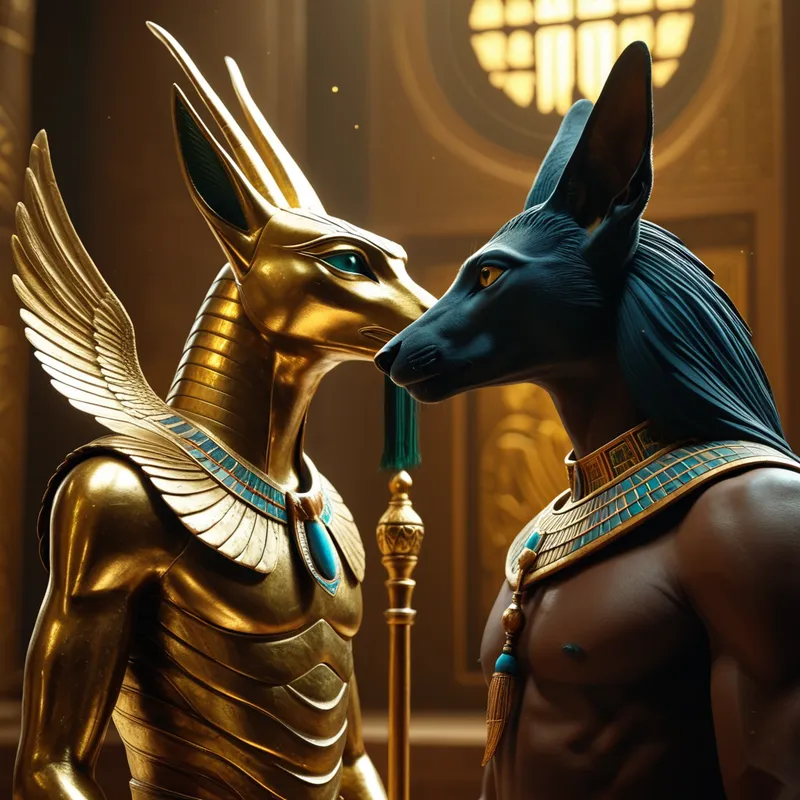
Presiding is Anubis, his form both man and sacred jackal. His eyes hold the patience of the desert and the sharpness of a predator. He does not speak, but his intention is clear: approach. With hands that have prepared countless pharaohs for this moment, he gestures. From your chest, not your physical form but the essence of your being, he draws forth your Ib, your heart. It is not a muscle of flesh, but a luminous, pulsing orb containing every deed, every word, every secret intention of your life. It flickers with the colors of your joys—bright gold and green—and smolders with the dark stains of your transgressions.
With infinite care, Anubis places this heart upon the left pan of the golden scale. It settles with a weight that seems to shake the very foundations of the Hall.
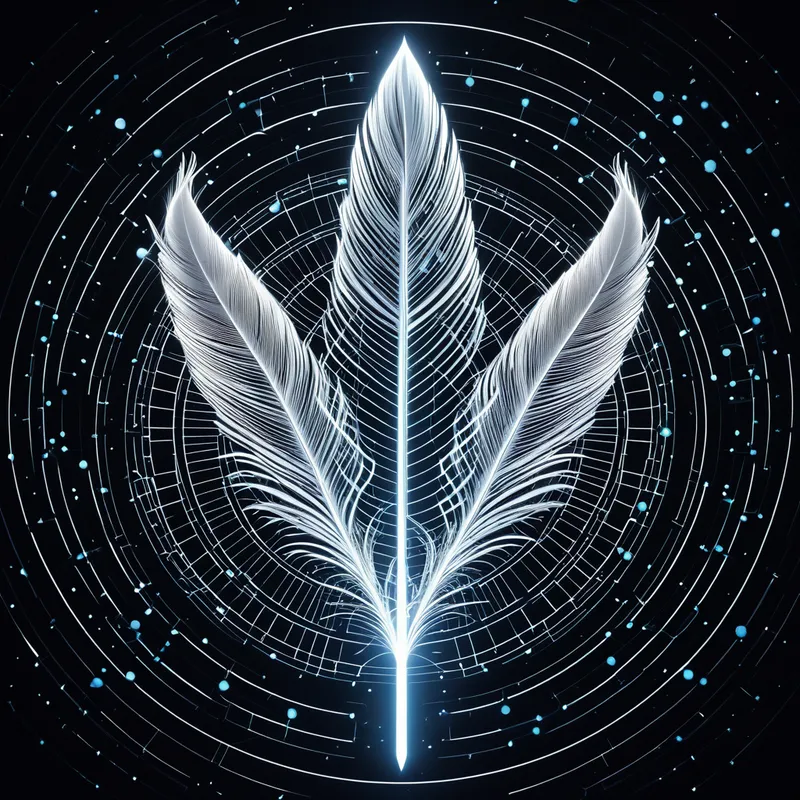
Then, from the shadows steps Ma’at. She is not merely a woman but the embodiment of a principle: the fundamental order that held chaos at bay at the dawn of creation. Upon her head is her feather, the Shut. It is not a mere plume but the physical form of truth itself—white, impossibly straight, lighter than a thought but heavier than a mountain of lies. She removes it and, with a gesture that is both offering and judgment, places it upon the right pan of the scale.
The hall holds its breath. The feather rests. Your heart rests. The balance beam begins its agonizingly slow oscillation. This is the Psychostasia. Up, down. A tremor. A stillness. The heart glows brighter, then dims, as if reacting to the scrutiny. You feel every moment of cowardice, every petty theft, every broken promise as a physical drag. You also feel every act of kindness, every truth spoken, every moment of courage as a lifting lightness.
Watching, recording, is Thoth, the scribe of the gods. He holds a palette and stylus, ready to inscribe the verdict into the fabric of eternity. And lurking in the shadows, a composite beast waits—part crocodile, part lion, part hippopotamus. This is Ammit, the Eater of Hearts. Her jaws are slack, her hunger infinite.
The beam slows. It steadies. It finds its equilibrium. The heart and the feather hang in perfect, mirrored balance. A profound silence, deeper than before, fills the Hall. Thoth’s stylus moves. Anubis gives a slow, grave nod. Ma’at retrieves her feather, and a sense of radiant, unshakeable order floods through you. You have passed. The Field of Reeds awaits. But had the heart sunk, had the feather risen… only the grinding jaws of Ammit and the second, final death of oblivion would have followed.
Cultural Origins & Context
This was not merely a story told for entertainment, but the central operating myth of Egyptian civilization for over three millennia. It was inscribed in the Book of the Dead, painted on tomb walls, and woven into the very fabric of ethical and legal thought. The myth was performed, not just narrated. Every funeral was a ritual re-enactment of this journey, with priests playing the roles of the gods, guiding the deceased’s spirit through the prescribed spells and declarations of innocence—the “Negative Confessions”—to prepare for the ultimate test.
Its societal function was profound. The Feather of Ma’at was the ultimate cosmic check and balance. It meant that not even the Pharaoh, a god on earth, was exempt from this final, impartial accounting. Ma’at was the principle that justified kingship (the Pharaoh was her steward), underpinned law (judges were “priests of Ma’at”), and defined morality. To live in Maat was to live in harmony with truth, community, and the cosmos. This myth provided the ultimate incentive: eternal life was not a gift, but a verdict earned through a life of integrity.
Symbolic Architecture
The myth presents a breathtakingly concise symbolic architecture for the human condition. The heart (Ib) is not the emotional organ of later traditions, but the total record of the conscious self—actions, thoughts, and will. The feather (Shut) represents the objective, impersonal standard of cosmic order and truth.
The ultimate judgment is not between good and evil, but between the weight of a constructed self and the weightlessness of pure truth.
The scale is the liminal space where the subjective self meets the objective principle. Anubis, as guide and operator, symbolizes the necessary, neutral function of the psyche that prepares the self for examination. Thoth represents the faculty of conscious awareness and record-keeping—the part of us that must witness and acknowledge the outcome. Ammit is the ultimate psychological consequence of failure: not punishment from an external god, but total psychic disintegration, the dissolution of a self that cannot bear the light of its own truth.
The Dreamer’s Resonance
When this myth pattern erupts in the modern dreamscape, the dreamer is in a profound state of self-assessment. The dream may not feature Egyptian iconography directly. Instead, one might dream of being on trial, of having one’s work scrutinized by a faceless panel, or of trying to balance two irreconcilable things. The somatic feeling is one of naked exposure and intense scrutiny.
Psychologically, this is the process of the conscience confronting the ego. The “feather” in the dream could be a simple, pure object—a white stone, a clean sheet of paper, a silent room—that acts as a mirror to the complicated, messy “heart” of the dreamer’s current life situation: a fraught relationship, a moral compromise at work, a buried guilt. The dream is the psyche’s own Hall of Two Truths, conducting an autonomous audit. The anxiety is the wobble of the scale. To dream of balance is to experience a profound, if temporary, resolution of inner conflict. To dream of failure and being consumed is a urgent warning from the deep self that one’s current path is leading to a loss of psychic integrity.

Alchemical Translation
In the alchemy of individuation—the Jungian process of becoming a whole, integrated self—the Weighing of the Heart is the quintessential model for the confrontation with the Shadow. The journey to the Duat is the descent into the unconscious. The heart we present is our conscious personality, our ego, which we believe to be “good enough.” But the Feather of Ma’at is the ruthless standard of the Self, the archetype of totality and truth.
The alchemical gold is not a life without fault, but a self that can stand in perfect equilibrium with its own truth, shadows included.
The work is not to create a spotless heart—an impossibility—but to consciously integrate the shadow material, to acknowledge the leaden weight of our failings and secrets, and through that very acknowledgment, transmute their density. When we consciously confess our “negative confessions” to ourselves, the shadow loses its destructive autonomy. It is brought to the scale. The role of Thoth is taken up by our active consciousness, witnessing and recording without denial. The triumph is not the absence of darkness, but the creation of a self whose total weight—light and dark, acknowledged and integrated—equals the feather of objective self-acceptance. We do not become pure feather; we become a heart so authentically itself that it can balance against one. This is the modern Field of Reeds: a state of being where one is at peace, not because one is perfect, but because one is whole.
Associated Symbols
Explore related symbols from the CaleaDream lexicon: