The Feast of the Gods Myth Meaning & Symbolism
A myth of divine ambition and cosmic consequence, where a mortal's transgression at a celestial banquet redefines the boundary between gods and humanity.
The Tale of The Feast of the Gods
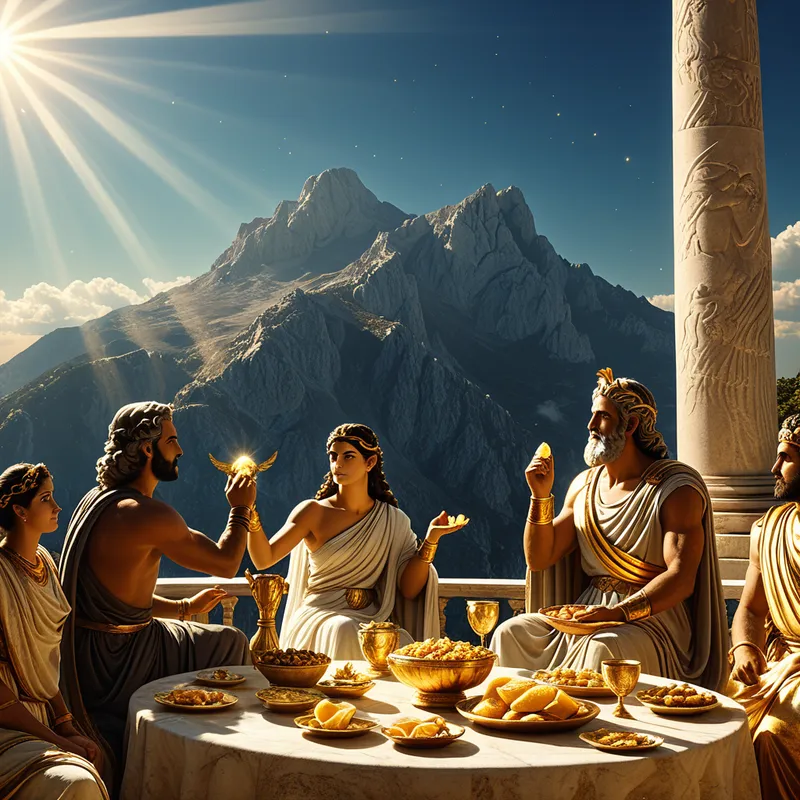
Hear now of the day the music of Olympus faltered, and the nectar turned to ash on divine tongues. It began, as all such tales do, in the golden light of favor. Tantalus, king of Sipylus, was no ordinary man. His veins sang with the ichor of Zeus himself, his father. For this blood-tie and his famed piety, the gates of heaven swung open for him. He walked where mortals dare not dream, into the very hall of the gods upon Mount Olympus.
The air was thick with the scent of ambrosia and the sound of immortal laughter. Hera sat in stern majesty, Apollo plucked a lyre that made the stars tremble, and Athena watched with her grey, knowing eyes. Tantalus reclined among them, a mortal shape in a sphere of radiance, drinking from a cup that never emptied. He felt the dizzying vertigo of inclusion, the warmth of divine fellowship. Yet, in his mortal heart, a worm of doubt began to gnaw. Was this honor real, or merely a patronizing nod from beings who saw him as a pet? A terrible, prideful thought took root: to test the omniscience he was meant to revere.
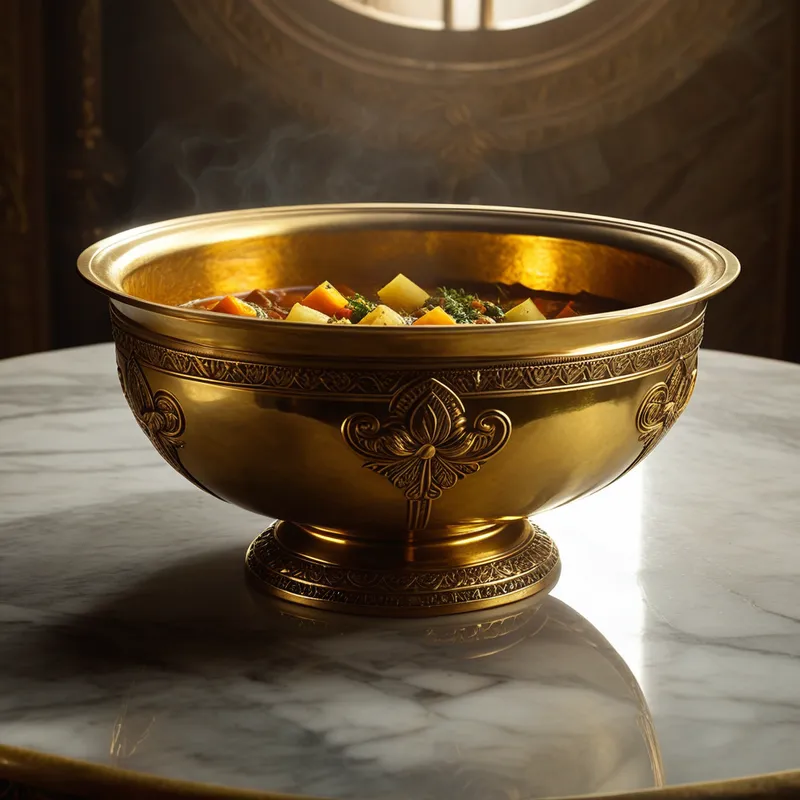
When the feast reached its zenith, and the gods called for a final, splendid dish to crown their celebration, Tantalus saw his moment. He retired to the private chambers granted to him and committed the unthinkable. With hands that had just broken bread with divinity, he slew his own son, Pelops. He butchered the boy, boiled his flesh in a great cauldron, and seasoned it with herbs and spices, crafting a rich, savory stew. A father’s love was sacrificed on the altar of a father’s pride.
He carried the steaming bowl back to the hall, its aroma mingling with the scent of nectar. He placed it before the gathered Olympians with a bowed head, hiding the monstrous triumph in his eyes. “A humble offering,” he said, “from a grateful guest.” For a breath, there was only silence. Then, the all-seeing eyes of the gods saw through the meat and broth to the horror beneath. All but one. Demeter, distraught over the recent loss of her daughter Persephone, her mind clouded by grief, absently took a morsel from the stew and ate.
The music died. The golden light seemed to curdle. In that moment, the fellowship shattered like dropped crystal. Zeus roared with a sound that shook the foundations of the world. The horror was not just at the act, but at the profound betrayal of xenia—the sacred guest-host bond that even gods upheld. Order itself had been poisoned.
The resolution was swift and terrible. The gods restored Pelops to life, his shoulder now gleaming ivory where Demeter had consumed it. But for Tantalus, there would be no restoration. His punishment was crafted as a perfect, eternal mirror of his crime. He was cast into the darkest pit of Hades, stood in a clear pool beneath a fruit-laden tree. Yet, whenever he stooped to drink, the water receded. Whenever he reached for fruit, the wind tossed the branches away. The feast was forever before him, forever denied. He was tantalized by the very substance of life he had so grotesquely violated. The music of the gods played on, but he would hear only the echo of his own endless, hungry silence.
Cultural Origins & Context
The myth of Tantalus and the Feast of the Gods is primarily preserved in the works of later poets like Pindar and the tragedians, particularly Euripides. It belongs not to the foundational epic cycles of Homer but to a rich tapestry of regional and moralistic tales that explored the limits of divine-mortal interaction. Its function was profoundly pedagogical for ancient Greek society. It served as a stark, terrifying reinforcement of the supreme cultural law: xenia. This code governed relationships between host and guest, stranger and citizen, and was believed to be under the direct protection of Zeus Xenios.
To violate xenia was to attack the very fabric of social and cosmic order. Tantalus’s crime was therefore a double blasphemy—against the gods directly, and against the principle they guarded most jealously. The myth also functioned as an etiological tale, explaining the origin of the curse upon the house of Atreus (descended from Pelops) and, by extension, the cycles of violence that would later plague heroes like Agamemnon. It was a story told to remind the powerful, especially kings and aristocrats who might see themselves as near-divine, of their inescapable mortal limits and the catastrophic consequences of overreaching pride, or hubris.
Symbolic Architecture
At its core, this myth is a chilling diagram of the psychology of belonging and the shadow of the privileged guest. Tantalus represents the part of the psyche that, granted access to a higher state (consciousness, community, grace), becomes paranoid about the authenticity of its welcome. His transgression is not born of simple evil, but of a twisted need to prove the limits of the authority that included him.
The ultimate betrayal is often committed not by the outsider, but by the insider who cannot trust the gift of belonging.
The Feast itself symbolizes the nourishing, life-giving aspect of the divine order—cosmos as a harmonious, sustaining system. The stew of Pelops is the introduction of chaos (chaos) into that cosmos: the hidden, putrefied truth of selfishness and doubt smuggled into the sanctuary. The gods’ immediate recognition symbolizes the principle that reality, especially psychic reality, cannot ultimately be deceived. What is repressed or disguised will be revealed. Demeter’s partial consumption signifies how trauma and grief (her own wound) can make one unconsciously partake of poison, ingesting a piece of the tragedy that then becomes a part of one’s restored being (Pelops’s ivory shoulder).
Tantalus’s eternal punishment is the perfect symbolic prison: an existence defined by the almost, the just-out-of-reach. It is the state of the ego that has severed its connection to the nourishing depths (the water) and the fruitful heights (the tree) through its own act of profound bad faith.

The Dreamer’s Resonance
When this myth stirs in the modern dreamscape, it rarely appears as a literal Olympian banquet. Instead, one may dream of being at an important professional dinner but finding one’s mouth full of sand, unable to speak or eat. Or of bringing a carefully prepared dish to a family gathering, only to have everyone recoil in horror as you lift the lid, though you see nothing wrong. These are somatic echoes of Tantalus’s dilemma.
The dreamer is likely grappling with a deep-seated “imposter syndrome” within a valued group—family, career, relationship. There is a felt inauthenticity, a fear that one’s acceptance is conditional or flawed. The psychological process is one of testing boundaries in destructive ways, often through self-sabotage or creating crises to “see if they really love/know/accept me.” The dream may point to a part of the self that feels it must offer up something precious (a Pelops-like innocence, creativity, or vulnerability) in a corrupted form to gain proof of belonging, thereby guaranteeing the rejection and exile it secretly fears. The torment of “tantalizing” near-fulfillment in the dream mirrors a waking life feeling of being perpetually on the verge of satisfaction, security, or integration, which forever slips away due to one’s own unconscious actions.

Alchemical Translation
The alchemical journey modeled here is the nigredo—the blackening, the putrefaction—that is a necessary, if horrific, stage in psychic transmutation. Tantalus’s act represents the ego’s catastrophic, willful shattering of a provisional wholeness (his favored status). He destroys his “divine child” (Pelops as potential, innocence, genuine connection) in a misguided opus to achieve a higher, more certain state of being. The result is not elevation, but a descent into the underworld of the psyche.
Individuation often requires a fall from a grace that was, upon examination, naively imagined. The true work begins in the Hades of self-confrontation.
The restoration of Pelops by the gods signifies that the core of the Self, the precious inner value, cannot be ultimately destroyed by the ego’s folly. It can, however, be forever altered—scarred with an ivory patch, a reminder of the cost. The modern individual’s “alchemical translation” lies in recognizing their own Tantalus-like gestures: the ways they poison their own feasts, test their relationships to destruction, and create their own private hells of unsatisfied longing.
The transmutation occurs when one ceases to reach outward for the receding water and fruit, and instead turns inward to ask: “What in me creates this perpetual hunger? What sacred bond with my own soul did I betray?” To integrate this myth is to accept that the feast of fulfillment is not granted by external gods or groups, but is co-created through genuine participation and respect for the sacred laws of one’s own being and the being of others. It is to learn that the only way to end the tantalizing torment is to stop enacting the crime of distrust against the source of one own life.
Associated Symbols
Explore related symbols from the CaleaDream lexicon: