The Feast of Lupercalia Myth Meaning & Symbolism
A primal Roman rite of purification and fertility, where priests ran through the city, striking women with februa to ensure health and drive out malevolent spirits.
The Tale of The Feast of Lupercalia
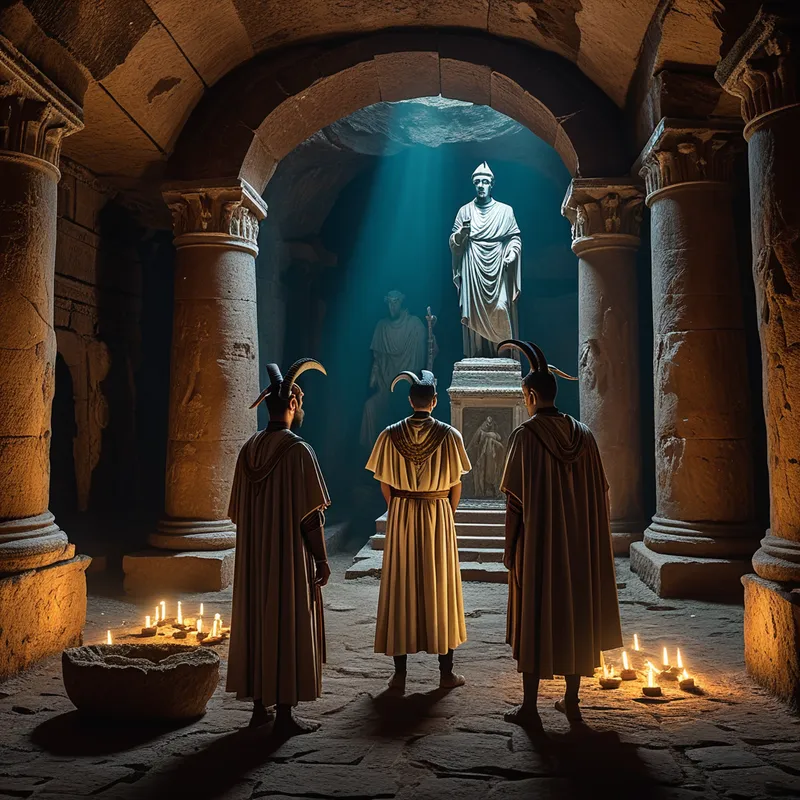
Hear now the tale of the running, the stripping, and the striking. It begins not in the sun, but in the deep, damp dark of the Lupercal. The air is thick with the smell of wet stone, animal musk, and cold earth. It is the Ides of Februarius, a time when the world is caught between death and life, when the last grip of winter lingers but the seed stirs blindly in the frozen ground.
Into this sacred grotto come the Luperci. They are young, vital, and their laughter echoes sharply off the walls, a sound both joyful and tense. Before them, two animals are brought: a goat, for fertility, and a dog, for purification. The knife flashes in the torchlight—a quick, stark motion. The blood is caught, smeared upon the foreheads of two chosen youths. As the warm blood touches their skin, a command is given, and they must laugh. This is the first magic: laughter in the face of death, a defiance of the grim season.
Then comes the stripping. The skins of the sacrificed goats are cut into thongs, the februa. The young men shed their tunics, wrapping themselves only in these bloody pelts. They are no longer merely citizens of Rome; they are something else. They have taken the wild into themselves. They become agents of Faunus Lupercus, the wolf-god, the horned one who guards the threshold.
And then, they run.
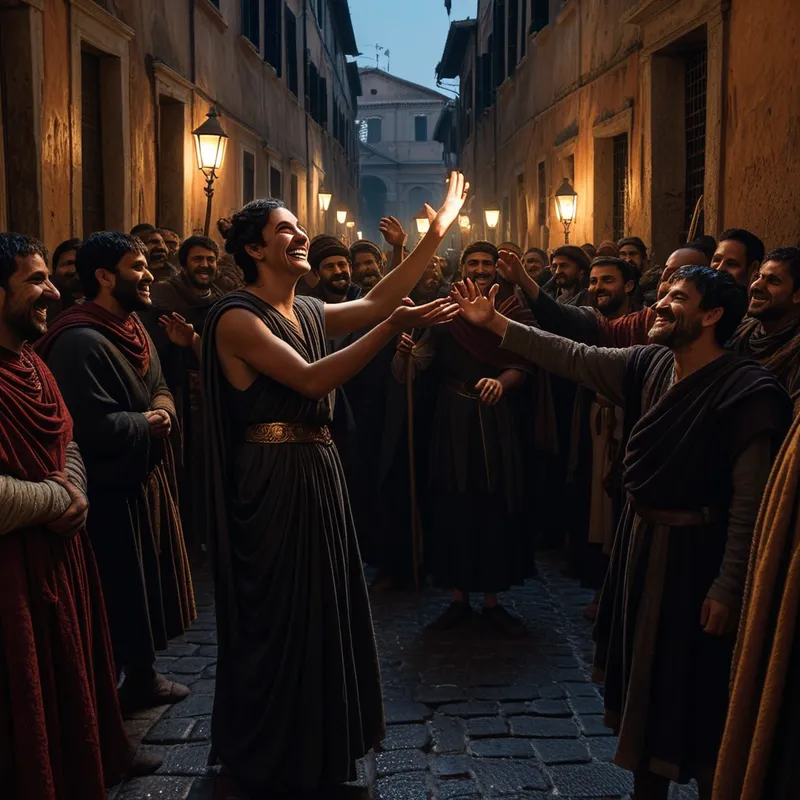
They burst from the cave’s mouth into the sharp light of the February day, a shouting, laughing, half-naked pack. They stream down the Via Sacra and through the Forum, a river of fur and flesh. The city holds its breath, then exhales in a roar. Women line the path, pushing forward, hands outstretched, faces turned upward in hope and a flicker of fear. They bare their arms, their backs. As the Luperci race past, they swing their februa. The strips of hide snap through the air, landing not with cruelty, but with a purposeful slap on waiting palms and offered shoulders.
Each strike is a blessing, a spark. It is said to ensure fertility, to ease the pains of childbirth, to drive out barrenness. But more than that, in that stinging contact, something invisible is driven out. The malaise of the long winter, the lingering spirits of ill-fortune, the stagnant air of a closed household—all are scattered by the wind of their passing and the touch of the wild hide. They run a circuit around the ancient boundary of the city, a living, breathing purification. They complete the circle, and the city, having been touched by chaos, is made whole again. The feast begins, but the heart of the myth is in the run, the strike, the wild laugh in the sacred dark.
Cultural Origins & Context
The Feast of Lupercalia was not merely a story told, but a story performed. Its roots are buried deep in the pre-Roman past of the Italic tribes, likely a pastoral rite for the protection of flocks from wolves (lupus) and for the encouragement of fertility. By the time of the late Republic and early Empire, it was a central, if notoriously chaotic, fixture of the Roman religious calendar, overseen by the ancient priesthood of the Luperci.
Its societal function was profoundly liminal. It served as a collective catharsis and a reset. In the heart of the ordered, rigidly structured Roman world, Lupercalia created a sanctioned space for controlled chaos. The noble youths, temporarily stripped of social status and clothing, became vessels of a primal force. The ritual touched directly on the most fundamental concerns of the state and family: health, fertility, and the purification of the community (Februarius derives from februum, meaning purification). It was a time when the wild, natural world, symbolized by Faunus and the wolf, was invited into the city not as an enemy to be destroyed, but as a necessary, cleansing power. The myth was passed down not in scrolls first, but in the pounding of feet on cobblestones and the collective memory of the sting that promised life.
Symbolic Architecture
At its core, Lupercalia is a myth of integration through controlled eruption. It presents a symbolic map for dealing with what is raw, instinctual, and “un-civilized” within both the individual and the collective psyche.
The Lupercal cave represents the womb of the unconscious, the dark place where undifferentiated instincts reside. The sacrifice signifies the necessary offering—the conscious ego must surrender something (its dignity, its order) to access this power. The transformation of the youths into Luperci clad in goat-skin is a ritualized possession by the Dionysian or wild-man archetype.
The blessing does not come from avoiding the wild, but from being skillfully struck by it.
The run itself is the critical symbol. It is the instinctual force (libido in its broadest sense) unleashed but channeled. It is not random destruction; it follows the sacred boundary (pomerium). The februa are the mediating objects—they are the raw hide of nature, fashioned into a tool that transmits vitality (fertility) and performs a cleansing exorcism (purification). The women who present themselves are not passive victims but active participants seeking this ambiguous, powerful contact. The myth asserts that fertility—creative power—and purification—the removal of psychic toxins—are two sides of the same coin, both activated by an encounter with the untamed.

The Dreamer’s Resonance
When this myth stirs in the modern dreamer, it often signals a psyche grappling with the tension between over-civilization and a stifled instinctual life. To dream of being chased or touched by a wild, half-animal figure may not be a nightmare, but an invitation.
Somatically, the dream may be preceded by feelings of stagnation, “sterility” in projects or relationships, or a vague sense of being haunted by old patterns (the “spirits” of winter). The psyche is preparing a februum—a purification. The running figures in a dream represent autonomous complexes, bundles of instinctual energy, breaking free from their cave. If the dreamer is one of the runners, it may indicate a conscious or unconscious engagement with one’s own wild, rebellious, or highly creative energies. If the dreamer is among those struck, the psyche is positioning itself to receive a necessary, perhaps startling, infusion of vitality or a clearing of obstructive energies. The sting of the strike in the dream translates to the often uncomfortable but awakening jolt of confronting repressed aspects of the self.
Alchemical Translation
The alchemical process mirrored in Lupercalia is solutio (dissolution) followed by coagulatio (coagulation). The rigid, ordered persona (the clothed noble youth) is dissolved in the dark cave of the unconscious (the nigredo). This is the sacrifice, the laughter in the face of the shadow. The ego is stripped and re-clad in the skin of the instinctual self—a temporary but total identification with the wild.
The individuation run is not a straight path to a goal, but a circular purification of the boundaries of the self.
The subsequent run is the albedo, the whitening. The unleashed energy is not left to rampage; it is given a sacred task: to circuit the boundaries of the self. The strikes of the februa are the moments of insight and confrontation where this raw energy “touches” and transforms stagnant psychic content—old wounds, frozen potentials, sterile attitudes. The fertility promised is the birth of new psychic structures; the purification is the scouring away of what hinders life.
For the modern individual, the myth models a profound truth: wholeness is not achieved by banishing the primitive, but by ritually inviting it in, clothing oneself in its power for a time, and directing that force to cleanse and fertilize the inner world. The feast that follows is the conscious integration of that experience, a celebration of a self made more vibrant and complete because it has dared to run with the wolves, and in doing so, has protected its own hearth.
Associated Symbols
Explore related symbols from the CaleaDream lexicon: