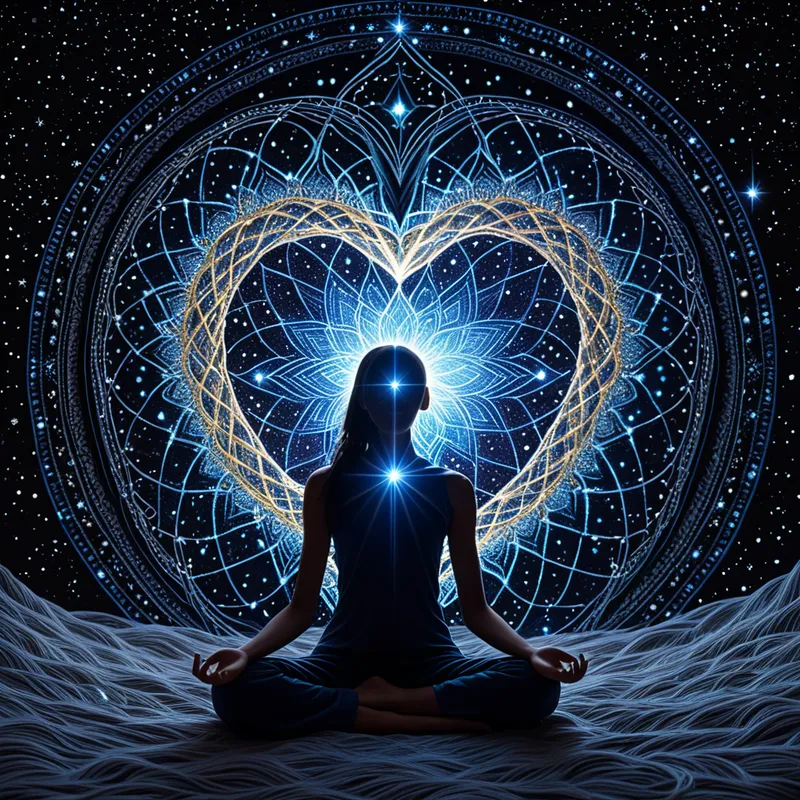
The Fatesspinning Myth Meaning & Symbolism
A cosmic entity weaves the threads of destiny, binding all lives into a single, intricate tapestry of fate and free will.
The Tale of The Fatesspinning
Listen. Before the first word was spoken, before the first star drew its fiery breath across [the void](/myths/the-void “Myth from Buddhist culture.”/), there was the hum. A low, resonant thrumming in the absolute dark, the sound of potential waiting to be born. And from that hum emerged the Weaver, known in the oldest whispers as The Fatesspinner.
No eyes have ever truly seen the Spinner, for it is not a form but a function, a ceaseless motion at the core of things. Yet, the stories say if you could perceive it, you would see a being of sublime and terrible focus, seated at the loom of eternity. From its left hand flows the raw, unspun stuff of possibility—silver mist, [stardust](/myths/stardust “Myth from Scientific culture.”/), and the breath of unborn souls. This is the Primordial Fluff. With a touch, the Spinner draws out a single, luminous filament.
The right hand holds the spindle, an object that is both tool and axis of all worlds. As the spindle turns, the filament is drawn, twisted, given strength and direction. This is the moment of becoming. The thread now holds a quality—a destiny of joy, a strand of sorrow, a length of struggle, a filament of peace. No thread is purely one [thing](/myths/thing “Myth from Norse culture.”/); each is a subtle braid of all possibilities, its dominant hue determined by the Spinner’s intent and the tension of the spin.
And then, the weaving. The loom is vast beyond comprehension, its warp threads the fixed points of cosmic law—gravity, time, death, love. The Spinner’s shuttle, flying with the speed of thought, passes the fate-threads through this warp. Here, a thread of a great leader crosses the warp of ambition; there, a thread of a simple farmer intersects the warp of contentment. Where threads cross, they knot. A knot of meeting. A knot of conflict. A knot of love. A knot of loss. Each knot a moment of consequence, binding one life to another, one choice to a thousand ripples.
The tapestry grows. It is not a flat cloth but a living, breathing, multidimensional web. It contains every sunrise that ever was or will be, every tear shed in darkness, every burst of laughter in the light. You can see the glittering thread of a galaxy being born, and right beside it, the faint, brave strand of a mayfly’s single day. All are connected. All are necessary. The Spinner works without pause, without judgment, a silent architect of the grand pattern.
Yet, the oldest verse speaks of a single, eternal rule: the thread, once spun, must be woven. But the tension of the weave is not fixed. A thread pulled too taut may snap. A thread left too slack may tangle. The beauty and the terror of the tapestry lie in this delicate balance—the unchangeable fact of the thread, and the mutable give-and-take of its place in the whole.
And so the hum continues, the spindle turns, the shuttle flies. The story is never finished, for with every breath taken by every creature in every world, a new filament is drawn from [the mist](/myths/the-mist “Myth from Celtic culture.”/), and [the great work](/myths/the-great-work “Myth from Alchemical culture.”/) goes on.
Cultural Origins & Context
The myth of the Fatesspinning is perhaps humanity’s most universal story, appearing not as a single narrative but as a profound archetypal pattern. We find its echoes in the [Norns](/myths/norns “Myth from Nordic culture.”/) of Scandinavia, who carve [runes](/myths/runes “Myth from Norse culture.”/) of destiny at the foot of [Yggdrasil](/myths/yggdrasil “Myth from Global/Universal culture.”/). It whispers in the Greek [Moirai](/myths/moirai “Myth from Greek culture.”/)—Clotho, Lachesis, and Atropos. It is present in the concept of Qadar, the divine decree, and in the Hindu Dharma, the righteous order that upholds creation.
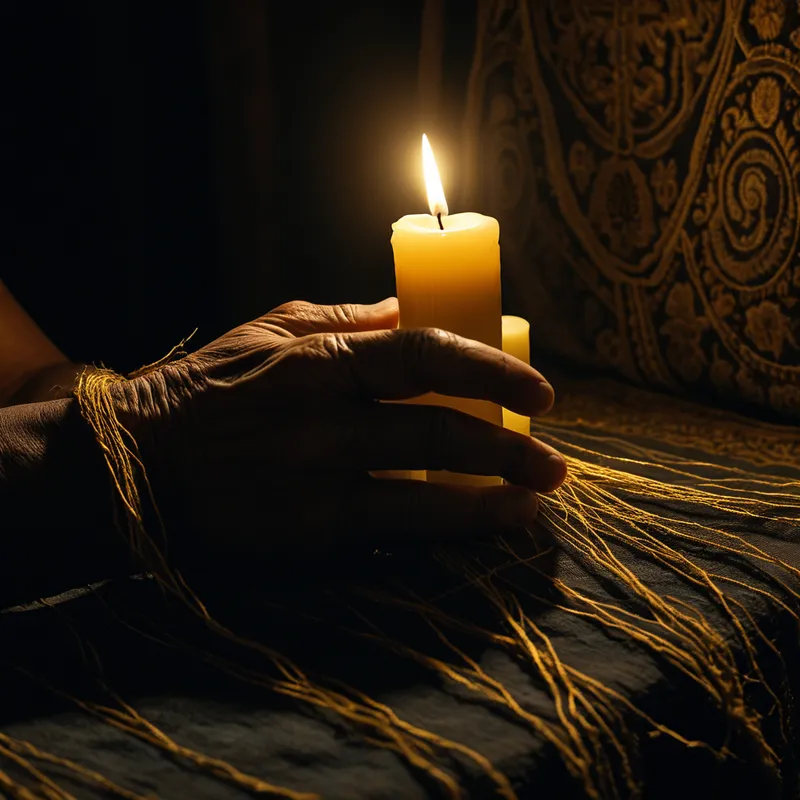
This was not a myth confined to temples or holy books. It was a story told by grandmothers at [the hearth](/myths/the-hearth “Myth from Norse culture.”/), its rhythm matching the turn of the spinning wheel. It was invoked by sailors reading the tangled lines of [the sea](/myths/the-sea “Myth from Greek culture.”/), by farmers sensing the weave of the seasons, by lovers feeling the inexplicable pull of a knot tied long before their birth. Its societal function was foundational: it provided a cosmology of connection. It answered [the child](/myths/the-child “Myth from Alchemy culture.”/)’s question of “why?” with an image of profound, if mysterious, interdependence. It taught that no life, however small, was an isolated strand. Your sorrow was part of a pattern that also contained another’s joy; your action pulled on threads far beyond your sight.
Symbolic Architecture
At its [heart](/symbols/heart “Symbol: The heart symbolizes love, emotion, and the core of one’s existence, representing deep connections with others and self.”/), the Fatesspinning is a supreme [metaphor](/symbols/metaphor “Symbol: A figure of speech where one thing represents another, often revealing hidden connections and deeper truths through symbolic comparison.”/) for the [psyche](/myths/psyche “Myth from Greek culture.”/)’s [relationship](/symbols/relationship “Symbol: A representation of connections we have with others in our lives, often reflecting our emotional state.”/) with determinism and agency. The Fatesspinner represents the unconscious, impersonal ground of being—[the Self](/myths/the-self “Myth from Jungian culture.”/), in Jungian terms, which generates the raw [material](/symbols/material “Symbol: Material signifies the tangible aspects of life, often representing physical resources, desires, and the physical world’s influence on our existence.”/) of our potentialities (the Primordial Fluff). The spinning is the process of incarnation, where [infinite possibility](/symbols/infinite-possibility “Symbol: A spiritual symbol representing boundless potential, cosmic freedom, and the dissolution of limitations in consciousness.”/) is narrowed into the specific “thread” of a single [life](/symbols/life “Symbol: The symbol of ‘Life’ represents a journey of growth, interconnectedness, and existential meaning, encompassing both the joys and challenges that define human experience.”/) with its inherent tendencies, gifts, and challenges.
The thread is your fate—the facts of your birth, your innate temperament, the unavoidable events that befall you. The weave is your life—how you relate those facts to the world, the tension you hold in relationship, the pattern you co-create.
The loom’s warp—cosmic law—symbolizes the objective, collective structures of [reality](/symbols/reality “Symbol: Reality signifies the state of existence and perception, often reflecting one’s understanding of truth and life experiences.”/): biology, [physics](/symbols/physics “Symbol: Physics in dreams represents the desire to understand life’s fundamental rules, patterns, and predictable outcomes through playful exploration.”/), societal norms, archetypal patterns. The shuttle’s [flight](/symbols/flight “Symbol: Flight symbolizes freedom, escape, and the pursuit of one’s aspirations, reflecting a desire to transcend limitations.”/) is the relentless forward [motion](/symbols/motion “Symbol: Represents change, progress, or the flow of life energy. Often signifies transition, personal growth, or the passage of time.”/) of chronological time. The knots are the moments of [synchronicity](/symbols/synchronicity “Symbol: Meaningful coincidences that suggest an underlying connection between events, often interpreted as guidance or confirmation from the universe.”/), meaningful coincidence, where inner [fate](/symbols/fate “Symbol: Fate represents the belief in predetermined outcomes, suggesting that some aspects of life are beyond human control.”/) (the thread) and outer circumstance (the warp) intersect in a way that feels destined.
The myth’s deepest wisdom is its non-duality. It does not preach passive [acceptance](/symbols/acceptance “Symbol: The experience of being welcomed, approved, or integrated into a group or situation, often involving validation of one’s identity or actions.”/) of a rigid [destiny](/symbols/destiny “Symbol: A predetermined course of events or ultimate purpose, often linked to spiritual forces or cosmic order, representing life’s inherent direction.”/), nor does it champion a fantasy of absolute free will. Instead, it presents a third thing: patterned participation. We are given a thread, but we influence the [tension](/symbols/tension “Symbol: A state of mental or emotional strain, often manifesting physically as tightness, pressure, or unease, signaling unresolved conflict or anticipation.”/), the drape, and the [beauty](/symbols/beauty “Symbol: This symbol embodies aesthetics, harmony, and the appreciation of life’s finer qualities.”/) of the [knot](/symbols/knot “Symbol: A knot symbolizes connections, commitments, complications, and the binding or untying of relationships and situations.”/) where we meet others.
The Dreamer’s Resonance
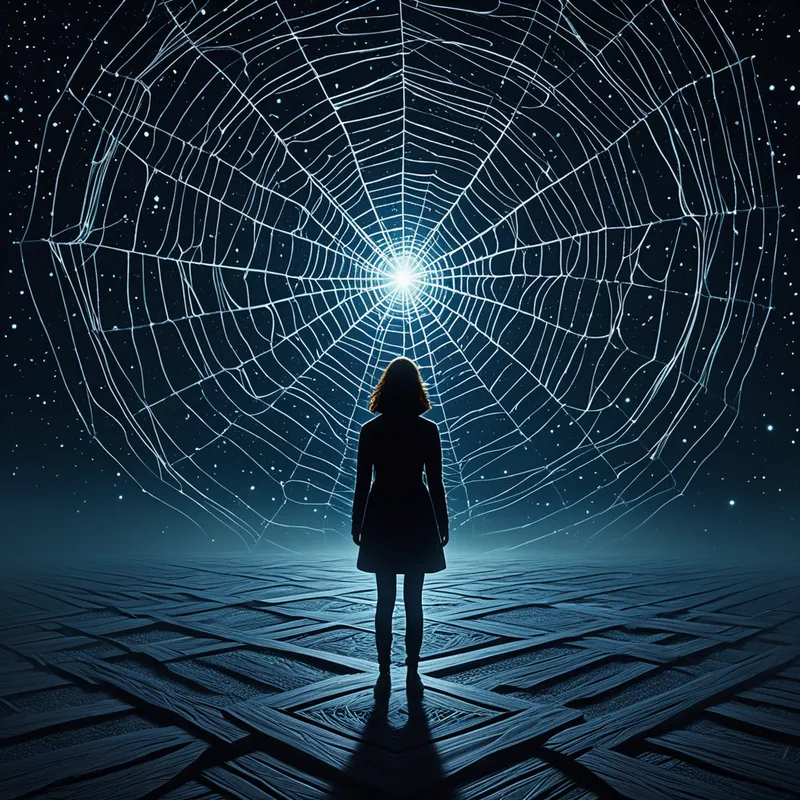
When this myth activates in the modern psyche, it often surfaces in dreams of webs, nets, intricate knitting, or being guided to mend a specific piece of fabric. The dreamer may find themselves in a vast room with a humming machine (the loom), feeling awe or anxiety. They may dream of holding a thread that connects to everything, or of a tangled mess they feel compelled to unsnarl.
Somatically, this can correlate with feelings of being “wired” or “strung tight,” or conversely, of feeling “unraveled” and lacking structure. Psychologically, these dreams mark a confrontation with the archetype of meaning. The dreamer is processing a life event that feels fated—a meeting, a loss, a diagnosis—and is struggling to integrate it into their sense of self. The dream is the psyche’s way of saying, “This is part of your thread. Now, how will you weave it?” The tangled dream is an invitation to examine where one’s agency has become slack, where one is resisting the necessary tension of their own growth.
Alchemical Translation
The individuation process, the alchemical Opus, is mirrored perfectly in the myth. [The first stage](/myths/the-first-stage “Myth from Alchemical culture.”/), [nigredo](/myths/nigredo “Myth from Alchemical culture.”/) (the blackening), is the recognition of the thread itself—confronting one’s inherent limitations, one’s “fate.” This is the dark, unspun Primordial Fluff, the chaotic potential that feels overwhelming.
Albedo (the whitening) is the spinning—the conscious effort to draw out a coherent identity from that chaos, to understand one’s core nature. This is the hard work of self-knowledge.
The ultimate alchemy is not in changing your thread, but in realizing you are both the thread and the weaver. The hands that work the loom are your own conscious attention.
Citrinitas (the yellowing) and [rubedo](/myths/rubedo “Myth from Alchemical culture.”/) (the reddening) are the weaving and the appreciation of the tapestry. This is where the individual, having come to terms with their own thread, begins to see its necessary place in the larger pattern. They move from ego-centricity (“my thread is the most important”) to cosmos-centricity (“my thread is essential to the whole”). The [triumph](/myths/triumph “Myth from Roman culture.”/) is not autonomy, but harmonious connection. The modern individual’s task is to spin their awareness with intention and then to weave their life with compassion, understanding that every relationship, every choice, is a knot that alters the grand design. In doing so, they participate in the Fatesspinning, becoming a conscious co-creator within the great, humming loom of existence.
Associated Symbols
Explore related symbols from the CaleaDream lexicon: