The Fates' Thread Myth Meaning & Symbolism
Three ancient goddesses spin, measure, and cut the thread of life for every mortal and god, weaving destiny into an unbreakable cosmic tapestry.
The Tale of The Fates’ Thread
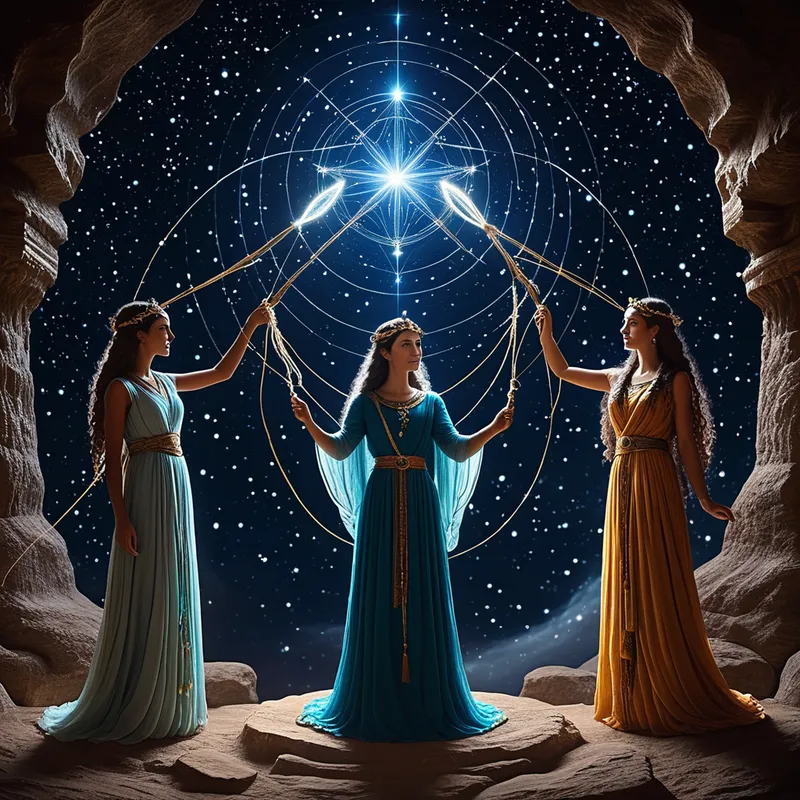
Listen, and hear the hum that underlies [the world](/myths/the-world “Myth from Tarot culture.”/). It is not [the wind](/myths/the-wind “Myth from Various culture.”/) in the olive groves, nor the crash of the wine-dark sea. It is the low, eternal drone of the spindle, turning in a place beyond time. Here, in a cave where the roots of the Okeanos drink from [the void](/myths/the-void “Myth from Buddhist culture.”/), [three sisters](/myths/three-sisters “Myth from Native American culture.”/) tend the loom of existence.
They are the [Moirai](/myths/moirai “Myth from Greek culture.”/), daughters of primordial Nyx, and their names are whispered with awe and dread. The eldest is Klotho. Her fingers, gnarled and swift as a [spider](/myths/spider “Myth from Native American culture.”/)’s, draw the raw stuff of potential from a mist of star-stuff and breath. She teases it, twists it, and with a turn of her spindle, a single, shimmering thread is born. It pulses with the first cry of a newborn, the first beat of a heart, the first thought of a soul. It is life, pure and unformed.
The thread passes to the second sister, Lachesis. Her eyes are not like ours; they see not forward or backward, but through. She gazes at the newborn thread and perceives its entire length in a single, silent moment. With hands that are both gentle and implacable, she measures it against a rod of celestial ivory. She determines its span—the years of obscurity, the moments of glory, the long stretches of quiet toil. She allocates its portion of joy and sorrow, love and loss. Her touch is not cruel, but it is absolute. The thread now has a shape, a destiny.
Finally, it comes to the youngest, Atropos. Do not be deceived by her title; she is ancient, older than the mountains. In her lap rests a pair of shears, their blades forged from a metal that drinks light. She waits. She watches the thread, now glowing with the lived experience of its journey, as it plays out across the loom of the cosmos. She feels its vibrations—the crescendo of a great deed, the dimming pulse of illness, the final, weary sigh. And when the measure is full, when the last note of the allotted song has been sung, her hand, which never trembles, closes the shears. Snip. The sound is softer than a falling leaf, yet it echoes in the halls of Zeus himself. The light of the thread winks out. Its story is complete, woven forever into the vast, unfathomable tapestry that hangs behind the sisters, the record of all that was, is, and will be.
Gods and mortals alike are subject to this hum, this spin, this cut. Even mighty Zeus may tilt the scale, but he cannot break the thread. It is the first law and the last. [The cave](/myths/the-cave “Myth from Platonic culture.”/) is silent save for the hum, and Klotho’s fingers are already moving, drawing forth another glimmer from the void.

Cultural Origins & Context
The myth of the Moirai is not a story with a single author, but a deep, cultural bedrock. It predates the Olympian [pantheon](/myths/pantheon “Myth from Roman culture.”/), emerging from the chthonic (earthly) and primordial layers of Greek belief. They were originally conceived not as personalized goddesses, but as an impersonal, distributed force—moira, meaning “portion” or “share.” Every being, from a king to a slave, had their moira, their allotted lot in life.
This concept was central to the Greek worldview, providing a framework for understanding fortune, misfortune, and the limits of human and divine action. The myth was passed down through the oral tradition of epic poetry, most notably in Hesiod’s Theogony, where their lineage from Nyx (Night) establishes their fundamental, pre-Olympian authority. They appear in the tragedies of Aeschylus and Sophocles, where characters grapple with the terrifying intersection of their own choices and the unyielding thread of destiny.
Societally, the myth functioned as a profound container for anxiety. In a world of plagues, wars, and sudden death, the idea of a measured, allotted span gave a semblance of order to chaos. It was a comfort and a terror: your life had a shape and a purpose, but its end was fixed and irrevocable. Rituals, from birth ceremonies to funeral rites, were ways of honoring one’s moira and appeasing the powers that governed it.
Symbolic Architecture
The [symbolism](/symbols/symbolism “Symbol: The use of symbols to represent ideas or qualities, often conveying deeper meanings beyond literal interpretation. In dreams, it’s the language of the unconscious.”/) of [the Fates](/myths/the-fates “Myth from Greek culture.”/) is a tripartite [map of existence](/symbols/map-of-existence “Symbol: The Map of Existence symbolizes the intricate blueprint of life, representing the interconnectedness of experiences, choices, and the journey of self-discovery.”/) itself, a psychological model of time and [consciousness](/symbols/consciousness “Symbol: Consciousness represents the state of awareness and perception, encompassing thoughts, feelings, and experiences.”/).
Klotho (The Spinner) represents the raw potential of the present [moment](/symbols/moment “Symbol: The symbol of a ‘moment’ embodies the significance of transient experiences that encapsulate emotional depth or pivotal transformations in life.”/), the point of [emergence](/symbols/emergence “Symbol: A process of coming into being, rising from obscurity, or breaking through a barrier, often representing birth, transformation, or revelation.”/). She is the creative [impulse](/symbols/impulse “Symbol: A sudden, powerful urge or drive that arises without conscious deliberation, often linked to primal instincts or emotional surges.”/), the spark of [life](/symbols/life “Symbol: The symbol of ‘Life’ represents a journey of growth, interconnectedness, and existential meaning, encompassing both the joys and challenges that define human experience.”/), the initial conditions set at [birth](/symbols/birth “Symbol: Birth symbolizes new beginnings, transformation, and the potential for growth and development.”/)—our genetics, our [family](/symbols/family “Symbol: The symbol of ‘family’ represents foundational relationships and emotional connections that shape an individual’s identity and personal development.”/), our innate talents. She is the arche (beginning), the endless possibility contained in the “now.”
The thread begins not with a plan, but with a twist of potential from the formless void.
Lachesis (The Measurer) symbolizes the unfolding of time and the development of [character](/symbols/character “Symbol: Characters in dreams often signify different aspects of the dreamer’s personality or influences in their life.”/). She is the process of living, where potential meets circumstance. Her measurement is not a predetermined [script](/symbols/script “Symbol: The symbol of ‘script’ indicates a narrative or roadmap for one’s life, representing the conscious and unconscious stories we tell ourselves.”/), but the allocation of experiences—the challenges, loves, losses, and triumphs that stretch and test the thread. She represents the [narrative arc](/symbols/narrative-arc “Symbol: A narrative arc represents the structured path that a story follows from introduction to resolution, reflecting growth and transformation.”/) of a life, the choices that give it unique contour and [length](/symbols/length “Symbol: Length in dreams often represents the measure of time, distance, and the emotional investment in pursuit of goals.”/).
Atropos (The Cutter) embodies necessity, limit, and completion. She is the end that gives meaning to the middle. Psychologically, she represents the necessary endings that make growth possible: the [death](/symbols/death “Symbol: Symbolizes transformation, endings, and new beginnings; often associated with fear of the unknown.”/) of [the ego](/myths/the-ego “Myth from Jungian culture.”/), the closing of chapters, the [acceptance](/symbols/acceptance “Symbol: The experience of being welcomed, approved, or integrated into a group or situation, often involving validation of one’s identity or actions.”/) of [mortality](/symbols/mortality “Symbol: The awareness of life’s finitude, often representing transitions, impermanence, or existential reflection in dreams.”/). She is the final [integration](/symbols/integration “Symbol: The process of unifying disparate parts of the self or experience into a cohesive whole, often representing psychological wholeness or resolution of internal conflict.”/), where the lived [story](/symbols/story “Symbol: The symbol of ‘Story’ represents the narrative woven through our lives, embodying experiences, lessons, and emotions that shape our identities.”/) becomes a whole, finished [thing](/myths/thing “Myth from Norse culture.”/).
The thread itself is the individuated [psyche](/myths/psyche “Myth from Greek culture.”/)—the [soul](/symbols/soul “Symbol: The soul represents the essence of a person, encompassing their spirit, identity, and connection to the universe.”/), [the self](/myths/the-self “Myth from Jungian culture.”/), the [continuum](/symbols/continuum “Symbol: A philosophical concept representing an unbroken sequence or progression where all points are connected without gaps, often symbolizing the flow of time, existence, or consciousness.”/) of consciousness. It is vulnerable, luminous, and singular. The [tapestry](/symbols/tapestry “Symbol: The tapestry represents interconnected stories, creativity, and the weaving of personal and collective experiences into a cohesive narrative.”/) is the [collective unconscious](/symbols/collective-unconscious “Symbol: The Collective Unconscious refers to the part of the unconscious mind shared among beings of the same species, embodying universal experiences and archetypes.”/), the interconnected web of all lives and [stories](/symbols/stories “Symbol: Stories symbolize the narratives of our lives, reflecting personal experiences and collective culture.”/), the [pattern](/symbols/pattern “Symbol: A ‘Pattern’ in dreams often signifies the underlying structure of experiences and thoughts, representing both order and the repetitiveness of life’s situations.”/) that emerges from the interplay of countless individual threads.
The Dreamer’s Resonance
When the motif of the Fates’ Thread appears in modern dreams, it signals a profound engagement with the archetypal forces of destiny and agency. The dreamer is not merely recalling a myth; they are experiencing its dynamics somatically within their own psyche.
To dream of spinning or tangling thread often coincides with a period of new beginnings, creative projects, or feeling that one’s life force is being actively shaped—perhaps by external pressures (the “tangling”) or by a newfound sense of purpose (the “spinning”). It is the Klotho phase: a somatic sense of potential being drawn forth, often accompanied by anxiety or excitement.
A dream of measuring a length of string, road, or life against a ruler speaks to the Lachesis function. The dreamer is in a phase of assessment, taking stock of their path, their time, their choices. There may be a feeling of destiny or “rightness,” or conversely, a panic that time is running out. The body may feel stretched thin or pulled in a specific direction.
The most potent and often alarming dream is of scissors, shears, or sudden severing. This is Atropos breaking into consciousness. It rarely signifies literal physical death. Instead, it heralds a necessary psychological death: the end of a relationship, a career, an identity, or a long-held belief. The somatic sensation can be one of shocking release, sudden emptiness, or a clean, cold cut. It is the psyche’s brutal, efficient way of forcing an ending to make space for a new beginning.
Alchemical Translation
The journey of individuation—the process of becoming a whole, integrated Self—is perfectly modeled by the triad of the Fates. It is an alchemical operation on the soul’s thread.
The [Nigredo](/myths/nigredo “Myth from Alchemical culture.”/), or blackening, is found in the raw, unspun mass before Klotho. It is the chaotic, unconscious potential of the psyche, the [prima materia](/myths/prima-materia “Myth from Alchemical culture.”/) of the self. The first alchemical work is to “spin” this material—to engage in conscious self-reflection, to draw forth the latent talents and wounds that define our initial condition.
The Albedo, or whitening, is the long work of Lachesis. As we live, we measure ourselves against our experiences. This is the stage of conscious living, analysis, and differentiation. We encounter our trials (the stretching of the thread) and our joys (its luminous periods). We work to understand our personal myth, our allotted portion. This is the refinement, the washing clean through experience and insight.
The final cut is not an annihilation, but the signature that authenticates the masterpiece.
The [Rubedo](/myths/rubedo “Myth from Alchemical culture.”/), the reddening or culmination, is achieved only through the acceptance of Atropos’s shears. In psychological terms, this is the sacrifice of the ego’s illusion of control and permanence. It is the conscious integration of one’s mortality and limits. To embrace one’s “cutting” is to achieve wholeness; it is to look back on the completed pattern of one’s life—with all its knots, colors, and lengths—and see it as a necessary and beautiful whole. The thread ends, but its pattern is forever woven into the great tapestry of being. The modern individual’s alchemy is to spin with intention, measure with wisdom, and, when the time comes, to meet the shears not with terror, but with the solemn recognition of a story fully told.
Associated Symbols
Explore related symbols from the CaleaDream lexicon: