The Faravahar Symbol Myth Meaning & Symbolism
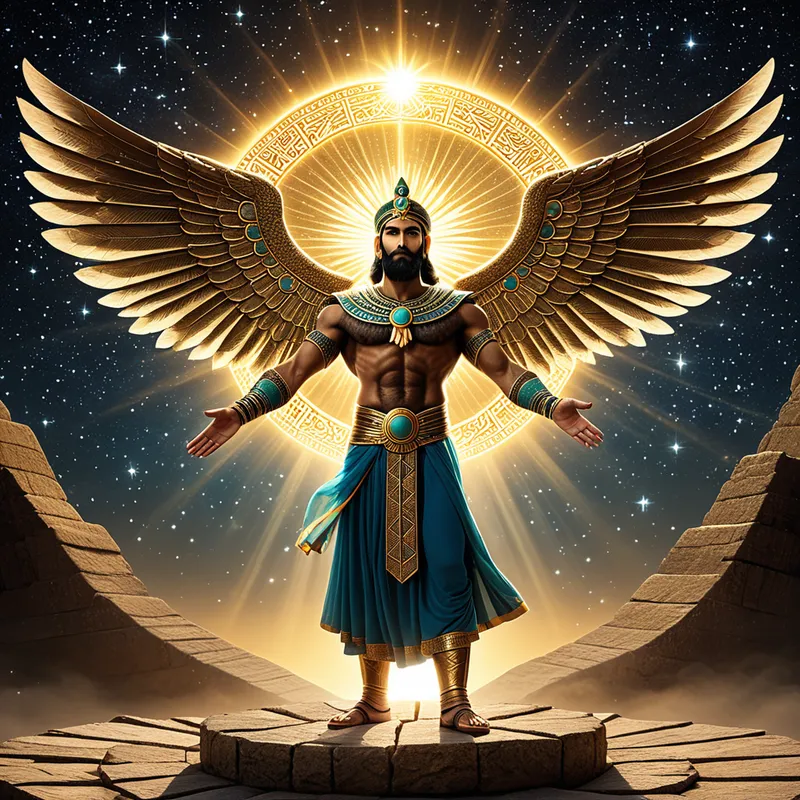
A winged figure emerges from the sun, holding the ring of covenant, embodying the soul's divine choice between truth and falsehood on its eternal journey.
The Tale of The Faravahar Symbol
Listen, and let the dust of ages settle. Before empires of stone, before the first fires were lit in hearths, there was the Light. Not the light of sun or flame, but the First Light, [Ahura Mazda](/myths/ahura-mazda “Myth from Persian culture.”/), the Wise Lord, whose very thought spun the fabric of the cosmos. From this boundless radiance, a concept took form, not as a god, but as a principle made manifest—a guardian, a guide, a divine echo of the soul itself.
It appeared in the space between spaces, where the music of the spheres hums its eternal tune. Behold the Faravahar! Its face is that of a sage, bearded and ancient, yet ageless, gazing forward with eyes that have witnessed the birth of stars. From its shoulders erupt two magnificent wings, each feather a blade of ordered light, tiered in three rows—a testament to the sacred triad: Good Thoughts, Good Words, Good Deeds. Its body, robed in the majesty of kings, does not walk but floats, for it is a being of spirit, not clay.
In its hand, it holds a ring. This is no mere ornament, but the Ring of Covenant, the promise between the Creator and the Created. The other hand points forward, a single finger directing all who see it toward the one path, the straight path of Asha. But below, a second ring hangs, and from it flow two ribbons. These are not decorations, but the twin currents of existence. One ribbon curls toward the figure, representing the pull of Asha, of harmony and truth. The other streams away, the seductive drift toward Druj, the Lie, the chaos that seeks to unravel the world.
This is the moment the symbol captures for all eternity: not a battle, but a choice. The figure does not fight the ribbons; it acknowledges them. It is the eternal witness at the crossroads of every soul’s journey. It is the divine blueprint within each human, the Fravashi, that part of us which chose, before time, to enter the material world and fight for the Light. It stands poised between the celestial sphere from which it emerged and the mortal realm it guides, a bridge of consciousness, forever reminding us of our primordial oath to uphold the good creation.
Cultural Origins & Context
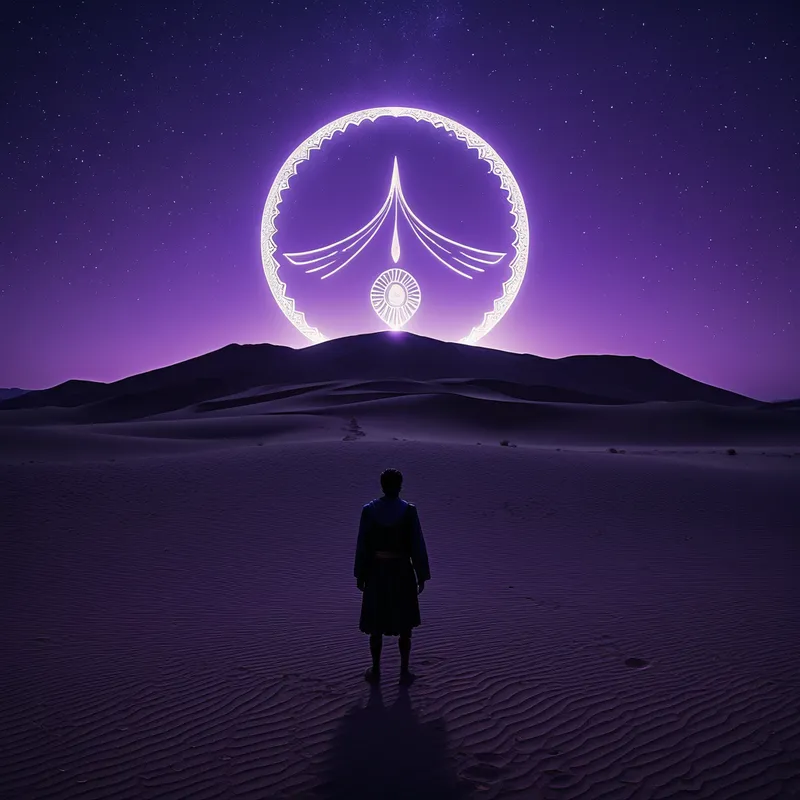
This symbol, which we now call the Faravahar, is the visual heart of Zoroastrianism, an ancient faith that shaped the Persian empires of the Achaemenids, Parthians, and Sassanians. Its origins are etched not in a single story, but in a worldview. It was carved into the stone walls of Persepolis, stamped on royal seals, and adorned the standards of kings. It was not an idol to be worshipped, but a sacred diagram of cosmic and ethical reality—a creed made visible.
The myth it embodies was passed down through the poetic hymns of the Avesta, recited by priests known as Magi. Its societal function was profound: it was the emblem of divine authority and human responsibility. It told every subject, from the king on his throne to the farmer in his field, that their role was sacred. The king was not a god, but a shepherd tasked with maintaining Asha on earth. Every individual was a soldier in the cosmic struggle, and the Faravahar was their standard, a constant reminder of their alliance with the divine and the eternal consequences of their choices.
Symbolic Architecture
The Faravahar is a complete [mandala](/symbols/mandala “Symbol: A sacred geometric circle representing wholeness, the cosmos, and the journey toward spiritual integration.”/) of the [soul](/symbols/soul “Symbol: The soul represents the essence of a person, encompassing their spirit, identity, and connection to the universe.”/)‘s [condition](/symbols/condition “Symbol: Condition reflects the state of being, often focusing on physical, emotional, or situational aspects of life.”/) and [purpose](/symbols/purpose “Symbol: Purpose signifies direction, meaning, and intention in life, often reflecting personal ambitions and core values.”/). Every element is a deliberate instruction.
The old man’s face represents wisdom accrued through the ages, the accumulated [consciousness](/symbols/consciousness “Symbol: Consciousness represents the state of awareness and perception, encompassing thoughts, feelings, and experiences.”/) of choosing rightly. The two wings symbolize spiritual [ascent](/symbols/ascent “Symbol: Symbolizes upward movement, progress, spiritual elevation, or striving toward higher goals, often representing personal growth or transcendence.”/), but their three-tiered [structure](/symbols/structure “Symbol: Structure in dreams often symbolizes stability, organization, and the framework of one’s life, reflecting how one perceives their environment and personal life.”/) grounds this [flight](/symbols/flight “Symbol: Flight symbolizes freedom, escape, and the pursuit of one’s aspirations, reflecting a desire to transcend limitations.”/) in a practical, earthly ethic: elevation of thought, purification of speech, and righteousness in [action](/symbols/action “Symbol: Action in dreams represents the drive for agency, motivation, and the ability to take control of situations in waking life.”/). They are the tools for the [journey](/symbols/journey “Symbol: A journey in dreams typically signifies adventure, growth, or a significant life transition.”/).
The ring held forth is the contract of existence itself—the universe is not random, but covenantal. Our presence here is by agreement, for a purpose.
The central circle from which the figure emerges is the sun, the visible face of Ahura Mazda’s light in our world, and also the soul in its primordial, pristine state. The two streamers are the fundamental duality of existence: not good and evil as external forces, but as directions for the will. The [choice](/symbols/choice “Symbol: The concept of choice often embodies decision-making, freedom, and the multitude of paths available in life.”/) for Asha integrates the self with cosmic order; the [choice](/symbols/choice “Symbol: The concept of choice often embodies decision-making, freedom, and the multitude of paths available in life.”/) for Druj leads to [fragmentation](/symbols/fragmentation “Symbol: The experience of breaking apart, losing cohesion, or being separated into pieces. Often represents disintegration of self, relationships, or reality.”/) and [dissolution](/symbols/dissolution “Symbol: The process of breaking down, dispersing, or losing form, often representing transformation, release, or the end of a state of being.”/). The figure points ahead, for the [path](/symbols/path “Symbol: The ‘path’ symbolizes a journey, choices, and the direction one’s life is taking, often representing individual growth and exploration.”/) is always forward, through the [crucible](/symbols/crucible “Symbol: A vessel for intense transformation through heat and pressure, symbolizing spiritual purification, testing, and alchemical change.”/) of time and matter, toward a final reconciliation where all is made whole again.
The Dreamer’s Resonance
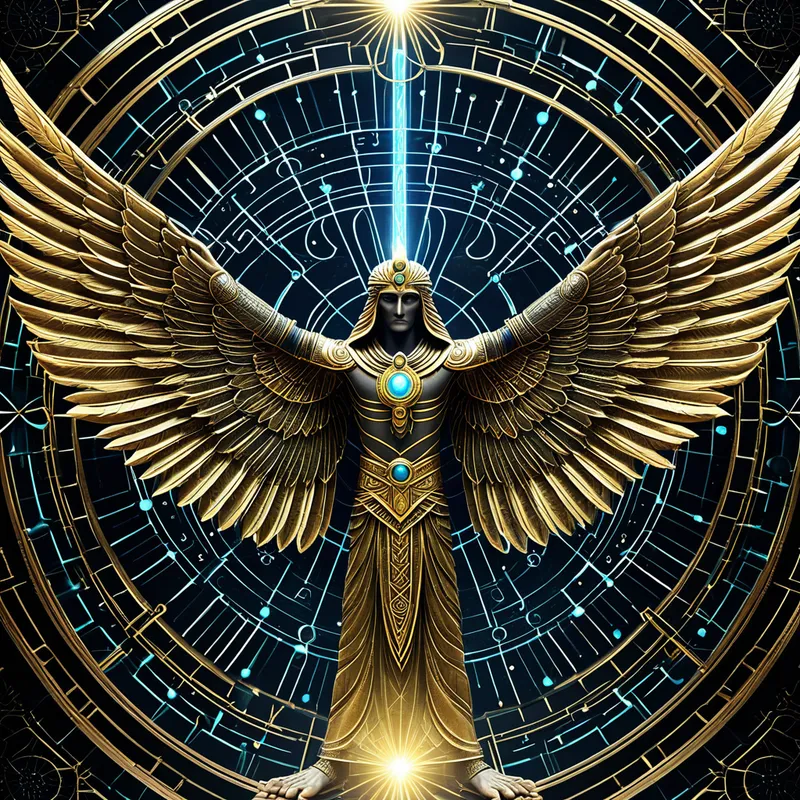
When the Faravahar appears in a modern dream, it is rarely as a historical artifact. It manifests as an atmospheric pressure, a geometric certainty emerging from the dream fog. The dreamer might be at a critical life junction—a career change, an ethical dilemma, a commitment. The symbol appears on a door they must pass through, or as a tattoo on their own skin they don’t remember getting, or glowing on a horizon they are compelled to walk toward.
Somatically, this dream often accompanies a feeling of being “called” or of bearing a sobering responsibility. There is a tightening in the chest, not of anxiety, but of solemn recognition. Psychologically, it marks the activation of what Jung called the archetype of the Self—the central, ordering principle of the psyche. The dream is the soul’s Fravashi checking in, presenting the dreamer with the two ribbons of their own potential: one path leading to greater integrity, the other to a more comfortable but soul-eroding falsehood. The dream is a referendum on authenticity.
Alchemical Translation
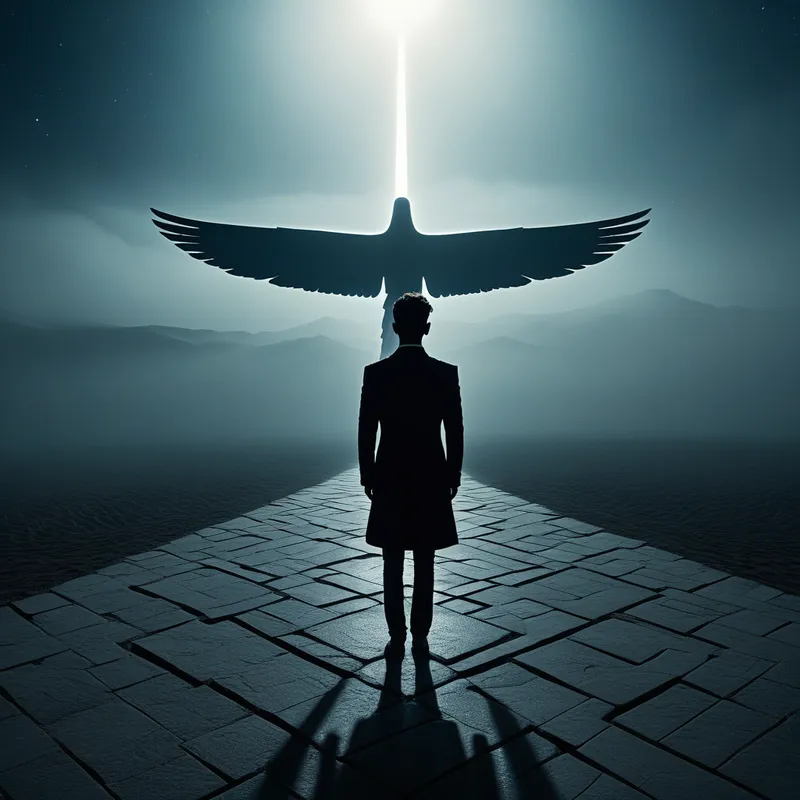
The myth of the Faravahar models the alchemical process of individuation not as a quest to find something new, but to remember and fulfill an ancient oath. The first stage is Recognizing the Covenant (the ring). The modern individual must move from seeing life as a series of random events to understanding it as a meaningful, participatory drama. Your existence is not an accident; your consciousness is here by a kind of agreement to engage.
The core struggle is Navigating the Dual Stream (the ribbons). This is the nigredo, the dark night. Every psychological complex, every temptation to take the easier, falser path, is an encounter with Druj. Every act of brutal self-honesty, every difficult choice for truth over convenience, is a movement toward Asha. This is not about being perfect, but about conscious orientation.
The triumph is in becoming the pointing figure—the one who, through accumulated wise choices, becomes a living axis between the divine spark (the sun) and the earthly reality. The wings are earned, not given.
The final stage is Becoming the Guide. The integrated Self does not hoard its light. Like the Faravahar on the palace wall, it becomes an emblem for others, a silent witness to the possibility of order, choice, and purposeful journeying. The individual becomes a stabilizing symbol in their own world, a small center of Asha within the chaos, having transmuted the base metal of unconscious living into the gold of conscious, covenanted existence.
Associated Symbols
Explore related symbols from the CaleaDream lexicon:
- Sun — The radiant disc from which the Faravahar emerges, representing the supreme divine light of Ahura Mazda, the source of all consciousness and the soul’s point of origin.
- Circle — The fundamental shape of the sun-disc and the rings, symbolizing wholeness, eternity, the covenant of existence, and the cyclical nature of the soul’s journey.
- Journey — The core narrative of the Faravahar, representing the soul’s descent into matter and its ultimate return to the light, a path defined by continuous ethical choice.
- Choice — The central action implied by the symbol, encapsulated by the two flowing ribbons, representing the eternal human capacity to choose between truth (Asha) and falsehood (Druj).
- Order — The principle of Asha, which the symbol venerates, representing cosmic harmony, righteousness, and the divine law that structures a meaningful universe.
- Light — The essential substance and goal of the symbol, representing divine wisdom, purity, consciousness, and the ultimate victory of good over darkness.
- Soul — The entity represented by the Faravahar itself, specifically the Fravashi, the pre-existent, immortal guardian spirit that guides the individual toward their destiny.
- Covenant — The sacred agreement symbolized by the held ring, representing the bond between the divine and the human, and the soul’s solemn responsibility within creation.
- Wisdom — Embodied by the aged face of the figure, representing the accrued understanding and discernment required to navigate the path of truth and make righteous choices.
- Sky — The domain of the Faravahar’s flight, representing the celestial realm, boundless freedom, spiritual aspiration, and the vast arena of the cosmic struggle.