The Famine in Egypt Myth Meaning & Symbolism
A Pharaoh's prophetic dreams of famine are interpreted by Joseph, leading to a national strategy of preparation that saves Egypt and his estranged family.
The Tale of The Famine in Egypt
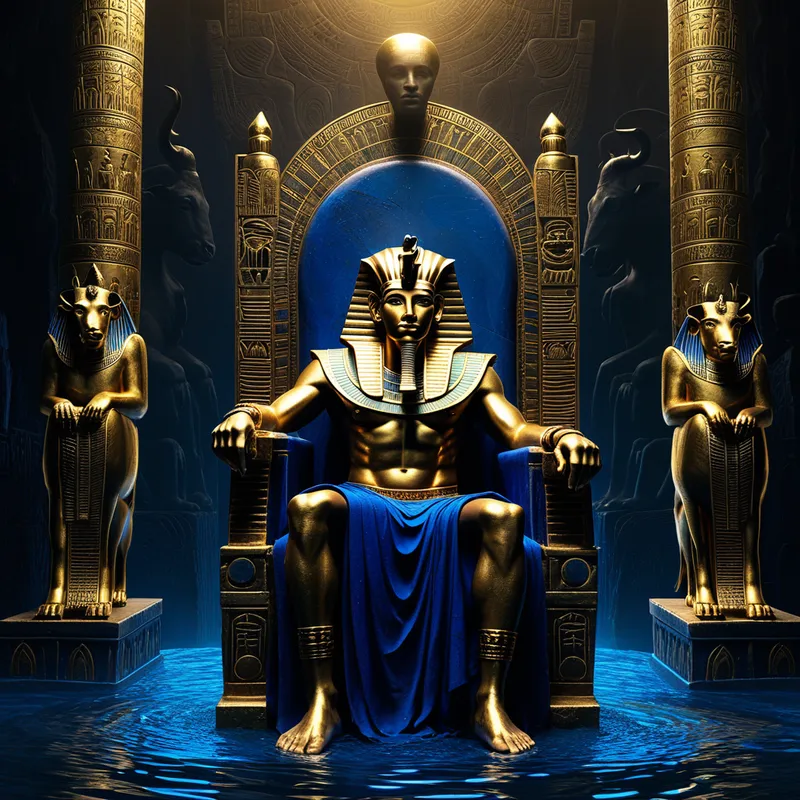
The air over the Nile was thick, not with the usual promise of the inundation, but with a silence that tasted of dust. In the palace of white stone, the [Pharaoh](/myths/pharaoh “Myth from Egyptian culture.”/) tossed upon his bed of linen and ivory. Sleep, when it came, was not a refuge but a court of terrifying visions.
First, he stood by the sacred river’s edge. From the dark, life-giving waters emerged seven cows, sleek and fat, their hides gleaming like polished obsidian under the Egyptian sun. They moved with a grace that spoke of endless pasture. But as they bowed their heads to drink, the waters churned. A second wave of creatures heaved themselves onto the bank: seven more cows, but these were vile, gaunt, and skeletal, their ribs like the struts of a broken boat, their eyes hollow pits. The lean beasts did not graze. They turned upon the fat ones, and consumed them whole, yet their own wretched forms did not change. [The Pharaoh](/myths/the-pharaoh “Myth from Egyptian culture.”/) awoke, heart hammering against his chest, the image of consumption without nourishment seared behind his eyes.
He sought his bed again, pleading for a gentler dream. Instead, he found himself in a field of golden grain. Seven ears of corn grew upon a single stalk, full and ripe, heavy with the promise of bread. Then, as if scorched by a hidden sun, seven more ears sprouted beside them—blighted, thin, and withered, shriveled by the east wind. The parched ears devoured the healthy ones. The Pharaoh awoke a second time, the taste of chaff in his mouth.
A pall fell over the court. The wisest magicians and scribes of Egypt were summoned. They unrolled their scrolls, consulted the stars, and whispered incantations to [Thoth](/myths/thoth “Myth from Global/Universal culture.”/). But the dreams defied them. They were a cipher written in a divine hand, and their meaning remained locked, feeding the growing dread in the palace halls.
Then, a whisper rose from the depths of the dungeon. A cupbearer, his memory stirred by the general despair, recalled a Hebrew slave with a gift. A man who had once interpreted a dream in a prison cell and whose words had proven true. His name was [Joseph](/myths/joseph “Myth from Biblical culture.”/).
Brought from [the pit](/myths/the-pit “Myth from Christian culture.”/), washed and clothed, Joseph stood before the incarnation of the sun-god on earth. “I cannot do this,” Joseph said, his voice steady, “but Elohim will give Pharaoh an answer of peace.”
And so the vision was told. Joseph listened, and the spirit of understanding settled upon him. “The two dreams are one,” he declared. “The seven good cows and the seven good ears are seven years of great plenty throughout all the land of Egypt. The seven lean and blighted beasts and ears that follow are [seven years of famine](/myths/seven-years-of-famine “Myth from Egyptian culture.”/). It is fixed by Elohim, and it will soon come to pass.”
But Joseph did not stop with the prophecy of despair. The dream demanded action. “Now therefore,” he continued, his words now shaping policy, “let Pharaoh select a man discerning and wise, and set him over the land of Egypt. Let him appoint officers to take one-fifth of the harvest of the good years. Let them gather all the food under the authority of Pharaoh, and store grain in the cities. That food shall be a reserve for the land against the seven years of famine.”
The Pharaoh saw the truth and the wisdom as one. “Since Elohim has shown you all this, there is none so discerning and wise as you.” The signet ring was placed on Joseph’s finger, robes of fine linen draped on his shoulders, and a gold chain around his neck. The former slave was made vizier, second only to the throne itself.
The years of abundance came, and [the earth](/myths/the-earth “Myth from Hindu culture.”/) gave forth in heaps. Joseph oversaw the gathering, and granaries rose like mountains in every city, filled to their ceilings with grain. Then, as foretold, the fertile wind ceased. The Nile did not fail, but its blessing seemed withheld. The famine gripped the land, a great and terrible fist closing over Egypt and all the surrounding world. The storehouses were opened. Egypt had bread. And as the famine tightened its grip on the known world, a thread of destiny drew a family from Canaan—Joseph’s own brothers, bowing before the Egyptian lord they did not recognize—to the very grain that would save them, setting the stage for a reconciliation written in tears and tested grain.

Cultural Origins & Context
This narrative is embedded in the Book of Genesis (Chapters 41-47), a foundational text of the Israelite tradition, later adopted into the Christian Old Testament. It functions as a pivotal turning point in the Patriarchal narratives, bridging the story of a single family with the national history of Israel in Egypt.
Its societal function is multifaceted. Historically, it provides an etiological explanation for the Israelite presence in Egypt, setting the stage for the later Exodus. Politically, it offers a model of divinely inspired, prudent statecraft—a king heeding wisdom to ensure national survival. Theologically, it is a powerful testament to a providential worldview, where even the dreams of a pagan monarch are instruments of a single, sovereign God’s plan to preserve a chosen lineage. It was passed down orally for generations before being codified, told around fires and in tents as a story of how their ancestors were saved by the foresight granted by their God, through the unlikely agency of a betrayed brother risen to power.
Symbolic Architecture
At its core, this is a myth about the confrontation with cyclical time and inevitable [shadow](/symbols/shadow “Symbol: The ‘shadow’ embodies the unconscious, repressed aspects of the self and often represents fears or hidden emotions.”/). The seven fat years and seven lean years represent the unavoidable [rhythm](/symbols/rhythm “Symbol: A fundamental pattern of movement or sound in time, representing life’s cycles, emotional flow, and universal order.”/) of [life](/symbols/life “Symbol: The symbol of ‘Life’ represents a journey of growth, interconnectedness, and existential meaning, encompassing both the joys and challenges that define human experience.”/): [expansion](/symbols/expansion “Symbol: A symbol of growth, increase, or extension beyond current boundaries, often representing personal development, opportunity, or overwhelming change.”/) and [contraction](/symbols/contraction “Symbol: A symbolic process of compression, reduction, or inward movement, often representing preparation, transition, or the tension between opposing forces.”/), [abundance](/symbols/abundance “Symbol: A state of plentifulness or overflowing resources, often representing fulfillment, prosperity, or spiritual richness beyond material needs.”/) and [scarcity](/symbols/scarcity “Symbol: A dream symbol representing lack, limitation, or insufficient resources, often reflecting fears of deprivation or unmet needs.”/), [summer](/symbols/summer “Symbol: Summer often symbolizes warmth, growth, and abundance, representing a time of vitality and fruition.”/) and [winter](/symbols/winter “Symbol: Winter symbolizes a time of reflection, introspection, and dormancy, often representing challenges or a period of transformation.”/). The myth does not promise perpetual spring but provides a map for navigating [the fall](/myths/the-fall “Myth from Biblical culture.”/).
The unconscious always speaks in doubles; the single dream is never enough. The cow and the grain, the animal and the vegetable, are twin manifestations of the same prophetic truth, insisting from the depths that the message be heard.
Joseph himself is the [archetype](/symbols/archetype “Symbol: A universal, primordial pattern or prototype in the collective unconscious that shapes human experience, behavior, and creative expression.”/) of the individuated [consciousness](/symbols/consciousness “Symbol: Consciousness represents the state of awareness and perception, encompassing thoughts, feelings, and experiences.”/). He is the interpreter, the one who can translate the symbolic [language](/symbols/language “Symbol: Language symbolizes communication, understanding, and the complexities of expressing thoughts and emotions.”/) of the deep unconscious (the Pharaoh’s dreams) into conscious, actionable [strategy](/symbols/strategy “Symbol: A plan of action designed to achieve a long-term or overall aim, often involving competition, resource management, and foresight.”/). The granaries are not just storehouses of [food](/symbols/food “Symbol: Food in dreams often symbolizes nourishment, both physical and emotional, representing the fulfillment of basic needs as well as deeper desires for connection or growth.”/); they are symbols of psychic [structure](/symbols/structure “Symbol: Structure in dreams often symbolizes stability, organization, and the framework of one’s life, reflecting how one perceives their environment and personal life.”/)—[the ego](/myths/the-ego “Myth from Jungian culture.”/)’s [capacity](/symbols/capacity “Symbol: A measure of one’s potential, limits, or ability to contain, process, or achieve something, often reflecting self-assessment or external demands.”/), built during times of psychic [energy](/symbols/energy “Symbol: Energy symbolizes vitality, motivation, and the drive that fuels actions and ambitions.”/) (plenty), to contain and manage the periods of depression, [aridity](/symbols/aridity “Symbol: Aridity symbolizes emotional or spiritual barrenness, a lack of nourishment, and a state of profound dryness or emptiness.”/), and emotional [famine](/symbols/famine “Symbol: A profound lack or scarcity, often of food, representing deprivation, survival anxiety, and systemic collapse.”/) that visit every life. The famine is the shadow of the plenty, and the myth teaches that [the shadow](/myths/the-shadow “Myth from Jungian culture.”/) cannot be avoided, only prepared for.

The Dreamer’s Resonance
When this myth pattern stirs in the modern dreamer, it often signals a profound somatic and psychological process of anticipatory integration. The dreamer may not dream of cows and grain, but of overflowing bank accounts suddenly drained, lush gardens turning to dust, or feeling full and then inexplicably, ravenously empty.
This is the [psyche](/myths/psyche “Myth from Greek culture.”/)’s early-warning system. It is the body-mind sensing a coming contraction—a period of emotional drought, creative barrenness, or financial strain—long before the conscious mind admits it. The anxiety is not the problem; it is the prophetic dream. The psychological process is one of being called to become one’s own Joseph: to stop dismissing the unsettling vision and to begin the work of interpretation and preparation. The somatic feeling is often a tightness in the gut, the very “granary” of the body, urging the dreamer to “store up” resilience, rest, and resources before the lean season arrives.

Alchemical Translation
The alchemical journey modeled here is the transmutation of prophecy into substance. The base material is the raw, terrifying, and chaotic [prima materia](/myths/prima-materia “Myth from Alchemical culture.”/) of the prophetic dream—an irrational, frightening image from the deep. The first operation is interpretatio (Joseph’s insight), which extracts the meaningful pattern from the chaos. The second is strategia, the conscious, disciplined work of building [the vessel](/myths/the-vessel “Myth from Alchemical culture.”/) (the granaries/ego structure).
The true philosopher’s stone is not a thing, but a process: the sustained act of preparing in light for the coming darkness.
For the modern individual, this is the core of individuation. We all receive “Pharaoh’s dreams”—intimations of our own mortality, the fragility of our successes, the shadow that follows our light. The immature psyche fears them, ignores them, or is paralyzed by them. The individuating psyche does the work of Joseph. It listens, deciphers, and then engages in the humble, unglamorous labor of building inner granaries: cultivating emotional intelligence during stable times, strengthening relationships in periods of peace, and refining one’s philosophy during times of clarity. When the famine of doubt, grief, or loss inevitably comes, one is not destroyed by it. One administers from the stored wisdom. Furthermore, the myth promises that this very process of preparation and endurance creates the conditions for the ultimate alchemical feat: the reconciliation of fractured parts of [the self](/myths/the-self “Myth from Jungian culture.”/) (Joseph and his brothers), where the very substance of your survival becomes the means of healing your deepest wounds.
Associated Symbols
Explore related symbols from the CaleaDream lexicon: