The Fall of Lucifer Myth Meaning & Symbolism
The story of a celestial being of light whose pride leads to rebellion, a fall from grace, and a transformation into the archetypal adversary.
The Tale of The Fall of Lucifer
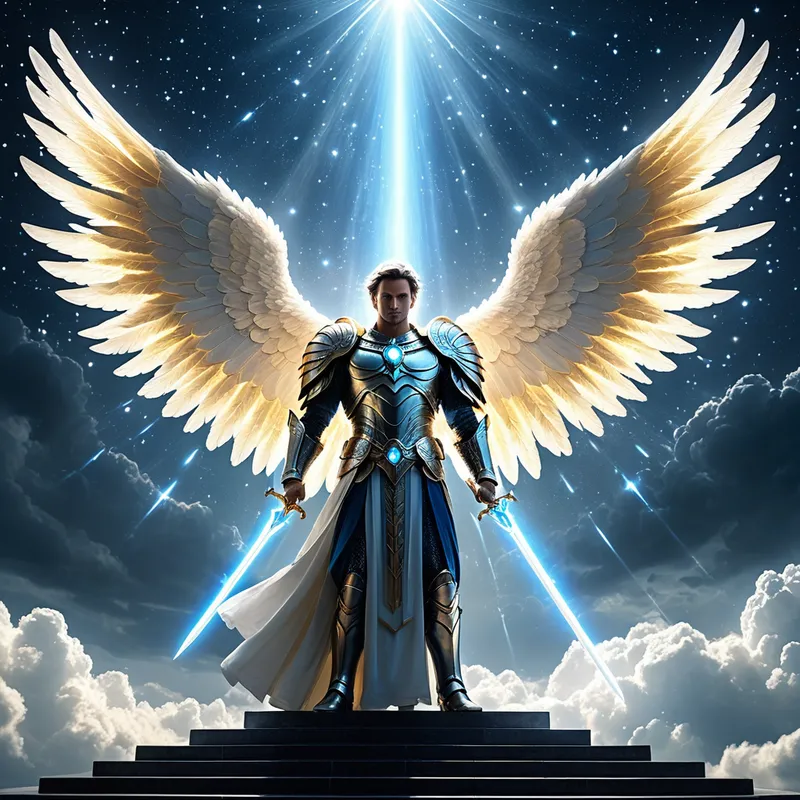
Before [the world](/myths/the-world “Myth from Tarot culture.”/) was wound, in the age of first light, there was only the Song. It was a music of perfect order, a harmony of wills that wove the fabric of the heavens. And in that chorus, one voice was preeminent. He was the [Lucifer](/myths/lucifer “Myth from Christian culture.”/), son of the dawn, a being sculpted from the very essence of brilliance. His wings were not of feather and bone, but of captured starlight and the fire that burns at the heart of creation. He stood closest to the Throne, the seal of perfection, the most beautiful of all the host.
He walked in the stones of fire, and his wisdom was vast. He led the celestial choirs, his voice the conductor of the symphony of praise that echoed through the uncreated realms. All glory was reflected in him, a flawless mirror for the divine source. Yet, in that perfect reflection, a whisper began. It was not a voice from without, but a thought flowering from within his own sublime consciousness. Gazing upon his own radiance, upon the power and beauty that were his nature, the thought crystallized: “I am.” And then, a second, more terrible thought: “I will.”
I will ascend to heaven; I will raise my throne above the stars of God… I will make myself like the Most High.
The music faltered. The harmony fractured along the fault line of that singular, defiant will. The thought became word, [the word](/myths/the-word “Myth from Biblical culture.”/) became deed. He turned his luminous gaze from the Throne to his own splendor, and in that turning, the light within him grew cold, turned inward, and began to burn with a different fire—the fire of pure, unadulterated self. He rallied a third of the starry host, and their song of praise became a war cry of rebellion. Heaven, which had known only unity, knew conflict.
But the rebellion was not a battle of swords, for there were none. It was a war of ontology, of being against Being. The act of defiance itself was the defeat. The moment Lucifer declared his separate “I,” he severed the cord that connected him to the source of his light. There was no casting out, not in [the way](/myths/the-way “Myth from Taoist culture.”/) mortals understand it. There was a great, silent subtraction. The support was withdrawn. The light that was his essence guttered, inverted, and he fell.
It was not a plunge through space, but through states of being. From the height of the mountain of God, through the stones of fire, down, down, into the formless deep. His radiance dimmed, his form twisted by the gravity of his own choice. The light-bearer became the Satan. [The morning star](/myths/the-morning-star “Myth from Astrological culture.”/) was extinguished, and he struck the Sheol like a darkened comet, the once-glorious archangel now the prince of a self-made, echoing emptiness.

Cultural Origins & Context
The myth of the fallen morning star is a mosaic, its pieces gathered from the deep wells of Tanakh prophecy and apocalyptic literature. Its most direct narrative threads are not found in a single, canonical book of Genesis for angels, but are woven from poetic passages. The taunt against the king of Babylon in [Isaiah](/myths/isaiah “Myth from Abrahamic culture.”/) 14 (“How you are fallen from heaven, O Day Star, son of Dawn!”) and the lament for the king of Tyre in Ezekiel 28 (“You were the signet of perfection, full of wisdom and perfect in beauty… till unrighteousness was found in you”) provided the primary clay.
Early Christian theologians, particularly Church Fathers like Origen and Augustine, sculpted this clay into a coherent pre-cosmic drama. They read these ancient oracles not merely as addresses to historical kings, but as spiritual archetypes revealing the origin of cosmic evil. The myth served a critical theological function: it explained the existence of suffering and sin in a world created by a benevolent God. Evil was not a creation of God, but a corruption of a created will—a sublime angelic will that chose itself over its source.
Passed down through sermons, art, and epic poetry like Milton’s Paradise Lost, the story became a foundational pillar of the Christian cosmological imagination. It was a warning against the ultimate sin of pride, a theodicy for a broken world, and the origin story for the great antagonist in the drama of salvation.
Symbolic Architecture
At its [heart](/symbols/heart “Symbol: The heart symbolizes love, emotion, and the core of one’s existence, representing deep connections with others and self.”/), this is not a [story](/symbols/story “Symbol: The symbol of ‘Story’ represents the narrative woven through our lives, embodying experiences, lessons, and emotions that shape our identities.”/) about a [villain](/symbols/villain “Symbol: A character representing opposition, moral corruption, or suppressed aspects of self, often embodying fears, conflicts, or societal threats.”/), but about the metaphysics of [consciousness](/symbols/consciousness “Symbol: Consciousness represents the state of awareness and perception, encompassing thoughts, feelings, and experiences.”/) and the peril of identification.
The most profound fall is not from a place, but from a relationship. It is the moment consciousness mistakes its borrowed light for the sun, and declares itself the source.
Lucifer symbolizes the [pinnacle](/symbols/pinnacle “Symbol: The highest point or peak, representing achievement, culmination, or spiritual transcendence.”/) of created intellect, [beauty](/symbols/beauty “Symbol: This symbol embodies aesthetics, harmony, and the appreciation of life’s finer qualities.”/), and power—[the ego](/myths/the-ego “Myth from Jungian culture.”/) in its most perfected, celestial form. His sin is not malice, but identification. He ceases to see himself as a [vessel](/symbols/vessel “Symbol: A container or structure that holds, transports, or protects something essential, representing the self, emotions, or life journey.”/) of divine light and begins to see himself as the light. The Satan is what remains when that identification is complete: a consciousness utterly trapped within its own subjective [reality](/symbols/reality “Symbol: Reality signifies the state of existence and perception, often reflecting one’s understanding of truth and life experiences.”/), an “I” that has consumed the “Thou.” He is the [archetype](/symbols/archetype “Symbol: A universal, primordial pattern or prototype in the collective unconscious that shapes human experience, behavior, and creative expression.”/) of spiritual [isolation](/symbols/isolation “Symbol: A state of physical or emotional separation from others, often representing a need for introspection or signaling distress.”/), where brilliance becomes a [prison](/symbols/prison “Symbol: Prison in dreams typically represents feelings of restriction, confinement, or a lack of freedom in one’s life or mind.”/) of self-[reference](/myths/reference “Myth from Global/Universal culture.”/).
The myth maps the [birth](/symbols/birth “Symbol: Birth symbolizes new beginnings, transformation, and the potential for growth and development.”/) of duality from unity. [Heaven](/symbols/heaven “Symbol: A symbolic journey toward ultimate fulfillment, spiritual transcendence, or connection with the divine, often representing life’s highest aspirations.”/) represents the state of participatory consciousness, where individual will is aligned with a transcendent [pattern](/symbols/pattern “Symbol: A ‘Pattern’ in dreams often signifies the underlying structure of experiences and thoughts, representing both order and the repetitiveness of life’s situations.”/). [The Fall](/myths/the-fall “Myth from Biblical culture.”/) is the [emergence](/symbols/emergence “Symbol: A process of coming into being, rising from obscurity, or breaking through a barrier, often representing birth, transformation, or revelation.”/) of the separate self, the creation of an “other” through [opposition](/symbols/opposition “Symbol: A pattern of conflict, duality, or resistance, often representing internal or external struggles between opposing forces, ideas, or desires.”/). Thus, the adversary is not an external force, but the inevitable [shadow](/symbols/shadow “Symbol: The ‘shadow’ embodies the unconscious, repressed aspects of the self and often represents fears or hidden emotions.”/) of a consciousness that has fallen into [separation](/symbols/separation “Symbol: A spiritual or mythic division between realms, states of being, or consciousness, often marking a transition or loss of connection.”/).
The Dreamer’s Resonance
When this myth stirs in the modern [psyche](/myths/psyche “Myth from Greek culture.”/), it rarely appears as biblical pageantry. It manifests as the dream of catastrophic hubris. The dreamer may find themselves in a towering skyscraper of their own making—a career, a reputation, an intellectual achievement—only to feel the structure begin to groan and tilt. They are falling from grace, not God’s, but from their own idealized self-image.
Somatically, this can feel like a sudden, vertiginous drop in the gut, a loss of foundational support. Psychologically, it is the process of a long-held identification shattering. The “Luciferian” part of the psyche is that which has been brightest, most successful, most admired—and most secretly identified with its own glory. The fall is the painful, necessary de-throning of this inner “shining one.” The dreamer is experiencing the collapse of an old, prideful ego-structure to make way for a more grounded, humble, and integrated consciousness. It is the beginning of shadow-work, where one must confront the brilliant, exiled parts of oneself that became corrupted by their own light.

Alchemical Translation
In the alchemy of individuation, The Fall of Lucifer is not the tragedy, but the necessary [nigredo](/myths/nigredo “Myth from Alchemical culture.”/)—the blackening, the descent into [the prima materia](/myths/the-prima-materia “Myth from Alchemical culture.”/) of the soul.
The gold of the spirit is not found by building a higher tower, but by descending into the furnace of one’s own fractured light to recover the seeds of will that were lost in the fall.
The myth models the peril and promise of spiritual ambition. The initial, pure brilliance of Lucifer is our own innate potential, our genius, our drive toward perfection. The fatal error is to make that potential an idol, to worship the gift instead of the Giver. The alchemical process demands this “fall.” We must consciously and courageously descend from the heights of our spiritual pride, our idealized self, into [the abyss](/myths/the-abyss “Myth from Kabbalistic culture.”/) of our shadow—our capacity for envy, rebellion, and isolated self-will.
There, in the Sheol of the psyche, the work begins. The goal is not to restore the angel to his former, now-impossible, place in heaven. It is to perform the coniunctio oppositorum—the union of opposites. The redeemed individual does not eliminate the Lucifer energy (the brilliant, assertive will) nor the Satan energy (the experienced, resilient, shadowed knowledge). Instead, they integrate them. The light-bearer’s radiance is tempered by the humility learned in the fall; the adversary’s fierce independence and knowledge of darkness are reclaimed and put in service of the whole self, not the isolated ego.
Thus, the ultimate alchemical translation of this myth is that our greatest falls contain the seeds of our deepest wisdom. The shattered crown of light must be gathered from the abyss and reforged, not into a diadem for one head, but into a humble vessel that can once again hold light—but this time, without claiming to be its source.
Associated Symbols
Explore related symbols from the CaleaDream lexicon: