The Faerie Mirror Myth Meaning & Symbolism
A bard journeys to the Otherworld, finds a mirror that reveals his deepest soul, and must choose between a perfect lie or an imperfect truth.
The Tale of The Faerie Mirror
Listen now, and let the fire’s crackle become the rustle of oak leaves in a forgotten time. In the days when [the world](/myths/the-world “Myth from Tarot culture.”/) was thinner, and the music of the [Sídhe](/myths/sdhe “Myth from Celtic / Irish culture.”/) drifted on [the mist](/myths/the-mist “Myth from Celtic culture.”/), there lived a bard named Mac an Bhaird. His voice could soothe a chieftain’s rage and make stones weep for joy, yet in his own heart, he heard only a hollow wind. He knew all the songs of heroes, but he did not know his own true name.
Driven by a longing he could not name, he left the warm halls of men and walked into the deep forest where twilight reigns eternal. He followed a fox with eyes of green fire, crossed a stream that sang in a language of pure sorrow, and finally stood before a mound crowned with [hawthorn](/myths/hawthorn “Myth from Celtic culture.”/). A door of woven roots and shadow opened, and he stepped into the [Tír na nÓg](/myths/tr-na-ng “Myth from Celtic culture.”/).
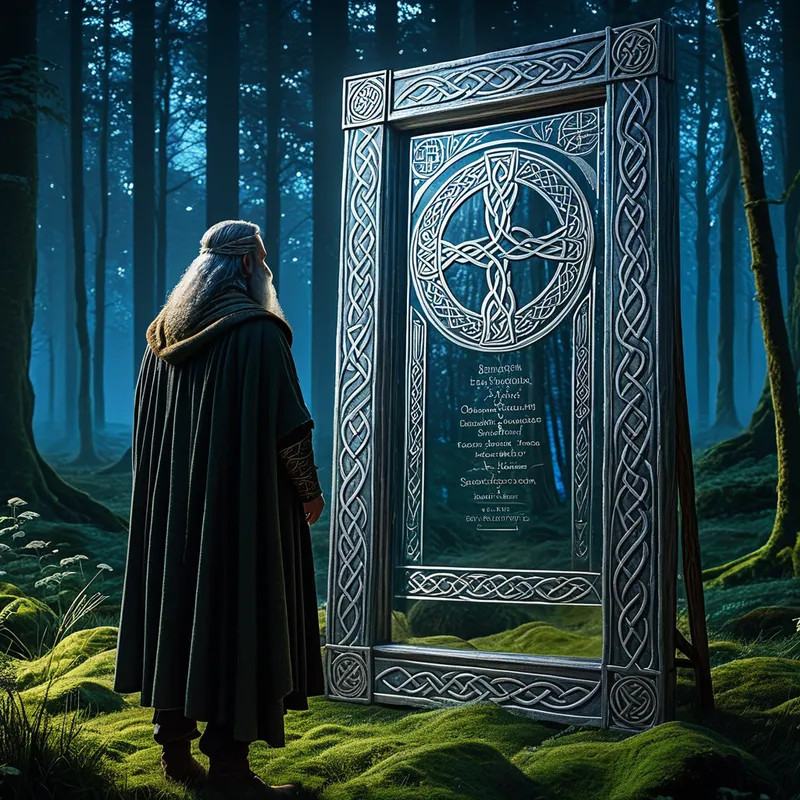
The air was sweet and heavy, smelling of crushed apple-blossom and cold stone. In a silent hall lit by will-o’-the-wisps, the Aos Sí awaited him. Their beauty was terrible, their eyes ancient as stars. Their queen, clad in robes of shifting moss and starlight, spoke not a word but gestured to the center of the hall. There, upon a stand of blackthorn, stood [the Mirror](/myths/the-mirror “Myth from Various culture.”/).
It was not glass, but a disc of still, liquid silver, framed in interwoven patterns that seemed to move when not directly watched. “Sing for us, Son of Song,” the Queen’s voice echoed in his mind. “And then, look. See what we see.”
Mac an Bhaird sang. He sang of love lost and battles won, of the green earth and the grey sea. When his last note faded into the fragrant air, he approached the Mirror. He expected to see his own weary, travel-stained face. He did not.
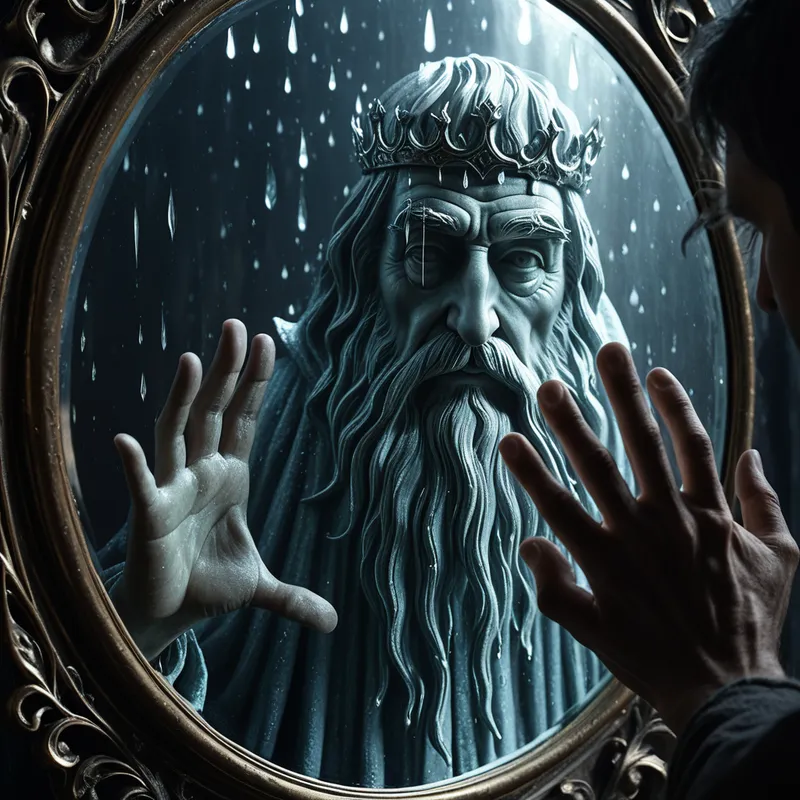
He saw a king, crowned with light, his face radiant with wisdom and power. This was the hero of his own ballads, the unblemished soul he had always longed to be. A cry of joy caught in his throat. But as he watched, the image rippled. [The crown](/myths/the-crown “Myth from Various culture.”/) of light tarnished to cold iron. The king’s robes frayed into beggar’s rags. The radiant face fractured, and in its place he saw every fear he had ever swallowed: the cowardice hidden behind brave words, the envy masked as praise, the small, mean thoughts he whispered to no one. He saw not a hero, but a totality—the glorious and the wretched, woven together in one shimmering, undeniable truth.
The Faerie Court watched, silent. The Queen finally spoke aloud, her voice like a chill breeze. “The Mirror shows the soul, not the face. You may stay. We will give you the first reflection—the perfect king. You will believe that lie forever, and sing for us in endless bliss. Or, you may take the truth you have seen back to the world of men, and bear its terrible, beautiful weight.”
Mac an Bhaird stood at the precipice of paradise, a perfect illusion in one hand, a fractured reality in the other. He looked once more into the Mirror, at the whole, flawed, living man staring back. He turned from the throne of eternal twilight, and with the true song of his own soul now burning in his chest—a song of both king and beggar—he walked back through the root-door, into the world of rain, struggle, and mortal dawn.
Cultural Origins & Context
The motif of the Faerie Mirror is not a single, standardized myth from a specific manuscript, but a powerful archetypal fragment woven through the tapestry of Celtic lore, particularly from the Irish and Welsh traditions. It emerges from the deep-seated belief in the Tír na nÓg or Annwn as a realm of absolute truth, opposite to our world of partial perceptions. These stories were the currency of the fili and bards, the keepers of memory and identity.
Told at the fireside or in the chieftain’s hall, such tales served a crucial societal function beyond entertainment. They were maps of the [psyche](/myths/psyche “Myth from Greek culture.”/) and ethical guides. In a culture that valued honor, truth (fír), and the integrity of one’s word above almost all else, a story about a mirror that reveals the unvarnished soul was a profound teaching tool. It warned of the seductive illusions of the Aos Sí, who could offer perfection but at the cost of one’s authentic self. [The bard](/myths/the-bard “Myth from Celtic culture.”/)’s journey mirrors the imbas forosnai, the “illumination that enlightens,” a poetic inspiration sought through sensory deprivation or liminal states. The myth thus codifies the peril and necessity of seeking true self-knowledge, suggesting that the ultimate wisdom comes not from without, but from a courageous confrontation with what is within.
Symbolic Architecture
The Faerie Mirror is the ultimate [symbol](/symbols/symbol “Symbol: A symbol can represent an idea, concept, or belief, serving as a powerful tool for communication and understanding.”/) of unmediated [consciousness](/symbols/consciousness “Symbol: Consciousness represents the state of awareness and perception, encompassing thoughts, feelings, and experiences.”/). It does not show the [persona](/symbols/persona “Symbol: The social mask or outward identity one presents to the world, often concealing the true self.”/)—[the mask](/myths/the-mask “Myth from Various culture.”/) worn for society—but the totality of the psyche, the Self in Jungian terms, encompassing both the ego and the [shadow](/symbols/shadow “Symbol: The ‘shadow’ embodies the unconscious, repressed aspects of the self and often represents fears or hidden emotions.”/).
The Mirror does not judge; it merely reveals. In its surface, the illusion of the perfect, singular self shatters, making way for the complex, living truth of the whole.
The initial [vision](/symbols/vision “Symbol: Vision reflects perception, insight, and clarity — often signifying the ability to foresee or understand deeper truths.”/) of the [king](/symbols/king “Symbol: A symbol of ultimate authority, leadership, and societal order, often representing the dreamer’s inner power or external control figures.”/) represents the ego-ideal, the glorious fiction we construct to navigate the world and hide our vulnerabilities. Its transformation into the [beggar](/symbols/beggar “Symbol: A symbol representing vulnerability, need, and social inequality, often reflecting the dreamer’s feelings of lack, dependence, or neglected aspects of self.”/)-[king](/symbols/king “Symbol: A symbol of ultimate authority, leadership, and societal order, often representing the dreamer’s inner power or external control figures.”/) is the inevitable [integration](/symbols/integration “Symbol: The process of unifying disparate parts of the self or experience into a cohesive whole, often representing psychological wholeness or resolution of internal conflict.”/) of [the shadow](/myths/the-shadow “Myth from Jungian culture.”/). The Aos Sí themselves symbolize the autonomous, archetypal forces of the unconscious—alluring, amoral, and holding both creative inspiration and psychic [dissolution](/symbols/dissolution “Symbol: The process of breaking down, dispersing, or losing form, often representing transformation, release, or the end of a state of being.”/). Their offer is the temptation to remain in the unconscious, identified with a beautiful [archetype](/symbols/archetype “Symbol: A universal, primordial pattern or prototype in the collective unconscious that shapes human experience, behavior, and creative expression.”/) (the Eternal [Hero](/symbols/hero “Symbol: A hero embodies strength, courage, and the ability to overcome significant challenges.”/), the Perfect [Artist](/symbols/artist “Symbol: An artist symbolizes creativity, expression, and the exploration of the human experience through various forms of art.”/)), forever avoiding the difficult work of conscious [integration](/symbols/integration “Symbol: The process of unifying disparate parts of the self or experience into a cohesive whole, often representing psychological wholeness or resolution of internal conflict.”/) in the flawed, mortal world.
The [bard](/symbols/bard “Symbol: Bards represent the power of storytelling, music, and the transmission of culture and history.”/)’s [choice](/symbols/choice “Symbol: The concept of choice often embodies decision-making, freedom, and the multitude of paths available in life.”/) is the core of the myth’s [symbolism](/symbols/symbolism “Symbol: The use of symbols to represent ideas or qualities, often conveying deeper meanings beyond literal interpretation. In dreams, it’s the language of the unconscious.”/). To stay is to choose eternal [inflation](/symbols/inflation “Symbol: A dream symbol representing feelings of diminishing value, loss of control, or expansion beyond sustainable limits in one’s life or psyche.”/), a psychic [death](/symbols/death “Symbol: Symbolizes transformation, endings, and new beginnings; often associated with fear of the unknown.”/) disguised as [paradise](/symbols/paradise “Symbol: A perfect, blissful place or state of being, often representing ultimate fulfillment, harmony, and transcendence beyond ordinary reality.”/). To return is to accept the burden of consciousness—to carry the known conflict of one’s own [nature](/symbols/nature “Symbol: Nature symbolizes growth, connectivity, and the primal forces of existence.”/) back into [life](/symbols/life “Symbol: The symbol of ‘Life’ represents a journey of growth, interconnectedness, and existential meaning, encompassing both the joys and challenges that define human experience.”/), which is the only [path](/symbols/path “Symbol: The ‘path’ symbolizes a journey, choices, and the direction one’s life is taking, often representing individual growth and exploration.”/) to genuine creativity and authenticity.
The Dreamer’s Resonance
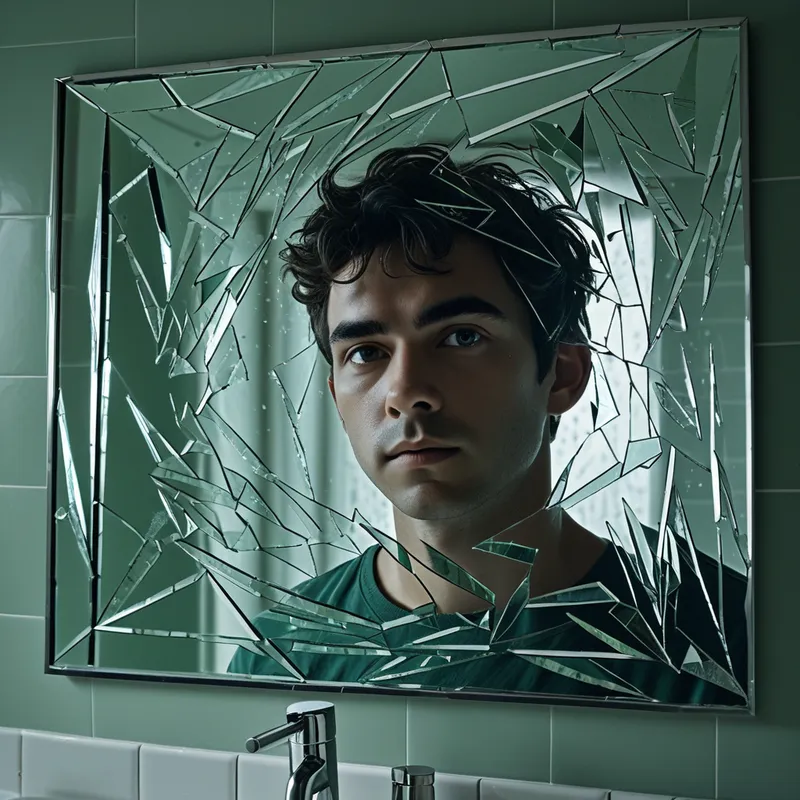
When this myth stirs in the modern dreamer, it often announces a critical juncture in the process of individuation. To dream of a mirror that shows a shocking, grotesque, or wondrously different reflection is to encounter the Faerie Mirror in the soul’s own language.
Somatically, this may be preceded by feelings of disorientation, a sense of living a “false” life, or anxiety with no clear object. The dream itself is often charged with a numinous, awe-full quality. The reflection might be monstrous, angelic, much younger or older, or a different gender entirely. This is the psyche presenting the disowned parts of [the self](/myths/the-self “Myth from Jungian culture.”/) for recognition. The terror or fascination felt upon waking is a direct measure of the distance between the dreamer’s conscious self-image and the fuller truth of their inner being.
The psychological process here is one of acute self-confrontation. [The ego](/myths/the-ego “Myth from Jungian culture.”/) is being challenged to release its rigid self-definition. The dream is not an indictment, but an invitation—a call from the internal Sídhe Queen to look, truly look, and begin the work of reclamation.
Alchemical Translation
The myth of the Faerie Mirror is a perfect allegory for the alchemical [nigredo](/myths/nigredo “Myth from Alchemical culture.”/), [the dark night of the soul](/myths/the-dark-night-of-the-soul “Myth from Christian Mysticism culture.”/) that precedes transformation. The bard’s journey into the Tír na nÓg is the descent into the unconscious (nekyia). The Mirror is the agent of the [solutio](/myths/solutio “Myth from Alchemical culture.”/), dissolving the hardened [persona](/myths/persona “Myth from Greek culture.”/) into its constituent parts—the gold of the king and the base matter of the beggar.
The triumph is not in becoming the king, but in holding the tension between the king and the beggar until a third, transcendent thing—the integrated human—is born.
The bard’s refusal of the Faerie offer is the crucial act of coagulatio. He takes the dissolved, chaotic truth of himself and chooses to “coagulate” it back into the world of time, matter, and relationship. His new song, born of this integration, is the [lapis philosophorum](/myths/lapis-philosophorum “Myth from Alchemical culture.”/)—not a perfect, static artifact, but a living, creative expression of the reconciled self.
For the modern individual, this translates directly to the courage required for shadow work. It is the process of withdrawing projections, of seeing our own darkness in the “mirror” of conflicts and strong reactions to others, and of forgoing the comforting illusions of blame or idealized self-images. The myth teaches that our wholeness—and with it, our true creative power—lies on the other side of that terrifying, truthful reflection. We are not asked to become flawless kings, but to acknowledge the beggar in our own court, and in doing so, become sovereign over the entire, real kingdom of the self.
Associated Symbols
Explore related symbols from the CaleaDream lexicon: