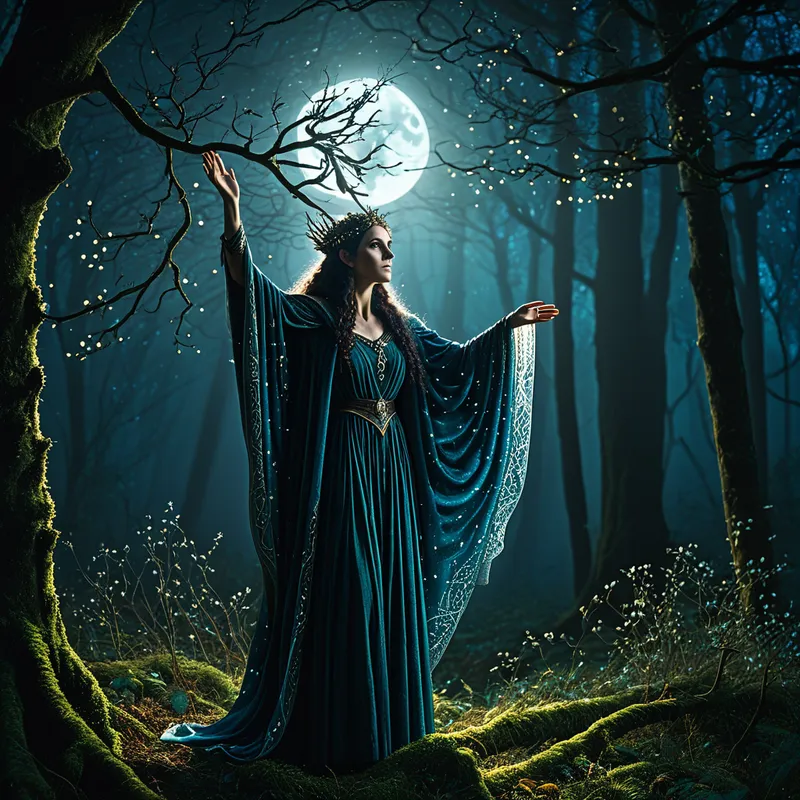
The Faerie Cloak Myth Meaning & Symbolism
A mortal steals a faerie woman's cloak of power, binding her to his world until she finds it and reclaims her sovereignty, vanishing forever.
The Tale of The Faerie Cloak
Listen now, and let [the hearth](/myths/the-hearth “Myth from Norse culture.”/)-fire grow low. Let [the wind](/myths/the-wind “Myth from Various culture.”/) from the west carry the salt and the sorrow. In the time when [the world](/myths/the-world “Myth from Tarot culture.”/) was thinner, when [the veil](/myths/the-veil “Myth from Various culture.”/) between the Middle Kingdom and the [Sídhe](/myths/sdhe “Myth from Celtic / Irish culture.”/) was but a breath of mist, there lived a man of the coast. His heart was as lonely as the cry of the curlew, his days measured by the empty nets he hauled from the grey sea.
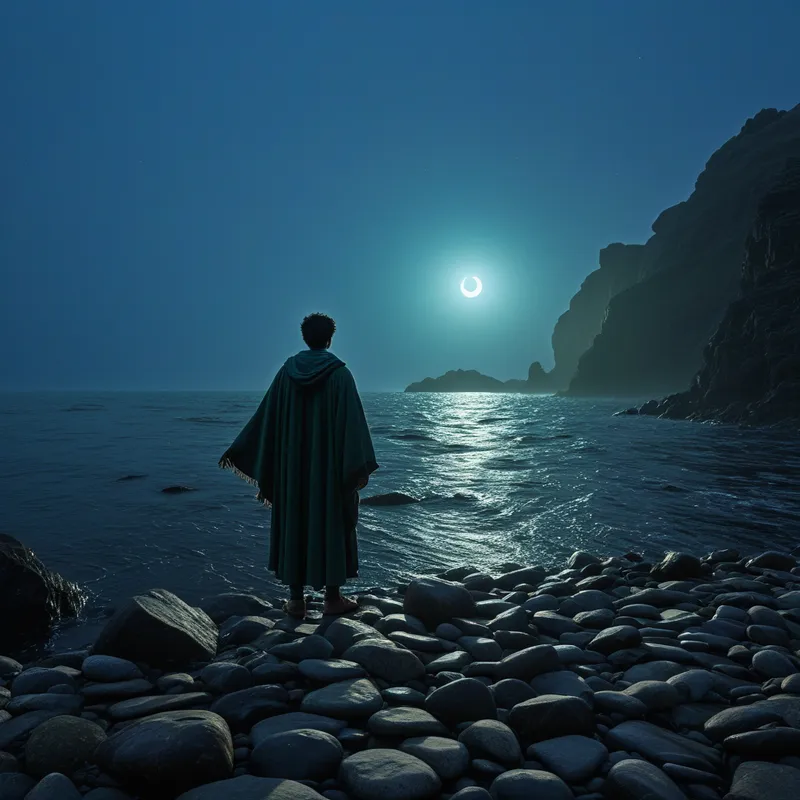
One evening, as the sun drowned in the western waves and the first star, the Polar Star, pricked the twilight, he heard a sound that was not of this earth. It was laughter, silver and cold as a mountain stream, and the soft, rhythmic beat of feet upon [water](/myths/water “Myth from Chinese culture.”/). Creeping over the black rocks, he beheld a sight that stole his breath. There, dancing upon the very surface of the incoming tide, were nine women. Their hair flowed like captured moonlight, their forms were of a beauty that ached in the soul. And upon a flat rock lay nine cloaks, each one shimmering with a light of its own—one woven from seafoam, another from crow’s feathers, another from the petals of foxglove.
A desperate, covetous longing seized the fisherman’s heart. To hold such beauty, to bind it to his lonely hearth! As silent as [the shadow](/myths/the-shadow “Myth from Jungian culture.”/) of a cloud, he stole forward and snatched one cloak, the colour of deep moss and twilight, and fled to hide it beneath the stone of his threshold.
The dancing ceased. The music died. Eight of the women gave cries like startled gulls, snatched up their cloaks, and vanished into the rising mist. The ninth stood alone on the rock, her radiance dimming, her form seeming to grow more solid, more real in the mortal way. She turned her sea-grey eyes upon the man who now emerged from hiding. “You have taken my cochall,” she said, and her voice held the emptiness of a windswept shore. “Without it, I cannot return home. I cannot fly.”
So she went with him, for she had no choice. She became his wife. Years passed. She bore him children—fair-haired and strange-eyed—and kept his house. Yet a melancholy hung about her like a perpetual autumn. She would often stand at the door, looking towards the lone [hawthorn](/myths/hawthorn “Myth from Celtic culture.”/) on the hill, or sing lullabies in a tongue that made the hearth-fire burn blue.
The man, though he had what he desired, lived in quiet fear. He watched her constantly, and he moved the hidden cloak from threshold to rafters to byre, forever keeping its secret. But one day, as their eldest child played with a hound pup in the yard, the boy chased a ball into the old, disused byre. He came out not with a ball, but dragging a wondrous, shimmering cloth that smelled of damp earth and wildflowers. “Mother!” he cried. “See what I found!”
The faerie woman turned. The moment her eyes fell upon her cochall, a light long extinguished blazed within her. She did not run. She walked to her son, took the cloak from his hands, and wrapped it around her shoulders. She looked at her husband, and in her gaze was neither love nor hate, but a vast, ancient pity. She looked at her children, and a single tear, bright as a [pearl](/myths/pearl “Myth from Chinese culture.”/), fell. Then she spoke a word that cracked the air like ice.
And she was gone. Not a footprint in the mud, not a rustle in the thatch. Only the echo of that word, and the lingering scent of hawthorn in a month when it does not bloom.
Cultural Origins & Context
This story, in its myriad local variations, is a cornerstone of the Gaelic folk tradition, particularly in Ireland, Scotland, and the Isle of Man. It belongs not to the grand mythological cycles of the Tuatha Dé Danann, but to the later, rich oral tradition of the seanchaí—the storyteller who kept the lore alive by the fireside. These tales functioned as more than entertainment; they were maps of the invisible world.
The myth of the stolen cloak is fundamentally an aetiological tale, explaining the origins of certain families who claimed descent from the Aos Sí. It served as a stern lesson in the protocols of [the Otherworld](/myths/the-otherworld “Myth from Celtic culture.”/): its gifts are perilous, its inhabitants are not to be trapped or owned. The story reinforced a cultural worldview where the supernatural was intimately close, capricious, and required respect. The faerie woman is not a goddess, but a being of the Sídhe, whose power and identity are inextricably linked to a physical object—her cloak. This reflects a deeply animistic perspective, where spirit and matter, identity and artifact, are not separate.
Symbolic Architecture
At its [heart](/symbols/heart “Symbol: The heart symbolizes love, emotion, and the core of one’s existence, representing deep connections with others and self.”/), the Faerie [Cloak](/symbols/cloak “Symbol: A garment that conceals identity, protects from elements, or signifies authority and transformation in dreams.”/) is a myth about the theft and reclamation of sovereignty. The cloak is not merely a garment; it is the integument of the [soul](/symbols/soul “Symbol: The soul represents the essence of a person, encompassing their spirit, identity, and connection to the universe.”/), the visible form of one’s innate power, wildness, and [connection](/symbols/connection “Symbol: Connection symbolizes relationships, communication, and bonds among individuals.”/) to a numinous [reality](/symbols/reality “Symbol: Reality signifies the state of existence and perception, often reflecting one’s understanding of truth and life experiences.”/).
The cloak is the boundary between worlds, and to possess it is to hold the key to a soul’s homeland.
The [fisherman](/symbols/fisherman “Symbol: Represents exploration of emotional depths and the pursuit of desires, often reflecting patience and skill.”/) represents the conscious ego that, in its [loneliness](/symbols/loneliness “Symbol: A profound emotional state of perceived isolation, often signaling a need for connection or self-reflection.”/) and [hunger](/symbols/hunger “Symbol: A primal bodily sensation symbolizing unmet needs, desires, or emotional voids. It represents craving for fulfillment beyond physical nourishment.”/), attempts to capture and domesticate an archetypal force—the [Anima](/symbols/anima “Symbol: The feminine archetype within the male unconscious, representing soul, creativity, and connection to the inner world.”/), the [spirit](/symbols/spirit “Symbol: Spirit symbolizes the essence of life, vitality, and the spiritual journey of the individual.”/) of [nature](/symbols/nature “Symbol: Nature symbolizes growth, connectivity, and the primal forces of existence.”/), the creative daimon. He succeeds only in creating a beautiful [prison](/symbols/prison “Symbol: Prison in dreams typically represents feelings of restriction, confinement, or a lack of freedom in one’s life or mind.”/). The faerie woman’s [melancholy](/symbols/melancholy “Symbol: A deep, lingering sadness often associated with introspection and a sense of loss or longing.”/) is the [symptom](/symbols/symptom “Symbol: A physical or emotional sign indicating an underlying imbalance, distress, or message from the unconscious mind.”/) of a soul forced into an [alien](/symbols/alien “Symbol: Represents the unknown, otherness, and the exploration of new ideas or experiences.”/) shape, living a [life](/symbols/life “Symbol: The symbol of ‘Life’ represents a journey of growth, interconnectedness, and existential meaning, encompassing both the joys and challenges that define human experience.”/) that is not its own. Her eventual [discovery](/symbols/discovery “Symbol: The act of finding something previously unknown, hidden, or lost, often representing personal growth, new opportunities, or hidden aspects of the self.”/) of the cloak, often through the [innocence](/symbols/innocence “Symbol: A state of purity, naivety, and freedom from guilt or corruption, often associated with childhood and moral simplicity.”/) of a [child](/symbols/child “Symbol: The child symbolizes innocence, vulnerability, and potential growth, often representing the dreamer’s inner child or unresolved issues from childhood.”/) (the nascent, undomesticated Self), catalyzes the inevitable return. The [resolution](/symbols/resolution “Symbol: In arts and music, resolution refers to the movement from dissonance to consonance, creating a sense of completion, release, or finality in a composition.”/) is not a reconciliation, but a severance. The reclaimed sovereignty is absolute and leaves no [room](/symbols/room “Symbol: A room in a dream often symbolizes the self, representing personal space, mental state, or aspects of one’s identity.”/) for the old, binding contract.
The Dreamer’s Resonance
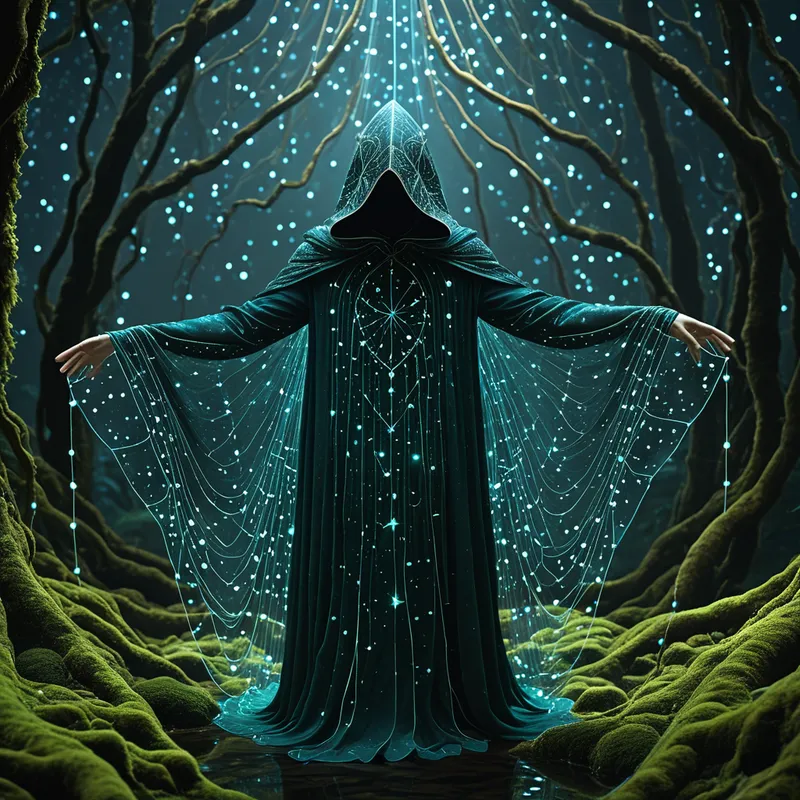
When this myth pattern stirs in the modern [psyche](/myths/psyche “Myth from Greek culture.”/), it often manifests in dreams of searching for a lost object of immense personal significance, or of being trapped in a life or role that feels fundamentally foreign. The dreamer may find themselves in a familiar house but discover a secret room containing something wondrous and forgotten—a direct parallel to the hidden cloak.
Somatically, this can feel like a chronic, low-grade depression or ennui, a sense of “living the wrong life.” There is a feeling of performing a part, of wearing a “skin” that does not fit. The psychological process at work is the initial stirring of [the Self](/myths/the-self “Myth from Jungian culture.”/), the true personality beneath the [persona](/myths/persona “Myth from Greek culture.”/) constructed for family, society, or survival. The dream is the first hint from the unconscious that a vital piece of one’s essence has been compartmentalized, hidden away, or bargained for security. The ensuing search is the beginning of shadow-work—the often painful process of retrieving those disowned parts.

Alchemical Translation
The myth models the alchemical process of [separatio](/myths/separatio “Myth from Alchemical culture.”/) and the return to one’s [prima materia](/myths/prima-materia “Myth from Alchemical culture.”/)—the original, uncorrupted substance of the soul. The fisherman’s act is the initial, misguided coniunctio (union), a fusion based on possession, not integration. The long years of the faerie woman’s captivity represent the [nigredo](/myths/nigredo “Myth from Alchemical culture.”/), the blackening: a state of depression, stagnation, and soul-loss where the individual feels alienated from their own nature.
The recovery of the cloak is the moment of illuminatio, where the hidden truth is suddenly revealed, shining in the hands of the innocent Self.
The modern individuation journey mirrored here is not about adding something new, but about recovering something ancient that was stolen—often by our own ego’s choices for safety, approval, or love. The “cloak” may be a creative gift abandoned for a sensible career, a spiritual intuition silenced by dogma, or a wild, instinctual nature civilized into numbness. The “fisherman” is the part of us that made that bargain. The triumphant, sorrowful departure is the necessary, often painful, act of psychic differentiation. One must leave the cramped but familiar “house” of the old identity to reclaim sovereignty. One does not get to keep both the domesticated life and the wild cloak. The final reintegration is not with the mortal world, but with the deep, native ground of the Self, the inner Sídhe. The myth assures us that while the journey is perilous and the cost is high, the call of that cloak is the most authentic call there is. To answer it is to become whole, even if it means vanishing from the world that once knew you.
Associated Symbols
Explore related symbols from the CaleaDream lexicon: