The Eucharist Myth Meaning & Symbolism
A myth of divine sacrifice where bread and wine become the body and blood of a god, establishing an eternal covenant through sacred consumption.
The Tale of The Eucharist
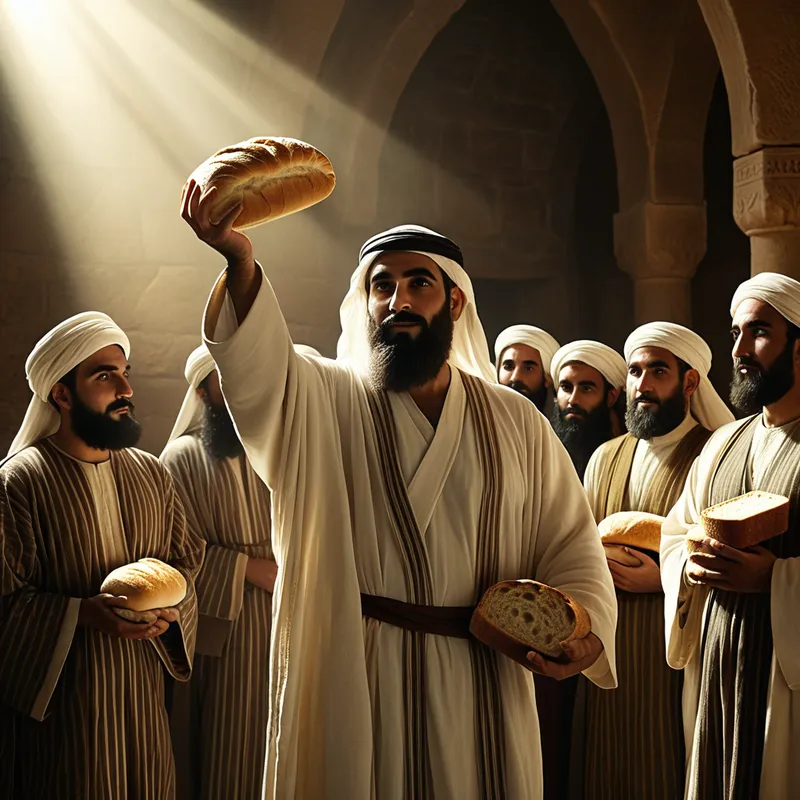
The night air in [Jerusalem](/myths/jerusalem “Myth from Biblical culture.”/) was thick with the scent of roasting lamb and impending doom. In a borrowed [upper room](/myths/upper-room “Myth from Biblical culture.”/), shadows danced on stone walls, thrown by the flicker of oil lamps. The Teacher was with them, his twelve, but a chill had settled upon the gathering, a silent knowledge that [the world](/myths/the-world “Myth from Tarot culture.”/) was about to turn on its axis.
He, the one they called Rabbi, moved with a heavy grace. The Passover meal lay before them, the bitter herbs, the unleavened bread, the wine—all symbols of an ancient deliverance. But on this night, he would inscribe a new covenant, not in stone or scroll, but in the very substance of their shared life. He took the bread, a simple, flat loaf of matzah, and held it up. His voice, usually a river of parables, was now a deep, still well.
“Take this,” he said, and the words seemed to carve the air itself. “This is my body, given for you.”
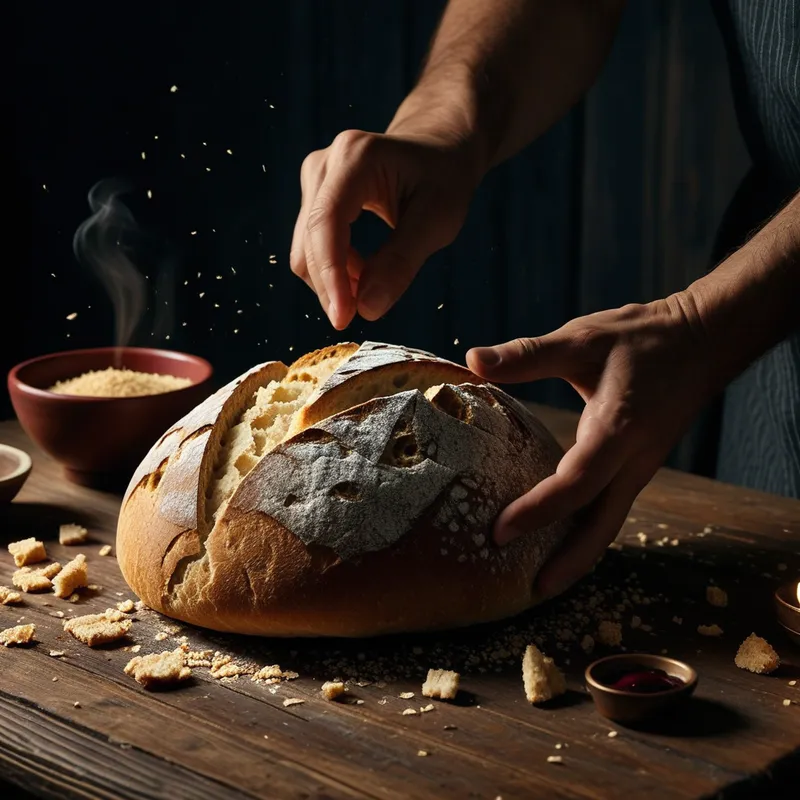
He broke the bread. The sound—a dry, final crack—echoed in the silent room. He passed the pieces, and each disciple, with trembling hands, took a fragment. They did not merely eat; they ingested the mystery. The bread was no longer just bread; it had become a vessel, a terrible and beautiful truth made edible.
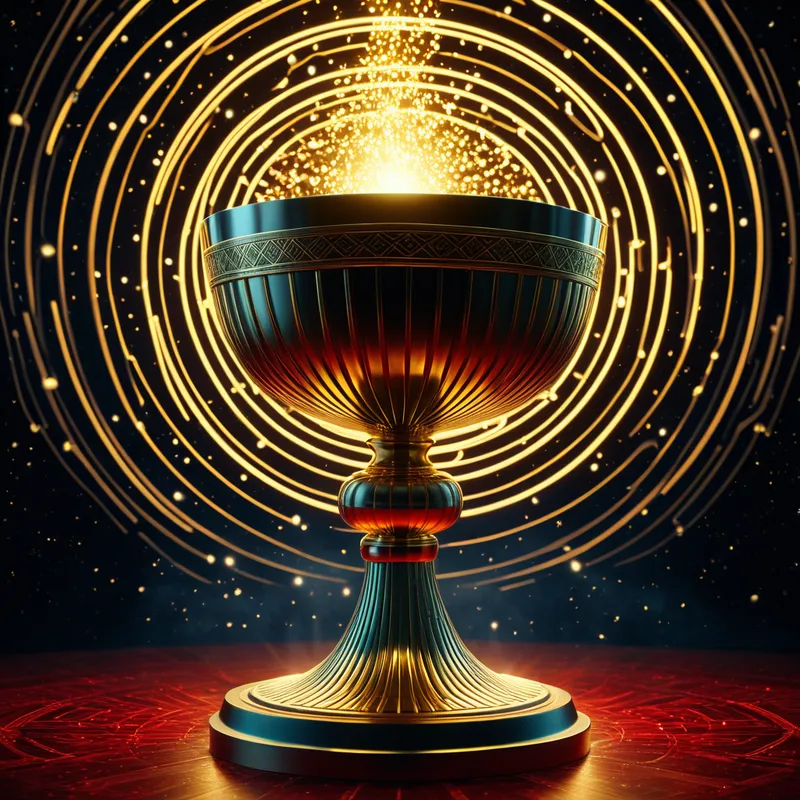
Then he took the cup, filled with the fruit of the vine. He gave thanks, and the light seemed to gather in the dark liquid. “This cup,” he intoned, “is the new covenant in my blood, which is poured out for you.” He passed the cup. Each man drank, the wine a metallic promise on the tongue, a seal of a pact written in sacrifice. To drink was to consent, to allow the story of his impending suffering to flow into their own veins.
He spoke of betrayal, of denial, of a kingdom not of this world. The atmosphere was electric with love and dread. This was no mere memorial supper. It was a final, profound act of binding. He was giving them himself—not his teachings, not his example, but his very substance. He was making his imminent death their perpetual nourishment, his spilled life their eternal drink. The meal ended, but the ritual was born. They filed out into the dark garden, the taste of bread and wine, of body and blood, lingering on their lips—the first taste of a mystery that would outlast empires.
Cultural Origins & Context
The myth of the Eucharist is rooted in the complex tapestry of first-century Judea, within the Jewish renewal movement that formed around Yeshua. It was transmitted orally within the earliest Christian communities before being codified in the synoptic Gospels and the letters of Paul. The storytellers were the apostles and their successors, who saw in this final meal not just a historical event, but the foundational axis mundi of their new faith.
Its societal function was multifaceted. For a persecuted minority, it created an unbreakable in-group identity; to partake was to be part of the Body of Christ, distinct from both Roman imperial cults and mainstream Judaism. It served as the central act of worship, replacing [the Temple](/myths/the-temple “Myth from Jewish culture.”/) sacrifices with a participatory, internalized sacrifice. The ritual, repeated in homes and catacombs, was the engine of community cohesion, a weekly re-membrance (re-membering) that literally put the shared story into the bodies of the believers, transforming a scattered group into a single, mystical organism.
Symbolic Architecture
At its core, the Eucharist is a myth of radical immanence and transformative participation. The symbols are stark, physical, and shocking: [body](/symbols/body “Symbol: The body in dreams often symbolizes the dreamer’s self-identity, personal health, and the relationship they have with their physical existence.”/), [blood](/symbols/blood “Symbol: Blood often symbolizes life force, vitality, and deep emotional connections, but it can also evoke themes of sacrifice, trauma, and mortality.”/), [bread](/symbols/bread “Symbol: Bread symbolizes nourishment, sustenance, and the daily essentials of life, often representing fundamental needs and comfort.”/), [wine](/symbols/wine “Symbol: Wine often symbolizes celebration, indulgence, and the deepening of personal connections, but it can also represent excess and escape.”/).
The divine is not merely observed or worshipped; it is dismantled, distributed, and digested. The ultimate separation—death—becomes the ultimate means of union.
The [Host](/symbols/host “Symbol: The symbol of a ‘host’ often represents nurturing, hospitality, or the willingness to offer support and guidance to others.”/) represents [the principle](/symbols/the-principle “Symbol: A fundamental truth, law, or doctrine that serves as a foundation for a system of belief, behavior, or reasoning, often representing moral or ethical standards.”/) of solidity, incarnation, and brokenness—the divine made fragile, fractured for the sake of communion. The [Chalice](/symbols/chalice “Symbol: The chalice symbolizes the receptacle of spiritual transformation and the act of communion, often representing purity, wholeness, and the nurturing aspects of virtue.”/) represents [the principle](/symbols/the-principle “Symbol: A fundamental truth, law, or doctrine that serves as a foundation for a system of belief, behavior, or reasoning, often representing moral or ethical standards.”/) of [life](/symbols/life “Symbol: The symbol of ‘Life’ represents a journey of growth, interconnectedness, and existential meaning, encompassing both the joys and challenges that define human experience.”/), [spirit](/symbols/spirit “Symbol: Spirit symbolizes the essence of life, vitality, and the spiritual journey of the individual.”/), and poured-out sacrifice—the vital essence offered freely. Psychologically, this maps onto the [human](/symbols/human “Symbol: The symbol of a human represents individuality, complexity of emotions, and social relationships.”/) experience of offering one’s own substance—one’s time, [energy](/symbols/energy “Symbol: Energy symbolizes vitality, motivation, and the drive that fuels actions and ambitions.”/), love, even one’s suffering—to nourish a [relationship](/symbols/relationship “Symbol: A representation of connections we have with others in our lives, often reflecting our emotional state.”/) or [community](/symbols/community “Symbol: Community in dreams symbolizes connection, support, and the need for belonging.”/). It is the [archetype](/symbols/archetype “Symbol: A universal, primordial pattern or prototype in the collective unconscious that shapes human experience, behavior, and creative expression.”/) of the [Caregiver](/symbols/caregiver “Symbol: A spiritual or mythical figure representing nurturing, protection, and unconditional support, often embodying divine or archetypal parental energy.”/) taken to its cosmic extreme: God as the ultimate nourisher, whose self-offering becomes the [food](/symbols/food “Symbol: Food in dreams often symbolizes nourishment, both physical and emotional, representing the fulfillment of basic needs as well as deeper desires for connection or growth.”/) of eternal [life](/symbols/life “Symbol: The symbol of ‘Life’ represents a journey of growth, interconnectedness, and existential meaning, encompassing both the joys and challenges that define human experience.”/).
The act of eating and drinking the deity is a profound [symbol](/symbols/symbol “Symbol: A symbol can represent an idea, concept, or belief, serving as a powerful tool for communication and understanding.”/) of internalization. The myth asserts that transformation does not happen through intellectual assent alone, but through somatic, metabolic [integration](/symbols/integration “Symbol: The process of unifying disparate parts of the self or experience into a cohesive whole, often representing psychological wholeness or resolution of internal conflict.”/). The sacred must become part of your cellular fabric.
The Dreamer’s Resonance
When this mythic pattern surfaces in modern dreams, it often signals a profound process of psychic assimilation. The dreamer may find themselves at a strange meal, being offered a food that is unsettling yet compelling, or drinking from a cup that holds a liquid both beautiful and terrifying.
Such dreams can emerge during life transitions that require a “metabolizing” of a difficult experience—a loss, a betrayal, a great sacrifice made for others. The somatic feeling is one of deep, sometimes anxious, incorporation. To dream of consuming a sacred or taboo substance is the [psyche](/myths/psyche “Myth from Greek culture.”/)’s way of enacting the process of making an external truth, a painful reality, or a heavy responsibility an internal part of [the self](/myths/the-self “Myth from Jungian culture.”/). It is the unconscious working to transform a passive suffering into an active, nourishing part of one’s identity. The conflict in the dream mirrors the myth’s tension: the revulsion and the longing, the horror of the sacrifice and the deep hunger for the unity it promises.
Alchemical Translation
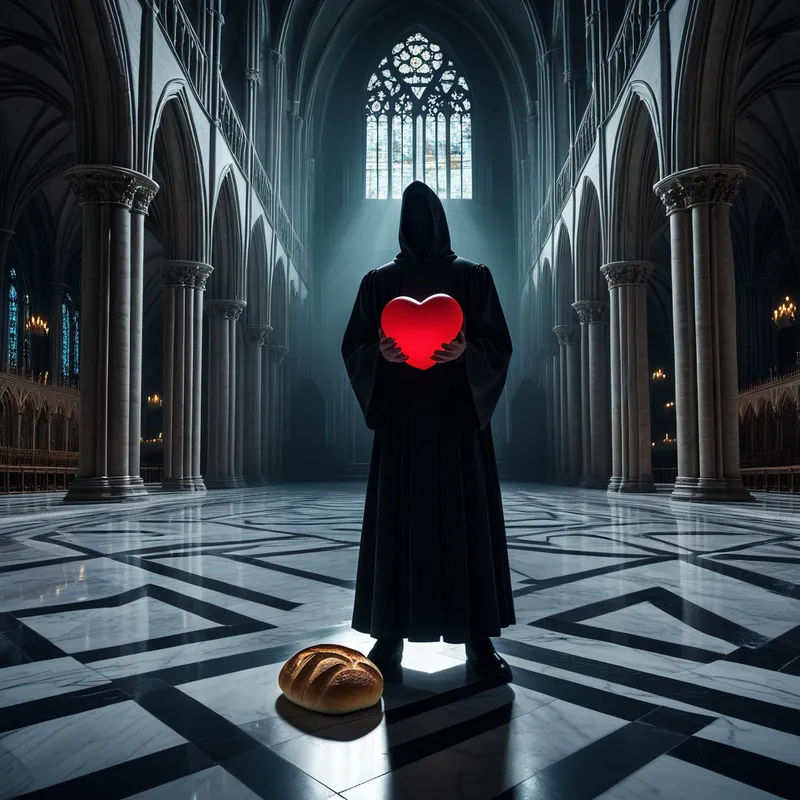
The alchemy of the Eucharist is a precise model for individuation. The process begins with the sacrificium—the willing offering of the conscious ego’s prized possession (in the myth, the divine life itself). This is the “death” that feels like an end.
The prima materia of the soul is the unintegrated self. The alchemical fire is the heat of conscious suffering. The gold that emerges is a consciousness that has digested its own darkness and found it to be nourishment.
The consecration—the moment of “this is my body”—represents the transformation of perception. Through the lens of meaning and intention, the base materials of our suffering (our “brokenness,” our “spilled” vitality) are seen not as waste, but as the sacred substance of growth. The fracturing of the bread is the necessary [separatio](/myths/separatio “Myth from Alchemical culture.”/) that precedes a deeper coniunctio.
Finally, the communion—the eating and drinking—is the assimilatio. This is the critical, internal work where the transformed substance is taken in and made part of the psychic organism. For the modern individual, this translates to the hard work of integrating shadow material, of consciously “eating” the consequences of one’s choices, of digesting painful truths until they become a source of wisdom and resilience, rather than poison. The ritual cycle—offering, blessing, breaking, sharing—becomes a map for turning the leaden weight of experience into the gold of a coherent, nourished, and nourishing Self. The myth promises that what is offered up in love and truth, and then broken open, does not vanish; it becomes the very food that sustains the journey toward wholeness.
Associated Symbols
Explore related symbols from the CaleaDream lexicon: