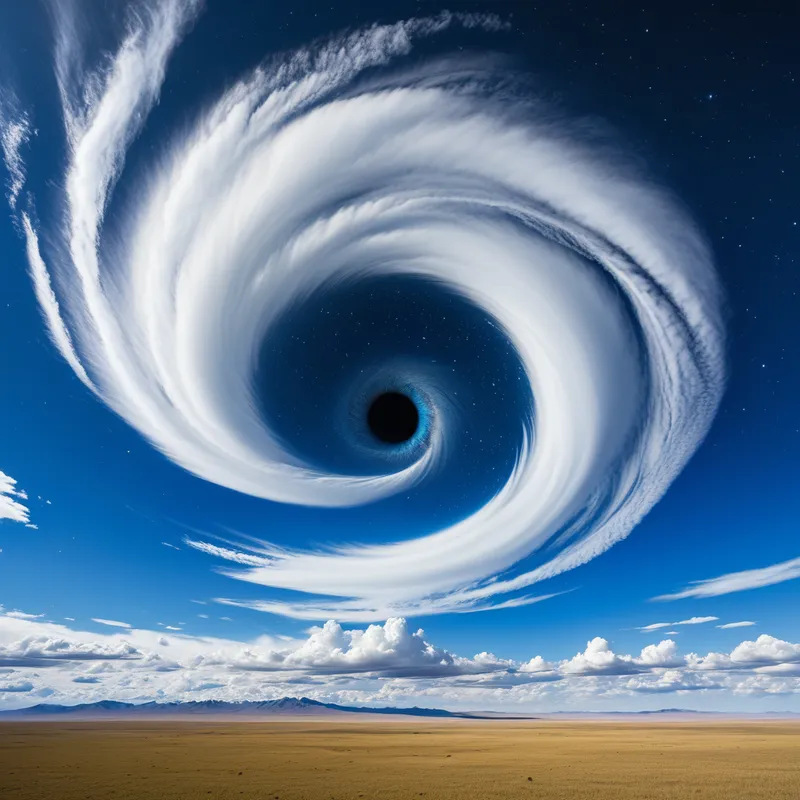
The Eternal Blue Sky Myth Meaning & Symbolism
The foundational myth of the boundless, all-seeing sky father, the source of order, law, and the sacred breath of life on the vast steppe.
The Tale of The Eternal Blue Sky
Listen. Before the first horse was tamed, before the first yurt was raised, there was the Silence and [the Wind](/myths/the-wind “Myth from Various culture.”/). And above the Silence and the Wind, there was the Tengri. Not a god with a beard or a throne, but a Presence. The Eternal Blue Sky.
In the beginning, [the world](/myths/the-world “Myth from Tarot culture.”/) below was dark and formless, a churning of earth and [water](/myths/water “Myth from Chinese culture.”/). The Wind howled in chaos. Then, from the endless void, a breath was drawn. It was the first thought, the first law. And with that breath, [the Sky](/myths/the-sky “Myth from Persian culture.”/) blazed into being—a dome of pure, boundless azure, stretching from horizon to horizon in a perfect, unbroken circle. This was Tengri’s body: the Blue Vault. His breath became the clean, cold wind that scoured the steppe. His gaze became the sun, a single, unwavering eye of gold.
But [the earth](/myths/the-earth “Myth from Hindu culture.”/) remained wild. Mountains clashed like unruly beasts; rivers ran where they pleased, drowning the low places. The Sky Father looked down, and his will was order. He did not reach down a hand. He simply was. His very existence, the vast, calm, immutable blue, imposed a principle. The mountains stilled, learning their place against [the horizon](/myths/the-horizon “Myth from Various culture.”/). The rivers found their courses, reflecting his blue in their depths. The Wind, once chaotic, learned to move in great, purposeful circles, carrying his law.
Then, from the meeting place of the Sky’s breath and the Earth’s body, life was sparked. The first grass pierced the soil, a tender green mirror to the blue above. Then animals, then, finally, the first people. They emerged blinking into the immense light, small and fragile on the endless plain. They felt fear. They felt alone.
So the Eternal Blue Sky gave them his second gift: not a command, but a connection. He taught them to look up. To see in the unclouded azure the model of a clear mind. To feel in the sun’s warmth his sustaining power. To understand in the predictable turn of the stars his unwavering [justice](/myths/justice “Myth from Tarot culture.”/). He became the Kök Tengri, the Blue Heaven, the great ancestor and ruler of all. He asked for no temples, only the high places where earth reached for sky. His priests were the wind, the eagle that soared into his realm, and the shamans who, in trance, felt their souls rise on the smoke of juniper to brush against his infinite presence.
The myth has no violent conquest, no thunderbolt. Its climax is a state of being. The resolution is a relationship. The Eternal Blue Sky does not rule by force, but by sublime, pervasive presence. The conflict is the human struggle against chaos within and without; the resolution is the quiet, daily act of looking up, aligning one’s spirit with that vast, ordered calm, and remembering one’s place in the sacred whole. The story ends every dawn, when the sky once again reveals itself, eternal and new.
Cultural Origins & Context
This is the heart of Tengrism, the indigenous spiritual worldview of the nomadic peoples of the Central Asian steppes, from the Mongols to the Turkic tribes. The myth of the Eternal Blue Sky was not a single story told around a fire one night; it was the ever-present backdrop to every day. It was lived.
It was passed down not in sacred texts, but in the orientation of the yurt, whose central smoke hole opened directly to the heavens. It was in the ritual of sprinkling milk or airag to the sky before drinking. It was in the title of rulers like Genghis Khan, who derived his mandate from “Tengri” himself. The myth’s societal function was foundational: it provided a cosmic model for social and natural order. Just as the sky presided over the earth without interfering in every detail, so too should a wise khan rule. It fostered resilience, teaching that personal fortune was tied to this celestial balance, and that disrespect to the natural world (gazriin ezen) was a disruption of Tengri’s law.
Symbolic Architecture
The Eternal Blue Sky is perhaps the ultimate [symbol](/symbols/symbol “Symbol: A symbol can represent an idea, concept, or belief, serving as a powerful tool for communication and understanding.”/) of [consciousness](/symbols/consciousness “Symbol: Consciousness represents the state of awareness and perception, encompassing thoughts, feelings, and experiences.”/) itself. It represents the transcendent function, the higher, organizing principle that brings coherence to the chaotic contents of the earthly, unconscious [psyche](/myths/psyche “Myth from Greek culture.”/).
The Blue Sky is the archetype of the Self—the total, regulating center of the psyche that exists beyond the ego’s limited horizon.
The boundless azure symbolizes limitless potential and the [clarity](/symbols/clarity “Symbol: A state of mental transparency and sharp focus, often representing resolution of confusion or attainment of insight.”/) of a mind free of psychic clouds—of doubt, [obsession](/symbols/obsession “Symbol: An overwhelming fixation on a person, idea, or object that consumes mental energy and disrupts balance.”/), and unresolved [emotion](/symbols/emotion “Symbol: Emotion symbolizes our inner feelings and responses to experiences, often guiding our actions and choices.”/). The sun as Tengri’s eye represents illuminating [awareness](/symbols/awareness “Symbol: Conscious perception of self, surroundings, or internal states. Often signifies awakening, insight, or heightened sensitivity.”/), the light of consciousness that sees all and from which nothing can be hidden. This is not a punitive gaze, but one of complete, objective witness. The wind, his [breath](/symbols/breath “Symbol: Breath symbolizes life, vitality, and the connection between the physical and spiritual realms.”/), is the [spirit](/symbols/spirit “Symbol: Spirit symbolizes the essence of life, vitality, and the spiritual journey of the individual.”/) (sülde)—the animating force that connects the high, remote principle of order with the living, breathing [reality](/symbols/reality “Symbol: Reality signifies the state of existence and perception, often reflecting one’s understanding of truth and life experiences.”/) of the world below. The myth encodes a profound psychological [truth](/symbols/truth “Symbol: Truth represents authenticity, honesty, and the quest for knowledge beyond mere appearances.”/): order is not imposed from outside, but emerges when the psyche (the [earth](/symbols/earth “Symbol: The symbol of Earth often represents grounding, stability, and the physical realm, embodying a connection to nature and the innate support it provides.”/)) relates itself to a higher, integrating principle (the sky).
The Dreamer’s Resonance
When this myth stirs in the modern soul, it often manifests in dreams of vast, open skies, of flying or looking down from great heights, or of searching for something in an immense, blue-tinted space. To dream of the Eternal Blue Sky is to experience a somatic pull toward integration and perspective.
The dreamer undergoing this process may feel a profound, often unsettling, sense of smallness—not of insignificance, but of proper scale. [The ego](/myths/the-ego “Myth from Jungian culture.”/)‘s dramas shrink under the gaze of the infinite. This can feel like loneliness at first, a “cosmic orphan” state. But if attended to, it shifts into a feeling of immense relief and connection. The dream is an invitation to stop identifying solely with the cluttered “earth” of personal history, emotional reactions, and social roles, and to remember the “sky” part of [the self](/myths/the-self “Myth from Jungian culture.”/)—the part that observes, contains, and gives context to all those earthly events. It is the psyche’s natural movement toward self-regulation, often appearing during times of chaos or moral confusion, offering the symbolic model of an unshakeable, panoramic viewpoint.

Alchemical Translation
The alchemical work modeled by this myth is not the mortificatio of dramatic destruction, but the sublimatio—the raising of base material to a higher, more refined state. The “base material” is the chaotic, driven, identified ego, tangled in the weeds of its own conflicts. The “vessel” is the human psyche, and the “heat” is the conscious effort to seek perspective.
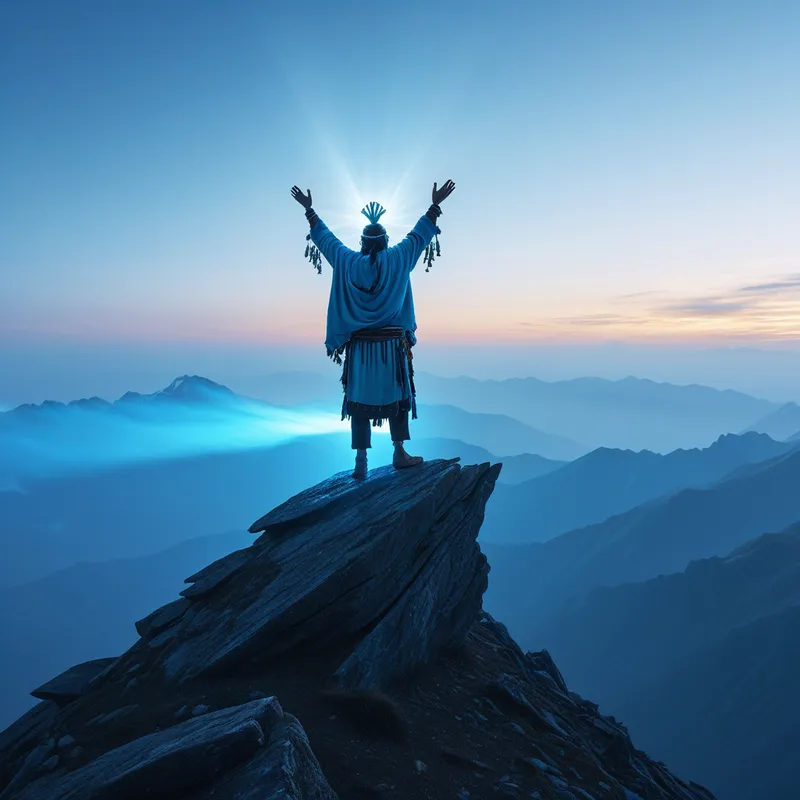
The process begins with the “ascent to the high place”—the act of introspection, meditation, or engaging with a guiding myth or philosophy that lifts one’s gaze from the immediate problem. This is [the shaman](/myths/the-shaman “Myth from Siberian culture.”/) climbing the mountain. The crucial phase is “standing under the sky,” allowing the immense, silent presence of a greater order to permeate one’s being. This is where the ego’s rigid claims are gently dissolved by a much larger reality.
The triumph of the myth is not victory over a monster, but the achieved state of alignment where the inner wind blows clean, directed by the law of the inner sky.
The “gold” produced is not a transformed world, but a transformed relationship to the world. It is the psychic state of sülde—vitality infused with purpose and connected to a source beyond itself. The modern individual completes this transmutation when they can hold their personal struggles within a framework of meaning that feels as vast, lawful, and ultimately benevolent as a clear blue sky. They become, in a sense, a steward of their own inner steppe, ruling their domain with the wisdom, justice, and calm detachment of the Eternal Blue Sky.
Associated Symbols
Explore related symbols from the CaleaDream lexicon: