The Epic of Gilgamesh Myth Meaning & Symbolism
A tyrannical king, forged by grief and friendship, quests for eternal life only to find wisdom in mortality's embrace.
The Tale of The Epic of Gilgamesh
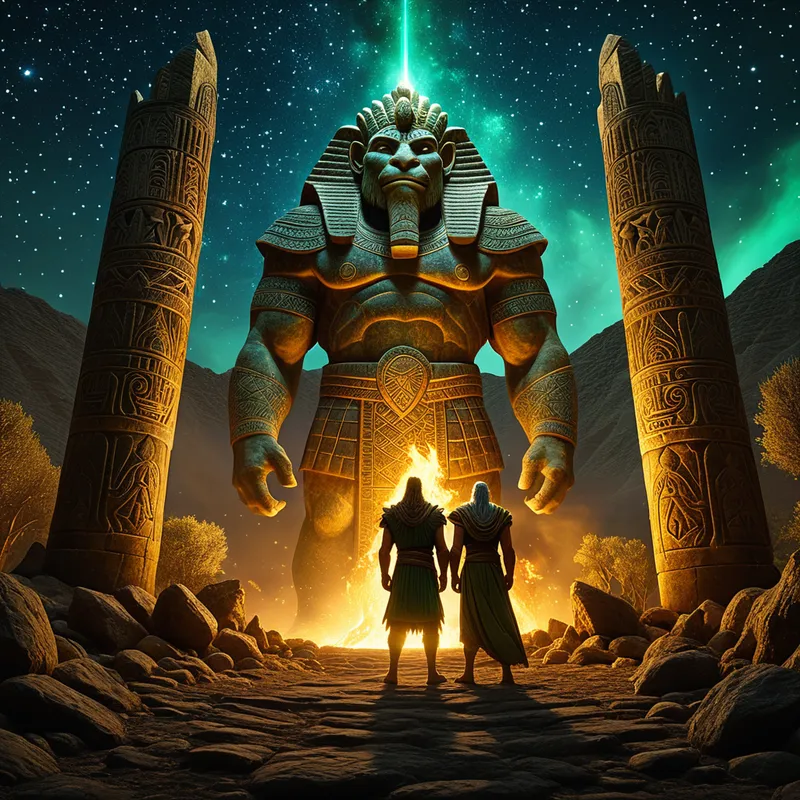
Hear now the tale etched in the clay of time, the story of the king who was two-thirds god and one-third man, and in that fraction, found all his torment and his truth. In the sun-baked city of Uruk, whose walls were said to be the work of gods, ruled [Gilgamesh](/myths/gilgamesh “Myth from Mesopotamian culture.”/). His strength was a storm; his will, an unyielding stone. He was a shepherd who consumed his people, taking sons for labor and brides for his bed before their wedding nights. The people’s cries rose like smoke to the heavens, and the gods heard.
They fashioned an answer from clay and spit: Enkidu, a man of the silent steppe, whose hair was a thicket and whose body was clothed in fur. He drank with the gazelles and knew no city. To civilize this wild soul, the gods sent a temple priestess, Shamhat. For seven days and nights, she lay with him, and the knowledge of humanity entered his bones. The animals fled from his new scent. Thus, he was brought to Uruk.
The meeting was not of words, but of bodies—a titanic clash at the city gates, a wrestling match that shook the very foundations. Dust clouded the air, muscles strained like river cords, and in the violent, sweating embrace, something broke and was remade. Gilgamesh, the untamed king, found his equal. Enkidu, the wild man, found his brother. Their laughter echoed where only tyranny had lived.
Seeking immortal fame to stave off mortal fear, they journeyed to the distant Cedar Forest. Its guardian was [Humbaba](/myths/humbaba “Myth from Mesopotamian culture.”/), whose roar was a flood and whose face was a maze of coiled intestines. With the aid of the sun god Shamash, they fought the monster. As [Humbaba](/myths/humbaba “Myth from Mesopotamian culture.”/) begged for mercy, Enkidu urged the killing blow. They returned triumphant, bathed in glory and the cedar’s sacred scent.
But glory attracts the eye of gods. The goddess [Ishtar](/myths/ishtar “Myth from Babylonian culture.”/), seeing the king’s splendor, offered herself to Gilgamesh. He refused her, recounting the bitter fates of her past lovers. In her wrath, she sent the Bull of Heaven to ravage Uruk. Again, the brothers stood together. Enkidu seized the bull’s tail, and Gilgamesh drove his blade into its neck. He tossed its haunch at the goddess in defiance.
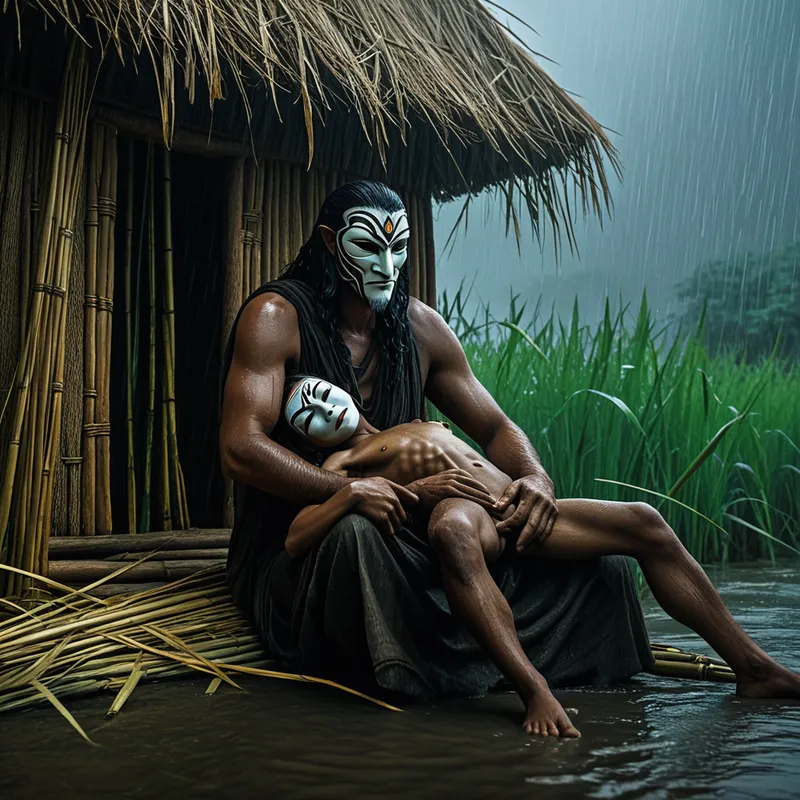
That night, Enkidu dreamed a terrible dream. The council of gods had decreed that for the slaying of Humbaba and the Bull, one of the two must die. The lot fell not on the king, but on the friend. A wasting sickness took Enkidu. For twelve days, Gilgamesh watched the light leave his brother’s eyes, felt the warmth seep from his hand. When Enkidu was still, Gilgamesh’s howl was that of a lioness robbed of her cubs. He would not let them bury him until a maggot fell from the nostril.
Then began the second, desperate journey. Clad in lion skins, driven by a terror that tasted of clay, Gilgamesh crossed the Mashu Mountains, guarded by scorpion-beings. He traversed the Garden of the Gods, and at [the world](/myths/the-world “Myth from Tarot culture.”/)’s end, he found [Utnapishtim](/myths/utnapishtim “Myth from Mesopotamian culture.”/), the Faraway. [The flood](/myths/the-flood “Myth from Biblical culture.”/) survivor told him of the great deluge and the gods’ grant of immortality, a gift not to be repeated.
Yet, pitying the king’s raw grief, Utnapishtim spoke of a plant that grew in the Apsu, a plant that could restore youth. Gilgamesh dove deep, retrieved the thorny plant. For a moment, hope was a tangible weight in his hand. But on his journey home, as he bathed in a cool pool, a serpent slithered from the [water](/myths/water “Myth from Chinese culture.”/) and stole the plant, shedding its skin as it vanished. Gilgamesh sat on the shore and wept. He returned to Uruk, to his mighty walls, and had his story inscribed on stone. The king who sought to conquer death finally looked upon his city, and in its enduring works, saw a different kind of eternity.
Cultural Origins & Context
This epic is not a single story but a river of stories, flowing from the Sumerian city-states around 2100 BCE, through Akkadian, Babylonian, and Assyrian hands. It was recorded in cuneiform on clay tablets, the “library” of the 7th-century BCE Assyrian king Ashurbanipal providing the most complete version.
It functioned as royal propaganda, wisdom literature, and a profound exploration of the human condition. Recited by court scribes and perhaps in temple precincts, it served to legitimize kingship (by showing even the greatest king is subject to divine law), to explore the fraught relationship between humanity and the gods, and to provide a cultural container for the universal anxieties of death, legacy, and the purpose of a civilized life. It is the foundational narrative of Western literature, establishing archetypes—the heroic quest, the wild companion, the search for wisdom—that echo through millennia.
Symbolic Architecture
At its core, the epic is a map of the [psyche](/myths/psyche “Myth from Greek culture.”/)’s confrontation with the limits of [the ego](/myths/the-ego “Myth from Jungian culture.”/). Gilgamesh begins as the uninitiated ruler, a pure [expression](/symbols/expression “Symbol: Expression represents the act of conveying thoughts, emotions, and individuality, emphasizing personal communication and creativity.”/) of will and power—[the ego](/myths/the-ego “Myth from Jungian culture.”/) unchecked. Enkidu represents the instinctual, somatic self, the [shadow](/symbols/shadow “Symbol: The ‘shadow’ embodies the unconscious, repressed aspects of the self and often represents fears or hidden emotions.”/) and the twin. Their battle is the necessary [collision](/symbols/collision “Symbol: A sudden, forceful impact between objects or forces, often representing conflict, unexpected change, or the meeting of opposing elements in life.”/) between [consciousness](/symbols/consciousness “Symbol: Consciousness represents the state of awareness and perception, encompassing thoughts, feelings, and experiences.”/) and the unconscious, a violent [integration](/symbols/integration “Symbol: The process of unifying disparate parts of the self or experience into a cohesive whole, often representing psychological wholeness or resolution of internal conflict.”/) that forges the coniunctio, the sacred [friendship](/symbols/friendship “Symbol: A bond characterized by mutual affection and support, representing an essential aspect of human social interaction.”/).
The first death is not of the body, but of the solitary ego. Friendship is the axe that breaks the shell.
The slaying of Humbaba and the [Bull](/symbols/bull “Symbol: The bull often symbolizes strength, power, and determination in many cultures.”/) of [Heaven](/symbols/heaven “Symbol: A symbolic journey toward ultimate fulfillment, spiritual transcendence, or connection with the divine, often representing life’s highest aspirations.”/) is the heroic ego’s [triumph](/myths/triumph “Myth from Roman culture.”/) over the monstrous aspects of [nature](/symbols/nature “Symbol: Nature symbolizes growth, connectivity, and the primal forces of existence.”/) and divine [authority](/symbols/authority “Symbol: A symbol representing power structures, rules, and control, often reflecting one’s relationship with societal or personal governance.”/), but it is a hubristic act. The gods’ decree that Enkidu must die represents the immutable law of [the Self](/myths/the-self “Myth from Jungian culture.”/): the integrated shadow cannot live forever in the [realm](/symbols/realm “Symbol: The symbol of ‘Realm’ often signifies the boundaries of one’s consciousness, experiences, or emotional states, suggesting aspects of reality that are either explored or ignored.”/) of conscious [action](/symbols/action “Symbol: Action in dreams represents the drive for agency, motivation, and the ability to take control of situations in waking life.”/). It must “die” so that the conscious mind can be forced into a deeper, more solitary [quest](/symbols/quest “Symbol: A quest symbolizes a journey or search for purpose, fulfillment, or knowledge, often representing life’s challenges and adventures.”/).
The plant of rejuvenation, stolen by the [serpent](/symbols/serpent “Symbol: A powerful symbol of transformation, wisdom, and primal energy, often representing hidden knowledge, healing, or temptation.”/), is the ultimate [symbol](/symbols/symbol “Symbol: A symbol can represent an idea, concept, or belief, serving as a powerful tool for communication and understanding.”/) of the ego’s futile attempt to possess the secret of the Self. The serpent, an ancient symbol of cyclical renewal, takes it back into the chthonic realm, demonstrating that [life](/symbols/life “Symbol: The symbol of ‘Life’ represents a journey of growth, interconnectedness, and existential meaning, encompassing both the joys and challenges that define human experience.”/) and [death](/symbols/death “Symbol: Symbolizes transformation, endings, and new beginnings; often associated with fear of the unknown.”/) are a process owned by nature, not a prize to be won by the [hero](/symbols/hero “Symbol: A hero embodies strength, courage, and the ability to overcome significant challenges.”/).
The Dreamer’s Resonance
When this myth stirs in the modern dreamer, it often manifests as a profound somatic process. To dream of a mighty, oppressive king or tower can signal an ego-inflation, a feeling of being tyrannized by one’s own ambition or societal role. The appearance of a wild, earthy companion or animal—an Enkidu figure—suggests the psyche’s attempt to re-introduce instinct, authenticity, and the repressed body.
Dreams of a beloved friend dying, or of holding a lifeless body, may not be literal premonitions. They are the psyche’s dramatic enactment of the “death of the companion”—the necessary end of a life phase, a relationship, or an identity (the “Enkidu” within) that once brought wholeness but must now be released to force a deeper maturation. The subsequent dream of a futile quest, of losing a precious object to a water creature, speaks to the grief and acceptance stage where one confronts the limits of personal control and the reality of irreversible change.

Alchemical Translation
The epic models the full alchemical opus, the journey of individuation. Gilgamesh’s tyranny is the [nigredo](/myths/nigredo “Myth from Alchemical culture.”/), the blackening—the leaden, chaotic state of the unexamined life. The fight with Enkidu and their bonding is the coniunctio, [the sacred marriage](/myths/the-sacred-marriage “Myth from Various culture.”/) of opposites (conscious/unconscious, civilized/wild), which produces the “gold” of true friendship and integrated energy.
The death of Enkidu plunges Gilgamesh back into a deeper, more spiritual nigredo—[the dark night of the soul](/myths/the-dark-night-of-the-soul “Myth from Christian Mysticism culture.”/), where the achievements of the ego are revealed as dust. His desperate journey is the albedo, the whitening—a purification through suffering and the stripping away of all former supports.
The treasure guarded by the serpent is not eternal life for the ego, but the realization that the ego must die into something greater: the witness who beholds the enduring city of the soul.
Meeting Utnapishtim is the encounter with the Senex, the wise old man archetype, who represents the transcendent function, the perspective beyond personal tragedy. The loss of the plant is the final surrender, the [rubedo](/myths/rubedo “Myth from Alchemical culture.”/) or reddening not as a triumphant gain, but as the acceptance of mortal limits. The return to Uruk is the circulatio, the return to the beginning, but transformed. He does not rule as a god, but as a human who has seen [the abyss](/myths/the-abyss “Myth from Kabbalistic culture.”/). His legacy is no longer his name alone, but the story itself—the conscious integration of his experience into the fabric of his culture and soul. The walls of the city become a symbol of the achieved, bounded Self, mortal but meaningful, a testament built not against death, but in its full, heartbreaking view.
Associated Symbols
Explore related symbols from the CaleaDream lexicon: