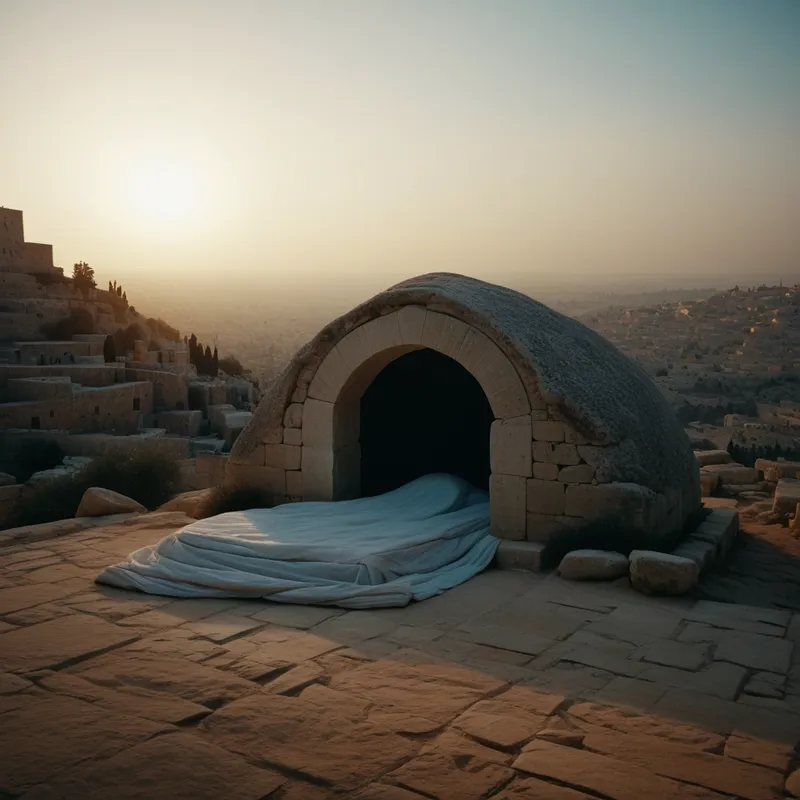
The Empty Tomb Myth Meaning & Symbolism
A story of a sealed tomb found empty, signaling a rupture in cosmic order and the birth of a new consciousness beyond the finality of death.
The Tale of The Empty Tomb
Listen. The world held its breath.
For three days, the sky had wept ash-grey tears. In a garden, hewn from living rock, a tomb yawned—a mouth silenced by a stone as vast as a giant’s heart. It was sealed by the authority of empire and the finality of death. The one within, Yeshua, the teacher from Nazareth, had been broken upon the Roman tree. His followers, scattered like chaff, carried only the cold weight of a finished story.
But before the sun could crown the hills, in the thin, violet hour between night and day, the earth trembled. Not with violence, but with a deep, resonant sigh, as if a long-held tension had finally released. The stone—that monumental seal—did not shatter. It was rolled aside, as easily as a curtain drawn to welcome the morning.
The first to come was Miriam of Magdala, her eyes raw, her hands clutching spices for a body she expected to anoint. She saw the gaping darkness and ran. She brought back Simon Kefa and the other disciple, the one Yeshua loved. They raced through the dewy garden, their breath coming in ragged clouds.
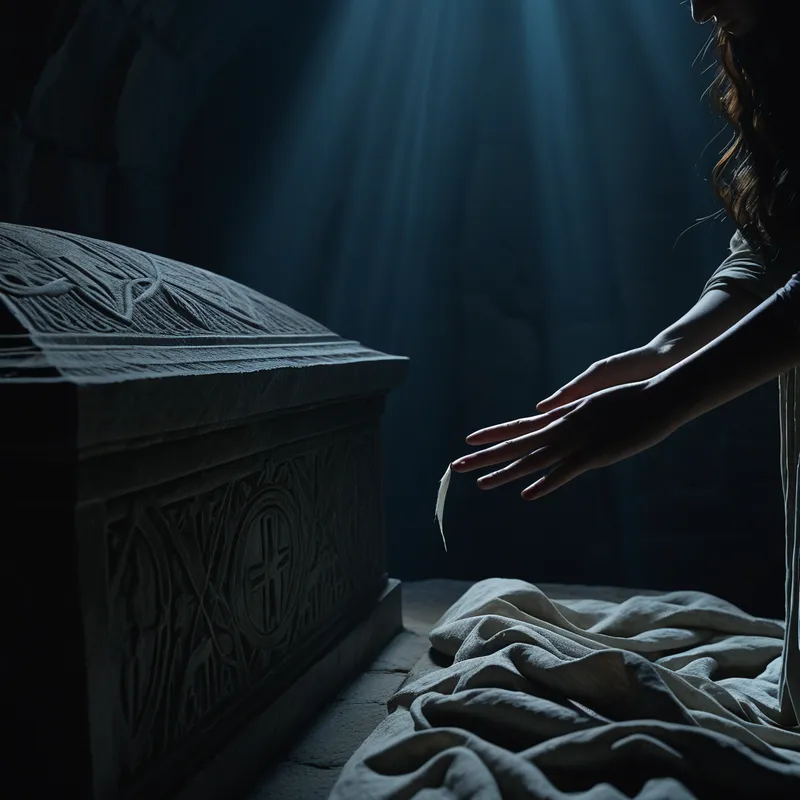
Kefa, ever impulsive, arrived first but halted at the threshold, his courage faltering before the mystery. The other disciple peered into the gloom, and saw. He saw the linen burial cloths, collapsed upon themselves like the shed skin of a serpent. He saw the head wrapping, not tossed aside, but neatly rolled and set apart. He saw not a scene of theft or desecration, but of profound, deliberate vacancy. A space where a body should be, but was not. And in that seeing, a seed of knowing was planted in his heart.
But Miriam remained, her grief a well with no bottom. Weeping, she bent to look again into the tomb. And there, where the body of her teacher had lain, two beings sat in radiant white, one at the head, one at the feet. “Woman,” they asked, “why are you weeping?”
“They have taken my Lord,” she sobbed, “and I do not know where they have laid him.”
Turning, through a veil of tears, she saw a figure she took for the gardener. “Sir, if you have carried him away, tell me where you have laid him.”
And then he spoke her name. “Miriam.”
One word. The sound of her own true name, spoken with a familiarity that pierced the world of death and shattered it. In that moment, the tomb was not merely empty of a corpse. It was full of a presence that could not be contained by stone, by ritual, or by the final, absolute law of the grave. The story was not over. It had broken its own spine and begun anew.
Cultural Origins & Context
This story emerges from a first-century Jewish apocalyptic milieu, a culture living under the heel of the Roman Empire and yearning for divine intervention. The accounts of the empty tomb are found in all four canonical Gospels, though with varying details—a hallmark of oral tradition where core truth is preserved within fluid storytelling. It was a tale first whispered by women, whose testimony was considered legally unreliable at the time, a detail that argues for its historical bedrock. The story was not a philosophical proposition but a shocking, community-defining event. Its primary function was kerygmatic—proclamation. It was the foundational proof for the early Christian claim that the Resurrection was a physical, historical reality, not a mere spiritual metaphor. This myth became the central axis around which a new community, identity, and understanding of cosmic history would form, shifting the focus from a political liberation of Israel to a liberation of all humanity from death itself.
Symbolic Architecture
The Empty Tomb is not a symbol of absence, but of a specific, transformative kind of presence. It represents the ultimate rupture in the psyche’s understanding of reality.
The tomb is the sealed chamber of the finished self, the ego’s final definition. The emptiness within is the shocking revelation that the true self cannot be contained there.
The Rolled-Away Stone symbolizes the removal of the ultimate obstacle: the absolute, internalized law of finality. It is the psyche breaking its own most rigid conviction. The Neatly Folded Linens are crucial. This is not a hurried escape. It signifies a deliberate, orderly transcendence of the physical form, a leaving-behind of the mortal shroud without violence or chaos. The body is not merely missing; it has been translated.
Psychologically, the tomb is the complex, the neurosis, the depression, the fixed identity we believe is our eternal truth. We seal ourselves in with the stone of “this is just who I am.” The emptiness is the terrifying, liberating discovery that the core of our being—the Self—is not identical to that entombed content. It has moved on. The encounter with the living presence (the calling of “Miriam”) outside the tomb represents the direct, personal experience of this liberated Self, which can only be recognized when we turn away from the empty place of our old suffering.

The Dreamer’s Resonance
When this myth stirs in the modern dreamer, it often manifests not as biblical imagery, but as a profound somatic and spatial experience. One may dream of a childhood home found utterly vacant, yet charged with significance. Of a locked room in a familiar house that is suddenly open, revealing not secrets, but a clean, empty space. Of a coffin at a funeral that, when peered into, contains only old clothes or rich soil.
The psychological process is one of decathexis—the withdrawal of psychic energy from a long-held object, identity, or trauma. The dreamer is undergoing the dissolution of a foundational self-narrative. The somatic feeling is often a mix of profound disorientation (“Where is it? Where is the problem, the pain, the person I thought I was?”) and a strange, unsettling peace. There is grief for what is gone, but also the terrifying freedom of a blank page. The dream is an announcement from the unconscious: the period of mourning a former state is complete. The energy that was bound in maintaining that old “body” of identity has been liberated. The tomb is empty so that the life may be lived elsewhere.
Alchemical Translation
In the alchemy of the soul, the Empty Tomb is the Nigredo giving way to the Albedo, not through effort, but through revelation. The process models the pinnacle of individuation.
The alchemical vessel is shattered from within. The goal is not to perfect the contents, but to discover that the true gold was never contained at all.
First, one must fully endure the crucifixion—the conscious suffering and death of the ego’s ambitions and identified attachments (the career, the relationship, the self-image). This is the necessary descent and entombment. The sealing of the stone is the ego’s acceptance of this death as final. The three days are the period of in the tomb, a necessary germination in absolute darkness.
The rolling away of the stone is an act of grace, performed by a force greater than the ego. It is the Self announcing its own autonomy. The modern individual’s parallel is the unexpected, often disruptive insight or synchronicity that forcibly opens a sealed chamber of the psyche. Looking inside to find it “empty” is the realization that the problem, the complex, the old wound, no longer has a living center. It has been evacuated by a transformative process that occurred unconsciously.
The final stage is the encounter outside the tomb. The liberated Self calls the ego by its true name. This is the integration: the ego, represented by Miriam, is not destroyed but is given a new purpose—to go and announce the reality of this liberation. The individuated person no longer lives from the entombed identity but from a dialogue with the living, mobile center that has passed through death and out the other side. The empty tomb remains as a monument, not to death, but to the fact that what we are cannot be held by any grave we dig for it.
Associated Symbols
Explore related symbols from the CaleaDream lexicon: