The Empty Room Myth Meaning & Symbolism
A master and student meet in a room stripped of all things, where the only treasure is the unadorned, luminous nature of awareness itself.
The Tale of The Empty Room
Listen.
There was once a seeker, a man whose mind was a clattering marketplace of thoughts. He had climbed mountains to sit with hermits, memorized scrolls until the ink bled behind his eyes, and worn his knees raw on meditation cushions, all in pursuit of the great secret—the jewel of enlightenment. His quest led him at last to the doorstep of a master renowned not for lengthy sermons, but for a silence so deep it was said to swallow questions whole.
The master lived in a simple hut at the forest’s edge. When the seeker arrived, breathless with anticipation, the master merely gestured him inside. The seeker entered, his eyes eagerly scanning the space for altars, for sacred statues, for libraries of wisdom. He found none.
The room was empty.
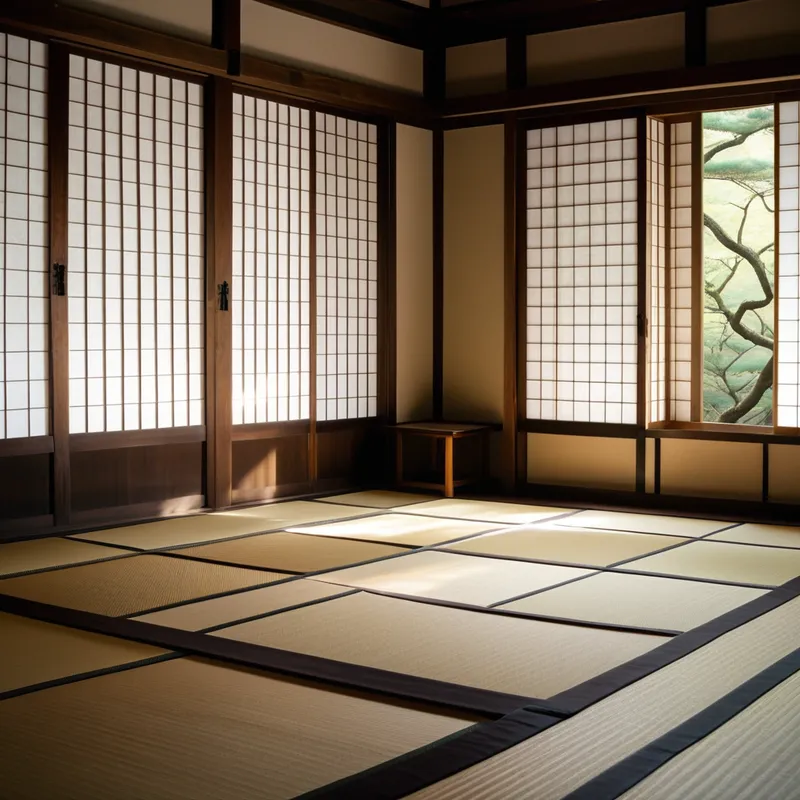
Not austerely furnished, but profoundly, utterly empty. No scrolls. No images. Not a single stick of furniture. The [tatami](/myths/tatami “Myth from Japanese culture.”/) mats were bare; the walls were unadorned. The only presence was the soft, grey light filtering through the paper screen and the vast, waiting silence that filled the space like clear [water](/myths/water “Myth from Chinese culture.”/) fills a vessel. The seeker’s heart sank. Where was the teaching? Where was the treasure?
He turned to the master, who had settled seamlessly onto the floor, a calm mountain in the center of this void. “Forgive me, venerable one,” the seeker stammered, “but I have come a great distance. I seek the Dharma. I seek awakening. Where are your teachings? Where is the truth to be found in this… emptiness?”
The master did not speak. He simply sat, his posture an embodiment of repose, his gaze holding the seeker without grasping him. The silence stretched, becoming a tangible [thing](/myths/thing “Myth from Norse culture.”/). The seeker fidgeted, his own questions echoing loudly in the hollow of the room. He heard the rustle of his robes, the frantic beat of his own heart, the shallow pull of his breath—sounds usually drowned in thought, now deafening in the stillness.
Hours bled into the fading light. The seeker sat, first in frustration, then in exhaustion, finally in a creeping, unsettling bewilderment. With nothing to look at, he began to see. With nothing to listen to, he began to hear. The distant cry of a bird was not a distraction but a piercing note in the symphony of silence. The grain of the tatami became a universe of lines and shadows. And his own restless mind, with no object to cling to, began to turn back upon itself—a snake seeking its own tail.
As dusk settled, painting the empty room in shades of indigo, something within the seeker broke open. Not with a flash, but with a gentle subsidence. The frantic search, the weight of his questions, the very identity of “the seeker”… it all seemed to dissolve into the spaciousness around him. There was no jewel to find because there had never been a box to contain it. The empty room was not lacking; it was complete. In that moment, he was not in the empty room. He was the empty room—aware, boundless, and at peace.
The master, seeing the shift in the young man’s countenance—the relaxation of a burden he never knew he carried—simply nodded. Not a word had been spoken. The teaching was complete.
Cultural Origins & Context
The story of the Empty Room is not a single, codified myth but a pervasive archetypal anecdote within the Zen tradition. It echoes in the dialogues of the Tang Dynasty masters in China and the Kamakura-period monks in Japan. It is the essence of the “wordless teaching” or “direct pointing” favored by lineages like the Rinzai and Soto schools.
This tale was never meant for scripture; it was passed mouth-to-ear in monastic halls, a living transmission from teacher to disciple. Its societal function was subversive. In cultures steeped in complex ritual, philosophical debate, and hierarchical religious structures, the Empty Room served as a radical equalizer. It bypassed intellect and status, presenting a mirror that reflected only the raw condition of the viewer’s own mind. It was a tool to stop the seeking mind in its tracks, to create a crisis of perception where all external supports were removed, forcing a confrontation with the fundamental ground of being.
Symbolic Architecture
The myth’s power lies in its devastating simplicity. Every element is a deliberate [symbol](/symbols/symbol “Symbol: A symbol can represent an idea, concept, or belief, serving as a powerful tool for communication and understanding.”/) pointing back to the [nature](/symbols/nature “Symbol: Nature symbolizes growth, connectivity, and the primal forces of existence.”/) of [consciousness](/symbols/consciousness “Symbol: Consciousness represents the state of awareness and perception, encompassing thoughts, feelings, and experiences.”/).
The [Seeker](/symbols/seeker “Symbol: A person actively searching for meaning, truth, or a higher purpose, often representing the dreamer’s own quest for identity or fulfillment.”/) represents the conditioned self, the [persona](/symbols/persona “Symbol: The social mask or outward identity one presents to the world, often concealing the true self.”/) and [the ego](/myths/the-ego “Myth from Jungian culture.”/), forever objectifying [reality](/symbols/reality “Symbol: Reality signifies the state of existence and perception, often reflecting one’s understanding of truth and life experiences.”/). He is the part of us that believes fulfillment is “out there,” in another person, [achievement](/symbols/achievement “Symbol: Symbolizes success, mastery, or reaching a goal, often reflecting personal validation, social recognition, or overcoming challenges.”/), or state of mind. His [journey](/symbols/journey “Symbol: A journey in dreams typically signifies adventure, growth, or a significant life transition.”/) is the spiritual [quest](/symbols/quest “Symbol: A quest symbolizes a journey or search for purpose, fulfillment, or knowledge, often representing life’s challenges and adventures.”/) turned into another form of craving.
The Master is the embodiment of the realized Self, the Self that has seen through the illusion of [separation](/symbols/separation “Symbol: A spiritual or mythic division between realms, states of being, or consciousness, often marking a transition or loss of connection.”/). He does not teach because he has nothing to add. He simply is, demonstrating that the goal is not a distant peak but the very ground upon which one stands.
The Empty Room is the supreme symbol. It is the mind in its natural state—unfabricated, unconditioned awareness. It is not a vacuum of absence, but a plenum of potential. It is Sunyata itself. The room is empty of things, but brilliantly full of awareness. To the seeker, it appears barren. To the awakened, it is the source of all things.
The Silence is the active agent. It is not the [absence](/symbols/absence “Symbol: The state of something missing, void, or not present. Often signifies loss, potential, or existential questioning.”/) of sound, but the [space](/symbols/space “Symbol: Dreaming of ‘Space’ often symbolizes the vastness of potential, personal freedom, or feelings of isolation and exploration in one’s life.”/) in which sound arises and falls. It represents the unconditioned [background](/symbols/background “Symbol: The background in a dream can reflect context, environment, and underlying influences in the dreamer’s life.”/) of all experience. In that enforced silence, the seeker’s internal narrative—his hopes, fears, and self-[story](/symbols/story “Symbol: The symbol of ‘Story’ represents the narrative woven through our lives, embodying experiences, lessons, and emotions that shape our identities.”/)—is stripped of its power, revealing the silent witness beneath.

The Dreamer’s Resonance
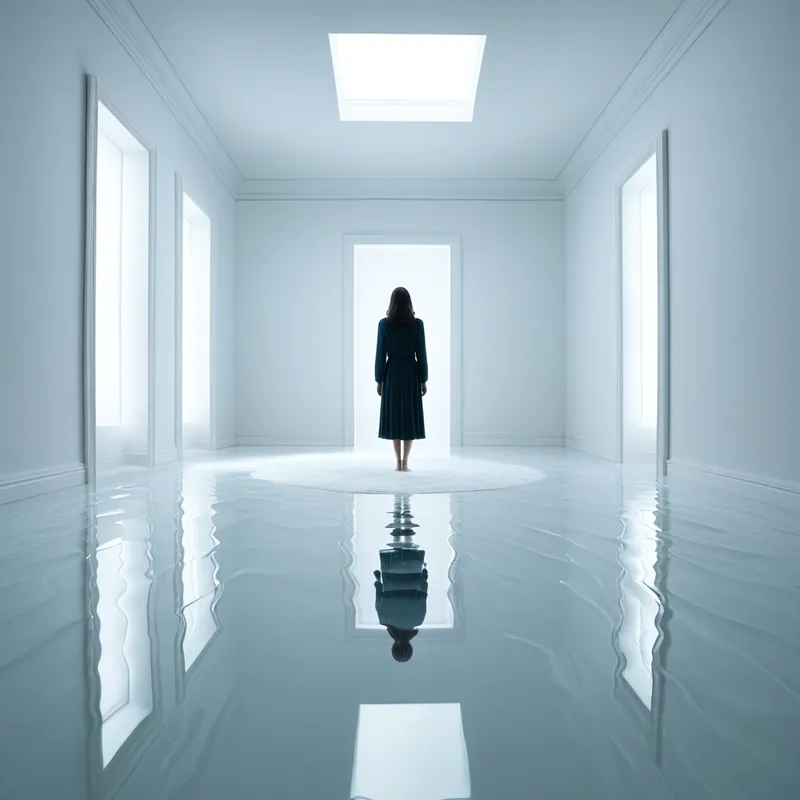
When this myth surfaces in modern dreams, it rarely appears as a Zen anecdote. It manifests as the dream of an endless, unfurnished house, a vast white warehouse, or an apartment where all the walls have vanished. The dreamer wanders these spaces, often with a sense of anxiety or profound loneliness. “Where is all my stuff? Where is my life?”
This is the [psyche](/myths/psyche “Myth from Greek culture.”/)’s somatic signal of a [nigredo](/myths/nigredo “Myth from Alchemical culture.”/) process underway. A previously held identity—a career, a relationship, a belief system—has dissolved or been stripped away. The conscious ego feels bereft, standing in the psychic “empty room” of transition. The anxiety is the ego’s protest at its own deconstruction. Yet, if the dreamer can stay in the dream space without fleeing, a shift can occur. The emptiness may become peaceful. The light in the room may grow softer. This signals the beginning of acceptance, the first glimpse that this void is not an end, but a necessary clearing for a more authentic existence to emerge.
Alchemical Translation
The myth of the Empty Room is a perfect map for the alchemical process of individuation. The seeker’s journey is the initial consciousness of lack (the nigredo). His frantic search through philosophies and practices is the futile attempt to fill the inner void with outer content.
The confrontation with the master in the empty room is the critical stage of mortificatio—the death of the old, seeking ego. All projections are withdrawn. All spiritual materialism is invalidated. The ego, faced with nothing to manipulate or understand, is humbled and dissolved.
Sitting in the ensuing silence is the albedo, the whitening. This is not an active doing, but a patient allowing. It is the purification of perception, where the psyche washes itself clean of compulsive identification. The “I” that sought becomes transparent.
The final realization—“I am the empty room”—is the [rubedo](/myths/rubedo “Myth from Alchemical culture.”/), the reddening, the culmination. It is the integration of [the void](/myths/the-void “Myth from Buddhist culture.”/) into conscious life. The individual no longer experiences awareness as a small, subjective “me” looking at an objective world. They recognize themselves as the spacious, empty awareness in which the entire world of form, thought, and sensation arises and plays. The seeker and the sought are unified. The empty room is no longer a place one enters, but the fundamental nature one has always been. This is the gold of psychological and spiritual freedom: to live from the boundless, empty fullness of the true Self.
Associated Symbols
Explore related symbols from the CaleaDream lexicon: