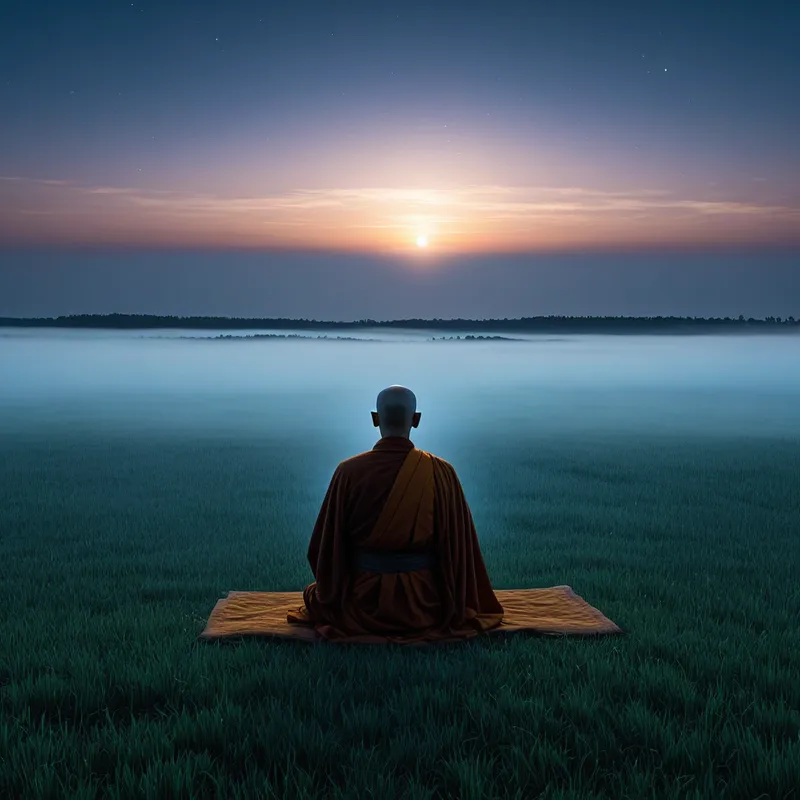
The Empty Field Myth Meaning & Symbolism
A monk seeks a sacred field of ultimate reality, only to discover that the true teaching is the field's perfect, ungraspable emptiness.
The Tale of The Empty Field
Listen. There is a story told when the lamps burn low and the mind turns inward, a story not of conquest, but of surrender.
In a time when the Dharma was young and fresh upon [the earth](/myths/the-earth “Myth from Hindu culture.”/), there lived a monk named Sāriputta. His intellect was a sharpened sword, his understanding profound. He had mastered the scriptures, could debate the nature of paticcasamuppāda until dawn, and his meditation was as steady as a mountain. Yet, a whisper persisted in the silent chambers of his heart—a whisper of something more ultimate, more final than all his knowing.
He heard tales of a place called the Empty Field. It was not on any map. It was said to be a tract of reality itself, a pure land not of splendor, but of absolute suchness. Here, it was told, [the veil](/myths/the-veil “Myth from Various culture.”/) of Māyā was utterly rent. To stand upon that ground was to know the truth without intermediary, to see the Dhammatā face-to-face. It became his compass point. While others sought [nirvana](/myths/nirvana “Myth from Buddhist culture.”/) as an end, Sāriputta sought this field as the very embodiment of the path.
For years he wandered. He left the comfort of the [Sangha](/myths/sangha “Myth from Buddhist culture.”/), his feet wearing thin on stone paths and through tangled forests. He crossed rivers that mirrored his doubt and climbed mountains that reflected his striving. He asked every sage, every dusty ascetic in cave and clearing: “Where lies the Empty Field? Point me to the place of ultimate truth!” Some smiled enigmatically. Others shook their heads. Many gave directions to beautiful groves, tranquil ponds, or powerful energy vortexes—places of great peace, but not what he sought. His bowl grew light, his robes faded, and the image of the Field burned ever brighter in his mind, a luminous goal just beyond the next ridge.
One evening, as a weary sun bled into the hills, he stumbled into a wide, flat expanse. It was not beautiful. No trees offered shade. No stream sang. It was simply earth and sky, an unremarkable stretch of land where [the wind](/myths/the-wind “Myth from Various culture.”/) moved unimpeded. In the center sat an old bhikkhunī, her form so still she seemed a part of the earth. Her eyes were closed, her face a landscape of deep peace.
Heart pounding with a hope he dared not name, Sāriputta approached. He bowed, the dust of his long journey falling from his shoulders. “Venerable one,” he whispered, his voice cracked with thirst and yearning. “I have searched across the breadth of [the world](/myths/the-world “Myth from Tarot culture.”/). I seek the Empty Field, the place of final understanding. Can you tell me… is this it?”
The old nun did not open her eyes. A silence stretched, filled only by the wind. Then, softly, she spoke. “Yes.”
A wave of euphoria washed over Sāriputta. At last! He fell to his knees, tears streaking the dust on his cheeks. He looked around with new eyes, expecting the very air to crackle with revelation, for the ground to glow with wisdom. He waited for the transformative vision, the final shattering of illusion.
He saw only the field. Brown grass. Pebbles. Distant hills. The vast, empty sky.
He looked again, straining his perception to its limit. He sought hidden symbols, felt for resonant energies, listened for celestial harmonies. There was nothing. No special quality. No profound essence. Just… this. The euphoria curdled into confusion, then into a deep, hollow ache. This was it? This barren patch was the goal of his life’s quest?
He turned back to the nun, desperation edging his voice. “But… I don’t understand. I see no emptiness. I see a field. It is just a field.”
Now, she opened her eyes. They were clear, like pools reflecting [the sky](/myths/the-sky “Myth from Persian culture.”/) itself. She looked not at him, but through him, at the expanse. “Precisely,” she said, her voice the sound of the wind itself. “It is just a field. You have reached the Empty Field. Now, put down your search. And see.”
In that moment, the seeking mind of Sāriputta—the mind that had clutched the concept of “Empty Field” as the ultimate answer—shattered. The tension of a lifetime dissolved. He was not in the Empty Field. He was the Empty Field. The seeker, the sought, and the search collapsed into the simple, undeniable suchness of the grass, the sky, the wind, and the dust on his own hands. He had arrived by ceasing to travel.
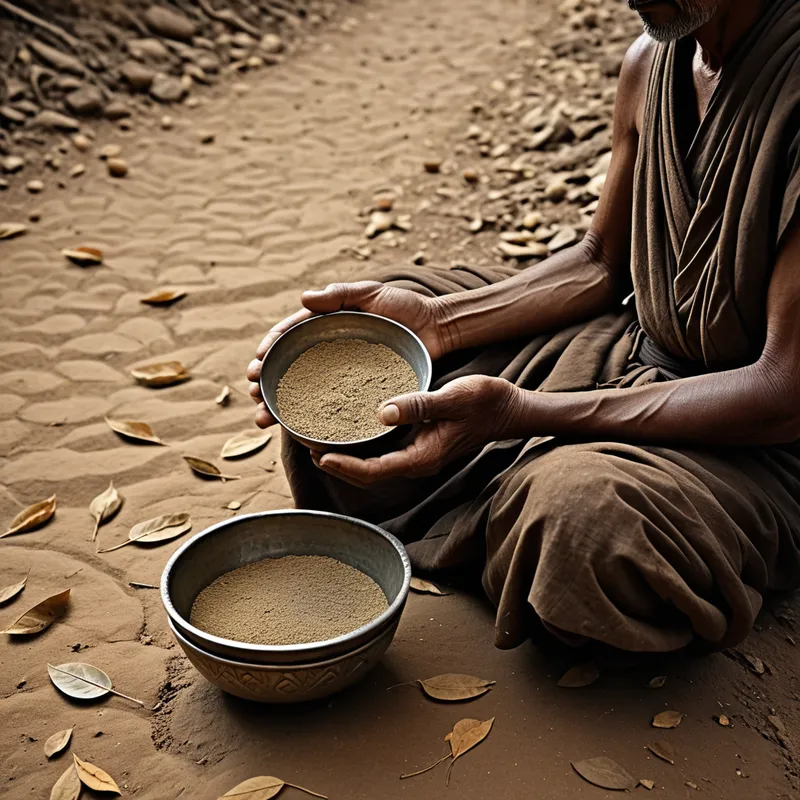
Cultural Origins & Context
The story of the Empty Field is not a canonical sutta from the Pali Canon, but a profound teaching tale that emerged from the Chán and Zen lineages, particularly within the Línjì tradition. It is a kōan in narrative form, a “pointer” story used by masters to break the conceptual fixation of their students.
These stories were transmitted orally in the meditation halls and monastic gardens of East Asia. A master, perceiving a disciple’s attachment to a particular state, ideal, or goal—even the goal of enlightenment itself—might recount this tale. Its function was surgical: to sever the root of spiritual materialism. In a culture where diligent practice and scriptural study were paramount, this myth served as the essential counterweight, reminding practitioners that the Tathatā is not an object to be acquired, but the ground of one’s immediate, ungraspable experience. It societal role was to prevent the Dharma from becoming just another system of belief to be clung to, preserving the radical, experiential core of the awakening.
Symbolic Architecture
The myth’s power lies in its devastatingly simple symbolic [architecture](/symbols/architecture “Symbol: Architecture in dreams often signifies structure, stability, and the framing of personal identity or life’s journey.”/). Every element is a mirror.
Sāriputta represents the intellect, the seeking [consciousness](/symbols/consciousness “Symbol: Consciousness represents the state of awareness and perception, encompassing thoughts, feelings, and experiences.”/)—the part of us that believes [truth](/symbols/truth “Symbol: Truth represents authenticity, honesty, and the quest for knowledge beyond mere appearances.”/) is “out there,” a [destination](/symbols/destination “Symbol: Signifies goals, aspirations, and the journey one is on in life.”/) to be reached through [effort](/symbols/effort “Symbol: Effort signifies the physical, mental, and emotional energy invested toward achieving goals and personal growth.”/), purification, or accumulation of [knowledge](/symbols/knowledge “Symbol: Knowledge symbolizes learning, understanding, and wisdom, embodying the acquisition of information and enlightenment.”/). He is the archetypal spiritual achiever.
The Empty Field is the central, paradoxical [symbol](/symbols/symbol “Symbol: A symbol can represent an idea, concept, or belief, serving as a powerful tool for communication and understanding.”/). It does not symbolize “[nothingness](/symbols/nothingness “Symbol: A profound emptiness or void, often representing existential anxiety, spiritual seeking, or emotional numbness in dreams.”/)” in a nihilistic sense, but Śūnyatā. It is [reality](/symbols/reality “Symbol: Reality signifies the state of existence and perception, often reflecting one’s understanding of truth and life experiences.”/) itself, unobscured by [projection](/symbols/projection “Symbol: The unconscious act of attributing one’s own internal qualities, emotions, or shadow aspects onto external entities, people, or situations.”/), preference, or concept. It is “empty” of our [stories](/symbols/stories “Symbol: Stories symbolize the narratives of our lives, reflecting personal experiences and collective culture.”/) about it, yet full of its own thusness. The field is not special, which is precisely what makes it ultimate.
The Long [Journey](/symbols/journey “Symbol: A journey in dreams typically signifies adventure, growth, or a significant life transition.”/) symbolizes the entire spiritual [path](/symbols/path “Symbol: The ‘path’ symbolizes a journey, choices, and the direction one’s life is taking, often representing individual growth and exploration.”/)—all the practices, disciplines, and struggles. It is necessary, for it exhausts the [seeker](/symbols/seeker “Symbol: A person actively searching for meaning, truth, or a higher purpose, often representing the dreamer’s own quest for identity or fulfillment.”/) and brings him to the brink. Yet, the myth reveals it as a circular [pilgrimage](/symbols/pilgrimage “Symbol: A spiritual or transformative journey toward a sacred destination, representing personal growth, devotion, and the search for meaning.”/) that leads back to the starting point, seen with new eyes.
The Old Bhikkhunī is the embodiment of awakened wisdom, but not as a [teacher](/symbols/teacher “Symbol: The symbol of the teacher in dreams often represents guidance, wisdom, and the process of learning or self-discovery.”/) who gives answers. She is the manifestation of the Field itself, silent and present. Her [role](/symbols/role “Symbol: The concept of ‘role’ in dreams often reflects one’s identity or how individuals perceive their place within various social structures.”/) is not to instruct, but to be, thereby reflecting the seeker’s own question back to him until it dissolves.
The ultimate truth is not found in the extraordinary, but in the complete and utter ordinariness that remains when all seeking stops.
The conflict is not between good and evil, but between the mind that seeks a special, enlightened state and the reality that is inherently free and complete, just as it is. The [resolution](/symbols/resolution “Symbol: In arts and music, resolution refers to the movement from dissonance to consonance, creating a sense of completion, release, or finality in a composition.”/) is the [death](/symbols/death “Symbol: Symbolizes transformation, endings, and new beginnings; often associated with fear of the unknown.”/) of the seeker, not the person, but the psychological [posture](/symbols/posture “Symbol: Posture in dreams represents one’s stance in life, social presentation, and inner confidence or submission. It reflects how one carries themselves through challenges and relationships.”/) of seeking. What remains is bare, aware [presence](/symbols/presence “Symbol: Presence in dreams often signifies awareness or acknowledgment of something significant in one’s life.”/)—the “field” of consciousness, empty of a separate self, yet vividly alive.
The Dreamer’s Resonance
When this myth stirs in the modern [psyche](/myths/psyche “Myth from Greek culture.”/), it often surfaces in dreams of profound searching and elusive destinations. You may dream of endlessly searching for a crucial room in a vast building, only to find it empty. You may dream of pursuing a radiant figure across a landscape that never changes, only to have them turn and reveal your own face. You may simply dream of a vast, open plain—feeling not peace, but a haunting anxiety of “There must be more than this.”
These are somatic dreams of the seeker’s exhaustion. The body-mind is processing the tension of striving—for the perfect job, the ideal relationship, the state of healed wholeness, or a defined spiritual peak. The dream is the psyche’s attempt to initiate a collapse. The emptiness encountered in the dream is not a warning, but an invitation to a deeper somatic truth: the clenched effort itself is the primary source of suffering. The dream presents the Empty Field as a lived experience, asking the dreamer to feel the barrenness, the absence of the expected reward, and to discover what awareness remains when hope for a specific outcome dies.
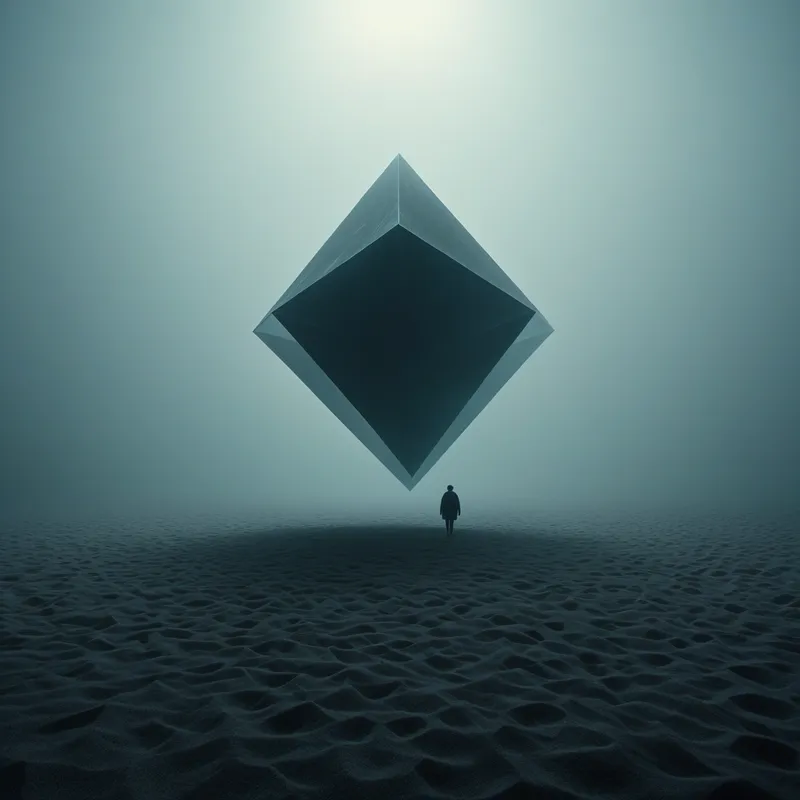
Alchemical Translation
For the modern individual navigating the path of individuation—the process of becoming whole, undivided from the unconscious—the myth of the Empty Field models the final, critical alchemical stage: the dissolution of the spiritual ego.
Our psychological development often follows Sāriputta’s journey. We identify a goal—the integrated Self, the healed inner child, the actualized [persona](/myths/persona “Myth from Greek culture.”/). We conscientiously engage in therapy, shadow-work, and self-improvement, traversing the inner landscape. This is vital work. Yet, a danger arises: [the ego](/myths/the-ego “Myth from Jungian culture.”/) can co-opt the process, creating a “spiritualized” self-image—the one who is healed, who is enlightened, who has attained wholeness. This becomes a new, subtler prison.
The Empty Field is the moment when the project of self-perfection meets its limit. It is the alchemical [solve et coagula](/myths/solve-et-coagula “Myth from Alchemical culture.”/) applied to the psyche itself: all concepts of who you are, who you should be, and what you must achieve are dissolved (solve) in the fire of direct, unadorned presence. What coagulates is not a better self, but the simple, undeniable fact of being-aware.
Individuation is not the creation of a perfect, finished self, but the realization that you are the space in which the totality of the self—light and shadow, seeker and found—arises and passes away.
The [triumph](/myths/triumph “Myth from Roman culture.”/) is not an acquisition, but a relinquishment. The treasure is not in the field; the realization that you are the field is the treasure. The modern individual learns that psychological wholeness is not a castle to be built on [the horizon](/myths/the-horizon “Myth from Various culture.”/) of the future, but the open, empty, and infinitely fertile ground of the present moment, upon which every thought, feeling, and archetype is allowed to come and go, without needing to be claimed as a final definition of who you are. This is the true, unshakeable grounding.
Associated Symbols
Explore related symbols from the CaleaDream lexicon: