The Empty Cup Myth Meaning & Symbolism
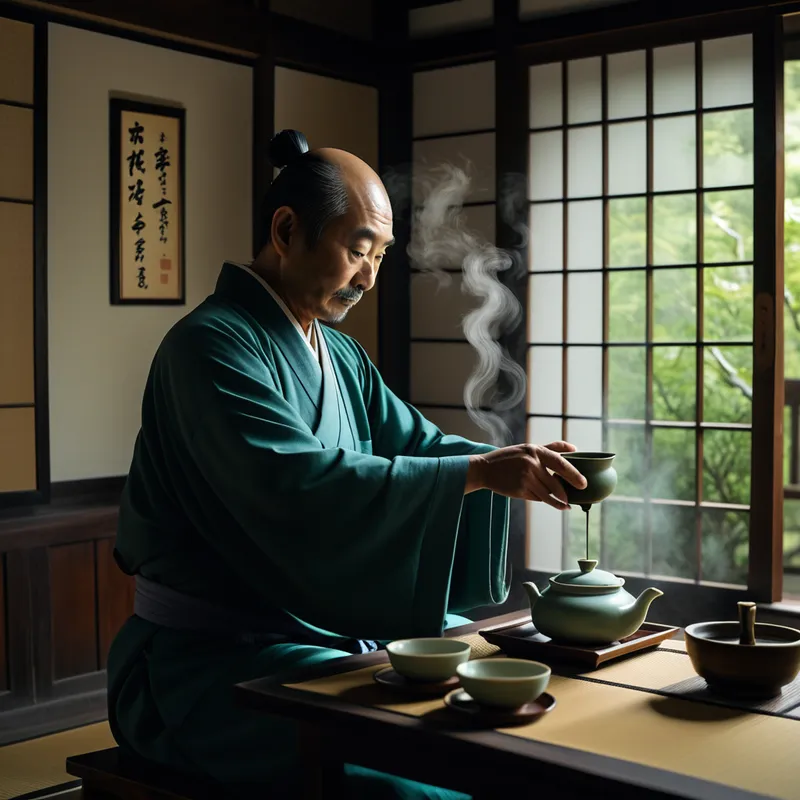
A scholar visits a master, his mind full of knowledge. Only when he empties his cup can the master's tea, and wisdom, flow in.
The Tale of The Empty Cup
Listen. The story does not begin with thunder or the birth of a star. It begins with dust. The fine, white dust of a mountain road, kicked up by the determined feet of a man who carried [the world](/myths/the-world “Myth from Tarot culture.”/) upon his shoulders. His name is lost, as all true names are, but we may call him the Scholar. His shoulders were bent not by physical weight, but by the immense burden of his knowing. He had consumed libraries. He could debate the nature of the Dharma for days, unravel the knots of [karma](/myths/karma “Myth from Hindu culture.”/) with logic, and quote the sutras like a river flows. Yet, a dryness was in his soul, a thirst no text could quench.
He had heard of a master who lived in a hermitage clinging to the cliffs, a man who spoke not in paragraphs but in silences. The Scholar climbed, his mind rehearsing his questions, polishing his arguments like swords. He would test this master, he thought. He would measure the depth of this famous silence with the plummet of his intellect.
He found the master in a small room that smelled of pine and old paper. The master was an old man, his face a map of wrinkles that spoke of smiling more than frowning. He said nothing, only gestured for the Scholar to sit. Without a word, the master prepared tea. He heated the [water](/myths/water “Myth from Chinese culture.”/), measured the green powder, his movements a slow, deliberate dance of utter simplicity.
The Scholar could bear the silence no longer. He launched into a magnificent discourse. He spoke of the [Nirvana](/myths/nirvana “Myth from Buddhist culture.”/) he understood, of the meditation techniques he had mastered, of the philosophical schools he had conquered. His words filled the small room, leaving no space for air.
The master listened, his eyes like still ponds. When the Scholar finally paused, breathless, the master simply picked up the teapot. He began to pour tea into the Scholar’s cup. He poured and poured. The rich, green liquid filled the cup to the brim, then overflowed. It cascaded over the lip, onto the fine silk of the Scholar’s robes, and pooled on the worn floorboards.
“Stop!” cried the Scholar, leaping back. “The cup is full! It can hold no more!”
The master set down the pot. His eyes held the Scholar’s. In a voice as calm as the space between heartbeats, he said, “You are like this cup. Full of your own ideas, your own knowledge. How can I show you Zen unless you first empty your cup?”
In that moment, the clatter of the Scholar’s mind ceased. The words, the theories, the proud arguments—they were the tea overflowing, useless and making a mess. He looked at the full, overflowing cup, then at the empty one before the master. For the first time in his adult life, he heard not the echo of his own thoughts, but the profound, echoing silence of his own capacity. The conflict was not with the master, but with the fullness of himself. The resolution was not an answer, but a space. He bowed, deeply. And in that bow, he began to pour himself out.

Cultural Origins & Context
This story, in its elegant simplicity, is a foundational koan-like parable. It is attributed to the broader Chan/Zen tradition, often used by masters like Linji Yixuan or referenced in the teachings of Dogen Zenji. Unlike formal koans from collections like the Mumonkan, it functions as an introductory teaching story, a “pre-koan.” It was passed down orally within monastic settings and later recorded in various collections of Zen anecdotes.
Its societal function was dual. For monastics, it was a direct, visceral warning against spiritual materialism—the danger of clinging to Buddhist doctrine as just another possession to be proud of. For lay students and the cultured elite (much like the Scholar in the tale), it served as a radical critique of intellectualism. In cultures that deeply revered scholarly achievement, such as Tang Dynasty China or Heian Japan, this story was a [thunderclap](/myths/thunderclap “Myth from Various culture.”/). It declared that the path to awakening (satori) did not lie in accumulating more knowledge, but in undergoing an alchemical process of unlearning. It was a tool to induce daigi, the great doubt that shatters the known.
Symbolic Architecture
The myth’s power lies in its stark, universal [symbolism](/symbols/symbolism “Symbol: The use of symbols to represent ideas or qualities, often conveying deeper meanings beyond literal interpretation. In dreams, it’s the language of the unconscious.”/). Each element is a mirror held up to the [psyche](/myths/psyche “Myth from Greek culture.”/).
The Cup: This is the [human](/symbols/human “Symbol: The symbol of a human represents individuality, complexity of emotions, and social relationships.”/) mind, the [heart](/symbols/heart “Symbol: The heart symbolizes love, emotion, and the core of one’s existence, representing deep connections with others and self.”/), the very [vessel](/symbols/vessel “Symbol: A container or structure that holds, transports, or protects something essential, representing the self, emotions, or life journey.”/) of [consciousness](/symbols/consciousness “Symbol: Consciousness represents the state of awareness and perception, encompassing thoughts, feelings, and experiences.”/). It is our [capacity](/symbols/capacity “Symbol: A measure of one’s potential, limits, or ability to contain, process, or achieve something, often reflecting self-assessment or external demands.”/) to receive, to experience, to be. In its natural state, it is open, empty, and useful.
The Tea: This represents [truth](/symbols/truth “Symbol: Truth represents authenticity, honesty, and the quest for knowledge beyond mere appearances.”/), wisdom, direct experience, or the teaching of [reality](/symbols/reality “Symbol: Reality signifies the state of existence and perception, often reflecting one’s understanding of truth and life experiences.”/) itself. It is not an [abstract concept](/symbols/abstract-concept “Symbol: An abstract concept represents intangible ideas or thoughts that challenge our ability to understand and categorize reality.”/) but a living, flowing substance—the “suchness” of the present [moment](/symbols/moment “Symbol: The symbol of a ‘moment’ embodies the significance of transient experiences that encapsulate emotional depth or pivotal transformations in life.”/).
The Overflowing: This is the [drama](/symbols/drama “Symbol: Drama signifies narratives, emotional expression, and the exploration of human experiences.”/) of the conditioned self. The Scholar’s [knowledge](/symbols/knowledge “Symbol: Knowledge symbolizes learning, understanding, and wisdom, embodying the acquisition of information and enlightenment.”/) is not false, but it is [static](/symbols/static “Symbol: Static represents interference, disruption, and the breakdown of clear communication or signal, often evoking feelings of frustration and disconnection.”/), conceptual, and past-tense. It occupies the [space](/symbols/space “Symbol: Dreaming of ‘Space’ often symbolizes the vastness of potential, personal freedom, or feelings of isolation and exploration in one’s life.”/) where immediate, transformative experience needs to flow. The overflow symbolizes the waste of [life](/symbols/life “Symbol: The symbol of ‘Life’ represents a journey of growth, interconnectedness, and existential meaning, encompassing both the joys and challenges that define human experience.”/) [energy](/symbols/energy “Symbol: Energy symbolizes vitality, motivation, and the drive that fuels actions and ambitions.”/) on maintaining preconceptions, the mess created when new [wine](/symbols/wine “Symbol: Wine often symbolizes celebration, indulgence, and the deepening of personal connections, but it can also represent excess and escape.”/) is forced into old wineskins.
The cup is not judged for being full, only rendered incapable of its true function.
The Act of Pouring Out: This is the core of the myth. It is not destruction, but kenosis—a self-emptying. It represents the voluntary [suspension](/symbols/suspension “Symbol: A state of being held in limbo, neither progressing nor regressing, often representing unresolved tension or transitional phases in life.”/) of judgment, the setting aside of [identity](/symbols/identity “Symbol: Identity represents the sense of self, encompassing personal beliefs, cultural background, and social roles.”/) (“I am a learned man”), and the humility to become a beginner again. It is the psychological [death](/symbols/death “Symbol: Symbolizes transformation, endings, and new beginnings; often associated with fear of the unknown.”/) of the knower to make [room](/symbols/room “Symbol: A room in a dream often symbolizes the self, representing personal space, mental state, or aspects of one’s identity.”/) for the experiencer.

The Dreamer’s Resonance
When this myth patterns a modern dream, it signals a critical juncture in the psyche’s development. You may dream of a room flooding because a sink won’t stop running, of a suitcase you cannot close because it is too full, or of trying to drink from a fountain but your mouth is already full of pebbles.
Somatically, this often correlates with a feeling of being “clogged up,” mentally fatigued, or suffering from analysis paralysis. Psychologically, the dreamer is at the limit of a conscious attitude. They have likely been trying to solve a life problem—a relationship issue, a career crossroads, a creative block—with the same old tools of analysis, planning, and past experience. The psyche, in its wisdom, is declaring that the current vessel of understanding is full. The conflict the dream presents is between [the ego](/myths/the-ego “Myth from Jungian culture.”/)‘s desire to add more (more advice, more research, more control) and [the Self](/myths/the-self “Myth from Jungian culture.”/)‘s imperative to create space.
The dream is an invitation to a specific kind of suffering: the anxiety of emptiness. It asks the dreamer to tolerate not-knowing, to stop the frantic mental activity, and to allow a void to form. This is the prelude to true receptivity.

Alchemical Translation
The journey of the Scholar models the individuation process with stunning clarity. His initial state is one of inflation; his ego is identified with his intellectual [persona](/myths/persona “Myth from Greek culture.”/) (“the wise man”). This persona is a complex, a structure of adapted knowledge that shields him from the raw, unknown ground of being.
The master’s action is the catalyzing agent, the lapis that triggers the [nigredo](/myths/nigredo “Myth from Alchemical culture.”/). The overflowing tea is the shocking, often humiliating realization that one’s prized possessions (ideas, status, self-image) are actively preventing growth. This is a necessary humiliation, the crushing of the ore.
The alchemy happens not in the filling, but in the willingness of the vessel to be cleansed.
The emptying is the albedo, the washing pure. It is the conscious, often painful work of shadow integration—recognizing that one’s knowledge can be a form of arrogance, that one’s identity is a construct. The Scholar’s bow is the surrender of the ego’s sovereignty.
Finally, the empty cup poised to receive is the beginning of the [rubedo](/myths/rubedo “Myth from Alchemical culture.”/), the golden dawn. It represents the birth of a new consciousness that does not grasp at experience but allows experience to permeate it. This is the receptive consciousness of the Self. The individual is no longer a collector of truths but a living conduit for reality. They have transmuted the leaden weight of “knowing about” into the golden capacity for “knowing.” The myth, therefore, is not about acquiring Zen, but about becoming, once again, a vessel fit for the eternal, pouring- forth mystery of existence itself.
Associated Symbols
Explore related symbols from the CaleaDream lexicon: