The Empty Circle Myth Meaning & Symbolism
A tale of a deity who carves a perfect circle into the cosmos, then must release it entirely to discover the true nature of reality and self.
The Tale of The Empty Circle
In the time before the counting of kalpas, when the universe was a silent exhalation waiting for a thought, there dwelt a being named Vimalakirti. His realm was not of earth or heaven, but of the potential that hums between them. He resided in the Pavilion of Unborn Radiance, a place woven from the first light that dared to separate itself from the primordial dark.
Vimalakirti perceived a profound melancholy in the fabric of existence. All things arose, danced for a moment in the torchlight of consciousness, and then fell back into the silent dark, forgotten. He felt a great compassion for this fleeting dance, and a profound desire to offer it a vessel, a shape that could hold meaning. He gazed into the Dharmadhatu, the infinite realm of reality, and saw only the ceaseless, beautiful chaos of dependent origination. It needed a center. It needed a boundary to know itself.
With the substance of his own luminous awareness, he began to draw. His finger, tipped with starlight, moved against the dark velvet of the cosmos. He poured into this act all his wisdom, all his compassion, all his yearning for perfection. He drew not with ink, but with intention. He drew not on parchment, but on the face of [the void](/myths/the-void “Myth from Buddhist culture.”/) itself. For an acon, he labored, his form becoming faint with the effort of concentration. He smoothed away every irregularity, every tremor of doubt. He polished it with the breath of patience.
And then, it was done.
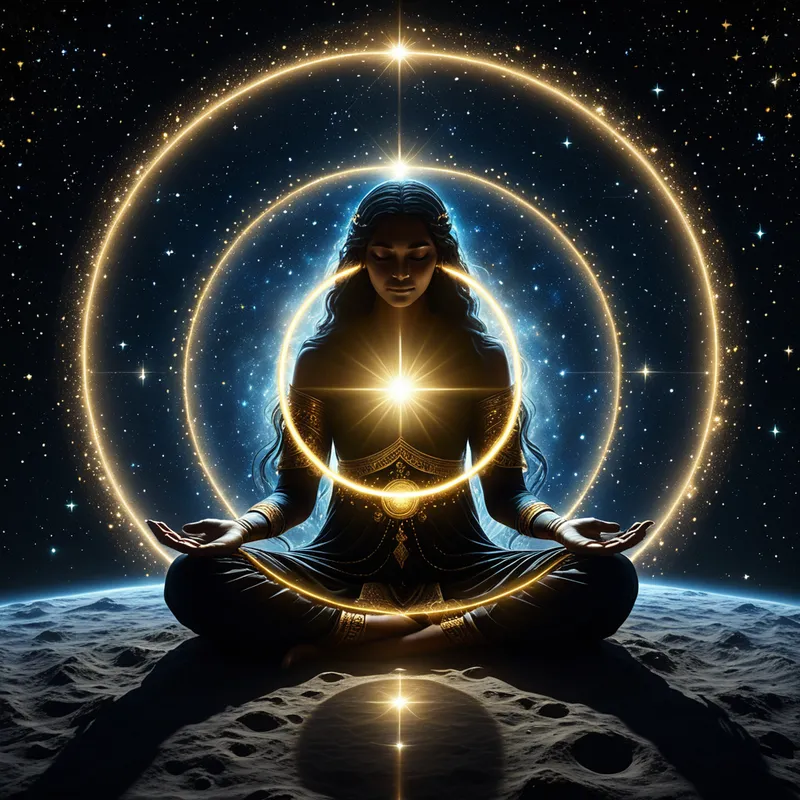
Before him, hanging in the infinite space, was the Circle. It was perfect. It held within its flawless line the promise of all mandalas, the orbit of all worlds, the wheel of the Dharma. It glowed with a soft, silver-gold light, a captured moonbeam defining a territory of sacred geometry. It was beautiful. It was complete. Vimalakirti felt a surge of joy. He had given the formless a form. He had made meaning manifest.
But as he sat in contemplation of his creation, a subtle disquiet arose. The Circle, in its very perfection, began to feel heavy. It was a declaration. It said, “Here is inside, and there is outside.” It whispered, “This is the sacred space, and that is the profane.” He saw how the light it emitted cast long, sharp shadows in the void—shadows of “self” and “other,” “attainment” and “lack.” The Circle, his child of compassion, had become the ultimate symbol of separation.
A great conflict tore at Vimalakirti’s heart. To love the creation was to cling to distinction. To release it was to surrender the work of ages. He sat for another acon, the perfect Circle before him, now feeling like a chain of exquisite gold. The resolution did not come as a thought, but as a tide. It was a knowing deeper than his bones, a whisper from the Tathagatagarbha itself.
With a sigh that was neither of sorrow nor joy, but of ultimate relinquishment, he reached out. Not to touch the Circle, but to embrace the space around it. And then, he let go. He released not the physical form—for it was made of mind—but the mental grasping that sustained it. He withdrew the [projection](/myths/projection “Myth from Alchemical culture.”/) of “I” and “mine.”
The Circle did not shatter. It did not vanish. It simply… emptied. The luminous line remained, but it now described nothing. It held no inside to be cherished, no outside to be rejected. It became a window, not a wall. In that moment of supreme release, the light of the Circle did not fade; it transformed. It stopped being a light that shone on the void and became the inherent luminosity of the void. Vimalakirti did not look at the Empty Circle. He realized he was seeing from it. And seeing from that emptiness, he saw the Pavilion of Unborn Radiance, his own form, and the swirling cosmos not as separate things, but as the playful, unimpeded expression of the Circle’ own empty nature. The conflict dissolved not in victory, but in a smile that had no origin.
Cultural Origins & Context
The narrative of The Empty Circle is not a single, canonical scripture, but a profound teaching tale that emerged from the Mahayana Buddhist tradition, particularly within the [Prajnaparamita](/myths/prajnaparamita “Myth from Buddhist culture.”/) literature and the later Chan</ab title=“A school of East Asian Buddhism emphasizing sudden enlightenment and the inherent Buddha-nature”>Zen koan tradition. It is a myth born from philosophy, a story crafted to embody the inexpressible doctrine of [Sunyata](/myths/sunyata “Myth from Buddhist culture.”/).
It was passed down not by historians, but by masters to disciples in meditation halls. It was told in the flickering light of butter lamps, not to record an event, but to precipitate an insight. Its societal function was subversive and therapeutic: to dismantle the mind’s compulsive habit of creating and clinging to “perfect” forms—be they dogmas, identities, status, or even idealized spiritual states. It served as a narrative mirror, showing the practitioner that the final and most subtle obstacle on the path is often the path itself, beautifully constructed.
Symbolic Architecture
The myth is a masterclass in symbolic [paradox](/symbols/paradox “Symbol: A contradictory yet true concept that challenges logic and perception, often representing unresolved tensions or profound truths.”/). Vimalakirti represents the highest aspiration of the conscious mind: the urge to create order, meaning, and sacred [structure](/symbols/structure “Symbol: Structure in dreams often symbolizes stability, organization, and the framework of one’s life, reflecting how one perceives their environment and personal life.”/). He is [the architect](/myths/the-architect “Myth from Various culture.”/) of the [psyche](/myths/psyche “Myth from Greek culture.”/), the part of us that builds a coherent self and a meaningful worldview.
The Circle is the ultimate symbol of the constructed self—the ego, the persona, the philosophical system, the spiritual achievement. It is perfect, beautiful, and utterly imprisoning.
The act of drawing the Circle is the entire project of civilization and personal development. The [crisis](/symbols/crisis “Symbol: A crisis symbolizes turmoil, urgent challenges, and the need for immediate resolution or change.”/) arises when this perfect creation is seen for what it ultimately is: a [boundary](/symbols/boundary “Symbol: A conceptual or physical limit defining separation, protection, or identity between entities, spaces, or states of being.”/) that creates duality. The void is not mere [nothingness](/symbols/nothingness “Symbol: A profound emptiness or void, often representing existential anxiety, spiritual seeking, or emotional numbness in dreams.”/); it is the fertile, pregnant Sunyata from which all forms temporarily arise. The Circle, by defining an “inside,” implicitly creates an “outside”—the [shadow](/symbols/shadow “Symbol: The ‘shadow’ embodies the unconscious, repressed aspects of the self and often represents fears or hidden emotions.”/), the repressed, the unknown.
The [resolution](/symbols/resolution “Symbol: In arts and music, resolution refers to the movement from dissonance to consonance, creating a sense of completion, release, or finality in a composition.”/)—the emptying—is not destruction, but de-identification. It is the profound psychological shift from “I have achieved enlightenment” to “[awareness](/symbols/awareness “Symbol: Conscious perception of self, surroundings, or internal states. Often signifies awakening, insight, or heightened sensitivity.”/) is simply functioning, unimpeded.” The Circle remains as a functional form in the relative world, but it is no longer mistaken for absolute [truth](/symbols/truth “Symbol: Truth represents authenticity, honesty, and the quest for knowledge beyond mere appearances.”/). It becomes a [vehicle](/symbols/vehicle “Symbol: Vehicles in dreams often symbolize the direction in life and the control one has over their journey, reflecting personal agency and decision-making.”/), not a [destination](/symbols/destination “Symbol: Signifies goals, aspirations, and the journey one is on in life.”/).

The Dreamer’s Resonance
When this myth stirs in the modern unconscious, it often manifests in dreams of profound architectural ambiguity. One may dream of finally building their perfect home, only to find it has no interior walls, or that the front door opens onto an endless landscape identical to the one inside. Another may dream of receiving a coveted award—a gold medal or a diploma—that, upon closer inspection, is blank or hollow.
Somatically, this process can feel like a dissolution. It’s the anxiety that comes after a major life goal is achieved: the promotion secured, the degree earned, the relationship cemented. A strange emptiness often follows, not of disappointment, but of disorientation. The psychological process is [the ego](/myths/the-ego “Myth from Jungian culture.”/)’s confrontation with the limits of its own projects. The dream is the psyche’s way of initiating the “emptying,” forcing the dreamer to experience the vertigo of release from the very structures they worked so hard to build. It is [the self](/myths/the-self “Myth from Jungian culture.”/) correcting its own idolatry.

Alchemical Translation
The alchemical journey modeled here is the heart of individuation: the coniunctio not of opposites, but of form and emptiness. The initial stage ([nigredo](/myths/nigredo “Myth from Alchemical culture.”/)) is the melancholy Vimalakirti perceives—the suffering inherent in all conditioned, impermanent forms. The drawing of the Circle is the albedo, the purification and perfect ordering of the psyche, creating a sterling silver consciousness.
The crisis at the Circle’s completion is the citrinitas, the dawning yellow light of awareness that this perfect order is itself a limitation. This is the most perilous stage, where spiritual pride solidifies.
The final transmutation (rubedo) is the act of release. It is the reddening not through heat of passion, but through the fire of wisdom that burns away the last subtle claim of the ego. The perfect, red-gold Circle is emptied, becoming the Philosopher’s Stone itself—no longer an object to be possessed, but the transformative perspective from which all is perceived.
For the modern individual, this translates to the courage to not only build a life—a career, a identity, a set of values—but to hold it lightly. It is the maturation from a psychology of acquisition (“I am what I have achieved”) to a psychology of presence (“Awareness is, and all forms are its ephemeral dance”). The [triumph](/myths/triumph “Myth from Roman culture.”/) is not in the creation of the perfect form, but in the liberation found in its emptiness. One becomes, as the myth implies, not the maker of the Circle, but the space in which it—and all things—freely appear and disappear.
Associated Symbols
Explore related symbols from the CaleaDream lexicon: