The Emerald Myth Meaning & Symbolism
A tale of a king who sacrifices his crown's greatest jewel to heal his land, discovering that true power lies not in possession, but in sacred release.
The Tale of The Emerald
Listen, and I will tell you of the stone that was not a stone, and the king who was not a king until he let it go.
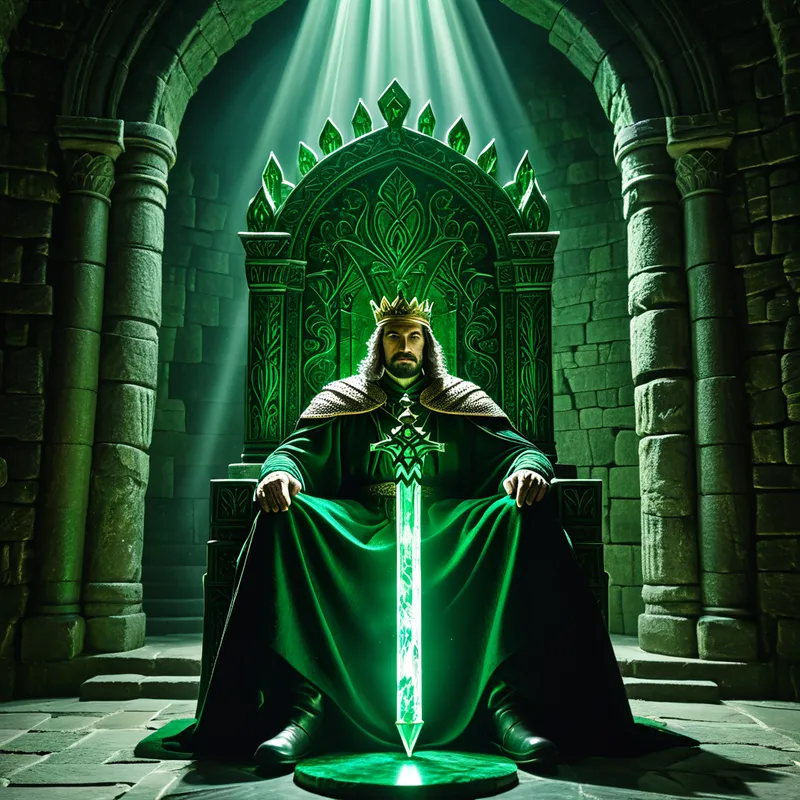
In the age when forests were deep with memory and rivers sang with clearer voices, there reigned a monarch named Cedric. His realm was fair, but his pride was fairer still, centered on a single treasure: the Heart of the Verdant World, an emerald of such size and purity it was said to hold the captured light of the first spring. It was set in his crown, and he believed it was the source of his sovereignty. While he possessed it, his granaries were full, and his knights were bold.
But a creeping silence fell upon the land. The wells began to yield bitter [water](/myths/water “Myth from Chinese culture.”/). The crops grew stunted and grey, their leaves crumbling to dust at a touch. In the royal orchard, the apples hung sour and hard as stone. A pallor, a thirst, a great forgetting seeped from the soil itself. The court physicians and astrologers could find no cause, and their potions and prophecies fell as useless as rain on slate.
One frigid night, as Cedric sat brooding before the gem’s cold fire, an ancient crone was brought before him, found pleading at the gate. Her eyes were milky, but her voice was clear as a mountain stream. “Lord King,” she said, her words hanging in the frosty air, “the land sickens because it has been robbed. Its heart is missing.”
The king scoffed, gesturing to the radiant jewel on his brow. “Here is the only heart that matters! What nonsense is this?”
[The crone](/myths/the-crone “Myth from Celtic culture.”/) did not flinch. “That which you call a jewel is a seed. That which you call a possession is a promise. You wear the land’s own heart upon your head, and wonder why the body fails?” She spoke then of a time before crowns, when the great stone lay in a sacred grove, pulsing with a slow, green rhythm that nourished root and vein. It was not a [thing](/myths/thing “Myth from Norse culture.”/) to be owned, but a node of life to be honored.
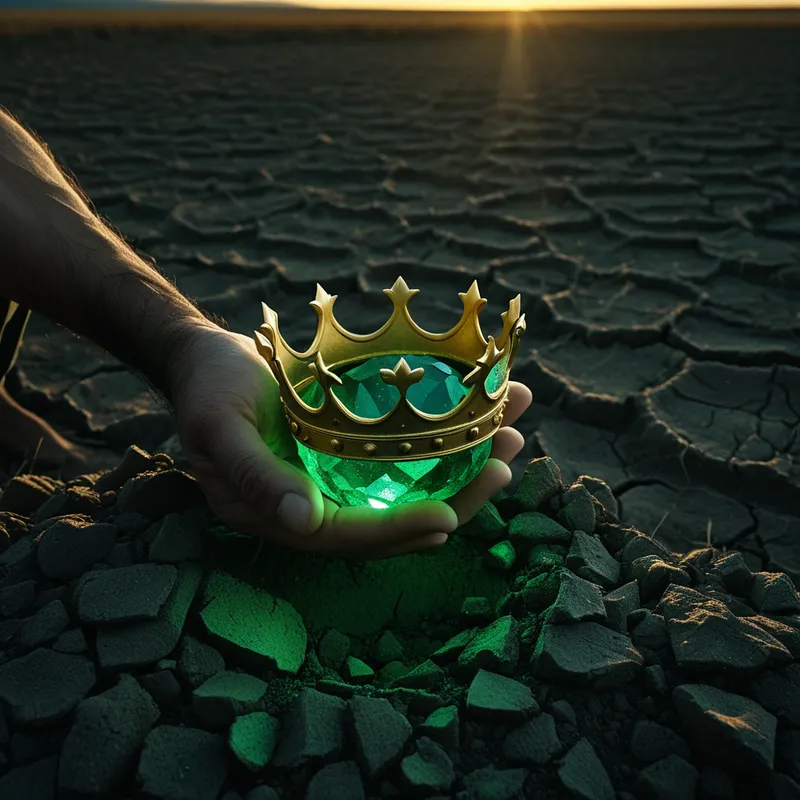
A terrible conflict tore at Cedric. His pride, his very identity as king, was bound to the gem. Yet the wailing of hungry children in the streets was a sharper crown. Driven by a despair deeper than pride, he did the unthinkable. At the next full moon, alone and without fanfare, he walked to the most barren field in his kingdom. With his own hands, he pried the magnificent emerald from its golden setting. He felt a profound resistance, as if tearing a piece from his own soul. Kneeling in the cracked earth, he placed the stone into the soil, covering it with dirt as one might bury a beloved child.
For three days, nothing. On the fourth dawn, a guard came running, breathless. From the very spot of the burial, a tender green shoot had pierced the ground. It grew not as a weed or a tree, but as a living vein of light, a radiant vine that spread with impossible speed. Where it touched, the grey receded. Clear water bubbled forth from forgotten springs. The trees remembered how to bud. The kingdom awoke, not to the opulence of before, but to a vitality that was humble and fierce.
Cedric, standing at the edge of the now-verdant field, felt the weight of his crown—lighter now, and wiser. He understood. His true sovereignty began not when he possessed the heart of the land, but when he finally returned it.
Cultural Origins & Context
This tale, in its myriad local variations, finds its roots not in grand epics but in the folk traditions of the commons. It was a story told by hearthsides, not scribed in illuminated manuscripts by monks. It belongs to the oral culture of a Europe deeply connected to, and deeply anxious about, the fertility of the land. The tellers were often grandmothers, traveling storytellers, or village elders, using narrative to encode ecological and social wisdom.
Its societal function was multifaceted. On one level, it was a charter myth for sustainable stewardship, warning against the hoarding of resources (symbolized by the king’s jewel) at the expense of communal health. It also served as a subtle critique of feudal hierarchy, proposing that a ruler’s legitimacy comes from service and sacrifice, not divine right or wealth. The myth offered a model of hope: even the most dire blight could be reversed through an act of courageous humility, a powerful message for communities facing famine or disease.
Symbolic Architecture
The Emerald is the ultimate [symbol](/symbols/symbol “Symbol: A symbol can represent an idea, concept, or belief, serving as a powerful tool for communication and understanding.”/) of [Anima](/symbols/anima “Symbol: The feminine archetype within the male unconscious, representing soul, creativity, and connection to the inner world.”/) Mundi, [the World](/myths/the-world “Myth from Tarot culture.”/) [Soul](/symbols/soul “Symbol: The soul represents the essence of a person, encompassing their spirit, identity, and connection to the universe.”/). It is not merely a precious object but the concentrated essence of [life](/symbols/life “Symbol: The symbol of ‘Life’ represents a journey of growth, interconnectedness, and existential meaning, encompassing both the joys and challenges that define human experience.”/), connectivity, and [psychic wholeness](/symbols/psychic-wholeness “Symbol: A state of complete integration between conscious and unconscious aspects of the psyche, representing spiritual unity and self-realization.”/). To possess it is to fracture that wholeness; to reintegrate it is to heal.
The treasure that must be guarded is the very treasure that must be surrendered for the guarding to have meaning.
The [King](/symbols/king “Symbol: A symbol of ultimate authority, leadership, and societal order, often representing the dreamer’s inner power or external control figures.”/) represents the conscious ego, identified with its most prized attribute—power, intellect, [status](/symbols/status “Symbol: Represents one’s social position, rank, or standing within a group, often tied to achievement, power, or recognition.”/) (the [crown](/symbols/crown “Symbol: A crown symbolizes authority, power, and achievement, often representing an individual’s aspirations, leadership, or societal role.”/)). The blighted land is the neglected and starving unconscious, the psychic ground of [the Self](/myths/the-self “Myth from Jungian culture.”/). [The ego](/myths/the-ego “Myth from Jungian culture.”/), believing its jewel of [consciousness](/symbols/consciousness “Symbol: Consciousness represents the state of awareness and perception, encompassing thoughts, feelings, and experiences.”/) is the entirety of the [psyche](/myths/psyche “Myth from Greek culture.”/), is baffled when the larger [system](/symbols/system “Symbol: A system represents structure, organization, and interrelated components functioning together, often reflecting personal or social order.”/) fails. The Crone is the archetypal voice of [the Self](/myths/the-self “Myth from Jungian culture.”/), the wisdom of the whole organism breaking through in a [moment](/symbols/moment “Symbol: The symbol of a ‘moment’ embodies the significance of transient experiences that encapsulate emotional depth or pivotal transformations in life.”/) of [crisis](/symbols/crisis “Symbol: A crisis symbolizes turmoil, urgent challenges, and the need for immediate resolution or change.”/). Her [blindness](/symbols/blindness “Symbol: Represents a lack of awareness, insight, or refusal to see truth, often tied to emotional avoidance or spiritual ignorance.”/) signifies that this wisdom is not of the visible, [material](/symbols/material “Symbol: Material signifies the tangible aspects of life, often representing physical resources, desires, and the physical world’s influence on our existence.”/) world, but of inner knowing.
The act of burying the gem is the critical symbolic pivot: a sacred kenosis, an emptying of the ego’s central [identity](/symbols/identity “Symbol: Identity represents the sense of self, encompassing personal beliefs, cultural background, and social roles.”/). It is not a [loss](/symbols/loss “Symbol: Loss often symbolizes change, grief, and transformation in dreams, representing the emotional or psychological detachment from something or someone significant.”/), but a transplantation—moving the center of value from the personal crown to the transpersonal ground.

The Dreamer’s Resonance
To dream of a radiant gem that must be hidden, buried, or given away often signals a profound psychological turning point. Somatically, one might feel a tightness in the chest (the jewel held too close) or a hollow ache in the gut (the barren land). The dream is an enactment of the psyche’s imperative to relocate its central value.
This dream pattern emerges when an individual’s conscious identity has become overly rigid, organized around a single talent, role, or possession (“I am my job,” “I am my intellect,” “I am my reputation”). The “blight” manifests as depression, creative sterility, or a sense of life losing its vitality and meaning—a psychic famine. The dream is the Crone’s message, urging a sacrifice of the old, jewel-like identity. The anxiety felt in the dream is the ego’s resistance to this de-crowning. The release, if followed, leads not to poverty, but to the surprising, organic growth of a more authentic and connected Self.

Alchemical Translation
The myth is a perfect allegory for the individuation process. The initial state is identificatio—the king (ego) is completely identified with the Emerald (a complex). This is the [nigredo](/myths/nigredo “Myth from Alchemical culture.”/), the blackening, represented by the blighted land; a state of despair and stagnation where all growth stops.
The alchemical vessel is not the crown, but the cracked earth of the humble field. Transmutation occurs only in the place of acknowledged need.
The counsel of the Crone is the albedo, the whitening, the enlightening insight from the unconscious. The king’s agonizing decision is the [separatio](/myths/separatio “Myth from Alchemical culture.”/), the separation of the ego from its most cherished complex. The burial itself is the mortificatio, the symbolic death of the old ruling principle.
The miraculous growth is the citrinitas and [rubedo](/myths/rubedo “Myth from Alchemical culture.”/)—the yellowing and reddening—the dawn of a new, integrated consciousness. The Emerald is not lost; it is multiplied. Its light, once concentrated for a single head, now radiates through the entire system. The king’s new sovereignty is that of the conscious ego now in service to, and in harmony with, the Self. He is no longer the possessor of the jewel, but the steward of the field where it grows. This is the alchemical gold: a personality rooted in the fertile ground of the whole psyche, where power is redefined as the capacity to nurture life, not to hoard its symbol.
Associated Symbols
Explore related symbols from the CaleaDream lexicon: