The Eleusinian Mysteries - anc Myth Meaning & Symbolism
The sacred story of a mother's grief, a daughter's abduction, and a divine pact that birthed the ancient world's most profound mystery rite of death and rebirth.
The Tale of The Eleusinian Mysteries - anc
Hear now the story that was never written, the tale that was only ever whispered in the dark, carried on the salt-tanged breath of the Aegean and sealed by a sacred oath. It begins not with a bang of thunder, but with a silence—a terrible, hollow silence that fell upon the world when the laughter of Demeter ceased.
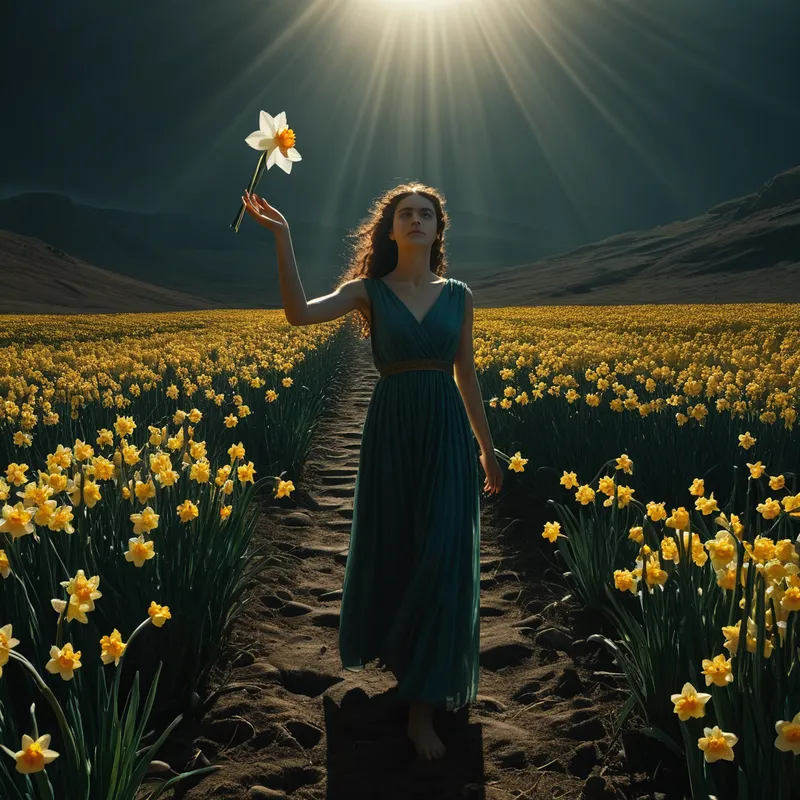
The sun was high over the fields of Nysa, painting the world in gold and green. Kore, the Maiden, was gathering flowers with the grace of a spring breeze—roses, crocuses, and violets. Then she saw it: a narcissus, a hundred blossoms sprung from one root, a lure so beautiful its fragrance stopped the very winds. As she reached, the earth groaned. The meadow split asunder with a sound like tearing silk. From the black abyss roared a chariot of polished jet, drawn by steeds the color of forgotten memories. A hand, strong as fate and cold as a tombstone, seized her. It was Hades, lord of the unseen realms. Her cry was swallowed by the closing earth, and the hole vanished, leaving only trampled flowers.
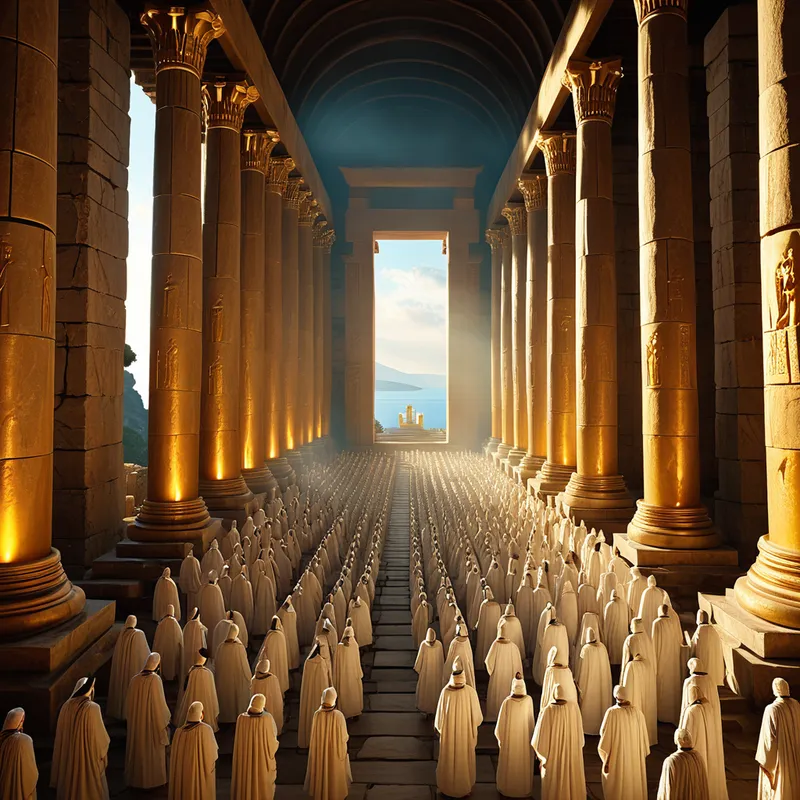
Demeter felt the rupture in her soul. She cast down her crown of grain, tore her divine robes, and for nine days and nights, she wandered the mortal world, a goddess unmade by grief. She took the form of an old woman, her eyes wells of unshed tears, and came to Eleusis. There, at the well, the daughters of King Keleus found her. In their kindness, she entered the royal house as a nurse to the infant prince Demophoön. In her sorrow, she sought to make the boy immortal, anointing him with ambrosia and laying him in the hearth’s fire each night. But a mortal mother’s fear interrupted the rite, and the chance was lost. In her wrath and renewed despair, Demeter revealed her true, awe-full form and commanded a temple be built. There, in her temple at Eleusis, she sat. And the world sat with her.
A great withering descended. No seed sprouted. No fruit swelled. The oxen plowed in vain. Mankind faced extinction, and the gods of Olympus found their altars cold. The great Zeus himself could not sway the grieving mother. Finally, he sent the messenger Hermes down the dank, echoing path to the kingdom of Hades to parley. In the sunless halls, Persephone (for she had been given a new name) sat beside her dark husband, a queen in a kingdom of shades, hunger gnawing at her for the world of light.
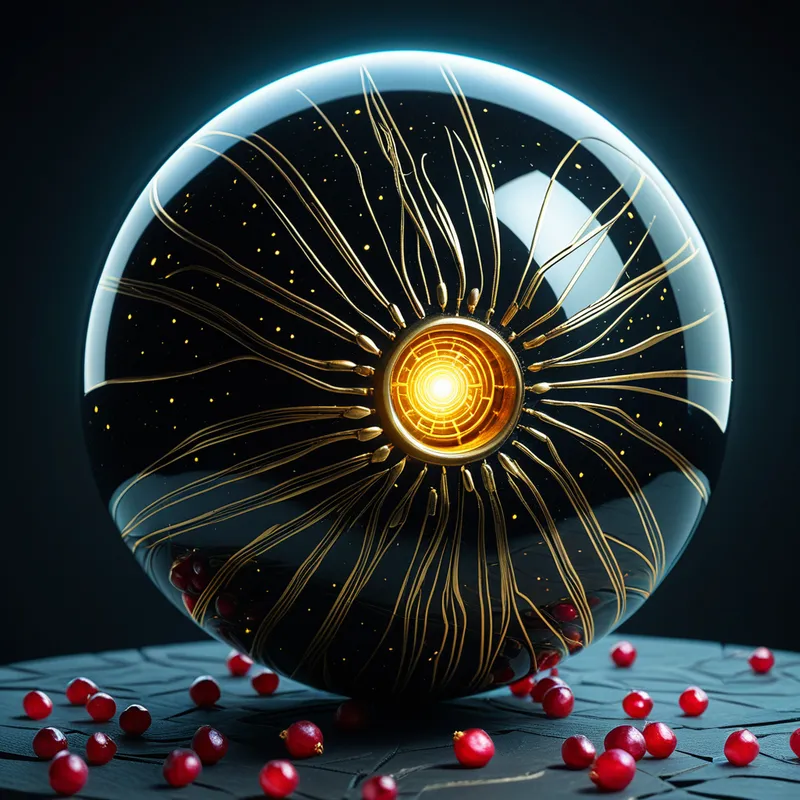
A pact was struck, a divine compromise woven from necessity. Because Persephone had eaten—a single, fateful pomegranate seed offered in the underworld—she was bound to it. For each seed consumed, a month of the year she must reign as Queen beside Hades. But for the rest, she could return. Hermes led her up the long path, back to the world of living green. At the threshold of Eleusis, mother and daughter saw each other. Demeter ran, her feet no longer heavy, and the earth trembled with a different kind of quake—a quake of joy. Where their tears fell upon the barren soil, green shoots erupted instantly.
And so, the rhythm was born. When Persephone ascends, Demeter’s heart unfolds and the earth blossoms; this is Spring and Summer. When she descends to her dark throne, Demeter withdraws, and the world grows cold and still; this is Autumn and Winter. From this agony and this reconciliation, Demeter bestowed upon the princes of Eleusis and all initiated thereafter the sacred knowledge—the Eleusinian Mysteries. She gave them the rites that soothe the terror of death, that whisper of a return not of the body, but of the essence, a promise written not on scrolls, but in the very cycling of the seed, the grain, and the soul.
Cultural Origins & Context
The myth of Demeter and Persephone is the sacred narrative heart of the historical Eleusinian Mysteries, a pan-Hellenic initiatory cult that flourished for nearly two millennia at Eleusis, near Athens. Unlike the written epics of Homer, this story was not literature for public consumption; it was the hieros logos (sacred story) performed and revealed only within the secret confines of the initiation. It was passed down through an oral tradition guarded by the Eumolpidae and Kerykes families.
Its societal function was profound and dualistic. On one level, it explained the natural world—the cycle of the seasons was made comprehensible and divine. On a deeper, far more significant level, it addressed the fundamental human anxiety: mortality. By undergoing the Mysteries, initiates (mystai) were not just hearing a story about the return of Persephone; through sacred drama, fasting, ritual bathing in the sea (halade mystai), and the final revelation in the torch-lit Telesterion, they were experiencing the descent into darkness and the blissful return. It promised eudaimonia (bliss) in the afterlife, a privilege originally reserved for heroes and demigods. Thus, the myth and its rites served as a great social and psychological equalizer, offering hope and a transformative experience to every free person who spoke Greek, from enslaved individuals to emperors like Marcus Aurelius.
Symbolic Architecture
At its core, this is not merely an agricultural allegory. It is a profound map of the psyche’s journey through catastrophic loss, disintegration, and holistic return. Demeter represents the conscious, nurturing, structured aspect of the Self—the ego that gives form and sustenance to life. Persephone is the youthful, latent potential, the innocent psyche (the anima) that is suddenly and violently taken into the unconscious realm.
The abduction is not a random tragedy, but a necessary violation of the conscious world by the depths. The ego does not choose its deepest trials; they seize it.
Hades is the ruler of the underworld—the shadow and the collective unconscious itself. His realm is not evil, but other; it is the repository of all that is forgotten, repressed, and potent. The pomegranate seed is the critical symbol of integration. To eat the food of the underworld is to internalize its reality, to take something of the depth into oneself. This is why Persephone cannot fully return; she is forever changed, now carrying the knowledge of both worlds. She becomes the Queen of the Dead, a mediator between the realms of light and darkness.
The cyclical resolution models a new psychic wholeness. The Self (Demeter) is no longer a static, eternally joyful entity. It is now a dynamic system that encompasses both creativity and withdrawal, connection and loss, summer and winter. The initiated individual understands life as this cycle, not as a linear march toward an end.
The Dreamer’s Resonance
When this mythic pattern stirs in the modern dreamer, it often manifests as a profound somatic and psychological process of involuntary descent. One may dream of a sudden fall—into a cave, a basement, or a dark body of water. There is a feeling of being taken, of agency stripped away. This mirrors the “abduction” phase, correlating with life events like sudden loss, depression, illness, or any rupture that pulls one out of ordinary life.
The figure of the searching, grieving Demeter may appear as the dream-ego itself, wandering a vast, barren landscape, or as an older, wise, but devastated woman. This symbolizes the conscious mind’s disorientation and profound grief when its familiar structures and attachments (the “daughter”) are lost.
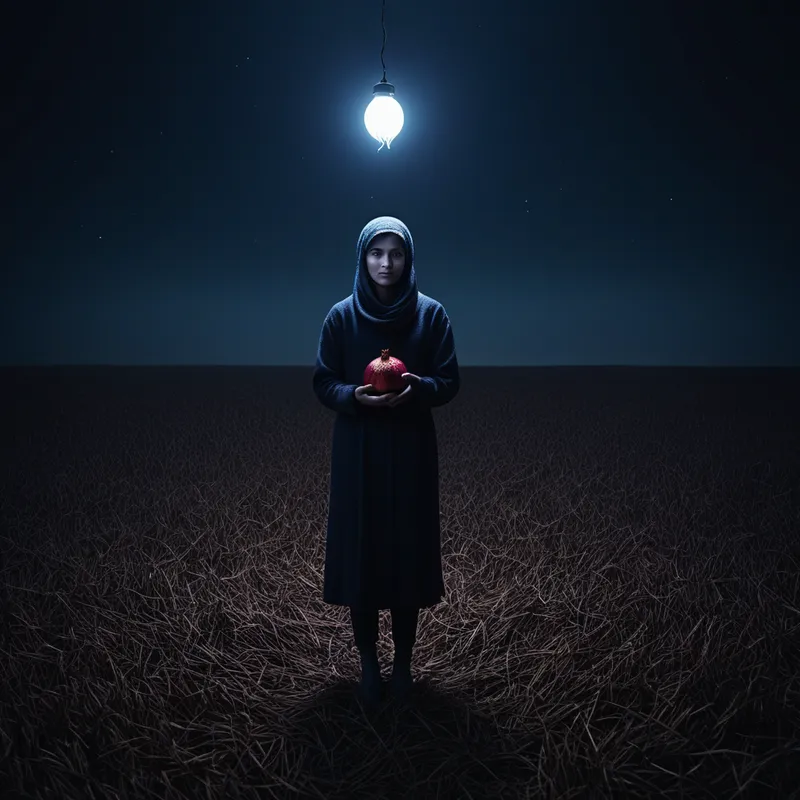
Dreams featuring pomegranates, seeds swallowed in the dark, or being offered food in an underground place point directly to the integration phase—the “eating of the pomegranate seed.” The psyche is signaling that a fundamental, irreversible change is occurring. The dreamer is, often unwillingly, internalizing the experience of the “underworld,” which will forever alter their perspective. The ultimate resolution in the dream may be simple but powerful: finding a single flower blooming in a wasteland, or seeing a loved one’s face in a shaft of light. This is the promise of the “return,” not to the old life, but to a life reconfigured around the truth of the depth experienced.
Alchemical Translation
The Eleusinian Mysteries offer a timeless model for the alchemical process of individuation—the psychic transmutation of the lead of suffering into the gold of wisdom. The journey is tripartite: Descent (Nigredo), Search/Liminality (Albedo), and Integrated Return (Citrinitas* towards Rubedo).
First, the Nigredo: the ego’s world is shattered (the abduction). This is the necessary mortificatio, the death of naive innocence. The modern individual must endure this darkening, this feeling of being unmade, without prematurely seeking escape. It is the plunge into depression, grief, or crisis that strips away false identities.
The temple at Eleusis is built during the despair, not after. The new psychic structure is formed in the hollow place left by loss.
Second, the Albedo: Demeter’s wanderings and her service in the mortal house. This is the liminal, purifying stage. The individual, stripped bare, must wander the “mortal” world of their own vulnerability. Here, in the humble act of care (nursing Demophoön) and the confrontation with mortal limits, a purification occurs. It is a period of waiting, processing, and slow, often painful, purification of intention.
The final transmutation is the pact itself—the Citrinitas and Rubedo. Integration is not a victory of light over dark, but a sacred pact between them. The individual who has “eaten the pomegranate seed” no longer fears their own depth (Hades) nor clings desperately to permanent spring (Demeter’s initial state). They become like Persephone-Queen, capable of moving between realms. Their consciousness is cyclical, resilient, and fertile precisely because it has acknowledged and incorporated its own winter. The “Mystery” revealed is this: that the soul, like the grain, must fall into the earth and die in its old form to yield new life. The initiate learns to hold both the abduction and the return, the grief and the joy, as parts of a single, sacred story of becoming whole.
Associated Symbols
Explore related symbols from the CaleaDream lexicon: