The Eleusinian Mysteries Myth Meaning & Symbolism
The abduction of Persephone by Hades plunges the world into barren winter until a sacred compromise is struck, revealing the cycle of life, death, and rebirth.
The Tale of The Eleusinian Mysteries
Hear now of the great turning, the hinge upon which the world swings from gold to grey and back again. It begins not with a war cry, but with a girl’s laughter.
Demeter of the golden sheaf walked the fields of Nysa with her daughter, Kore. The air was honey-thick with the scent of blooming iris and violet. Kore’s voice was the sound of a clear spring, her footsteps causing hyacinths to burst from the earth. She bent to pluck a narcissus of a hundred blooms, a flower of startling beauty placed there by the design of Zeus himself. As her fingers closed around the stem, the earth groaned and split. From the yawning chasm came a thunder of black horses and the gleam of a chariot of obsidian. A hand, strong as the roots of mountains, seized her. It was Hades, lord of the unseen realms, and his desire was a law unto itself. Kore’s cry was swallowed by the closing earth. Only the torn blossoms remained.
A cold silence fell upon Demeter. She felt the severing in her own flesh, a sudden hollowing of the world. For nine days and nine nights, the goddess of all growing things wandered the earth, a torch in each hand, her divine form cloaked in mortal grief. She tasted no ambrosia, drank no nectar. The green world began to wither at the edges, a blight following her footsteps.
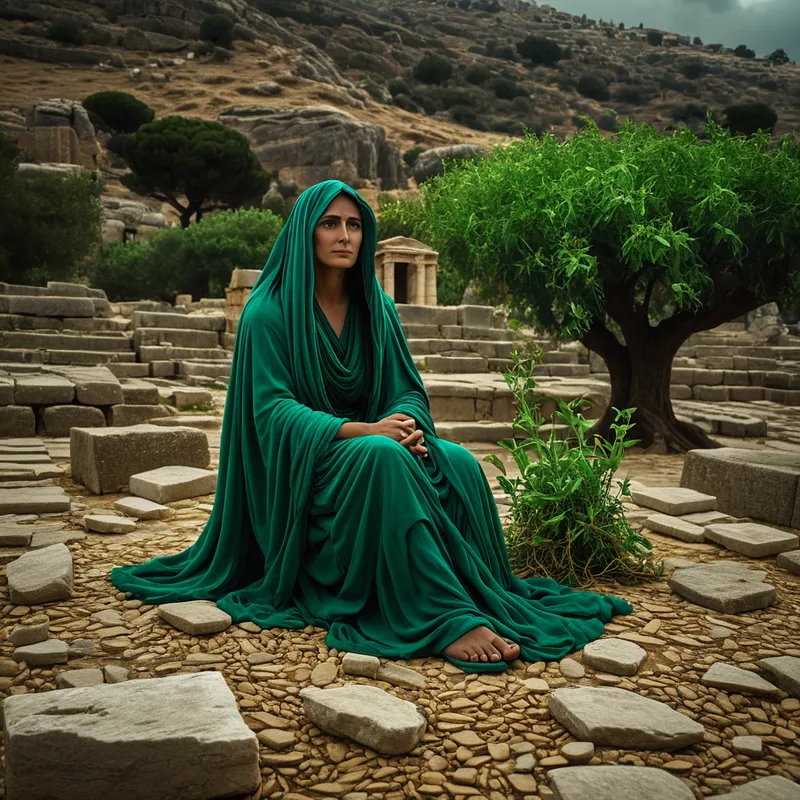
In her despair, she came to Eleusis, disguised as an old woman. She sat upon the Agelastos Petra, stone of no laughter. There, the daughters of King Celeus found her and brought her to their hearth. To repay their kindness, she sought to make their infant brother, Demophoön, immortal, anointing him with ambrosia and holding him in the heart of the sacred fire each night. But his mother, Metaneira, screamed in terror at the sight, breaking the magic. The goddess cast off her disguise, filling the house with a blinding light. “You, in your mortal fear, have doomed him to death,” she declared, her voice the sound of rustling, barren stalks. “Build me a temple here. My grief must have a home.”
And so the great temple was built. Within its confines, Demeter’s wrath became a global winter. Rivers froze. Seeds rotted in the frozen ground. Mankind faced extinction, and the cries of the starving reached Olympus. Zeus, author of the silent pact with Hades, could no longer ignore the unraveling of his creation. He sent messenger after messenger, but Demeter was a mountain of sorrow: she would not let the earth bear fruit until she looked upon her daughter’s face again.
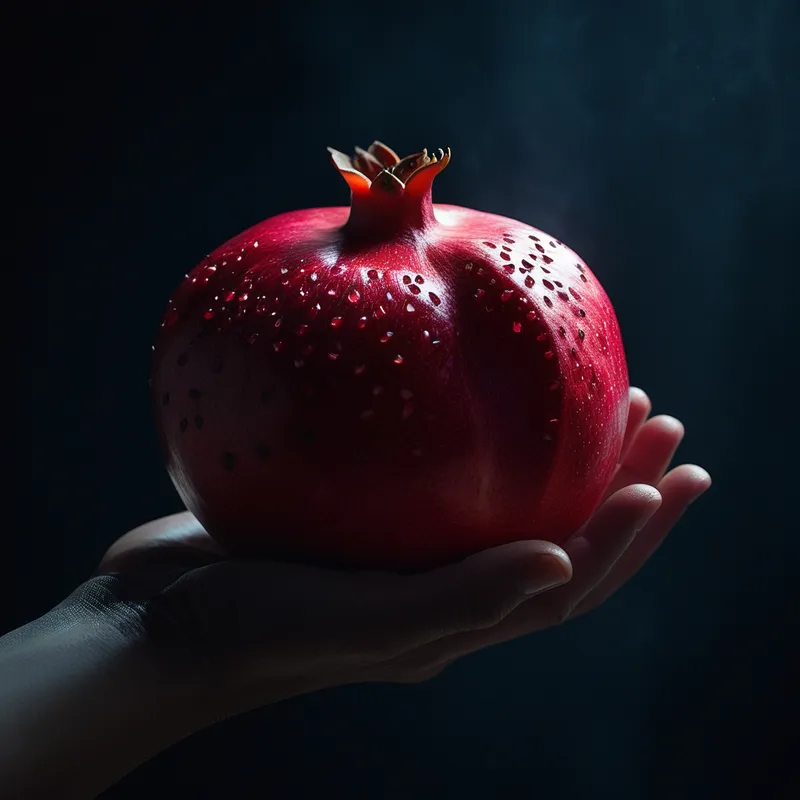
Finally, Zeus commanded Hades to release the bride of the underworld. Hermes, the swift guide of souls, descended the dark paths to the throne of Hades. The lord of the dead consented, but not before offering his queen a pomegranate seed—a simple, blood-red fruit. In her hunger or perhaps a dawning acceptance, Persephone (for she was no longer only Kore, the Maiden) ate four seeds. This simple act bound her to the realm of shades with an unbreakable cord.
She ascended, reunited with her mother in a field suddenly thawing. But the bond was forged. A compromise, delivered by Gaia herself, was decreed: for each seed eaten, Persephone would spend one month of the year in the underworld as its queen. The rest, she would walk in the sun with her mother.
Thus, the great wheel was set in motion. When Persephone descends, Demeter mourns, and we call it winter. When she returns, the goddess rejoices, and the world erupts in spring. The secret of this sacred cycle—of life, death, and the blessed return—became the heart of the most profound mystery known to the ancient world.
Cultural Origins & Context
The rites of Eleusis were not merely a retold story but a lived, secret experience that shaped the spiritual consciousness of the Greek world for nearly two millennia. Centered at the Telesterion in Eleusis, a massive hall capable of holding thousands, the Mysteries were an annual initiation open to all—Greek-speaking men, women, and even slaves—who were free of blood guilt. This radical inclusivity was unparalleled in the ancient world.
The myth was the sacred narrative (hieros logos) that underpinned the ritual, but the true power lay in the dromena (things done), legomena (things said), and deiknymena (things shown) within the initiation. The process began with a ritual bath in the sea, a purification. Then, a solemn, 14-mile procession from Athens to Eleusis along the Sacred Way, with participants (mystai) carrying sacred objects. After fasting, they entered the Telesterion, a windowless hall where, in utter darkness, they witnessed visions that were never to be spoken of. The penalty for divulging the secrets was death. What we know from hints suggests a revelation involving a single ear of grain, harvested in silence, and a culminating vision of a great light in the darkness, promising bliss in the afterlife. The function was clear: to conquer the terror of death by revealing the pattern of which death was merely a phase, granting initiates (epoptai, “those who have seen”) a hopeful serenity unknown to the uninitiated.
Symbolic Architecture
At its core, the myth is a profound map of the psyche’s necessary descent. Persephone is not a victim in the modern sense, but an archetypal figure of the innocent consciousness (Kore) who is claimed by a deeper, unseen aspect of reality (Hades). Her abduction is an initiation—a brutal, involuntary one—into the realm of the unconscious, the shadow, and the reality of loss and limitation.
The pomegranate seed is the contract with the underworld; it is the bitter knowledge that, once tasted, forever changes the composition of the soul.
Demeter represents the conscious ego, the part of us that nurtures, cultivates, and seeks to maintain life and order. Her grief is the ego’s catastrophic reaction to the loss of its cherished innocence and joy to the depths. The resulting barrenness is a psychic depression, a creative freeze, when the ego refuses to accept the demands of the deeper self. The resolution is not a victory, but a sacred compromise—a recognition of cyclical law. Persephone becomes the psychopomp for the modern soul, the one who knows both worlds and can navigate between them. She embodies the integrated self that can be both light and dark, maiden and queen.
The Dreamer’s Resonance
When this myth stirs in the modern dreamer, it often manifests as dreams of sudden, involuntary descents: falling into a basement that becomes a cavern, missing a train into a dark tunnel, or being pulled into deep water. The somatic feeling is one of profound helplessness mixed with a strange gravity. Alternatively, one might dream of a cherished garden that withers overnight, or a nurturing figure (a mother, a therapist, the dreamer themselves) frozen in inaction, unable to make things grow.
Psychologically, this signals a powerful encounter with the anima or animus as abductor—the compelling, often disruptive force of the unconscious that demands a sacrifice of our previous, simpler identity. The dreamer is in the process of being “taken down” into a confrontation with something foundational: grief, repressed desire, trauma, or a calling that feels like a death of the old life. The dream is the psyche’s enactment of the abduction, the beginning of the initiation the conscious self may be desperately resisting.

Alchemical Translation
The alchemical journey mirrored in Eleusis is the nigredo. It is the necessary descent into the prima materia of one’s own darkness, depression, or loss. Demeter’s rage and winter represent the ego’s necessary, painful dissolution. We must sit on our own Agelastos Petra, the Mirthless Stone of acknowledging that what we cherished is gone, and allow the old structures of meaning to freeze and fall away.
The initiation at Eleusis promised eudaimonia—not happiness, but the soul’s right functioning. It is the peace that comes from knowing the pattern of your own depths.
The return is not to the previous state, but to a transformed one. Persephone, having eaten the seeds of the underworld, carries its wisdom within her. For the modern individual, this is the process of individuation. The “pomegranate seeds” are the insights, wounds, or truths we assimilate from our darkest experiences. They bind us to that reality, but they also grant us authority over it. We are no longer victims of the cycle; we are its conscious participants. The final revelation—the shining ear of grain in the dark hall—is the symbolic birth of the new, resilient consciousness from the fertile decay of the old. It is the realization that life and death are not opposites, but partners in the sacred, spiraling dance of becoming. The mystery revealed is that we are both the mourner and the mourned, the seeker and the sought, and in that recognition lies our liberation from fear.
Associated Symbols
Explore related symbols from the CaleaDream lexicon: