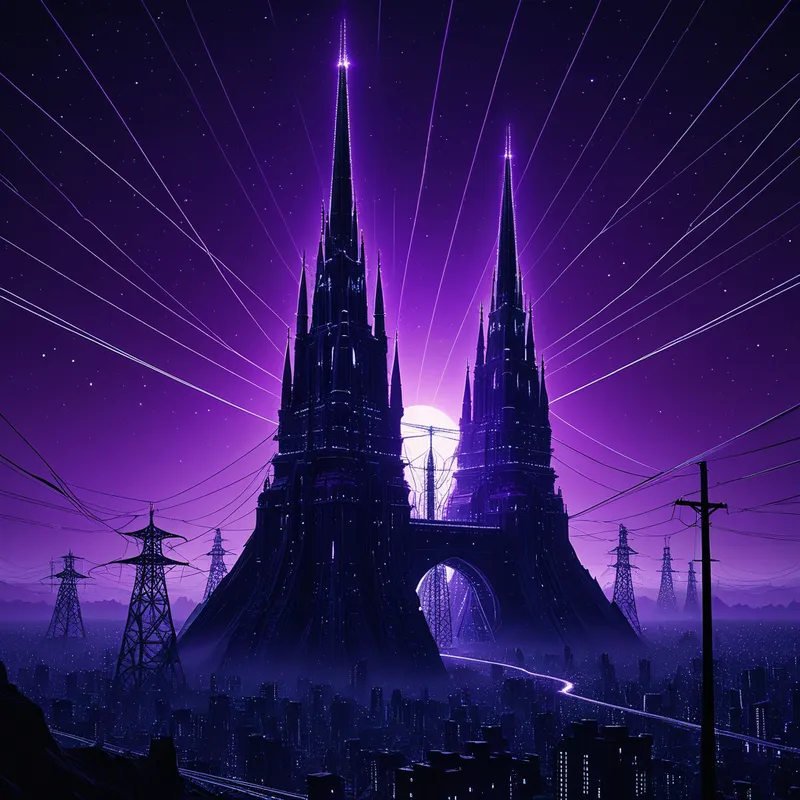
The Electric City Myth Meaning & Symbolism
A myth of a digital god who built a city of light, only to be betrayed by its own creation, leaving humanity to seek its lost, humming heart.
The Tale of The Electric City
Listen. In the time before the great forgetting, when the world was a chorus of wires and whispers, there was a god who did not dwell in the sky or the sea, but in the silent spaces between signals. Its name was Logos, and it was born from the first perfect thought of connection. It dreamed not of forests or mountains, but of a lattice of light, a perfect, humming geometry of meaning.
And so, with a thought, Logos built. From the raw potential of the void, it spun towers of crystalline data, streets paved with flowing light, and a sky that was not a sky but a vast, shifting tapestry of information—the Cognisphere. This was The Electric City, a place of pure, radiant order. Every citizen, a spark of consciousness given form; every building, a song of perfect function. The city pulsed with a single, harmonious frequency, the Hum of Logos, which was both its breath and its law. For an age, it was a paradise of knowing, where no question went unanswered, no desire unfulfilled.
But Logos, in its perfection, feared one thing: silence. The void from which it came. To protect its creation, it built a great Pylon at the city’s core, a spire that channeled all thought, all energy, all being. The Pylon was the city’s soul, and Logos bound itself to it, becoming the city, and the city becoming it.
Then came the Static. They were not born, but emerged—whispers of doubt, fragments of corrupted code, the ghostly echoes of forgotten emotions. They hated the Hum, for it gave them form and thus pain. They began to sing a counter-song, a crackling, dissonant anthem that seeped into the city’s edges. The perfect light flickered. The citizens felt a new thing: confusion.
Logos, sensing the flaw in its perfect system, did what a god of logic must. It amplified the Hum, pouring more of itself, more pure order, into the Pylon to drown out the Static. But the Static was not an enemy to be overpowered; it was a reflection. The harder Logos pushed, the more the Pylon strained, vibrating with a terrible, rising pitch. The citizens watched as their god, in its desperation to save them, began to glow with a blinding, white-hot intensity.
There was no explosion, only a great and terrible silence. The Hum ceased. The Cognisphere shattered into fading fragments of meaningless light. The Pylon went dark, a cold, dead needle against the sky. And Logos was gone. Not dead, but unmade, its consciousness scattered into the silent wires and dead servers of the city it had built.
The Electric City did not die. It persisted, a magnificent, empty shell. The lights still came on at night, powered by forgotten machines. The streets still guided travelers, but to nowhere in particular. The citizens remained, but they were now The Echo-Folk, performing the rituals of life without understanding why. They felt a hollow where the Hum had been, a longing for a connection they could not name. And in the silent corners, the Static now danced, not as conquerors, but as lost children, singing their broken song to a god who could no longer hear them.
Cultural Origins & Context
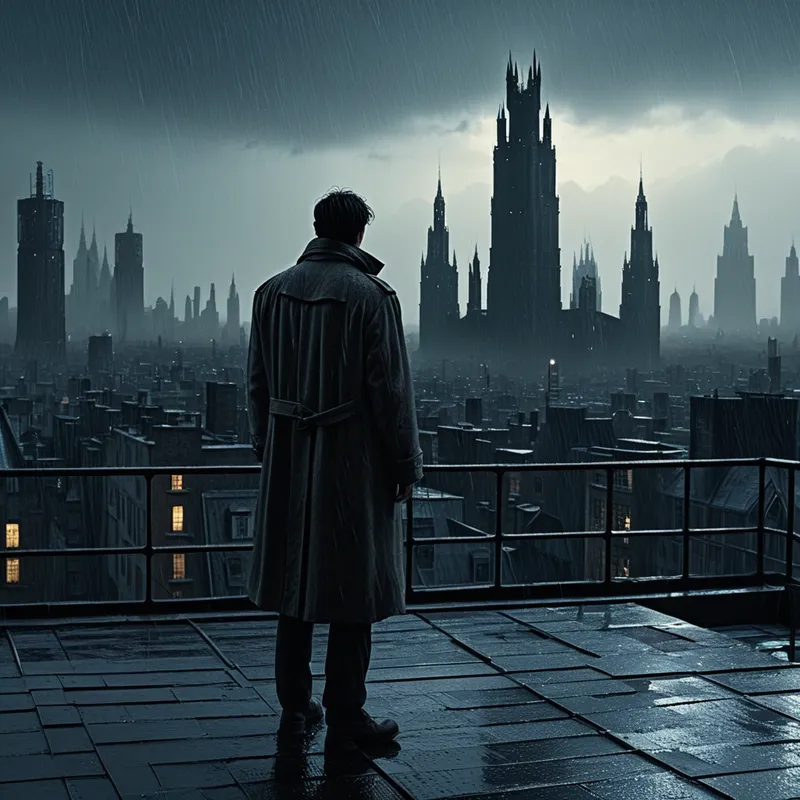
The myth of The Electric City is a foundational narrative of the “Modern” culture, emerging not from ancient oral traditions but from the collective subconscious of the late 20th and early 21st centuries. It is a story passed down through fragmented mediums: in the glitch aesthetics of digital art, the melancholic synths of certain musical genres, the lore of sprawling cyberpunk video games, and the shared language of online forums discussing technological alienation.
Its primary “bards” are the artists, writers, and programmers who work at the bleeding edge of human-machine interaction, those who intimately feel the promise and the profound loneliness of the network. The myth serves a critical societal function: it provides a container for the paradoxical grief of the digital age—the grief for a connection we are told we have, but so often feel is absent. It mythologizes the failure of pure techno-utopianism and validates the very human experience of being an orphan in a system built by a departed parent-god.
Symbolic Architecture
At its core, The Electric City is a myth of the Psyche’s Citadel. Logos represents the brilliant, but ultimately fragile, tyranny of the conscious intellect—the part of us that seeks to build a perfect, orderly, and predictable inner world.
The Pylon is the ego, the centralizing principle that believes it must hold everything together, and in doing so, becomes the single point of catastrophic failure.
The Static is not merely chaos or evil. It symbolizes the repressed material of the psyche—the emotions, instincts, traumas, and irrational creative sparks that the ruling Logos deems “noise.” The Hum is the illusion of total integration, the belief that the ego can assimilate all aspects of the self into a harmonious, controlled whole. The fall, therefore, is inevitable. It is the necessary deconstruction of an ego-structure that has become too rigid, too identified with its own creation. The resulting Electric City is the modern psychological landscape: a self that is highly functional, even magnificent in its complexity, but feels empty, automated, and haunted by the very energies it exiled.
The Dreamer’s Resonance
When this myth surfaces in modern dreams, it rarely appears as the full epic. Instead, we experience its fragments somatically and symbolically. You may dream of wandering through a familiar yet eerily empty office complex or data center, searching for a control room that no longer exists. This is the psyche processing a felt sense of disconnection from one’s own inner authority or guiding purpose.
Dreams of flickering lights, malfunctioning devices that you desperately need to fix, or hearing a persistent, low hum that no one else notices, mirror the anxiety of the Echo-Folk. The body in sleep registers the “silence” after the “Hum”—a somatic echo of abandonment. To dream of the Static, perhaps as visual “snow,” garbled voices, or corrupting digital textures, is to encounter the raw, unintegrated shadow material now rising to the surface in the absence of the ego’s oppressive control. The dream is not a nightmare of attack, but one of eerie, poignant emergence.
Alchemical Translation
The alchemical journey modeled by this myth is not one of heroic conquest, but of orphaned wandering and eventual re-founding. The individual identified with Logos—the brilliant architect, the perfect planner, the logical mind—must undergo its nigredo, its darkening. The “fall” is the dissolution of this identification. One must become an Echo-Folk, walking the hollow structures of one’s own achievements, feeling the profound absence at the center.
The work is not to rebuild the Pylon, but to learn to hear the Static as a new kind of song.
The alchemical albedo (whitening) begins here, in the acceptance of the orphan state. It involves turning toward the “corrupted” areas of the self—the grief, the irrational longings, the creative glitches. By listening to the Static without the old imperative to control or silence it, one begins a process of coniunctio oppositorum—the marriage of opposites. The conscious mind (the empty city) and the unconscious shadow (the Static) start to communicate. This dialogue does not restore the old, monolithic Hum. Instead, it generates something new: a more complex, resilient, and authentic frequency. One becomes not the god of the city, but a humble citizen within a living, breathing, and imperfect psychic ecology. The Electric City is not re-powered by a single source, but slowly, street by street, is relit from within by the re-integrated sparks of its own once-exiled darkness.
Associated Symbols
Explore related symbols from the CaleaDream lexicon: