The Eight Immortals Myth Meaning & Symbolism
Eight flawed mortals attain immortality, embodying the diverse paths to transcendence and the wholeness found in a unified, eccentric community.
The Tale of The Eight Immortals
Listen, and let the mists of time part. This is not a story of gods born in heaven, but of mortals who walked the dusty earth, who knew hunger, folly, despair, and joy, and who, through a alchemy of chance, virtue, and sheer eccentric will, stepped beyond the veil of death itself.
In the golden age of the Tang and the cultured Song, they walked among men. There was Zhongli Quan, a former general who found the elixir of life not in victory, but in the quiet of a mountain cave. There was Li Tieguai, a disciple of Laozi, whose soul traveled so often it returned to find its body burned, forcing it into the form of a beggar with an iron crutch—and a magical gourd that held healing medicine and his very spirit. He Xiangu dreamed of swallowing a mother-of-pearl cloud and ceased to hunger for earthly food, living on moonbeams and mountain mist.
They were a company of misfits. Cao Guojiu, an emperor’s brother who fled the corruption of court to seek purity. Han Xiangzi, whose melodies could make flowers bloom in winter. Lan Caihe, an androgynous street singer, one foot shod, the other bare, scattering immortality peaches from a basket. Zhang Guolao, an ancient magician who rode a paper donkey that could be folded into a pocket. And Lu Dongbin, the scholar tempted by wealth and lust, who endured ten trials to purify his heart and received a demon-slaying sword.
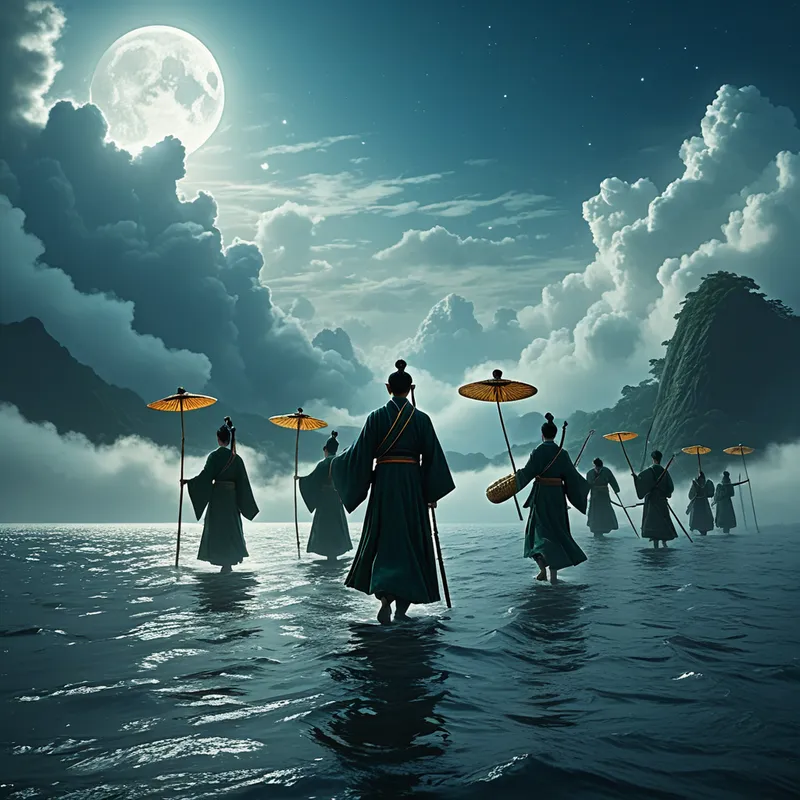
Their great saga unfolded at the Banquet of the Queen Mother of the West at Penglai, the isle of the blessed. Having partaken of the peaches of immortality, they set their sights on crossing the Eastern Sea. But this was no ordinary voyage. They made a pact: they would not ride a ship or a cloud, but would cross using only their humble, personal talismans—the very objects that defined their flawed, mortal journeys.
And so, before the eyes of heaven and the churning sea, they embarked. Lu Dongbin cast his sword upon the waves and stood upon it. Zhang Guolao sat backwards on his paper donkey, which galloped atop the foam. Han Xiangzi laid his jade flute upon the water and rode it like a raft. He Xiangu placed her lotus flower upon the sea, and it became a radiant boat. Li Tieguai, Cao Guojiu, Lan Caihe, and Zhongli Quan followed suit with gourd, jade tablet, flower basket, and fan. Together, this ragged, glorious fleet—a beggar’s crutch, a courtier’s tablet, a drunkard’s gourd, a mad singer’s basket—challenged the primal chaos of the ocean. They did not conquer the sea; they harmonized with it, their combined power stilling the waves and illuminating the path to the ultimate shore. They crossed not as eight individuals, but as one complete principle, a living constellation of transcendence.
Cultural Origins & Context
The myth of the Ba Xian is a uniquely Taoist tapestry, woven from threads of folklore, temple murals, oral storytelling, and popular theater over centuries, reaching its peak prominence during the Ming and Qing dynasties. Unlike the austere, bureaucratic celestial deities of state religion, the Eight Immortals were folk heroes. Their stories were told by traveling performers, painted on the walls of village temples, and carved into the wood of opera stages.
Their societal function was multifaceted. They served as accessible models of the Taoist ideal—immortality was not reserved for the pure ascetic but could be stumbled upon by the drunkard, the cripple, the singer, and the noble. They represented the protection of the common people; their images were placed in homes to ward off evil and bring blessings. Crucially, they embodied the concept of ba, the number eight, which in Chinese culture signifies prosperity and completeness, linking them to the eight trigrams of the I Ching. They were a mythic democracy, a pantheon where every walk of life—male and female, old and young, rich and poor, scholar and fool—had a path and a place in the ultimate scheme.
Symbolic Architecture
Psychologically, the Eight Immortals represent the archetype of the individuated Self not as a singular, perfected hero, but as a dynamic, communal constellation. Each Immortal is a fragment of the human psyche, a complex of strengths and flaws that, when isolated, is merely eccentric or broken. Li Tieguai’s crippled body and soul-travel speaks of dissociation, yet his gourd holds the healing elixir. Lu Dongbin’s struggle with lust and pride is the shadow of the intellectual.
The wholeness of the Self is not a monolithic perfection, but a symphony of redeemed flaws.
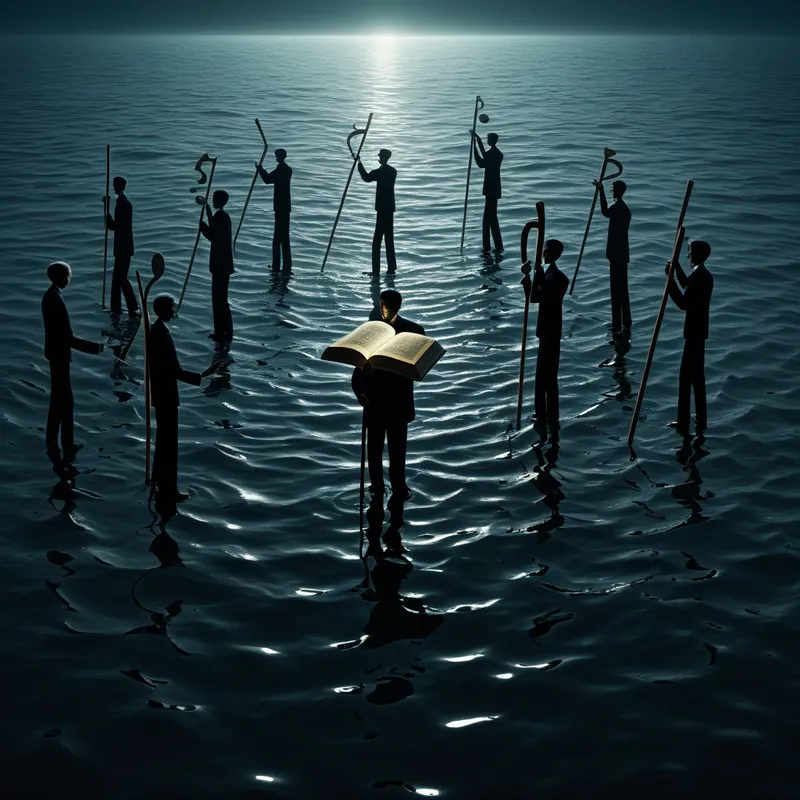
Their magical attributes are not weapons of domination, but tools of relationship—with the self, with others, and with the cosmos. The fan revives the dead, the flute commands nature, the gourd contains the spirit. These are symbols of psychic functions made sacred. Their crossing of the sea on these objects is the ultimate symbol of using one’s unique wound, talent, or obsession as the very vehicle for transcendence. The ocean is the unconscious, vast and chaotic. They cross it together, demonstrating that the journey to wholeness (Penglai) cannot be made alone; it requires the complementary strengths of all aspects of the psyche.
The Dreamer’s Resonance
When this myth pattern stirs in the modern dreamer, it often manifests as dreams of a motley group or team, each member possessing a distinct, odd, but crucial skill. One might dream of preparing for a journey with a collection of strange, personal items that seem useless yet feel vitally important. The somatic sensation is often one of lightness amidst burden—carrying a heavy object (a crutch, a basket) that suddenly enables one to walk on water or fly.
Psychologically, this signals a process of persona fragmentation and deeper integration. The dreamer’s conscious, adapted self (the singular hero) is breaking down, making way for the recognition of multiple, perhaps contradictory, inner figures. Dreaming of the Eight Immortals suggests the psyche is attempting to move beyond a one-dimensional identity (“I am only a caregiver,” “I am only an intellectual”) and is assembling the full council of inner characters needed to navigate a life transition or a sea of emotional turmoil. The conflict in the dream is rarely against a monster, but against a vast, elemental space (an ocean, a sky) that requires a collective, creative response.
Alchemical Translation
The alchemical process modeled here is the transmutation of the lead of personal limitation into the gold of authentic function. Each Immortal’s path is a specific alchemical recipe. Li Tieguai’s process is one of sublimation: a crippled body becomes a vessel for a transcendent soul. Lan Caihe’s is enantiodromia: the madness of the street fool becomes the wisdom of the divine child. Lu Dongbin’s is calcination: the fires of temptation burn away impurity to reveal the sharp sword of discernment.
For the modern individual, the myth instructs us not to eradicate our flaws, but to consecrate them. The workaholic’s obsessive focus (their “jade tablet”) can become the structure for deep discipline. The artist’s chaotic sensitivity (their “flower basket”) can become the vessel for scattering beauty. The healing journey is not about becoming perfectly balanced, but about discovering how your specific imbalance—your crutch, your addiction, your eccentricity—is, in truth, your unique vehicle.
Individuation is the crossing. Your symptoms are your attributes. Your council of inner misfits is your raft.
The final, crucial alchemical stage is coniunctio, the sacred marriage, which here is not between two lovers, but among the eight. It is the integration of the disparate parts into a functioning, cooperative whole. We achieve not solitary enlightenment, but a state of being where the beggar, the scholar, the drunkard, and the singer within us cease their civil war and pool their resources to cross the turbulent seas of life. We become, like them, a small, complete universe sailing toward its own mysterious, blessed isle.
Associated Symbols
Explore related symbols from the CaleaDream lexicon: