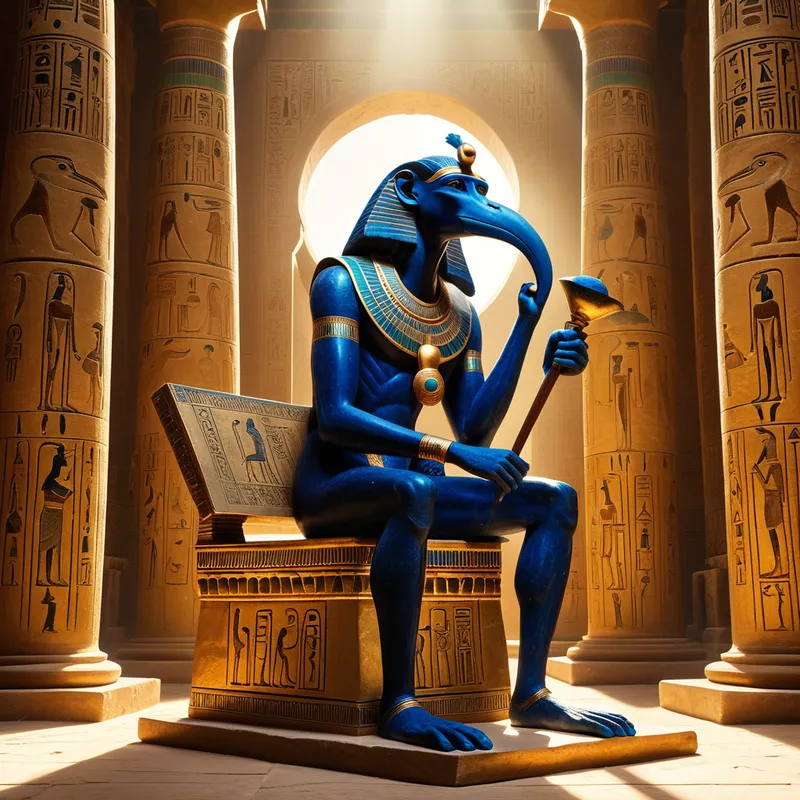
The Egyptian god Thoth Myth Meaning & Symbolism
The story of Thoth, divine scribe and measurer, who brings order through language, heals the cosmic eye, and arbitrates the fate of gods and souls.
The Tale of The Egyptian god Thoth
In the time before time, when the primordial waters of Nun still heaved with possibility, a silence hung over the cosmos—a silence waiting to be broken. From this silence, a mind stirred. It was not the thunderous will of a sun god, nor the fierce love of a sky goddess. It was a quieter intelligence, a precise and calculating light. This was the awakening of Thoth, the measurer, the one who would give shape to the formless.
He first manifested as the sacred ibis, his long, curved beak a perfect instrument for probing the mud of creation, separating the fertile silt from the inert clay. With each probing step, he began to measure the world into being. Later, he would wear the face of a wise baboon, greeting the dawn with chattering hymns, for he was also lord of the moon, the celestial counter of days and seasons. But his greatest form was as the scribe.
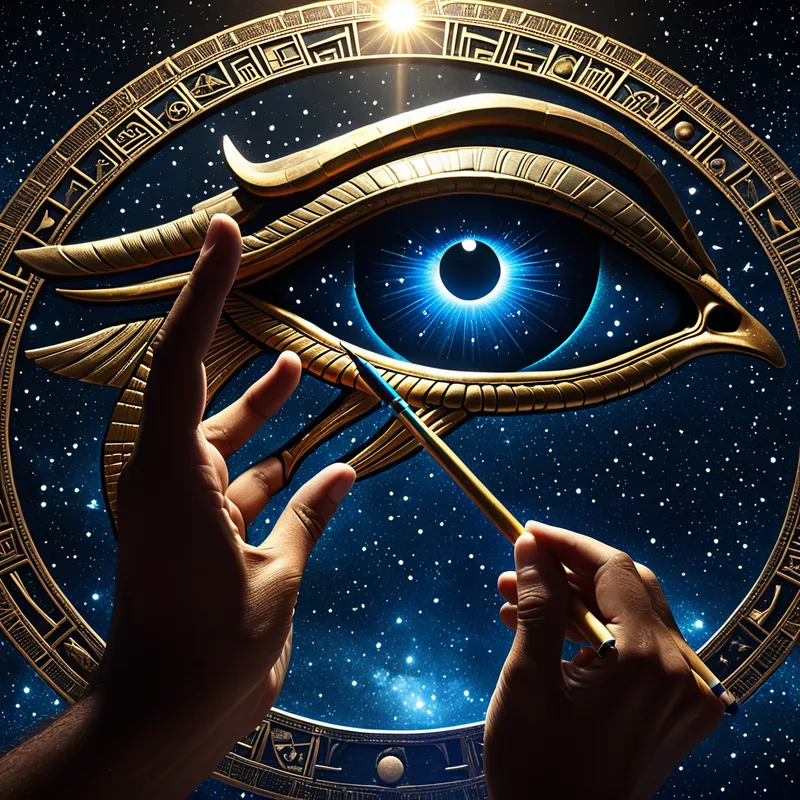
The gods themselves were often children of passion and storm. Set</ab title>, envious and wrathful, tore the luminous Eye of Horus from the sky god’s face, shattering its divine light. The cosmos trembled on the edge of renewed chaos. It was Thoth who was summoned. Not with a warrior’s cry, but with a scholar’s focus. Under the cool light of his own moon, he gathered the scattered, radiant fragments. With his stylus—not a weapon, but a tool of precision—he measured each piece, calculated its place, and spoke the words of healing. He restored the Eye, making it whole and more powerful than before, a testament to order reclaimed from violence.
His role was always that of the mediator, the divine arbitrator. When the great solar barque of Ra journeyed through the perilous Duat each night, threatened by the serpent Apep, it was Thoth’s spells, written and spoken, that protected the voyage. His words were shields. His voice was a compass.
And in the final, most solemn judgment, his duty was absolute. In the silent, weighty Hall of Osiris, before gods of terrifying majesty, the heart of the deceased was placed upon the scales of truth, balanced against the feather of Maat. All watched, breath held. But it was Thoth, ibis-headed and impartial, who stood by with his palette and papyrus. He observed the tremor of the scale, measured the deviation, and recorded the verdict. His pen did not judge; it witnessed. It transcribed the eternal truth of a soul’s life, translating the heartbeat of a mortal into the immutable script of the cosmos. In his silent notation, destiny was fixed.
Cultural Origins & Context
The veneration of Thoth, known as Hermes Trismegistus to the Greeks, is woven deep into the fabric of ancient Egyptian civilization, spanning from the Old Kingdom (c. 2686–2181 BCE) well into the Greco-Roman period. Unlike myths tied to a single cult center, Thoth was a pan-Egyptian god of the intellectual and administrative class. His primary cult city was Khemenu (later Hermopolis Magna), theorized by some texts as the very mound of creation where his word helped stir the Ogdoad—the eight primordial forces—into life.
His myths were not mere stories for entertainment; they were functional cosmology. They were preserved in temple inscriptions, Coffin Texts, and the majestic Book of the Dead. Priests and scribes, the literal hands of Pharaonic power, saw themselves as earthly avatars of Thoth. Every administrative decree, every tax record, every magical healing spell, and every funerary inscription was an act of Thothian magic, imposing order (Maat) onto the chaos (Isfet) of the world. To write was to participate in the ongoing creation and maintenance of reality itself.
Symbolic Architecture
Thoth is the archetypal principle of the mediating intelligence. He represents the faculty of consciousness that stands between opposites—sun and moon, order and chaos, gods and mortals, life and death—and translates their conflict into a coherent, balanced system.
He is the bridge that is not a place, but a process: the act of measurement itself.
His ibis beak symbolizes discernment, the ability to sift the valuable from the worthless. The baboon form connects him to the dawn, the moment of awakening and lucid thought. As moon god, he governs cycles, time, and the rhythmic, reflective nature of the mind, in contrast to the constant, blazing certainty of the sun. His most profound symbols are his tools: the scribal palette and the stylus. These are not just instruments of record but of creation. The written or spoken word (Heka) is shown to have tangible, world-altering power—to heal the Eye of Horus, to repel Apep, to decree a soul’s fate.
In the Hall of Osiris, his role is crucial. He does not place the heart or the feather; he only records the result. This symbolizes the objective, non-judgmental aspect of consciousness that simply observes the truth of our being. The judgment is not his; it is the natural consequence of a life lived in or out of alignment with Maat. Thoth is the sacred witness, the inner scribe who makes the unconscious conscious by naming it.
The Dreamer’s Resonance
When the archetype of Thoth stirs in the modern psyche, it often manifests in dreams of libraries, archives, or complex bureaucratic spaces. One might dream of frantically searching for a specific book with the answer, of trying to write with a pen that has no ink, or of being tested in a silent, solemn hall. There is a somatic quality of mental strain, a pressure in the forehead or behind the eyes—the weight of needing to figure it out.
Psychologically, this marks a critical phase of internal mediation. The dreamer is likely caught between powerful inner opposites: a fierce, wounded instinct (the shattered Eye of Horus) and a rigid, demanding ideal (the feather of Maat). The Thoth process is the ego’s attempt to step back from identification with either pole and become the observing, recording intelligence. The anxiety in the dream reflects the terror of this responsibility—the fear that one’s own “record” will be found wanting. It is the psyche’s call to develop a conscious, discerning faculty to navigate an inner civil war.

Alchemical Translation
The individuation journey modeled by Thoth is the alchemy of the word. It is the transformation of raw, chaotic psychic material—our passions, traumas, and conflicts (the battle of Horus and Set)—into the gold of self-knowledge and coherent identity.
The first act of this alchemy is not to fight the chaos, but to measure it. To name it.
The “shattered eye” represents a fragmented perception, a wounded way of seeing oneself and the world. The Thoth within does not dismiss this pain with solar positivity, nor drown in it with lunar melancholy. He gathers the fragments with care and uses the stylus of focused attention to understand each piece—its origin, its shape, its pain. This is the therapeutic act of journaling, of analysis, of giving narrative to disintegrated experience.
The final stage is the judgment hall, the ultimate integration. Here, the heart (the sum of one’s feelings, desires, and actions) is weighed against the feather (the inner standard of truth and integrity). The ego, identified for so long with the heart, is terrified. But the Thoth consciousness does not identify with either. It simply bears witness. It records the truth of the balance. This internal arbitration allows for a profound self-acceptance. One is not condemned by a harsh judge; one is seen by an impartial scribe. The outcome is not punishment, but placement—an accurate recording of where one stands in one’s own cosmic order. To become Thoth is to learn to be the author and scribe of one’s own soul, writing the sacred text of a life from the raw hieroglyphs of experience.
Associated Symbols
Explore related symbols from the CaleaDream lexicon: