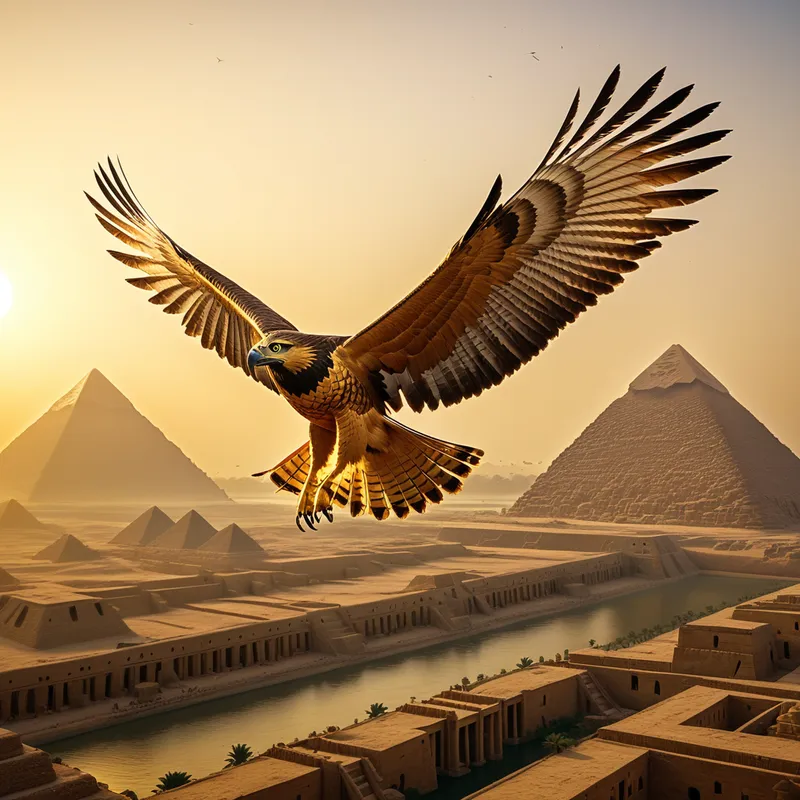
The Egyptian Ba bird - the sou Myth Meaning & Symbolism
The story of the Ba, the soul-bird of ancient Egypt, which must navigate the perilous Duat to reunite with its body and achieve eternal, conscious existence.
The Tale of The Egyptian Ba bird - the sou
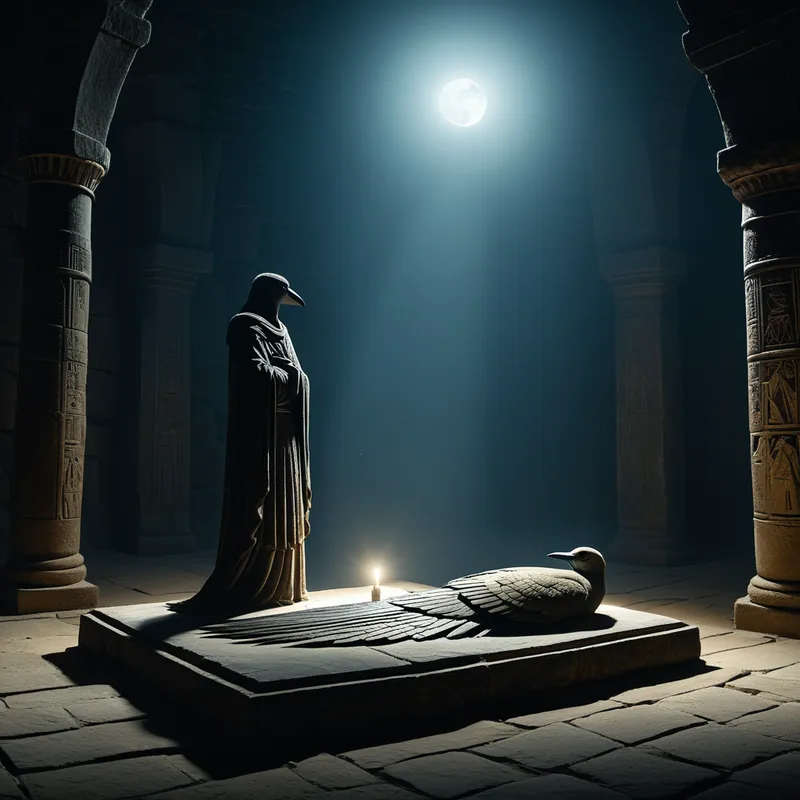
Listen. In the deep, star-dusted silence that follows the setting of the sun-god Ra, a different kind of awakening begins. It does not happen in the world of living breath and beating hearts, but in the cool, still dark of the tomb. The air here is thick with the scent of natron, cedar resin, and eternity.
Here lies the One Who Has Gone Forth, the body wrapped in linen, a shell of painted wood and amulets. But listen closer. A rustle, not of wind, for there is no wind here. A soft, golden light begins to pulse from the silent chest. It coalesces, gathers form from the very essence of memory and desire. From the mouth of the sleeper, it emerges—a creature of impossible beauty. It has the body of a falcon, sleek and powerful, but its head… its head is the face of the one who sleeps. Its eyes are open, seeing in a way the earthly eyes cannot.
This is the Ba. It stretches wings made of starlight and the echoes of laughter, of grief, of love spoken in life. With a beat that makes no sound, it rises. It passes through stone as if through mist, leaving the confines of the tomb behind. The world outside is a monochrome land under a moon like a silver coin. The Ba flies, not towards the moon, but towards the place where the sun has gone—the terrifying, glorious realm of the Duat.
Its journey is a solitary vigil. It must navigate rivers of fire and lakes of darkness. It must speak its name to silent, monstrous guardians with knives for fingers. It must recite the spells from the Book of the Dead, its voice the only weapon against oblivion. It seeks the Hall of Osiris, the Green God, Lord of the Silent Land. There, in that cavernous hall lit by unseen stars, its heart will be weighed against the feather of Maat. Truth against desire. If the scales balance, the Ba’s quest is not over, but transformed.
For the Ba does not seek to escape the earth. Its deepest longing is for return. Having proven its truth, it is granted the sacred knowledge: the ability to become an Akh, a shining, effective spirit. And with this power, as the first hint of dawn gilds the eastern horizon, the Ba turns its flight homeward. It speeds back across the desert, through the solid stone of the mastaba, and settles once more—a breath of light, a warmth, a presence—upon the silent, waiting chest of its body. Not as a prisoner, but as a sovereign returning to its kingdom. In that reunion, in that daily return, lies the promise: “I shall not be shut in. I shall not be fettered. I shall go in and out again to my heart’s desire.” The night’s perilous exploration finds its resolution in the dawn’s quiet reunion. The circle, for now, is complete.
Cultural Origins & Context
This was not a mere story for entertainment, but a central pillar of a civilization’s confrontation with mortality. The concept of the Ba evolved over millennia, from the Old Kingdom’s pyramid texts—royal spells carved in stone to aid the pharaoh’s ascent—to the more democratized Coffin Texts and Book of the Dead papyri placed with commoners. It was a theology inscribed on tomb walls, painted on sarcophagi, and whispered by priests. The myth functioned as a practical guide, a map for the soul, and a profound statement of identity. It asserted that a person was not just a physical body (Khat) or a shadow (Shut), but a dynamic, mobile consciousness that persisted. The Ba’s ability to “go forth by day” promised an afterlife not of static bliss, but of continued relationship with the living world—to receive offerings, to feel the sun, to partake in memory.
Symbolic Architecture
The Ba is one of the most potent symbols of the soul’s paradoxical nature in human history. It is not an abstract ghost, but a precise symbolic formulation.
-
The Human-Headed Bird: This hybrid form is the key. The bird—specifically a swift, soaring falcon or jabiru—symbolizes freedom, mobility, and perspective. It can traverse realms (earth, sky, underworld). The human head represents individual identity, personality, memory, and consciousness. The Ba is thus individual consciousness endowed with freedom. It is the part of us that can travel beyond our immediate circumstances, in thought, dream, and aspiration.
-
The Perilous Journey: The flight through the Duat is the soul’s confrontation with its own shadow. The monsters are the unintegrated aspects of the self; the weighing of the heart is the ultimate existential audit. The journey is not a punishment, but a necessary ordeal for purification and validation.
-
The Return to the Body: This is the most radical and often overlooked symbol. The Ba does not ascend to a disembodied heaven and stay there. It returns. This signifies that the goal is not escape from the physical or the personal, but a sacred reunion. It models a state of wholeness where spirit and matter, consciousness and embodiment, are in dynamic, loving relationship.
The soul is not a prisoner to be freed from the body, but a lover who must leave the beloved to know its own heart, only to return with a love made eternal by the journey.
The Dreamer’s Resonance
When this mythic pattern stirs in the modern dreamer, it often manifests not as a literal bird with one’s face, but through powerful somatic and narrative motifs. You may dream of flying with intense, personal agency—not as a superhero, but with a feeling of earned freedom and panoramic vision. Conversely, you may dream of being trapped in a dark, labyrinthine place (a basement, a maze-like office), desperately seeking an exit or a specific object; this is the Duat journey. Dreams of reuniting with a lost part of yourself, or of a beloved, familiar place that you must leave but are compelled to return to, echo the Ba’s core dynamic.
Psychologically, these dreams signal a process of soul retrieval. The conscious ego (the “body” in the tomb) has become stagnant or cut off from its vital, mobile essence. The dreaming psyche is activating the Ba function: sending out a part of your consciousness to explore the underworld of the unconscious, to face forgotten truths or unresolved pains (the weighing of the heart), in order to gather what was lost and return it to your waking life. It is a call to reintegrate.

Alchemical Translation
The alchemical process mirrored in the Ba’s myth is the circulatio—the sacred circulation. It is the core of Jung’s individuation process.
-
Separation (The Flight Out): Nigredo. The conscious personality feels entombed, dry, lifeless. The first, crucial step is not to fix it, but to allow a part of the psyche (the Ba) to separate and descend. In modern terms, this is engaging in deep introspection, therapy, art, or any practice that allows the conscious mind to explore the unconscious. It is a willing descent into the shadowy Duat of one’s own psyche.
-
Purification & Judgment (The Duat Journey): Albedo. In the underworld, the soul meets its monsters—its repressed fears, shames, and complexes. The “weighing of the heart” is the brutal, honest self-assessment: Does this thought, this pattern, align with my inner truth (the feather of Maat), or is it a lie born of ego or trauma? This stage is the painful purification necessary for clarity.
-
Reunion (The Return): Rubedo. This is the golden goal. The transformed consciousness does not abandon the personal, embodied self. It returns to it, enlivening it. The ego is not destroyed but becomes the vessel for the redeemed soul. This is the state of individuation: one can “go forth” into the world of ideas, relationships, and adventures (the Ba’s freedom), yet always return to a grounded, authentic, and vital sense of self. One becomes both the traveler and the home.
Individuation is not a final destination, but the mastery of a daily rhythm: the courage to fly into the unknown of the self, and the wisdom to return, over and over, to the sacred ground of being.
The myth of the Ba offers a timeless map. It tells us that our soul’s health depends on this sacred rhythm of departure and return, of exploration and embodiment. We are not meant to be forever tombs nor forever birds, but the miraculous, fleeting moment where the bird alights.
Associated Symbols
Explore related symbols from the CaleaDream lexicon: