The Ebony Horse Myth Meaning & Symbolism
A Persian sage crafts a magical flying horse, leading a prince on a perilous journey of desire, loss, and the hard-won wisdom of the soul.
The Tale of The Ebony Horse
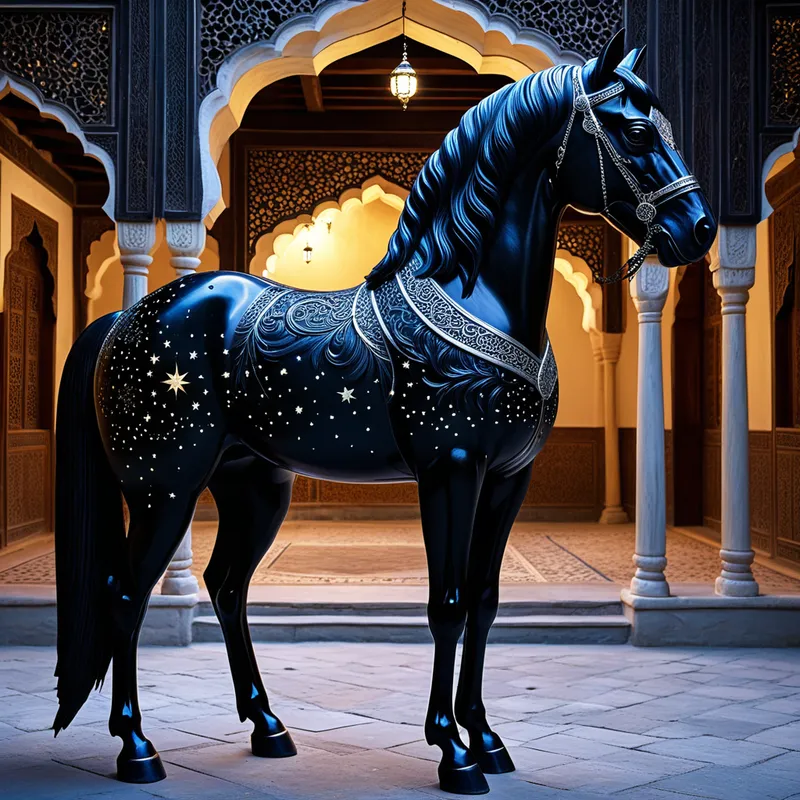
Listen, and let the scent of sandalwood and oud carry you to a time when the world was woven with deeper threads. In the court of a great Persian king, amidst the murmur of fountains and the rustle of silks, a day of marvels arrived. Three sages came bearing gifts of impossible craft. The first unveiled a peacock of gold that strutted and fanned its jewelled tail. The second presented a trumpet of brass that sounded alarms without a breath. But the third, a sage with eyes like chips of obsidian, drew back a velvet cloth to reveal his masterpiece: a horse, life-sized, carved from a single, flawless block of ebony.
A ripple of awe, then quiet disbelief, passed through the assembled court. It was beautiful, yes, with eyes of sapphire and tracings of silver, but it was, after all, a statue. The king’s son, the Prince, watched with a fire in his heart that the others lacked. The sage stepped forward. “O King of the Age,” he said, his voice dry as desert wind, “this is no idle carving. This steed can traverse the space of a year in a single day. He flies by a secret art, guided by a pin upon his neck.”
Scoffs turned to gasps as the sage demonstrated. With a turn of the pin, the horse shuddered, lifted from the marble floor, and circled the vaulted ceiling before settling gently down. The king was astonished, but his son was enchanted, possessed. He saw not a marvel of mechanics, but the very wings of his own boundless desire. He begged, he pleaded, and against his better judgment, the king consented. The sage showed the prince the twin pins: one to ascend, one to descend.
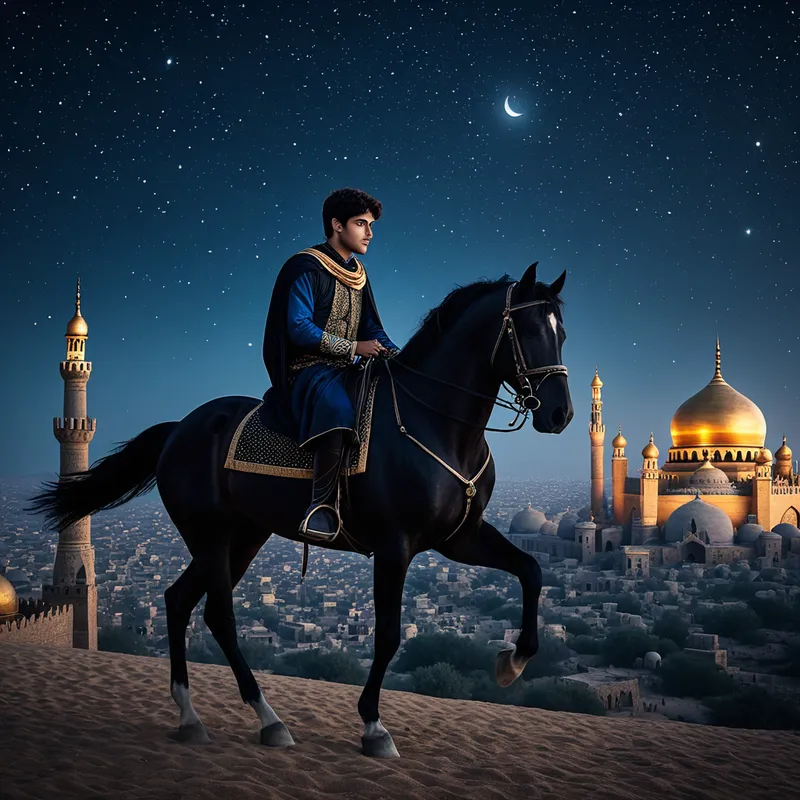
With the reckless joy of youth, the prince mounted the ebony steed, turned the ascent pin, and shot through an open archway into the vast bowl of the sky. The earth fell away, a tapestry of green and brown; rivers became silver threads, mountains mere wrinkles. He flew through cool cloud and burning sun, a god upon a mechanical Pegasus, drunk on the sheer intoxication of freedom. But desire, once unleashed, seeks an object. From the celestial silence, he spied a vision: a palace of such perfection it seemed a dream set in emerald gardens. And within, on a terrace scented with jasmine, he saw her—a princess of legendary beauty, sleeping amidst her handmaidens.
Landing softly, he was discovered. Yet, instead of fear, a spark passed between prince and princess, a recognition across the gulf of their worlds. Their talk was of stars and poetry, and a swift, secret love was sworn. But dawn brought discovery, wrath, and soldiers. The prince, fighting his way back to his horse, seized his love, mounted, and turned the pin. They soared away, leaving shouts fading into the sigh of the wind.
Yet here, in the triumph, lurked the fatal flaw. In his flight from the princess’s father, in his possessive joy, the prince had not asked the sage the most crucial secret: the location of the descent pin. High above his own homeland, he turned the wrong pin. The horse did not descend; it shot upward, violently, into the thin, freezing air. The princess, torn from his arms by the ferocious ascent, fell. His cry was lost in the void. The horse, obeying its last command, flew on until its magic spent, landing at last in a distant, wooded land. The prince was alone, his love lost, his soul shattered upon the rocks of his own unchecked passion. The steed of his desire had carried him to the pinnacle of experience, and then cast him into the abyss of consequence.
Cultural Origins & Context
The tale of The Ebony Horse is a gem from the vast treasure chest of the One Thousand and One Nights. While often grouped under the broad umbrella of “Arabian” tales, its specific imagery of Persian courts, sages, and princes points to a deep Persian influence, absorbed and retold across the trade routes and cultural exchanges of the medieval Islamic world. It was not a sacred text, but a teaching story, told in coffeehouses and royal courts by professional storytellers (hakawatis) who were masters of suspense and moral nuance.
Its function was multifaceted: to awe, to entertain, and to subtly instruct. For a society that valued wisdom (hikma), cleverness, and the dangers of ‘ajab (wonder that leads to heedlessness), the story served as a cautionary compass. It celebrated human ingenuity—the sage’s craft is undeniable—while simultaneously charting the terrible price of using that ingenuity without the corresponding wisdom to steer it. The prince is not evil; he is the embodiment of noble, yet uninitiated, passion. The story asks the listener: What good is a machine that can fly across the world, if the pilot has not first journeyed across the landscape of his own heart?
Symbolic Architecture
The Ebony Horse itself is the central [symbol](/symbols/symbol “Symbol: A symbol can represent an idea, concept, or belief, serving as a powerful tool for communication and understanding.”/), a perfect [emblem](/symbols/emblem “Symbol: A symbolic design representing identity, authority, or ideals, often used in heraldry, logos, or artistic expression.”/) of the directed intellect divorced from embodied wisdom. It is not a living [creature](/symbols/creature “Symbol: Creatures in dreams often symbolize instincts, primal urges, and the unknown aspects of the psyche.”/); it is a crafted [artifact](/symbols/artifact “Symbol: An object from the past carrying historical, cultural, or personal significance, often representing legacy, memory, or hidden knowledge.”/), a [vehicle](/symbols/vehicle “Symbol: Vehicles in dreams often symbolize the direction in life and the control one has over their journey, reflecting personal agency and decision-making.”/) of pure will.
The tool is perfect, but the hand that guides it is human—flawed, passionate, and prone to tragic error.
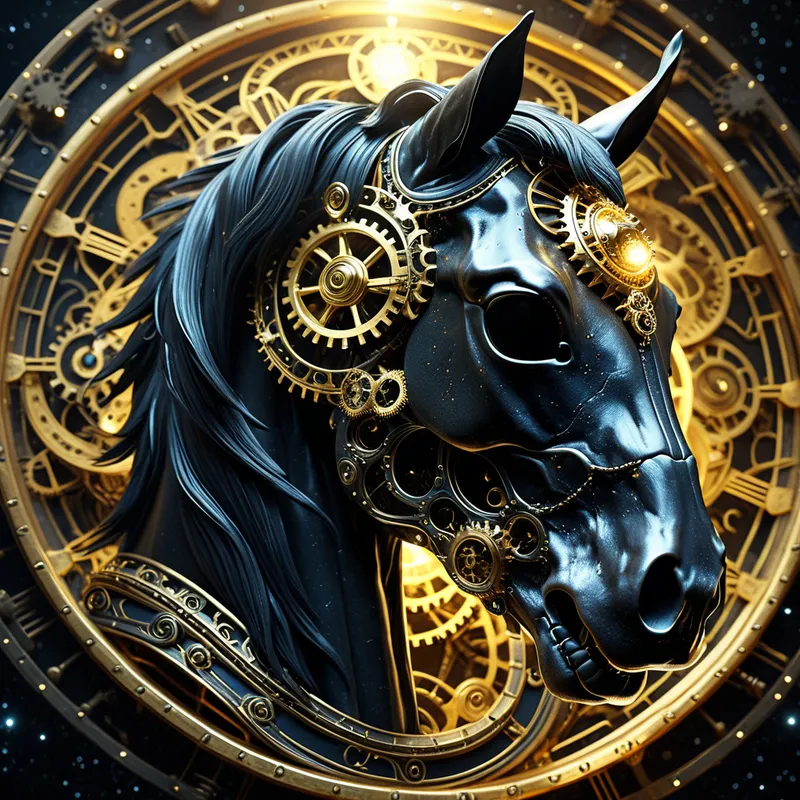
The horse, traditionally a symbol of vital [energy](/symbols/energy “Symbol: Energy symbolizes vitality, motivation, and the drive that fuels actions and ambitions.”/), instinct, and journeying, is here rendered in ebony—beautiful, polished, but lifeless. Its [movement](/symbols/movement “Symbol: Movement symbolizes change, progress, and the dynamics of personal growth, reflecting an individual’s desire or need to transform their circumstances.”/) is not born of [breath](/symbols/breath “Symbol: Breath symbolizes life, vitality, and the connection between the physical and spiritual realms.”/) and [blood](/symbols/blood “Symbol: Blood often symbolizes life force, vitality, and deep emotional connections, but it can also evoke themes of sacrifice, trauma, and mortality.”/), but of a hidden, mechanical principle (the pins). It represents the [human](/symbols/human “Symbol: The symbol of a human represents individuality, complexity of emotions, and social relationships.”/) ego’s fantastic ambition to transcend natural limits, to conquer [distance](/symbols/distance “Symbol: Distance in dreams often symbolizes emotional separation, unattainable goals, or the need for personal space and reflection.”/) and time through sheer cleverness. The [prince](/symbols/prince “Symbol: A prince symbolizes nobility, leadership, and aspiration, often representing potential or personal authority.”/)’s [flight](/symbols/flight “Symbol: Flight symbolizes freedom, escape, and the pursuit of one’s aspirations, reflecting a desire to transcend limitations.”/) is not a spiritual [ascent](/symbols/ascent “Symbol: Symbolizes upward movement, progress, spiritual elevation, or striving toward higher goals, often representing personal growth or transcendence.”/); it is a geographical one, fueled by curiosity and desire, culminating in a literal and spiritual fall.
The two pins—ascent and descent—are the myth’s most critical psychological detail. They represent the dual [nature](/symbols/nature “Symbol: Nature symbolizes growth, connectivity, and the primal forces of existence.”/) of any potent force: the power to launch and the power to land, to begin and to integrate, to inflate and to ground. The prince’s fatal ignorance of which is which is the ignorance of the unconscious psyche about its own dynamics. He knows how to activate his desires (ascent) but not how to manage their consequences or return to a state of [equilibrium](/symbols/equilibrium “Symbol: A state of balance, stability, or harmony between opposing forces, often representing inner peace or external order.”/) (descent).
The Dreamer’s Resonance
When this myth stirs in the modern soul, it often manifests in dreams of powerful, uncontrollable vehicles—cars with no brakes, rockets veering off course, or indeed, flying horses or machines that respond to unknown controls. The somatic feeling is one of exhilarating lift-off followed by dread, disorientation, or a terrifying fall.
Such a dreamer is likely in the grip of what psychology might call an inflation. A new idea, a project, a relationship, or a ambition has taken flight within them with tremendous force. Initially, it feels like liberation, a soaring above mundane constraints. The dream signals that this energy, while potent, is not yet integrated. The “descent pin” has not been located. The psyche is warning of a crash—a burnout, a failed venture, a relationship shattered by unmet expectations—if the conscious mind does not seek the missing knowledge: the wisdom of limits, the necessity of grounding, and the humility to ask for guidance.
The lost princess in the dream may represent whatever is sacrificed at the altar of unchecked ambition: genuine connection, beauty for its own sake, the softer aspects of the soul that cannot survive in the thin air of pure aspiration.
Alchemical Translation
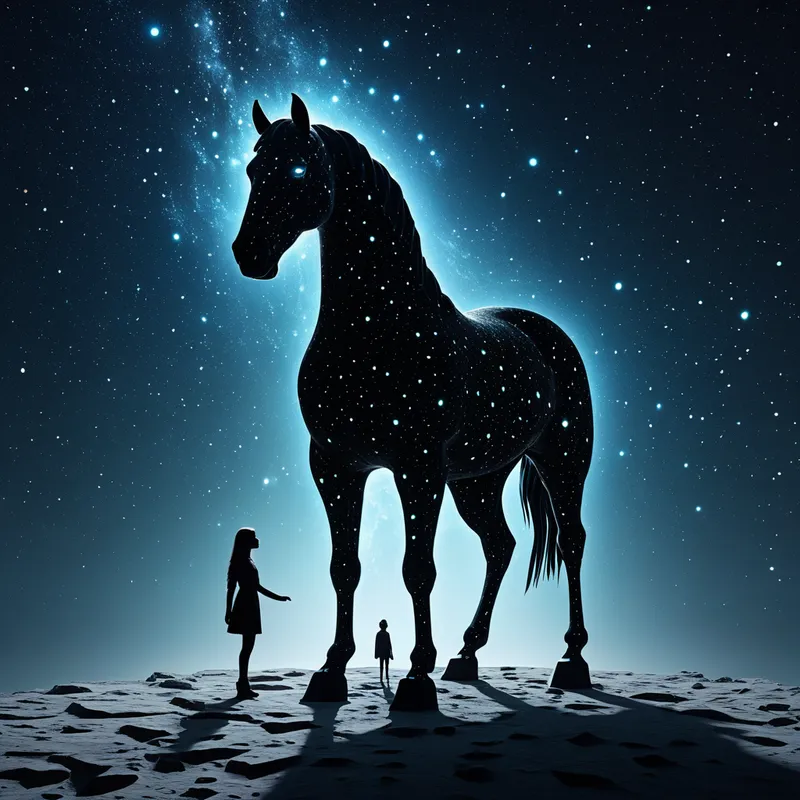
The myth of The Ebony Horse is a stark map of the individuation process, specifically its perilous middle passages. The prince begins in the ordered world of the Father (the King’s court). The Horse is the spirit archetype, the fascinating, volatile symbol that calls him away from collective norms into the adventure of the Self.
His flight is the necessary alienation, the breaking of the persona. He must leave home to find himself. The encounter with the princess is the confrontation with the anima—the soul-image. He recognizes her, connects, but then makes the critical alchemical error: he attempts to possess her and carry her off, rather than to be transformed by her. He treats the soul as another territory to be conquered by his flying machine.
The true alchemical marriage does not happen in flight, but in the shared, grounded work of the laboratorium.
The catastrophic fall—the loss of the anima—is the inevitable nigredo, the blackening, the descent into despair and meaninglessness. The prince, stranded and bereft, has his inflated identity utterly destroyed. This is not the end, but the essential beginning of real transformation. Only now, in the ruins of his grand adventure, is he capable of true humility. The story, in many versions, continues: he must embark on a new, pedestrian, and arduous journey—a walking quest—to find his lost love and truly earn her. This is the slow, conscious work of integrating the experience, of learning which pin is which, of uniting the soaring intellect with the grounded heart.
The final goal is not to destroy the Ebony Horse, but to learn its full operation. To become the sage who built it, not the prince who merely rode it. It is the transmutation of raw, magical thinking into applied, responsible wisdom—where the vehicle of the soul is guided by a consciousness that knows both how to soar and, more importantly, how and when to return home.
Associated Symbols
Explore related symbols from the CaleaDream lexicon:
- Horse — The core symbol of vital energy and journeying, here mechanized and intellectualized, representing the power of the directed will and ambition untethered from instinctual wisdom.
- Key — Represented by the pins on the horse’s neck; the secret knowledge that controls ascent and descent, symbolizing the crucial understanding needed to manage any powerful psychological force.
- Fall — The catastrophic descent of the princess and the prince’s spiritual collapse, embodying the inevitable consequence of inflation and the necessary nigredo or dark night of the soul in the alchemical process.
- Journey — The entire narrative arc, from the court to the sky to the place of exile, mapping the perilous voyage of consciousness from naive innocence through tragic error to potential wisdom.
- Sky — The domain of the Ebony Horse’s flight, representing boundless aspiration, spiritual ambition, and the dangerous allure of transcending earthly (embodied) limits.
- Pride — The prince’s initial state, believing he can master a divine-level technology without full instruction, leading directly to his tragic error and profound loss.
- Grief — The transformative emotion that engulfs the prince after the fall, crushing his inflated ego and creating the fertile ground for genuine humility and the search for redemption.
- Shadow — The Ebony Horse itself can be seen as a technological shadow, the dazzling but dangerous aspect of human ingenuity that, when unconscious, leads to catastrophe.
- Dream — The princess in her secluded palace is encountered almost as a dream vision, representing the soul-image that appears when one ventures beyond the familiar confines of the conscious world.
- Ritual — The sage’s demonstration and the specific operation of the pins imply a ritualistic, precise knowledge that must be respected, contrasting with the prince’s impulsive and irreverent use of the power.