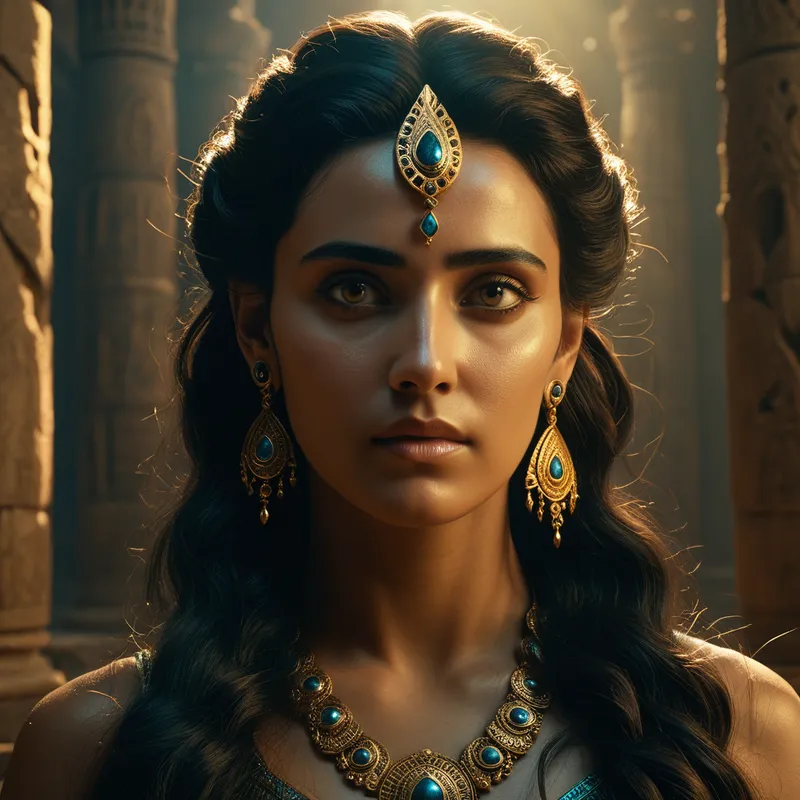
The Earrings of Harmonia Myth Meaning & Symbolism
A wedding gift from the gods becomes a cursed heirloom, binding generations of heroes to a fate of ruin and revelation.
The Tale of The Earrings of Harmonia
Hear now a story not of a single hero, but of an object, a glittering seed of destiny passed from hand to hand, heavy with the perfume of the gods and the iron scent of blood. It begins not with a birth, but with a wedding.
The air in Thebes was thick with ambrosia and [the music of the spheres](/myths/the-music-of-the-spheres “Myth from Greek culture.”/). Cadmus, [the dragon](/myths/the-dragon “Myth from Chinese culture.”/)-slayer, the city-founder, was to wed [Harmonia](/myths/harmonia “Myth from Greek culture.”/). Her very name was a prayer, a hope woven into the fabric of the new city. The gods themselves descended to bless this union, this fragile pact between mortal endeavor and divine order. They brought gifts of breathtaking beauty and terrible power.
But from her own parents—Ares, the storm of conflict, and Aphrodite, the whirlpool of desire—came a gift that held the echo of their union. A robe and a necklace, wrought by the smith-god [Hephaestus](/myths/hephaestus “Myth from Global/Universal culture.”/) himself, objects of such perfection they stole the breath from the throats of the assembled. And then, the earrings. Forged not merely of gold, but of the essence of the gods’ own strife and passion, they were masterpieces that held a shadow within their gleam. They were beautiful, and they were cursed.
Harmonia, the embodiment of concord, placed them in her ears, and the weight of a fate not her own settled upon her. The glory of Thebes was assured, but so was its fall. The earrings passed to her daughter, Semele, whose mortal form was incinerated by the unveiled glory of Zeus. They passed to Agave, who in a Dionysian frenzy tore apart her own son, King Pentheus, believing him a wild beast. They adorned Jocasta, in whose house the oracle’s words coiled like serpents, leading to patricide, incest, and self-blinding ruin.
The jewels traveled like a poisoned heirloom, down the bloody lines of the House of Cadmus. They were worn in [triumph](/myths/triumph “Myth from Roman culture.”/) and in terror, at weddings and at funerals, their beauty a constant, mocking witness to the unraveling of a royal line. They were not the cause, but the symbol—a condensed, glittering token of the inherited stain, the miasma, that clung to the family like a second skin. Finally, seeking to break the cycle, they were dedicated to [the temple](/myths/the-temple “Myth from Jewish culture.”/) of Athena at Argos. But even in sanctuary, their power drew fate to them. They were stolen, sparking new wars, new tragedies, a chain of catastrophe that seemed to have no end. The earrings of Harmonia, a gift meant to bless, became the engine of an endless, repeating curse.
Cultural Origins & Context
This myth is not the property of a single poet, but a collective haunting of the Greek imagination. It is woven from threads found in the epic cycles, in the tragic plays of Sophocles and Euripides, and in the later compilations of mythographers like Apollodorus. Its primary function was etiological and moral. It explained the persistent suffering of the great heroic houses—why fortune’s wheel turned so savagely against those who seemed most blessed.
The tale served as a profound cultural meditation on miasma and the limits of human agency. In a world governed by Moira, the gifts of the gods were never simple. They came with strings attached, often invisible, tying the recipient to the complex, often petty, dramas of Olympus. The earrings symbolized the inescapable baggage of lineage. To be born into a great house was to inherit not just its glory, but its unresolved conflicts, its debts to the gods, its hidden fractures. The myth was a warning and a consolation: even the greatest are subject to forces beyond their control, and suffering is often an inheritance before it is a personal fault.
Symbolic Architecture
The earrings are a perfect [symbol](/symbols/symbol “Symbol: A symbol can represent an idea, concept, or belief, serving as a powerful tool for communication and understanding.”/) of the complex, a crystallized packet of psychic [energy](/symbols/energy “Symbol: Energy symbolizes vitality, motivation, and the drive that fuels actions and ambitions.”/) that is both magnificent and destructive. They represent the paradoxical gifts of our ancestry.
A blessing can be a cage, and a curse can be the key. The most glittering inheritances are often those which we must, painfully, learn to dismantle.
Harmonia, whose name means “joining together,” receives an object that ensures everything will be torn apart. This is the first great [paradox](/symbols/paradox “Symbol: A contradictory yet true concept that challenges logic and perception, often representing unresolved tensions or profound truths.”/): the embodiment of [harmony](/symbols/harmony “Symbol: A state of balance, agreement, and pleasing combination of elements, often associated with musical consonance and visual or social unity.”/) is given the seed of discord. The earrings symbolize the inevitable [tension](/symbols/tension “Symbol: A state of mental or emotional strain, often manifesting physically as tightness, pressure, or unease, signaling unresolved conflict or anticipation.”/) in any [system](/symbols/system “Symbol: A system represents structure, organization, and interrelated components functioning together, often reflecting personal or social order.”/)—personal, familial, or societal. The initial union (the wedding) contains within it the potential for its own [dissolution](/symbols/dissolution “Symbol: The process of breaking down, dispersing, or losing form, often representing transformation, release, or the end of a state of being.”/). Psychologically, they represent the “[family](/symbols/family “Symbol: The symbol of ‘family’ represents foundational relationships and emotional connections that shape an individual’s identity and personal development.”/) neurosis,” the unprocessed [trauma](/symbols/trauma “Symbol: A deeply distressing or disturbing experience that overwhelms the psyche, often manifesting in dreams as unresolved emotional wounds or psychological injury.”/), the repeating [pattern](/symbols/pattern “Symbol: A ‘Pattern’ in dreams often signifies the underlying structure of experiences and thoughts, representing both order and the repetitiveness of life’s situations.”/) of [behavior](/symbols/behavior “Symbol: Behavior encompasses the actions and reactions of individuals, often as a response to various stimuli or contexts.”/) or misfortune that is passed down as surely as eye color or a heirloom [vase](/symbols/vase “Symbol: A vase represents containment, beauty, and preservation, often symbolizing the nurturing of emotions or ideas.”/).
They are not actively evil, but passively catalytic. They do not cause Semele’s demand to see Zeus, or Agave’s [frenzy](/symbols/frenzy “Symbol: A state of uncontrolled excitement, agitation, or wild activity, often indicating overwhelming emotions or loss of rational control.”/), or [Oedipus](/myths/oedipus “Myth from Greek culture.”/)’s [fate](/symbols/fate “Symbol: Fate represents the belief in predetermined outcomes, suggesting that some aspects of life are beyond human control.”/). Instead, they attract these events. They are a focal point for fate, making visible the [invisible threads](/symbols/invisible-threads “Symbol: Symbolizes the unseen connections that bind individuals and experiences, often reflecting relationships, fate, and destiny.”/) of [destiny](/symbols/destiny “Symbol: A predetermined course of events or ultimate purpose, often linked to spiritual forces or cosmic order, representing life’s inherent direction.”/). In this, they symbolize [the way](/myths/the-way “Myth from Taoist culture.”/) unconscious complexes operate: they draw experiences to us that resonate with their hidden [structure](/symbols/structure “Symbol: Structure in dreams often symbolizes stability, organization, and the framework of one’s life, reflecting how one perceives their environment and personal life.”/), creating patterns we mistake for bad luck or external persecution.
The Dreamer’s Resonance
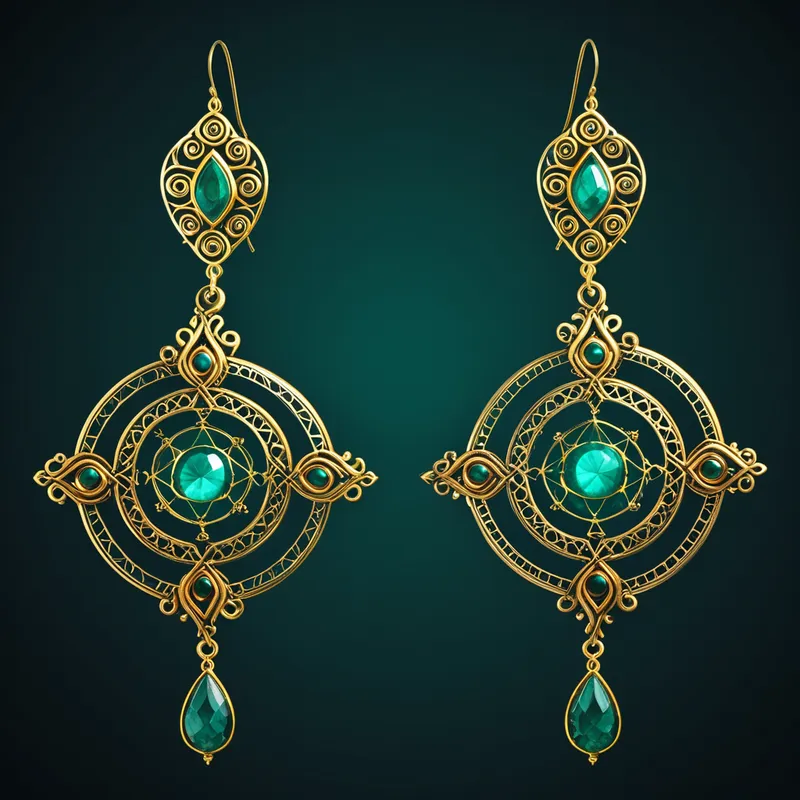
When this myth stirs in the modern [psyche](/myths/psyche “Myth from Greek culture.”/), it rarely appears as literal golden earrings. It manifests as a dream of being given a beautiful but burdensome gift, of wearing jewelry that feels impossibly heavy, or of discovering a family heirloom that fills you with both pride and dread. You may dream of trying to remove an ornament that has fused to your skin, or of a precious object that corrupts everything it touches.
Somatically, this is the process of feeling the weight of what you have “inherited.” This is not just genetic predisposition, but the emotional atmosphere of your upbringing, the unspoken family rules, the traumas that were never discussed but were absorbed into the very walls of your childhood home. The dreamer is experiencing the somatic truth of these patterns—a tightness in the chest (inherited anxiety), a heaviness in the shoulders (the burden of family expectations), a sense of being adorned with an identity that is splendid but not wholly your own.
Psychologically, the dream marks the moment when one stops seeing life’s repeating troubles as random misfortunes and begins to sense the outline of a pattern. It is the dawn of recognition: “This keeps happening. This feels familiar.” It is the uncomfortable, necessary step out of the role of the victim of fate and into the role of the investigator of one’s own psyche.
Alchemical Translation
The alchemical journey modeled by this myth is not one of heroic conquest, but of conscious transmutation. The goal is not to destroy the cursed heirloom, but to change its nature, to perform the calcinatio and [solutio](/myths/solutio “Myth from Alchemical culture.”/) on the psychic complex it represents.
The first step is Recognition and Naming, as Cadmus and Harmonia had to live with the consequences of their divine wedding. One must say, “This pattern is here. This curse is part of my story.” The second is Tracing the Lineage, following the jewel as it passes through Semele, Agave, Jocasta. In our lives, this is the work of genogram work, family history, and understanding the narratives of our ancestors. We see the complex in action, not as our unique flaw, but as a ghost in the family machine.
The curse is not the end of the story; it is the raw material. Fate becomes destiny only when it is met with consciousness.
The third and crucial step is Dedication to the Temple. This is the act of removing the complex from the compulsive flow of unconscious repetition and placing it in the sacred space of conscious observation. The temple of Athena—goddess of wisdom and strategy—symbolizes [the ego](/myths/the-ego “Myth from Jungian culture.”/)’s capacity for reflection and understanding. Here, the earrings are not worn; they are contemplated. They are seen for what they are: a beautiful, terrible artifact of a past that needs understanding, not re-enactment.
The final theft from the temple signifies that the work is never fully done. Complexes have a gravitational pull. But each time we recognize the pattern, trace its origin, and consciously choose a different response, we perform the alchemy. We are not erasing the curse, but integrating it. We transmute the leaden weight of fatal inheritance into the gold of self-knowledge. The earrings of Harmonia, in the end, become the mirrors of Gnothi Seauton—“Know Thyself.” Their curse was the relentless pressure toward that very knowing.
Associated Symbols
Explore related symbols from the CaleaDream lexicon: