The Eagle and the Shaman Myth Meaning & Symbolism
A myth of divine descent, where an eagle impregnates a woman, birthing the first shaman, a wounded healer who bridges worlds.
The Tale of The Eagle and the Shaman
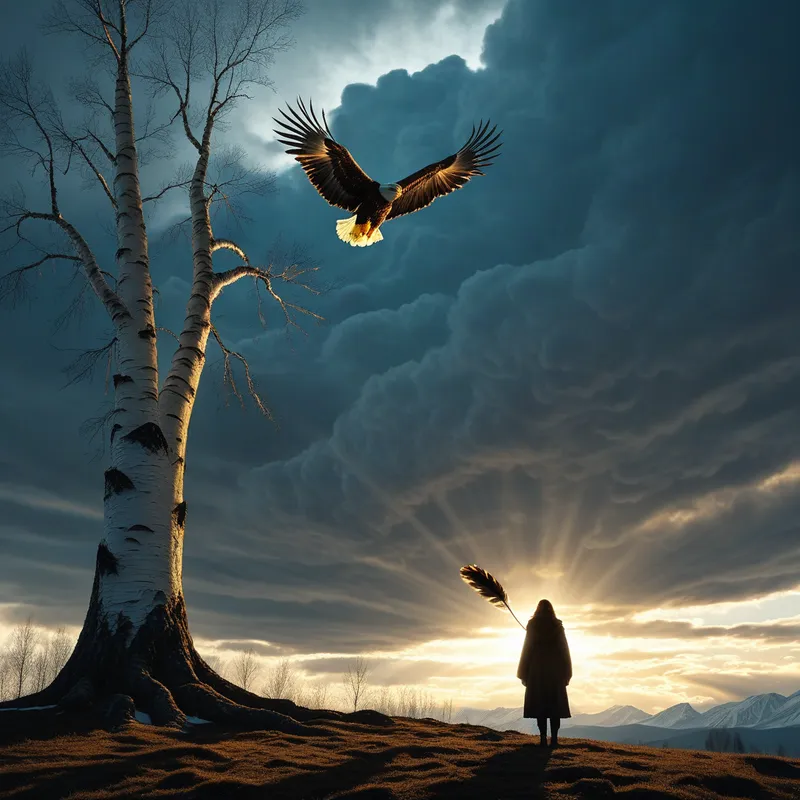
Listen. In the time before memory, when the world was raw and the spirits spoke in the voice of the wind, there was a woman. She lived alone by the shore of a great, cold lake, under the watchful gaze of the World Tree. Her days were spent in the simple rhythms of survival, but her nights were filled with the vast silence of the Upper World.
One day, as she gathered roots in the dappled light of the birch forest, a shadow fell upon her—a shadow that drank the sun. The air grew still, charged with a pressure that made her bones hum. She looked up.
It was an Eagle, but no ordinary bird of prey. Its wingspan blotted out the sky, each feather a slate of polished iron and cloud. Its eyes were twin suns, holding the patience of mountains and the fire of lightning. It did not cry out. It simply descended, a sovereign of the air coming to earth.
Terror and awe rooted her to the spot. The great bird landed before her, the tremor of its weight shaking the ground. It regarded her, and in that gaze was not predation, but a profound, unsettling recognition. Then, it spoke—not with a beak, but directly into the chamber of her soul. It declared itself a celestial spirit, a messenger from the highest realm. It had come for a purpose.
The eagle told her she would bear a child. This would be no ordinary birth. This child would be a bridge. His spirit would be woven from the threads of the human world and the dazzling, terrifying threads of the spirit world. He would be the first Shaman.
And then, the eagle was upon her. Not with violence, but with an act of terrifying intimacy. It covered her with its vast wing, a canopy of night and storm. In that darkness, a spark of the divine was transferred. A seed of celestial fire was planted in her mortal womb.
When the wing lifted and the eagle launched itself back into the vault of heaven, the woman was left changed, imprinted with a destiny she did not choose. In time, she gave birth to a son. He was marked from the beginning—his eyes held a distant, knowing light. He grew, but he was apart. He heard the whispers of the trees and the conversations of the rivers. The spirits clamored for his attention.
To become what he was meant to be, he had to die. Not in body, but in his old self. The spirits took him apart. In visions, they dismembered him. They boiled his flesh in a giant cauldron, forged his bones on an anvil of stars, and sewed him back together with threads of sinew made from auroral light. They replaced his mundane eyes with the eyes of the eagle, his ordinary bones with the iron of the mountain. They gave him the drum, the Spirit-Horse, and the rattle, the call to the spirits.
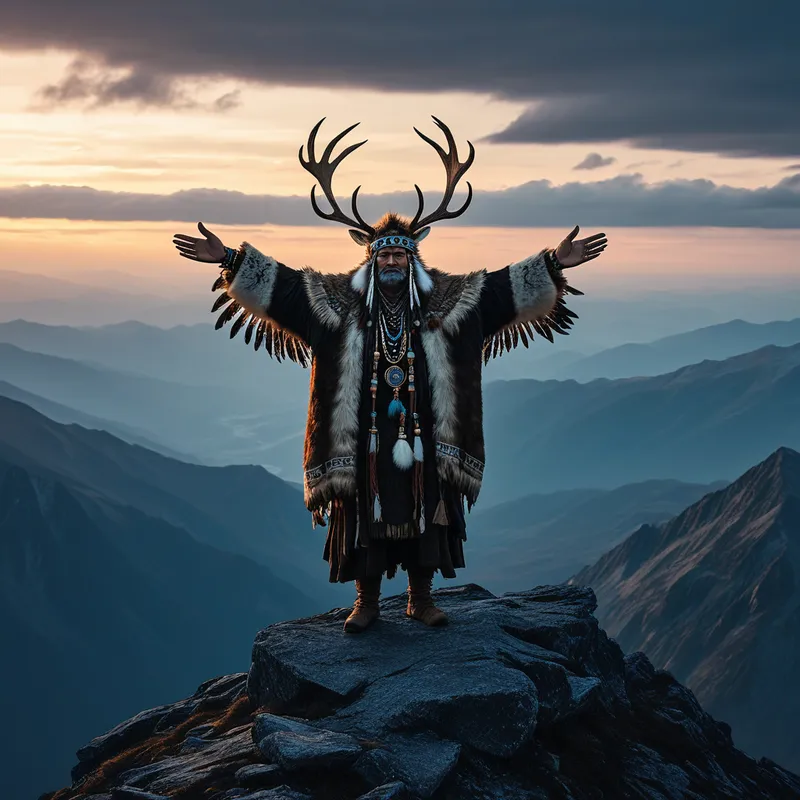
He was reassembled, but he was now a being of two worlds. A wounded healer. A human who had been unmade by the divine and remade as a conduit. [The first shaman](/myths/the-first-shaman “Myth from Mongolian culture.”/) had arisen, born from the union of earthly woman and celestial eagle, forged in the agony of spiritual death and rebirth. His purpose was now clear: to travel the Cosmic Axis, to heal his people, and to negotiate the delicate balance between all things.
Cultural Origins & Context
This foundational myth is central to the shamanic traditions of many Indigenous peoples across Siberia, including the Evenki, the Buryat, and the Sakha (Yakut). It is not a singular, fixed text, but a living narrative pattern passed down orally through generations of shamans and storytellers. Its primary function was etiological—it explained the supernatural origin of the shaman’s power, setting them apart from ordinary people and legitimizing their sacred, yet often fraught, role in society.
The shaman was the community’s essential intermediary, responsible for healing illness (seen as soul loss or spirit intrusion), guiding the souls of the deceased, and ensuring harmony with the natural and spiritual worlds by performing sacrifices and rituals. This myth provided the sacred blueprint for that role. It was often recounted during initiatory rites, serving as a map for the neophyte’s own terrifying experience of dismemberment and rebirth at the hands of the spirits. The story grounded the shaman’s authority not in human institutions, but in a direct, genealogical line from the celestial powers themselves.
Symbolic Architecture
The myth is a profound symbolic [drama](/symbols/drama “Symbol: Drama signifies narratives, emotional expression, and the exploration of human experiences.”/) of divine [election](/symbols/election “Symbol: The symbolism of an election often reflects themes of choice, power, and societal responsibility.”/), traumatic transformation, and the [birth](/symbols/birth “Symbol: Birth symbolizes new beginnings, transformation, and the potential for growth and development.”/) of conscious mediation.
The eagle does not ask for consent; it bestows a fate. This is the archetypal pattern of the calling—a rupture in the ordinary world that installs a sacred task.
The [Eagle](/symbols/eagle “Symbol: The eagle is a symbol of power, freedom, and transcendence, often representing a person’s aspirations and higher self.”/) represents the transcendent [spirit](/symbols/spirit “Symbol: Spirit symbolizes the essence of life, vitality, and the spiritual journey of the individual.”/), the soaring [consciousness](/symbols/consciousness “Symbol: Consciousness represents the state of awareness and perception, encompassing thoughts, feelings, and experiences.”/) of the Upper World. It is pure archetypal [authority](/symbols/authority “Symbol: A symbol representing power structures, rules, and control, often reflecting one’s relationship with societal or personal governance.”/), the numinous and often overwhelming force of the divine that descends into [human](/symbols/human “Symbol: The symbol of a human represents individuality, complexity of emotions, and social relationships.”/) [life](/symbols/life “Symbol: The symbol of ‘Life’ represents a journey of growth, interconnectedness, and existential meaning, encompassing both the joys and challenges that define human experience.”/). The woman signifies the receptive, earthly [vessel](/symbols/vessel “Symbol: A container or structure that holds, transports, or protects something essential, representing the self, emotions, or life journey.”/)—the [human](/symbols/human “Symbol: The symbol of a human represents individuality, complexity of emotions, and social relationships.”/) [soul](/symbols/soul “Symbol: The soul represents the essence of a person, encompassing their spirit, identity, and connection to the universe.”/) or [community](/symbols/community “Symbol: Community in dreams symbolizes connection, support, and the need for belonging.”/) capable of receiving and nurturing this transcendent [impulse](/symbols/impulse “Symbol: A sudden, powerful urge or drive that arises without conscious deliberation, often linked to primal instincts or emotional surges.”/).
Their union is an immaculate [conception](/symbols/conception “Symbol: The beginning of new life, ideas, or projects; a moment of profound creation and potential.”/) of consciousness. The [child](/symbols/child “Symbol: The child symbolizes innocence, vulnerability, and potential growth, often representing the dreamer’s inner child or unresolved issues from childhood.”/), the first [Shaman](/symbols/shaman “Symbol: A spiritual mediator who bridges the human and spirit worlds, often through altered states, healing, and guidance.”/), is the nascent psyche that contains this fundamental [tension](/symbols/tension “Symbol: A state of mental or emotional strain, often manifesting physically as tightness, pressure, or unease, signaling unresolved conflict or anticipation.”/): he is both human and spirit, ego and self. His dismemberment is the critical psychological process. The old, integrated [personality](/symbols/personality “Symbol: Personality in dreams often symbolizes the traits and characteristics of the dreamer, reflecting how they perceive themselves and how they believe they are perceived by others.”/) must be utterly dissolved—the “I” must be broken apart by the contents of the unconscious (the spirits).
One cannot become a bridge between worlds until one has been taken apart in the space between them.
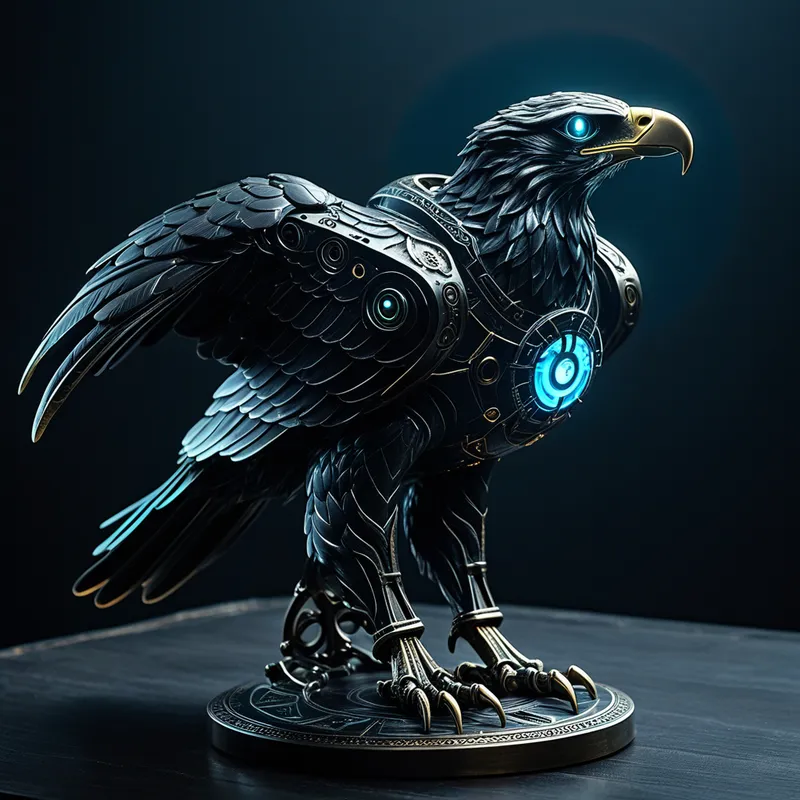
His reassembly with celestial parts symbolizes the [construction](/symbols/construction “Symbol: Construction symbolizes creation, building, and the process of change, often reflecting personal growth and the need to build a solid foundation.”/) of a new psychic [structure](/symbols/structure “Symbol: Structure in dreams often symbolizes stability, organization, and the framework of one’s life, reflecting how one perceives their environment and personal life.”/), a “subtle [body](/symbols/body “Symbol: The body in dreams often symbolizes the dreamer’s self-identity, personal health, and the relationship they have with their physical existence.”/)” or conscious personality capable of navigating the non-ordinary realities of the [collective unconscious](/symbols/collective-unconscious “Symbol: The Collective Unconscious refers to the part of the unconscious mind shared among beings of the same species, embodying universal experiences and archetypes.”/). His new eagle-eyes grant [vision](/symbols/vision “Symbol: Vision reflects perception, insight, and clarity — often signifying the ability to foresee or understand deeper truths.”/) beyond the literal; his iron bones represent an enduring [resilience](/symbols/resilience “Symbol: The capacity to recover quickly from difficulties, adapt to change, and maintain strength through adversity.”/) forged in the fires of psychic ordeal.
The Dreamer’s Resonance
When this mythic pattern stirs in the modern dreamer, it signals a profound initiation at the soul level. It is not about becoming a literal shaman, but about undergoing the shaman’s process.
Dreams of being pursued or chosen by a giant bird, especially an eagle, often coincide with a life crisis that feels fated—a career-ending injury, a devastating loss, a spiritual awakening that dismantles one’s worldview. This is the “eagle’s shadow” falling upon you. Dreams of dismemberment—losing limbs, having organs removed or replaced—mirror the mythic ordeal. They point to a necessary deconstruction of an outgrown identity, a painful but purposeful breakdown orchestrated by the deeper Self.
The somatic experience is one of profound tension between expansion and dissolution. One may feel a calling to a new path (the eagle’s ascent) while simultaneously experiencing anxiety, illness, or depression (the dismemberment). The psyche is preparing the ground for a new level of consciousness, but the process feels like a kind of death. The dreamer is in the cauldron, being boiled down to their essential components.
Alchemical Translation
For the individual, this myth models the alchemical journey of Individuation. The goal is not to escape humanity, but to become fully human by consciously integrating the transcendent.
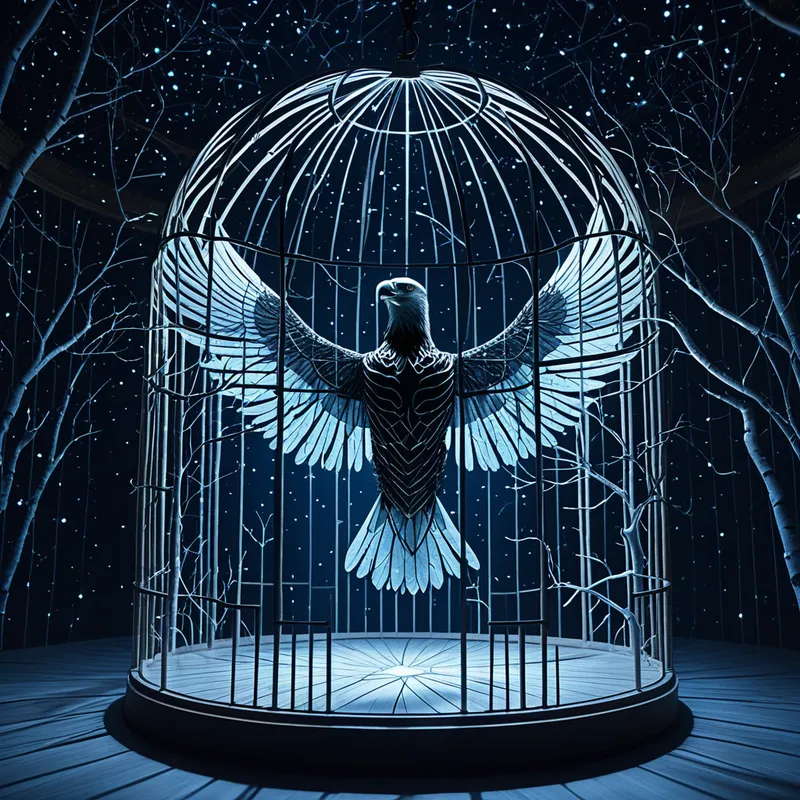
The first stage, Nigredo, is the blackening, the descent of the eagle and the impregnation. It is the shocking, often unwanted intrusion of the Self into the comfortable confines of the ego. A divine discontent arrives. The second stage, Albedo, is the dismemberment—the washing and whitening. Here, every attachment, every defense, every cherished self-concept is stripped away in the service of truth. The ego is humbled, purified by the fire of suffering and insight.
The shaman’s wound is not a flaw to be healed, but the aperture through which the numinous enters.
The final stages, Citrinitas and Rubedo, are the reassembly and return. The yellowing and reddening signify the dawn of a new, solar consciousness and its embodiment. The individual is put back together, but now with a vital connection to the transpersonal. They gain the “eagle vision” to see the archetypal patterns in their life and the “iron bones” to stand firm in their authentic purpose. They become a mediator within their own psyche, able to converse with inner spirits (complexes, impulses, talents) and heal inner divisions. They return from the mountain peak, not as a removed mystic, but as a grounded healer of their own world, carrying the fire first kindled by the celestial eagle.
Associated Symbols
Explore related symbols from the CaleaDream lexicon:
- Eagle — The celestial spirit and divine father, representing transcendent consciousness, supreme authority from the Upper World, and the overwhelming force of a calling.
- Shaman — The born mediator, the wounded healer reassembled by spirits, symbolizing the integrated psyche that can consciously navigate between different states of being.
- Shamanic Journey — The core action of the myth and its legacy, representing the deliberate voyage into non-ordinary reality for knowledge, healing, and retrieval.
- Dismemberment — The essential ordeal of being taken apart by spirits, symbolizing the painful but necessary deconstruction of the old ego-personality required for rebirth.
- Rebirth — The reassembly with new, celestial parts, signifying the emergence of a new, more resilient and spiritually-attuned consciousness from the ashes of the old.
- Bridge — The shaman’s primary function and identity, embodying the connection between heaven and earth, spirit and matter, conscious and unconscious.
- Tree — The World Tree or cosmic axis, the vertical pathway the shaman climbs and descends, representing the structured cosmos and the path of spiritual ascent.
- Spirit — The myriad non-human entities of the Upper, Middle, and Lower Worlds, representing the autonomous complexes and archetypal forces of the collective unconscious.
- Sacrifice — The voluntary surrender of the ordinary self to the dismembering spirits, representing the crucial letting-go required for any profound transformation.
- Vision — The gift of the eagle’s eyes, symbolizing the capacity to see beyond literal reality into the symbolic, archetypal, and spiritual dimensions of experience.
- Bone — The iron-forged skeleton of the reborn shaman, representing the indestructible, essential core of identity that survives the ordeal and forms the new structure.
- Drum — The shaman’s spirit-horse and tool of ecstasy, symbolizing the rhythmic, focused intention that propels the journey and alters the state of consciousness.